Yunmen Cavity Cloud Gate: Infraclavicular Fascial Decompression, Apical Pulmonary Expansion, and Upper-Limb Yin Meridian Conduction in Classical Neigong
## What Is This Practice?
At its simplest, cultivating *Yingxiang* involves manual fascial decompression paired with rhythmic, intention-led nasal breathing. Rather than relying solely on muscular effort to pull air into the lungs, the practitioner uses gentle physical touch and mental focus to liberate the soft tissues surrounding the nasal aperture. This allows the breath to be drawn deep into the lower belly—an area known in traditional somatic practice as the lower *Dantian* (丹田), located approximately two to three inches below the navel.
At its core, this somatic discipline is a method of craniocervical decompression designed to release the tight neurofascial bottleneck located directly behind the ears. In the classical lexicon of Traditional Chinese Medicine (TCM) and internal martial arts (*Neigong*), this exact anatomical gateway is designated as *Yifeng* (翳風), conventionally translated as the "Wind Screen" or "Wind Shield" and cataloged in modern international systems as [Acupuncture Point](https://en.wikipedia.org/wiki/Acupuncture_point) Triple Burner 17 (TB 17).
The precise anatomical topography of *Yaoyangguan* places it on the posterior midline of the human torso, situated directly in the depression inferior to the spinous process of the fourth lumbar vertebra (L4), at the interspinous level of L4–L5. Topographically, this point lies on the horizontal intercristal line—known clinically as Jacoby’s line—which connects the highest palpable points of the iliac crests. In clinical acupuncture as codified by the [World Health Organization](https://www.who.int/health-topics/traditional-complementary-and-integrative-medicine), Du 3 serves as a premier therapeutic locus for lumbosacral pain, lower-limb paresis, pelvic floor dysfunction, and systemic deficiencies of lower-body vitality.
At its core, this practice is a method of structural alignment and conscious joint decompression designed to restore free circulation and effortless kinetic power through the upper limbs. Rather than forcing the hands into rigid postures or letting them dangle lifelessly, the practitioner learns to gently expand the dorsal surface of the wrist so that the joint acts like a suspended suspension bridge rather than a collapsed hinge. In classical Chinese medicine and the internal martial traditions of Daoist Neigong, this precise anatomical gateway is designated as *Yangchi* (陽池, codified in modern clinical acupuncture as Triple Energizer 4 or TE4), which translates literally as the "Yang Pool."
Place your index fingers gently on the small, cartilaginous flaps just in front of your ear canals—the structures anatomically known as the tragus. Now, slide your fingertips a fraction of a millimetre forward into the soft skin, and let your lower jaw slacken, allowing your teeth to part by half an inch. Beneath your fingertips, a distinct, hollow depression immediately blossoms into being. Close your eyes, maintain your fingers on these bilateral hollows, and inhale slowly through your nose for four seconds. As you exhale, soften the muscular grip of your molars, allow your tongue to broaden against the roof of your mouth, and observe the immediate sensation of spatial widening directly inside your ears. In this single, quiet somatic shift, you have physically unlocked *Tinggong* (聽宮, SI 19)—the "Palace of Hearing"—and crossed the threshold into one of classical Chinese medicine's most sophisticated portals for craniosacral decompression, acoustic cultivation, and neuro-acoustic regulation.
In the language of classical Chinese medicine and internal martial arts (*Neijiaquan*), this physiological epicenter is known as *Tianzong* (SI11, 天宗), translated poetically as the "Celestial Gathering" or "Heavenly Ancestor." Situated directly in the infraspinous fossa of the scapula, Tianzong serves as the pivotal functional crossroad of the Hand Taiyang Small Intestine meridian (*Shou Taiyang Xiaochang Jing*). In everyday terms, this practice is a method of systematically decompressing the shoulder blades, ungluing the dense connective tissues that bind the upper back, and using synchronized breathwork to transform the thoracic spine from a rigid, stress-locked cage into a dynamic, elastic spring.
In the classical traditions of Chinese medicine and internal cultivation (*Neigong*), this precise anatomical hollow is known as *Tianzhu* (天柱, BL-10), translated poetically as the "Celestial Pillar." Just as massive stone columns were carved to support the heavy roofs of ancient imperial temples, your body possesses two bilateral muscular and fascial pillars designed to support the six-to-eight-kilogram weight of your cranium. When you chronically tilt your head forward to stare at a computer monitor or mobile device, these pillars undergo severe mechanical strain, locking the base of the skull in a vise-like grip that compresses vital blood vessels, pinches sensitive nerves, and traps the central nervous system in a state of low-grade, persistent agitation.
In the classical taxonomy of traditional Chinese medicine and Daoist internal cultivation, this specific anatomical depression is designated as *Taiyang* (EX-HN5, 太陽), an extraordinary acupuncture point whose name translates literally as "Supreme Yang" or "Great Sun." In everyday terms, the practice of Taiyang decompression is a method of consciously unbinding the deep muscular, fascial, and vascular tightness that accumulates around the temples, forehead, and jaw. Rather than treating the skull as an immovable solid box, classical [Neigong](https://en.wikipedia.org/wiki/Neigong) (internal skill cultivation) and modern biomechanics recognize that the cranial bones, their connective sutures, and the enveloping myofascial sheaths form a dynamic, responsive tensegrity structure.
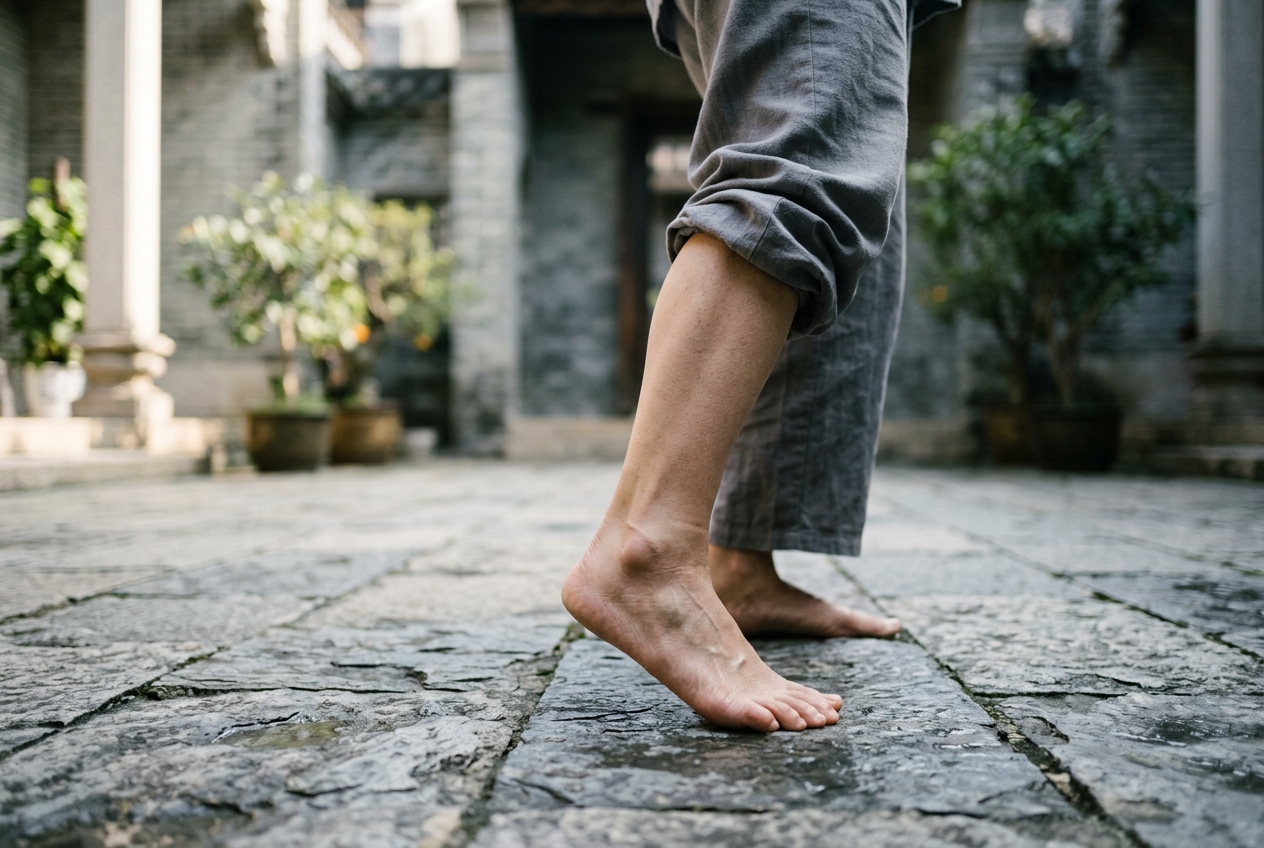
At its most fundamental level, working with the *Taibai* point is a method of waking up the structural spring inside the arch of your foot while revitalizing the body's digestive and energetic core. In everyday life, modern footwear, sedentary work, and chronic postural slouching cause the internal muscles of our feet to switch off, leading the inner arch to collapse inward and sending a chain reaction of mechanical stress upward into the knees, hips, and lower spine. In classical East Asian medicine, this physical collapse mirrors an internal fatigue: a weakening of the Spleen system (*Pi*), the functional network responsible for converting the food we eat into clear bodily energy (*Gu Qi*) and maintaining the firmness and tone of our muscles and connective tissues.
At its foundation, classical *Neigong* (internal skill cultivation) and *Daoyin* (guided breath and movement therapy) are systematic methods of fine-tuning the nervous system, fascial fabric, and circulatory dynamics through calibrated posture, intentional breathing, and micro-somatic adjustments. Within these systems, the human body is understood as an integrated electromagnetic and fluid circuit. The two principal energetic vessels governing this circuit are the *Du Mai* (Governing Vessel), which ascends along the posterior midline from the perineum through the spinal column and over the crown of the head, and the *Ren Mai* (Conception Vessel), which descends along the anterior midline down the throat, chest, and abdomen.
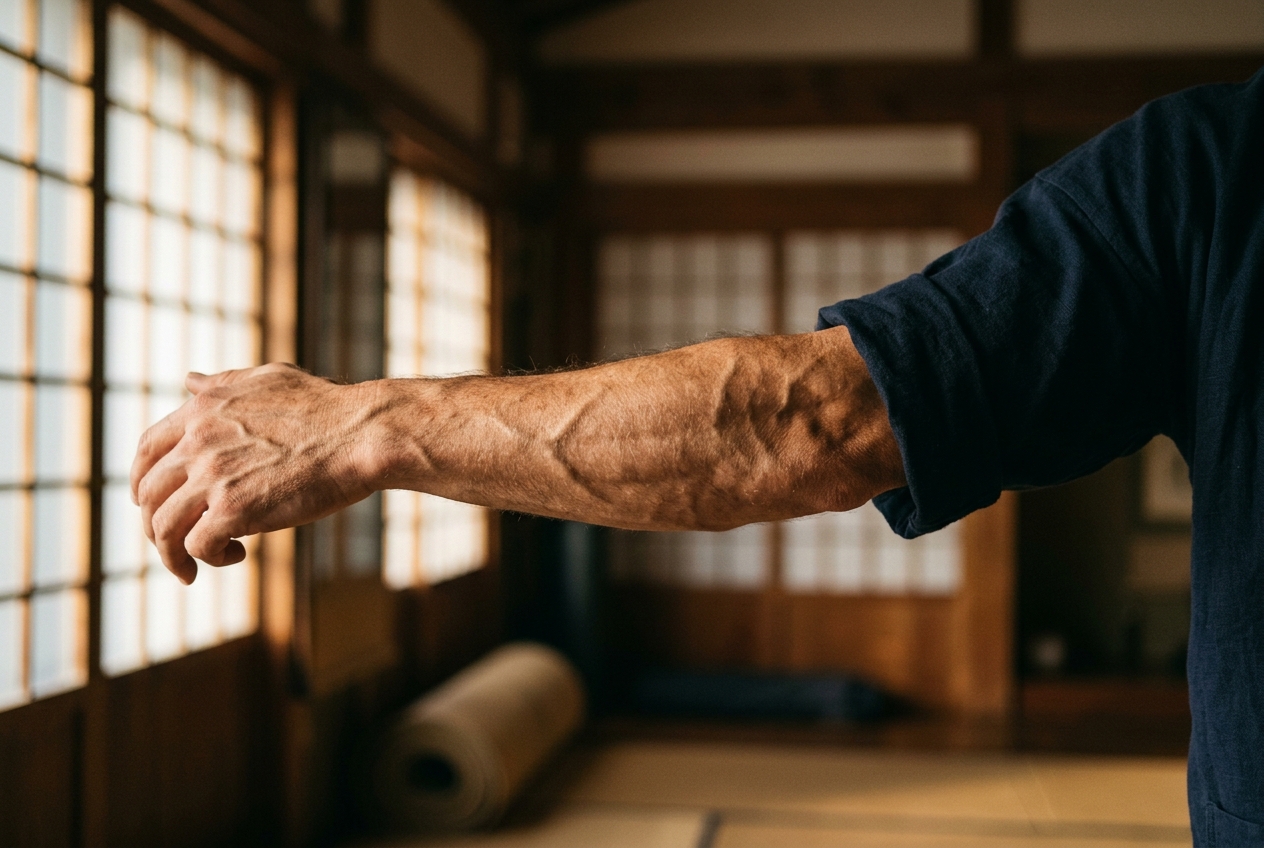
At its core, this practice is a method of conscious structural alignment and neuromuscular release centered on a pivotal point in your outer forearm. In traditional Chinese internal arts, practitioners do not rely on isolated muscular strain; instead, they align the bones and relax the deep connective tissue—the fascia—to allow kinetic force and vitality to flow uninterrupted from the feet, through the spine, and out the fingertips. The *Shousanli* cavity (手三里, literally translated as "Arm Three Miles") is the vital crossroads where the muscular tension of modern sedentary life, keyboard usage, and habitual stress accumulates, creating a physical "dam" that strangles blood flow, compresses peripheral nerves, and disrupts the natural elastic suspension of the arms.
At its core, this practice involves a classical standing posture paired with a specific internal breath vector designed to gently decompress the upper spine. In traditional Chinese medicine and Daoist internal training, this exact spinal nexus is known as *Shenzhu* (GV12), translated literally as the "Body Pillar" (*Shen* meaning body or person, and *Zhu* meaning pillar or support). Situated along the *Du Mai* (the Governing Vessel—an energetic channel traversing the dorsal midline), *Shenzhu* serves as the functional fulcrum that suspends the ribcage, balances the shoulder girdle, and anchors the breath.
This pedagogical sequence is designed for self-directed cultivation, requiring no specialized apparatus or prior experience. It systematically integrates tactile awareness, fascial decompression, and respiratory regulation.
At its core, this practice is the deliberate somatic unlocking of the inner elbow joint to open vascular, neurological, and myofascial pathways throughout the upper body. In everyday life, habitual desk work, repetitive gripping, and psychological stress cause us to hold our shoulders elevated and our elbows tightly flexed, pinching the inner arm tissues. In classical Chinese somatic arts, this critical junction is known as *Shaohai* (少海, translated as "Lesser Sea" or Acupoint Heart 3 / HT3), located along the *Hand-Shaoyin Heart Meridian* ([Hand-Shaoyin](https://en.wikipedia.org/wiki/Heart_meridian)).
At its core, this practice is the deliberate somatic activation and structural decompression of an energetic and biomechanical crossroad known in classical Chinese medicine as *Ququan* (曲泉, LR-8), translated poetically as the "Spring at the Crook." In modern movement terms, it is a method of micro-adjusting the inner knee to align the body's deepest muscular and connective-tissue chains, allowing gravity and ground reaction forces to flow unimpeded between the earth and the lower abdomen. Rather than treating the knee as a simple hinge that merely flexes and extends, internal cultivation traditions recognize the inner knee crease as an intelligent hydraulic pump and neurovascular gateway.
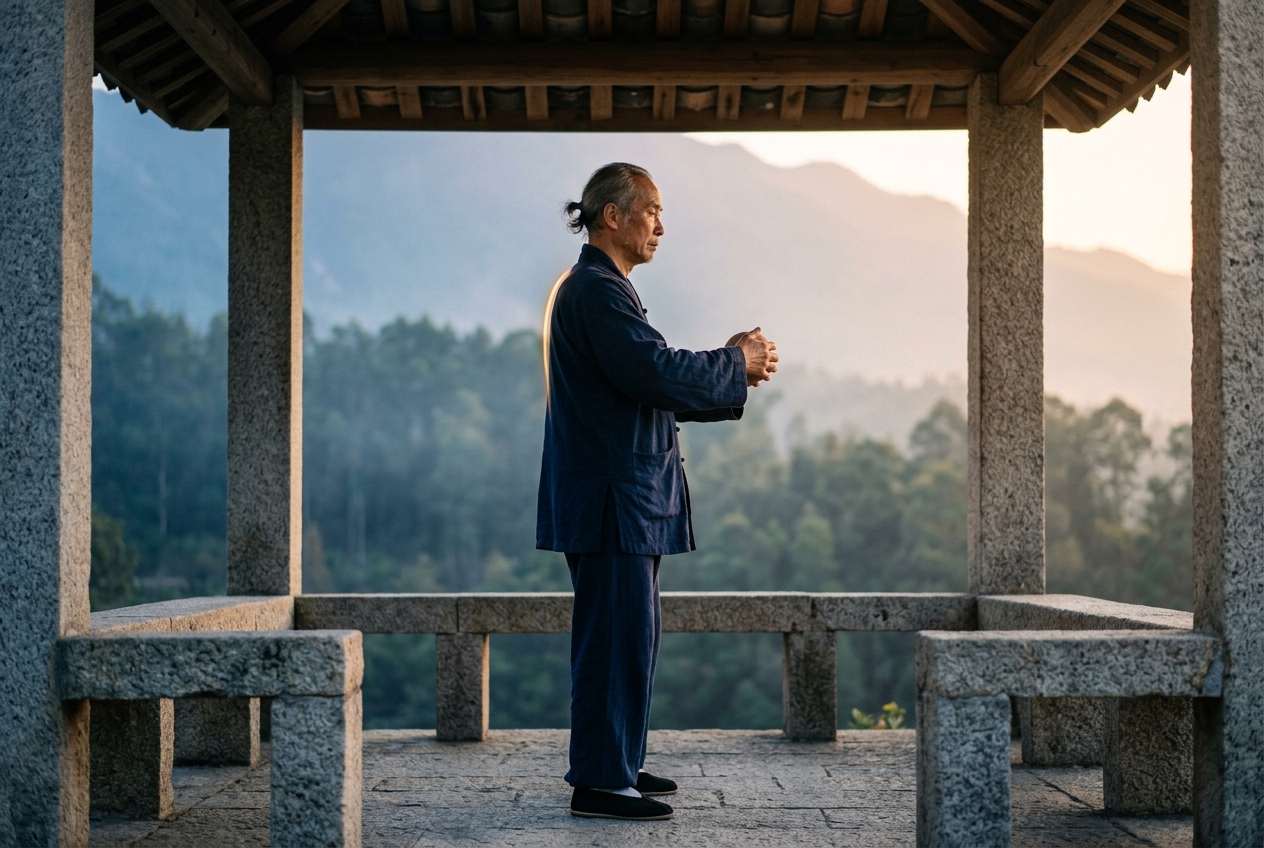
To liberate the supraclavicular space and cultivate authentic internal alignment, practice the following foundational protocol within the classical standing meditation framework known as [Zhan Zhuang](https://en.wikipedia.org/wiki/Zhan_zhuang). This sequence transitions from tactile self-palpation to dynamic internal micro-adjustments.
In the classical tradition of Chinese movement therapy and internal cultivation ([Daoyin](https://www.nqa.org/) and Neigong), your body is understood not as a static collection of independent muscles and bones, but as an interconnected web of tensegrity where breath, fascia, and neural signaling operate as a unified fluid system. At the mechanical and energetic crossroad of this system sits a specific junction on the outer ankle called *Qiuxu* (acupoint GB40, translated as "Mound of Ruins").
At its essence, this somatic discipline is the art of decompressing the cranium and harmonizing the nervous system by consciously mobilizing a single anatomical gateway at the base of the posterior kinetic chain: the Kunlun Cavity. In plain terms, modern posture and sustained mental stress cause mechanical tension, vascular pressure, and neurological hyper-reactivity to accumulate in the head, neck, and upper back. By learning to release the structural brace in the outer ankle, a practitioner establishes an unobstructed downward conduit, allowing mechanical strain and accumulated nervous arousal to discharge smoothly into the ground.
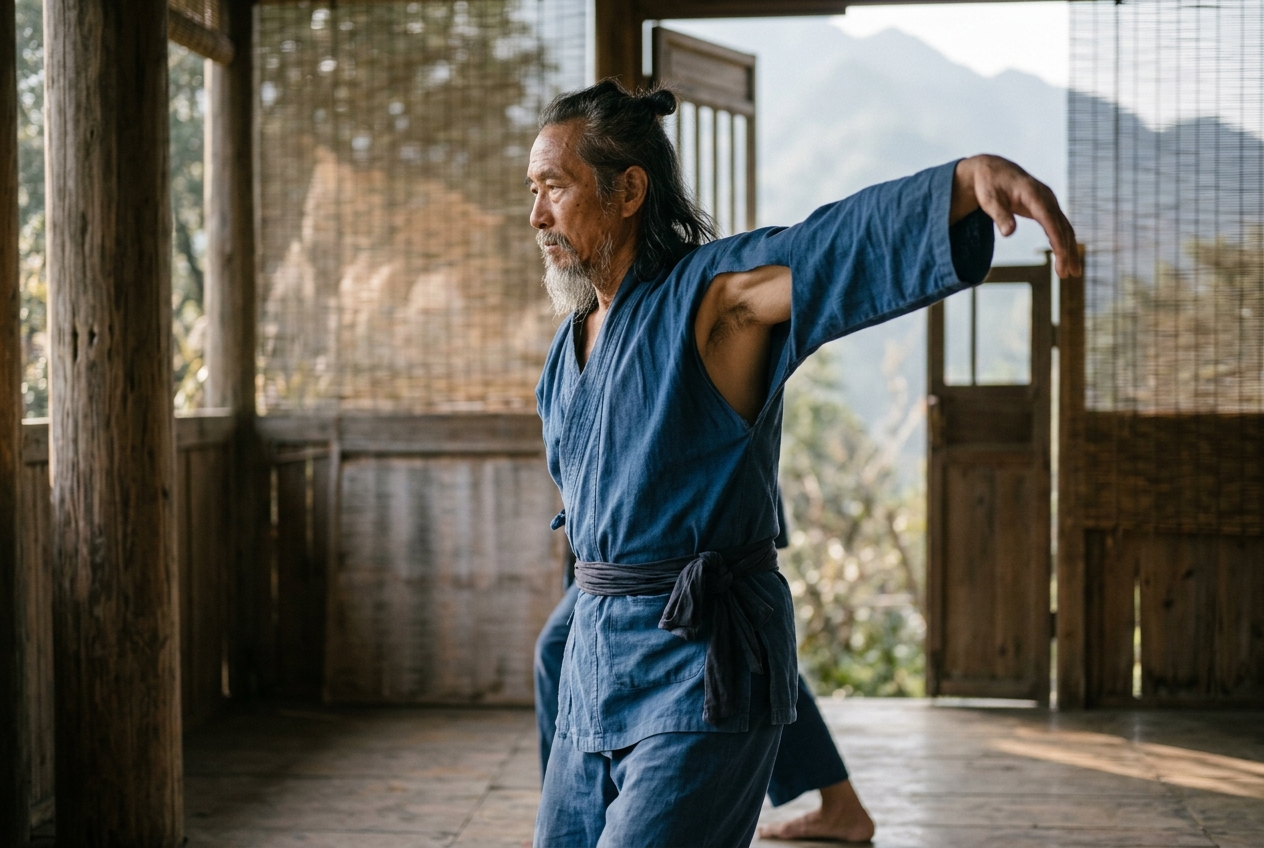
In the classical traditions of Daoist *Neigong* (internal skill cultivation) and Chinese medicine, this subtle physical adjustment is known as *Kong Xie* (空腋), or "hollowing the armpit." At the deepest anatomical center of this hollow lies an acupuncture point of supreme importance: *Jiquan* (极泉, designated as Heart 1 or HT1), translated poetically as the "Highest Spring" or "Ultimate Fountain."