Shenzhu Cavity Body Pillar: Upper Thoracic Interspinous Fascial Decompression, Du Mai Axial Tensegrity, and Posterior Kinetic Column Fortification in Classical Neigong
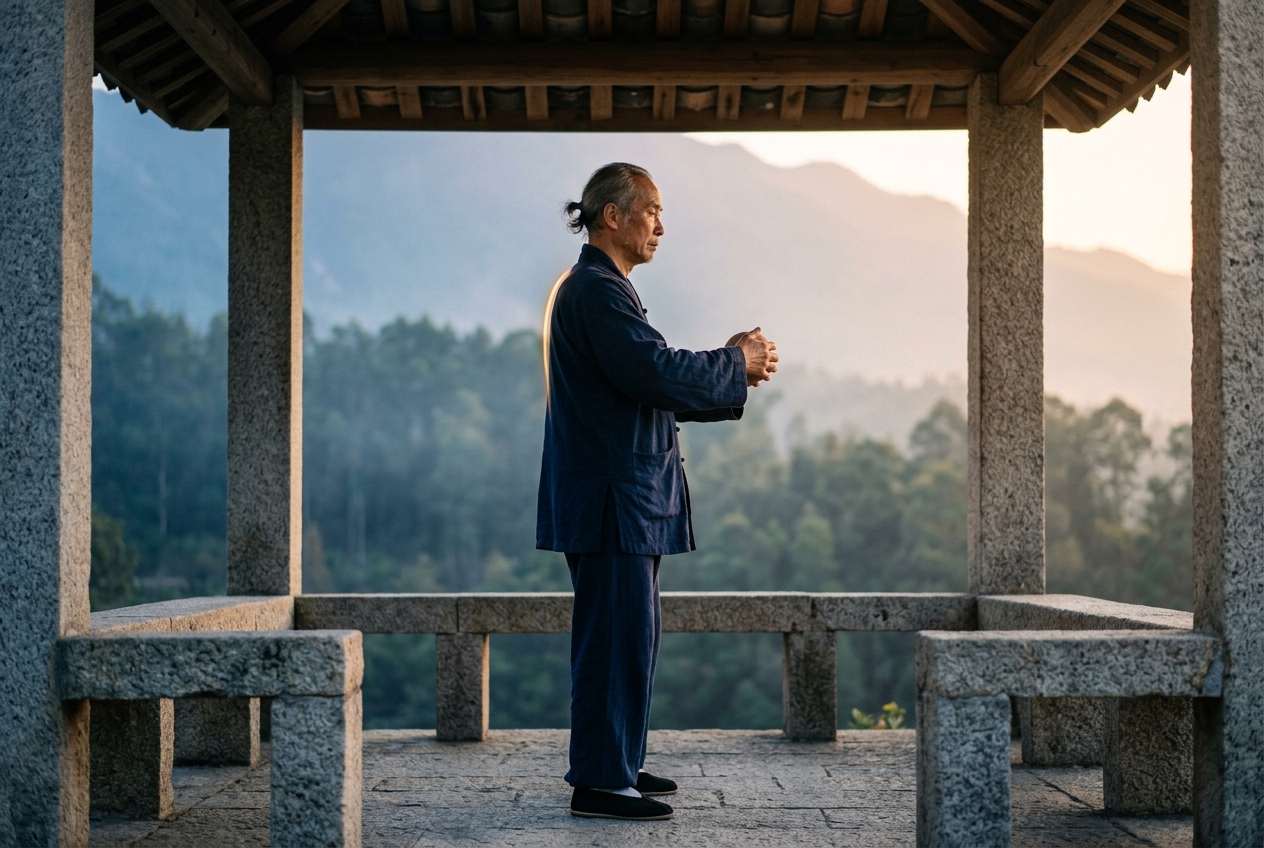
When you learn to gently widen your back and open this intervertebral space, you restore what modern biomechanics terms axial tensegrity: an evenly distributed structural balance that relieves spinal nerve pressure, deepens lung capacity, and settles an overstimulated nervous system.
Step-by-Step Somatic Cultivation Protocol
The following master-level didactic protocol outlines the cultivation of Shenzhu through the foundational standing posture (Zhan Zhuang, or "standing like a pillar") and the classical biomechanical principle of Han Xiong Ba Bei ("Sinking the Chest and Plucking/Rounding the Back").
1. Foundational Architecture & Zhan Zhuang Setup
- Foot Placement and Plantar Grounding: Position your feet parallel, pointing directly forward, aligned with the outer edges of your shoulders. Distribute your weight evenly across the tripod of each foot—the base of the big toe, the base of the pinky toe, and the center of the heel—engaging the Yongquan (Kidney 1) point on the sole.
- Pelvic Neutrality: Unlock your hip joints (Kua) and allow the sacrum to sink as though sitting onto a high stool. This flattens the lumbar lordosis naturally without aggressively tucking the pelvis.
- Spinal Suspension: Imagine a silk cord gently lifting the crown of your head at Baihui (Governing Vessel 20). This elongates the suboccipital region and naturally draws the chin inward, neutralizing cervical hyperextension.
- Embracing the Tree (Cheng Bao): Raise your arms to chest height, forming an open, rounded oval as if embracing a broad cedar tree. The fingertips point toward one another, separated by approximately four to six inches, with the wrists relaxed and elbows sinking slightly lower than the shoulders.
2. Vector Alignment: Han Xiong Ba Bei (Sinking the Chest and Rounding the Back)
- Sternocostal Softening (Han Xiong): Consciously soften the manubrium and sternum downward. Do not cave the chest inward or collapse the anterior ribs; rather, allow the pectoralis major and minor to release their chronic hypertonicity, yielding space for the sternum to drop toward the lower abdomen.
- Dorsal Fascial Broadening (Ba Bei): As the chest softens, feel a simultaneous, outward horizontal widening across the interscapular region. The medial borders of the scapulae gently glide away from the midline.
- Decompressing the T3 Interspinous Space: Direct your somatic intent (Yi) directly beneath the spinous process of the third thoracic vertebra (T3). Imagine a tiny, warm wedge gently widening the gap between the T3 and T4 spinous processes, anchoring the entire dorsal kinetic chain.
3. The Dantian-to-Shenzhu Respiration Vector
- Phase 1 (Inhalation — Grounding & Expansion): Inhale slowly through the nose over a count of four to six seconds. Direct the breath down the anterior midline into the lower belly (Lower Dantian, roughly two inches below the navel). Feel the lower abdomen, flanks, and lower back (Mingmen, GV4) expand circumferentially like a pressurized sphere.
- Phase 2 (Retention / Micro-Pause): Pause for one to two seconds without closing your glottis. Maintain the hydrostatic intra-abdominal pressure within the lower abdomen.
- Phase 3 (Exhalation — Upward Dorsal Vector): Exhale gently through the nose over six to eight seconds. Instead of collapsing the belly, draw the pelvic floor slightly upward and project an energetic, warm current upward along the inner channel of the spine, surging from the lower abdomen and Mingmen, passing through the mid-dorsal corridor (Jiaji), and blossoming outward at Shenzhu (GV12) between the shoulder blades.
- Phase 4 (Fascial Settling): At the end of the exhalation, allow the shoulders to sink further, feeling the back maintain its expanded, inflated dome while the breath rests.
4. Diagnostic Self-Palpation Checks
- The Finger-Spacing Test: Reach one hand over your opposite shoulder and place your middle finger directly into the interspinous depression beneath T3 (level with the medial spine of the scapula). Gently round and flatten your back. You should feel the spinous processes separate slightly and the surrounding tissue soften from a ropy, contracted cord into a supple, buoyant cushion.
- The Scapular Wall Test: Stand with your buttocks and upper back against a flat wall. Step your feet six inches forward. Without arching your lower back, soften your chest until your T3 vertebra makes firm, flat contact with the wall while your shoulders rest downward and outward, away from your ears.
5. Common Biomechanical Errors and Micro-Corrections
| Biomechanical Error | Somatic Pathology | Targeted Micro-Correction |
|---|---|---|
| Excessive Kyphosis (Caving the Chest) | Collapsing the anterior ribcage, restricting the diaphragm and compressing the visceral pericardium. | Retain axial elongation from the crown (Baihui). Expand the back horizontally rather than flexing the spine forward vertically. |
| Scapular Adduction (Pinching the Blades) | Hyper-extending the upper thoracic spine, trapping the dorsal primary rami and pinching Shenzhu. | Sink the elbows laterally and downward; imagine inflating a balloon between the shoulder blades to push the scapulae apart. |
| Hyper-Lordosis (Flared Ribs) | Thrusting the lower ribs forward, breaking tensegrity between the lower abdomen and upper thoracic spine. | Soften the xiphoid process downward toward the pubic bone; anchor the breath into the lower lumbar spine (Mingmen). |
| Clavicular Elevation (Shoulder Shrugging) | Engaging upper trapezius and levator scapulae, blocking venous and energetic return from the cranium. | Consciously drop the armpits (Kong Yi) as if holding an egg under each axilla without crushing it. |
6. Somatosensory Phenomenology: Sensations to Expect
During the initial five to ten minutes of static alignment and focused respiration, practitioners typically experience distinct neurological and bioenergetic milestones: - Warmth (Re): A distinct thermogenic sensation radiating outward from the T3 vertebra, spreading across the rhomboids and trapezii, signaling local vasodilation and the release of chronic neuromuscular holding patterns. - Tingling and Micro-Vibrations (Ma): Fine, effervescent sensations coursing down the ulnar nerve pathway to the ring and small fingers, indicating the decompression of upper thoracic spinal nerves and the opening of the Du Mai collateral channels. - Hydraulic Heaviness (Zhong): A profound sensation of structural rootedness, where the upper torso feels simultaneously weightless and anchored, mediated by the stabilization of the scapulothoracic girdle. - Spontaneous Fascial Unwinding (Song): Micro-adjustments and subtle clicking sensations along the costovertebral joints as chronic fascial adhesions dissolve under continuous hydrostatic and postural tensegrity.
Why It Works — The Neurofascial, Biomechanical, and Autonomic Science
The efficacy of opening Shenzhu (GV12) rests upon the intersection of modern structural kinesiology, neuroanatomy, and classical Chinese medical theory.
1. Topographical and Functional Neuroanatomy
Anatomically, Shenzhu lies on the posterior midline, in the interspinous space beneath the spinous process of the third thoracic vertebra (T3). Structurally, this site penetrates the cutaneous and subcutaneous fascial layers, the supraspinous ligament, and the interspinous ligament, bordering the dense aponeurotic insertions of the middle trapezius and rhomboid major musculature.
Innervation of this point is governed by the medial branch of the posterior primary ramus of the third thoracic spinal nerve ($T_3$), accompanied internally by the dorsal branch of the posterior intercostal artery and the regional internal vertebral venous plexus. Bilaterally, 1.5 cun (approximately two finger-widths) lateral to Shenzhu, lie the Feishu (BL13) points—the Back-Shu transport cavities of the Lung.
The somatosensory and viscerosomatic convergence between GV12 and BL13 creates a potent neuro-anatomical triangle: the dorsal root ganglia at T3 receive afferent feedback from both the deep postural axial myofascia and the visceral parenchyma of the lungs, bronchi, and heart.
2. Tensegrity and Scapulothoracic Mechanics
In conventional slumped posture, the thoracic spine undergoes passive, collapsed kyphosis accompanied by anterior shoulder protraction and cervical hyperextension. This shears the intervertebral discs and places the supraspinous ligament under dead strain.
Conversely, the practice of Han Xiong Ba Bei executes an active, micro-flexion and fascial elongation across the T3–T4 motion segment. By engaging the serratus anterior and the lower fibers of the trapezius, the scapulothoracic girdle is stabilized against the thoracic cage without pinching the rhomboids.
This functional reorganization distributes mechanical stress according to the principles of biological tensegrity—a structural paradigm wherein rigid compression struts (the vertebrae and ribs) are suspended within a continuous, unbroken network of tensile elements (the thoracolumbar fascia, deep spinal ligaments, and myofascial chains).
Decompressing the T3 interspinous space removes localized mechanical impingement, stabilizes the thoracic cage, and allows the posterior kinetic chain to transmit ground reaction forces seamlessly from the feet to the crown.
3. Autonomic Regulation and Cardiopulmonary Harmony
The upper thoracic spinal segment ($T_1$–$T_5$) houses the preganglionic sympathetic cell bodies destined for the cardiac and pulmonary plexuses within the intermediolateral cell column of the spinal cord. Chronic tension, dorsal subluxations, or fascial density at T3 induce localized nociceptive signaling, which drives hyperactive sympathetic outflow via the paravertebral sympathetic trunk. This manifests clinically as elevated resting heart rate, restricted tidal breathing, systemic hypertension, and persistent somatic anxiety.
By opening the T3 intervertebral junction through diaphragmatic respiration and dynamic postural elongation, the practitioner down-regulates sympathetic hyperarousal. Scientific investigations indexed in the National Center for Biotechnology Information demonstrate that slow, structural breathing practices significantly enhance heart rate variability (HRV), bolster vagal tone, and optimize baroreceptor sensitivity.
The physical decompression of Shenzhu acts as a biomechanical switch, quieting the sympathetic nervous system and triggering a parasympathetic shift that calms the heart and deepens respiration.
4. Bioenergetic Dynamics: The Du Mai and the Jiaji Corridor
In classical energetic physiology as recognized by the World Health Organization Traditional Medicine Strategy, Shenzhu serves as the fundamental "Pillar" of the Du Mai (Governing Channel), the primary Yang reservoir of the human organism. The mid-dorsal thoracic spine constitutes the central Jiaji gate—one of the infamous "Three Passes" (San Guan) through which ascending Yang Qi frequently struggles to penetrate.
When the T3 segment is compressed, a severe energetic bottleneck forms between Shendao (GV11, under T5) and Dazhui (GV14, under C7). Opening Shenzhu clears this energetic stagnation, allowing pure Yang Qi to ascend freely through the Yuzhen (Jade Pillow) pass at the occiput into the brain (Niwan Palace), while simultaneously fortifying the defensive Wei Qi that circulates across the superficial fascial layers of the upper back.
Classical Lineage and Historical Context
The cultivation of the Shenzhu cavity occupies a storied lineage within Daoist internal alchemy (Neidan), traditional medicine, and martial arts.
The earliest systematic treatises on the Du Mai appear in the Huangdi Neijing (Yellow Emperor's Inner Canon, c. 2nd century BCE), wherein the midline spinal points were recognized as vital command centers for governing systemic vitality, bone marrow nourishment, and cerebral vigor.
During the Tang Dynasty, the renowned physician-hermit Sun Simiao (581–682 CE) highlighted Shenzhu in his magnum opus, Beiji Qianjin Yaofang (Essential Formulas for Emergencies [Worth] a Thousand Pieces of Gold). Sun documented that moxibustion and directed somatic intent applied to Shenzhu possessed the profound capacity to treat severe respiratory distress, calm internal wind, eliminate pediatric convulsions, and fortify constitutionally weak individuals.
In Chinese pediatric tradition, Shenzhu was revered as the "Child's Pillar" (Xiao'er Zhu), routinely stimulated to foster robust immune resistance and skeletal development.
In the medieval Daoist Neidan traditions of Mount Wudang and Mount Huashan, Shenzhu became inextricably linked with the micro-circulation of the "Lesser Heavenly Circuit" (Xiao Zhou Tian or Microcosmic Orbit). Daoist masters recognized that the spinal passage behind the heart and lungs was prone to "ghostly stagnation" (Gui Qi)—stagnant metabolic waste and emotional constriction.
Practitioners employed precise standing postures to physically lengthen the spine, utilizing the buoyancy of the breath to bridge the gap across T3, transmuting dense essence (Jing) into refined breath (Qi) and luminous spirit (Shen).
By the late Qing Dynasty, this esoteric Daoist science was integrated into internal martial arts (Neijiaquan). When Grandmaster Yang Chengfu codified the foundational tenets of Taijiquan in the early 20th century, he placed Han Xiong Ba Bei second only to suspending the crown of the head.
In Xingyiquan, this same mechanism is preserved as the "Dragon Spine" (Long Shen), while Baguazhang characterizes it as the "Hollow Chest and Rounded Back" (Han Xiong Ba Bei, Hu Kou Yuan). Across these lineages, master teachers recognized that without the unlocking of the Shenzhu pillar at T3, martial power (Fa Jin) remains fractured, breath remains trapped in the upper chest, and the internal circulation of Qi cannot attain seamless, unbroken wholeness.
To deepen your study of authentic classical lineages, organizations such as the National Qigong Association provide comprehensive curricular resources bridging historical pedagogy and contemporary somatic education.
Diagnostic Palpation and Somatic Checks
To ensure your practice maintains didactic precision, integrate the following three-tier self-assessment before, during, and after standing cultivation:
+-----------------------------------------------------------------------------------+
|                           SOMATIC INTEGRATION CHECKLIST                           |
+-----------------------------------------------------------------------------------+
| [ ] 1. Axial Crown Lift: Chin gently retracted; suboccipital space open.         |
| [ ] 2. Scapular Spread: Interscapular region wide, flat, and buoyant.             |
| [ ] 3. T3 Decompression: No acute muscular pinching along the supraspinous band.  |
| [ ] 4. Diaphragmatic Root: Exhalations descend to lower abdomen without chest dip.|
| [ ] 5. Kinetic Connectivity: Weight transfers unimpeded into foot arches.         |
+-----------------------------------------------------------------------------------+
- The Interscapular Palpation: Reach behind your back with a soft massage ball or your fingertips. Press gently into the tissue directly between your spine and your left and right shoulder blades. If the rhomboid muscles feel like taut steel cables, your chest is excessively flared or your arms are being held up by shoulder tension rather than fascial suspension. Drop your elbows slightly lower to invite the tissue to soften.
- The Diaphragmatic Excursion Test: Place your right palm flat over your upper chest and your left palm flat over your lower abdomen. Breathe naturally. If the right hand rises and falls predominantly, your thoracic spine is locked in rigidity. Re-align Shenzhu, soften the sternum, and ensure that only the left hand moves forward and back with the breath.
- The Standing Rebound Test: While standing in Zhan Zhuang, have a training partner gently press their palms against your forearms in an outward and downward direction. If you meet their force with localized shoulder tension, Shenzhu is closed. If your T3 vertebra is expanded and your posture possesses true tensegrity, their incoming force will travel effortlessly down your dorsal spine, through your sacrum, and directly into the earth beneath your heels.
For broader anatomical reference on the spinal system and meridian pathways, consult the standardized indices on acupuncture point mappings and spinal neuroanatomy.
Today's Somatic Commitment
Tomorrow morning, before reaching for your phone or preparing your first cup of tea, dedicate precisely eight minutes to this foundational practice.
Stand quietly in a warm, draft-free room. Set your posture, suspend the crown of your head, soften your chest, and intentionally open the Shenzhu cavity beneath your third thoracic vertebra. Execute twenty-four continuous cycles of the Dantian-to-Shenzhu respiration vector.
As you step away from the stance and move into your daily activities, observe the immediate shifts: the newfound ease across your neck and shoulders, the unforced depth of your natural breathing, and the steady, grounded clarity of your mind throughout the day.