Tianzhu Cavity Celestial Pillar: Sub-Occipital Fascial Decompression, Bladder Meridian Marrow Ingress, and Craniocervical Kinetic Suspension in Classical Neigong
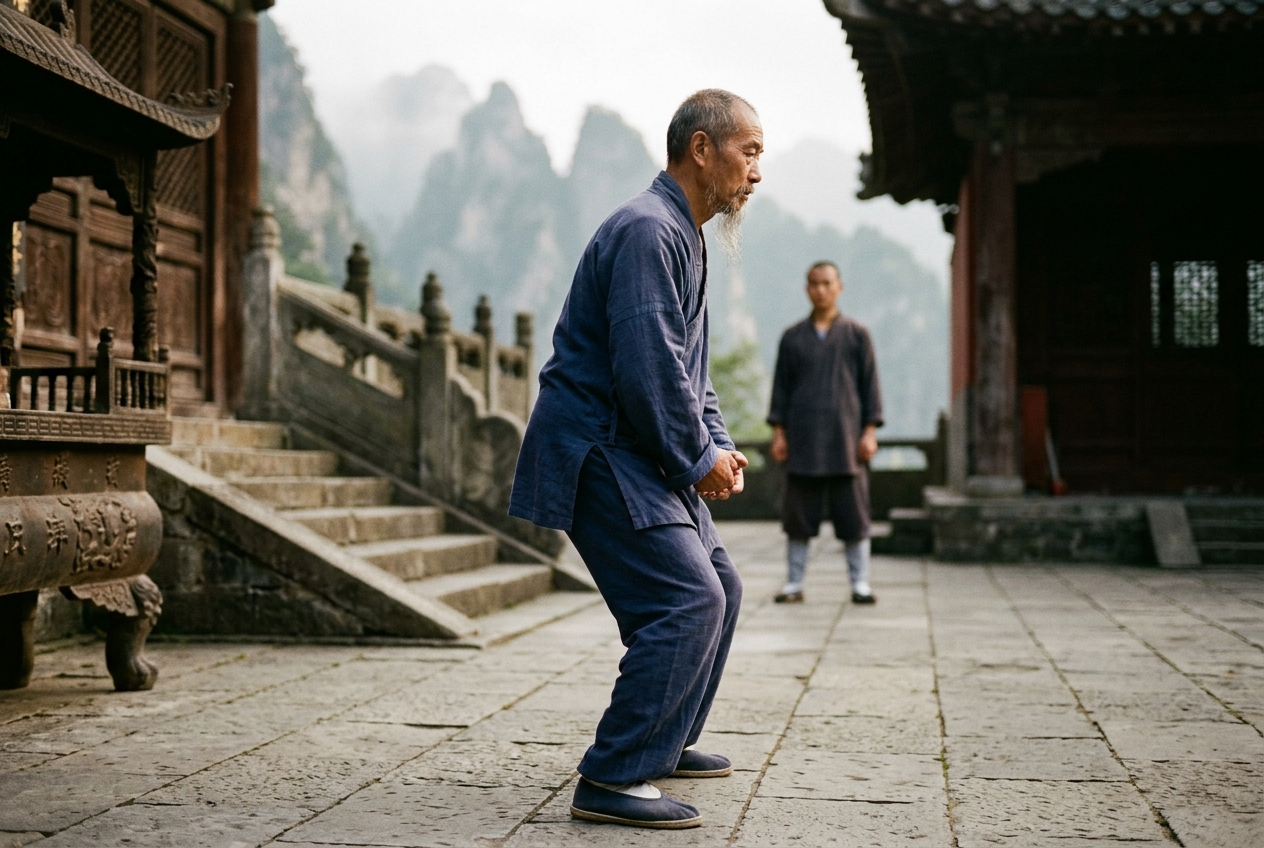
The practice detailed here is a specialized form of Daoyin (guided somatic stretching and breath vectoring) that systematically releases this craniocervical constriction. Instead of relying on aggressive neck cranking or passive stretching, it unites tactile micro-massage, diaphragmatic breath directed into the lower belly (Dantian respiration), and an internal postural adjustment that the ancient masters termed Xu Ling Ding Jin (虚灵顶劲)—the feeling of the head being lightly suspended from the heavens by an invisible silk thread. By unlocking the Celestial Pillars, you re-establish unobstructed circulation between the body and the brain, known in classical texts as the "Sea of Marrow" (Sui Hai), restoring clear sensory perception and calming an overstimulated nervous system.
                  OCCIPITAL BONE (Base of Skull)
         ________________________________________________
        /                     |                          \
       /    [Yuzhen / BL-9]   |    [Yuzhen / BL-9]        \
      /                       |                            \
     /       BL-10            | DU-16            BL-10      \
    |      (TIANZHU)          | (FENGFU)       (TIANZHU)     |
    |      [Lateral           | [Central       [Lateral      |
    |       Pillar]           |  Midline]       Pillar]      |
     \         \              |                /            /
      \         \--Trapezius--|--Trapezius----/            /
       \                      |                           /
        \_____________________|__________________________/
                              |
                    C1 (Atlas) / C2 (Axis)
                 Vertebral Artery & GON Path
Step-by-Step Practice Guide
This meditative decompression exercise can be executed in either a classic standing stance (Zhan Zhuang) or seated upright on a stool. Allocate eight to ten uninterrupted minutes in a quiet space with clean air.
Phase 1: Structural Alignment and Grounding
- The Stance: Place your feet parallel, precisely hip-width apart, pointing straight forward. Soften your knees so they are never hyperextended, and gently tuck your tailbone downward as if sitting lightly on the edge of a high barstool. This slight pelvic posterior tilt flattens excessive lumbar lordosis and anchors your lower center of gravity.
- Shoulder and Chest Settlement: Inhale deeply, shrug your shoulders upward toward your ears, roll them backward, and allow them to drop completely. Let the shoulder blades glide downward along the posterior rib cage, creating a wide, open feeling across your collarbones while allowing the sternum to sink inward naturally.
- Resting the Tongue: Place the tip of your tongue lightly against the hard palate of your mouth, just behind your upper front teeth. Keep your jaw relaxed with your molars slightly separated, eliminating any unconscious clenching.
Phase 2: Tactile Localization and Mobilization of Tianzhu (BL-10)
- Hand Placement: Bring both hands behind your head and interlock your fingers loosely, resting your palms against the curvature of the parietal bones. Extend both thumbs downward so they lie vertically along the sides of the cervical spine.
- Point Location: Slide your thumb pads upward along the lateral borders of the prominent trapezius muscle until you reach the inferior nuchal line at the base of the skull. You will find a distinct depression approximately 1.3 cun (about 1.5 inches or two finger-widths) lateral to the central midline groove of the spine.
- Vector of Pressure: Apply sustained, gentle pressure with your thumb pads directed anterosuperiorly—inward toward the center of your skull and subtly upward toward the crown. Do not gouge or use fingernails; maintain a firm, melting pressure that meets the tissue resistance without causing sharp pain.
- Rotational Friction: Maintain this inward pressure while executing small, rhythmic circular motions with your thumb pads for thirty seconds, moving clockwise for twelve rotations and counterclockwise for twelve rotations to disperse superficial myofascial adhesions.
Phase 3: Dantian Breath Vectoring and Craniocervical Release
- Lower Abdominal Priming: Release your hands from your neck and let your arms hang loosely at your sides, with your palms facing inward toward your thighs and your fingers gently curved as if holding soft cotton balls.
- The Inhalation Phase: Inhale slowly through your nose for a count of four. Direct the sensation of the breath straight down through your central torso into the lower belly (Xia Dantian), approximately two inches below the navel. Feel your lower abdomen, flanks, and lower back expand three-dimensionally like a filling sphere.
- The Ascending Vector: As your lungs reach natural capacity, do not hold your breath with a closed throat. Instead, visualize the accumulated abdominal pressure (Qi) transforming into an upward hydrodynamic wave traveling along the spinal column through the thoracic and cervical vertebrae.
- Micro-Nodding and Suspension (Xu Ling Ding Jin): At the peak of the inhalation, subtly drop your chin inward and downward by no more than two to three millimeters. Simultaneously, imagine the very vertex of your cranium (Baihui, GV-20) floating upward toward the sky. Feel the space between your occipital bone and the first cervical vertebra (C1 Atlas) widen, physically opening the bilateral Tianzhu cavities.
- The Exhalation Phase: Exhale smoothly through your nose for a count of six. As you exhale, maintain the physical elongation of your neck while relaxing the muscular effort in your neck, shoulders, and chest. Feel a wave of warmth descend down your back and limbs into your feet.
- Repetition: Repeat this coordinated breath and micro-alignment cycle for twelve to twenty-four full breath cycles.
       ===============================================================
       SUMMARY OF COMMON SENSORY MARKERS & PHYSIOLOGICAL MEANING
       ===============================================================
       Somatic Sensation             Underlying Physiological Mechanism
       ---------------------------------------------------------------
       Spontaneous Deep Sigh/Yawn   -> Parasympathetic vagal activation
       Occipital Thermal Warmth     -> Vasodilation of vertebral arteries
       Increased Clear Salivation   -> Sympathetic tone down-regulation
       Enhanced Visual Brightness   -> Decompression of ophthalmic tract
       Spinal Buoyancy / Floating   -> Myodural and fascial untorquing
       ===============================================================
Common Mistakes and How to Correct Them
- The "Military Chin Tuck" Error: A frequent mistake is aggressively jamming the chin backward into the neck, creating double chins and compressing the anterior cervical structures. Correction: The movement is an infinitesimal micro-nod from the atlanto-occipital joint, not a gross muscular retraction. Think of nodding slightly as if acknowledging a quiet thought.
- Shoulder Elevation: Tensing the upper trapezius muscles when attempting to lengthen the neck. Correction: Mentally decouple the action of the crown from the shoulders; the crown floats upward while the shoulder blades melt downward toward the kidneys.
- Lumbar Arching: Flaring the ribs forward and hyperextending the lower back when trying to stand tall. Correction: Keep the knees soft, sink the tailbone, and maintain slight intra-abdominal tone to support the spine from the front.
Why It Works — The Body Science
The remarkable efficacy of opening the Tianzhu cavity lies in its dense convergence of skeletal, neural, muscular, and vascular architecture at the craniocervical junction. Modern biomechanics and neuroscience validate why this specific anatomical hub governs systemic tension and cerebral function.
1. The Suboccipital Triangle and Greater Occipital Nerve
Tianzhu is situated directly over the lateral margin of the trapezius and splenius capitis muscles, overlying the deeper suboccipital muscles—namely the rectus capitis posterior major, rectus capitis posterior minor, obliquus capitis superior, and obliquus capitis inferior.
Piercing through this dense muscular complex is the greater occipital nerve (GON), originating from the medial branch of the dorsal ramus of cervical spinal nerve C2. When forward-head posture forces the suboccipital muscles into chronic isometric contraction, the greater occipital nerve becomes entrapped between the rigid muscle bellies and the occipital bone. This mechanical entrapment is the primary etiology of cervicogenic headaches and occipital neuralgia, creating referred pain patterns that wrap over the top of the skull and settle behind the orbits of the eyes. Releasing Tianzhu mechanically unloads this nerve, providing instant relief to the ocular and parietal pathways.
2. The Myodural Bridge and Dural Torque
One of the most profound anatomical discoveries bridging somatic cultivation and modern medicine is the myodural bridge—a dense band of fibrous connective tissue linking the rectus capitis posterior minor muscle directly to the posterior atlanto-occipital membrane and the underlying spinal dura mater. According to rigorous anatomical investigations published on NCBI PubMed, muscular tension in the suboccipital region transmits direct mechanical traction onto the thecal sac encasing the spinal cord and brain.
When Tianzhu is chronically constricted, this myodural tension induces dural torque, altering the delicate hydrodynamic fluctuations of cerebrospinal fluid (CSF) flowing through the foramen magnum. By executing the subtle micro-nod and crown suspension of Xu Ling Ding Jin, the practitioner releases the tension across this myodural bridge, restoring physiological CSF pulsatility and relieving mechanical stress throughout the entire craniosacral axis.
3. Vertebral Artery Hemodynamics
The third segment (V3) of the vertebral artery exits the transverse foramen of the atlas (C1), loops tortuously around the posterior arch, and traverses the suboccipital triangle before penetrating the dura mater to enter the cranium through the foramen magnum. There, the bilateral vertebral arteries unite to form the basilar artery, supplying the brainstem, cerebellum, and visual cortex.
Sustained suboccipital spasm compresses this vascular loop, compromising posterior cerebral perfusion. Gentle decompression of BL-10 removes extraneous myofascial compression from the vertebral arterial wall, facilitating optimal arterial inflow into the cranial vault and explaining the heightened visual clarity and mental alertness frequently reported following correct Daoyin execution.
4. Autonomic Entrainment and the Vagal Complex
The craniocervical junction houses the highest concentration of muscle spindles anywhere in the human body—exceeding two hundred spindles per gram of muscle tissue in the suboccipital group compared to fewer than twenty per gram in the gluteal muscles. This exceptional density functions as the central proprioceptive control room for the entire musculoskeletal framework.
Furthermore, the suboccipital myofascial matrix is neurologically intertwined with the superior cervical sympathetic ganglion and the nearby vagus nerve (Cranial Nerve X) exiting through the jugular foramen. Clinical research on NCBI PubMed on Suboccipital Decompression confirms that manual and postural decompression of the suboccipital tissues prompts a significant increase in high-frequency heart rate variability (HRV), signaling a rapid shift from sympathetic fight-or-flight hyperarousal to parasympathetic rest-and-digest dominance.
5. The Fascial Continuum: The Superficial Back Line
In structural integration and modern fascia science, the tissues surrounding Tianzhu form a critical anchor point along the Superficial Back Line, a continuous web of fascia running from the plantar fascia of the feet, up the calves, hamstrings, and erector spinae, over the occiput via the galea aponeurotica, and anchoring at the frontal brow. Constriction at Tianzhu acts as a kinetic snag along this systemic highway, locking the entire posterior chain in tension. Releasing this bilateral hub unlocks the mechanical integrity of the entire spinal column.
Classical Lineage & Context
The theoretical and experiential foundations of Tianzhu are rooted in the earliest classics of Daoist medicine and internal cultivation. To understand BL-10 is to understand how the ancient masters conceived of human architecture as a direct reflection of cosmological order.
       ===============================================================
       THE THREE OCCIPITAL GATES OF THE POSTERIOR CRANIUM
       ===============================================================
       Acupoint / Cavity     Location / Axis         Energetic Function
       ---------------------------------------------------------------
       DU-16 (Fengfu)        Sagittal Midline        Governing Vessel Sea;
                             (Nape Center)           Wind Elimination

       DU-17 / BL-9 (Yuzhen) Occipital Protuberance  The Jade Pillow Gate;
                             (Midline / Superior)    Upper Alchemical Pass

       BL-10 (Tianzhu)       Bilateral Columns       Foot Taiyang Gateway;
                             (Lateral Trapezius)     Structural Support &
                                                     Yang Qi Brain Ingress
       ===============================================================
The Foot Taiyang Meridian and the Sea of Marrow
In the Huangdi Neijing (The Yellow Emperor's Classic of Internal Medicine), formulated during the Han Dynasty (206 BCE – 220 CE), the Foot Taiyang Bladder channel is described as the longest and most exterior meridian of the body, governing the protective defensive energy (Wei Qi) and commanding the entire posterior surface of the organism. Chapter 10 of the Lingshu (Spiritual Pivot) outlines the trajectory of this channel as it ascends the spine, penetrates the nape at the Tianzhu cavities, enters the brain (Sui Hai, the Sea of Marrow), and emerges at the crown and forehead.
Chapter 33 of the Lingshu expounds upon the four great energetic seas of the body, declaring:
"The brain is the Sea of Marrow. When the Sea of Marrow is abundant, there is agile movement, light limbs, and boundless vitality. When it is deficient, there is dizziness, tinnitus, blurred vision, and heaviness of the head."
In this classical model, Tianzhu represents the indispensable bilateral conduit through which pure ascending Yang Qi is refined and delivered into the cranial reservoirs. If these pillars are obstructed by cold, physical strain, or emotional agitation, the brain is deprived of its vital sustenance, resulting in cognitive fatigue and physical stagnation.
The Three Occipital Passes: Tianzhu, Fengfu, and Yuzhen
Classical Daoyin and Daoist Internal Alchemy (Neidan) delineate three primary gateways along the craniocervical barrier, collectively forming the "Upper Pass" (Shang Guan) of the posterior energetic circulation:
- Fengfu (DU-16, Palace of Wind): Located on the posterior sagittal midline, directly below the external occipital protuberance. It is the central opening of the Governing Vessel (Du Mai), functioning primarily to dispel external pathogens ("wind") and clear the central spirit (Shen).
- Yuzhen (BL-9 / DU-17, Jade Pillow Pass): Situated directly over the occipital prominence, serving as the formidable energetic obstacle that ascending Yang must breach during the Microcosmic Orbit circulation (Xiao Zhoutian).
- Tianzhu (BL-10, Celestial Pillar): Unlike the single midline axis of Fengfu, Tianzhu is strictly bilateral. It represents the physical, structural architecture—the dual load-bearing columns that physically suspend and stabilize the cranium, providing the broad base necessary for the central axis to remain open and buoyant.
The Lineage of Dynamic Suspension: Wang Zongyue and Neigong
During the Song and Ming Dynasties, internal martial arts masters and physicians codified the relationship between physical posture and spiritual awareness. In the foundational Taijiquan Lun (Treatise on Tai Chi Chuan), attributed to the legendary master Wang Zongyue, the very first foundational rule for martial and energetic mastery is given as:
"Xu Ling Ding Jin, Chen Qi Dantian"
(虚灵顶劲, 沉气丹田)
"Let the crown be empty, agile, and suspended from above, while sinking the breath into the lower belly."
The character Xu (虚) denotes emptiness or complete absence of rigid muscular force, while Ling (灵) conveys agile, responsive awareness. This state cannot be achieved through sheer effort; it requires the total relaxation and mechanical widening of the bilateral Tianzhu cavities. Master Sun Simiao (581–682 CE), the revered Tang Dynasty "King of Medicine," documented specific morning Daoyin movements where the practitioner gently rotates the head while pressing Tianzhu to "disperse pathogenic cloudiness and invite the clear spirit to descend." This rich lineage is preserved today by international institutions such as the World Health Organization Traditional Medicine and the National Qigong Association, which catalog these classical somatic therapies as essential modalities for holistic preventative health.
Today's Practice Commitment
To transform this conceptual knowledge into enduring somatic capability, commit to the following five-minute decompression sequence once daily for the next seven consecutive days:
- When: First thing in the morning before interacting with your smartphone or computer, or immediately following an intensive work block at your desk.
- Duration: Exactly five minutes (roughly thirty full breath cycles).
- Protocol: 1. Stand or sit upright in the foundational posture (Phase 1). 2. Perform thirty seconds of warm, circular thumb friction over bilateral Tianzhu (Phase 2). 3. Spend four minutes executing the coordinated Dantian inhalation and Xu Ling Ding Jin micro-suspension exhalation (Phase 3).
- Observation: Pay close attention during the sixty minutes following the exercise. Notice if your eyes feel less strained, if your peripheral vision appears wider and brighter, if your natural breathing sits deeper in your belly, and whether the characteristic tightness across your upper back has dissolved. By dedicating five minutes a day to releasing these Celestial Pillars, you re-align your physical framework with classical wisdom, establishing an unshakable foundation of calm alertness and structural poise.