Shousanli Cavity Arm Three Miles: Antebrachial Extensor Fascial Decompression, Brachial Kinetic Transmission, and Yangming Channel Conduction in Classical Neigong
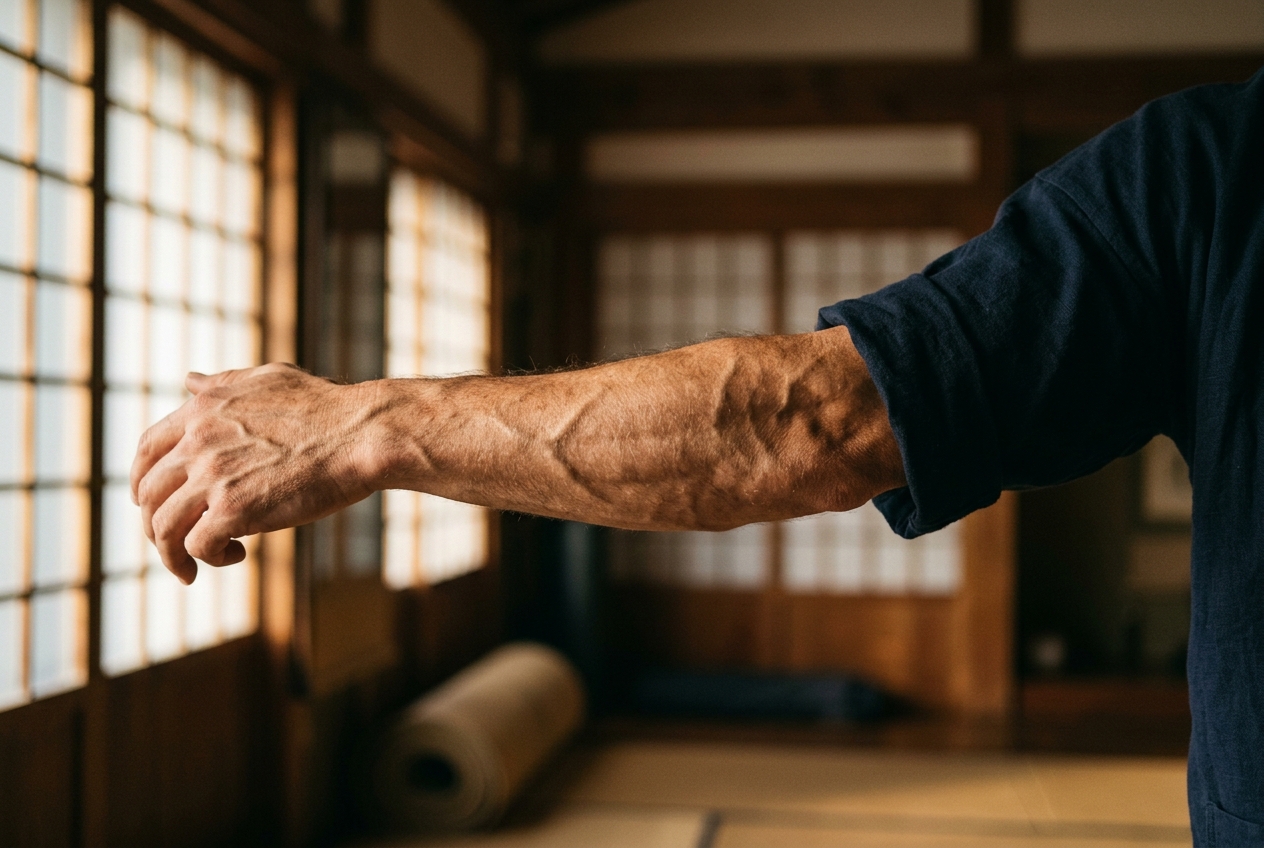
In traditional Chinese medicine (TCM), Shousanli belongs to the Hand Yangming Large Intestine meridian (Shou Yangming Dachang Jing), a primary bioenergetic pathway governing systemic motor vitality, tissue hydration, and the clearance of inflammatory heat from the head and digestive tract. Just as its famous lower-limb counterpart Zusanli (ST36, "Leg Three Miles") revitalizes the legs and digestive organs to allow an exhausted traveler to walk another three miles, Shousanli restores dynamic power and endurance to the upper limbs. By combining precise anatomical palpation, breath-coordinated forearm spiraling, and the meditative standing postures of Zhan Zhuang (standing pole meditation), you learn to disengage chronic forearm contraction, open the radial kinetic chain, and access a resilient, spring-like bodily connectivity known in internal martial arts as Peng Jin (expansive ward-off force).
   [ ELBOW JOINT: Lateral Epicondyle ]
                  |
     (Quchi / LI11 at the lateral crease)
                  |
            ~ 2 cun (3 cm)
                  |
         >> [ SHOUSANLI / LI10 ] <<  <-- Neuromyofascial Fulcrum
          /               \
[Brachioradialis]   [Extensor Carpi Radialis]
          \               /
   [ Deep Branch of Radial Nerve & Recurrent Artery ]
                  |
            ANTEBRACHIAL
           FASCIAL SHEATH
                  |
     [ WRIST & DORSAL DIGITS (LI4 / LI1) ]
Step-by-Step Practice Guide: Decompressing the Radial Kinetic Chain
To access the therapeutic and structural benefits of Shousanli, the practitioner must move beyond superficial massage and engage in integrated somatic cultivation. The following didactic protocol combines osteopathic myofascial release, classical Daoyin (guiding and pulling energy), and Zhan Zhuang standing mechanics.
1. Precise Anatomical Localization and Diagnostic Palpation
Begin by seating yourself comfortably or standing with an upright, suspended spine. Bend your left elbow to a ninety-degree angle across your chest with the palm facing inward. * Locate Quchi (LI11) at the lateral (outer) end of the transverse cubital crease when the elbow is fully flexed. * Lay the index and middle fingers of your right hand flat across your outer forearm, measuring directly downward (distally) along the muscular ridge toward the wrist. The distance of two cun corresponds anatomically to the combined breadth of your index and middle interphalangeal joints (approximately 3 to 4 centimeters). * Identify the longitudinal groove between the brachioradialis muscle belly and the extensor carpi radialis longus (ECRL). * Apply progressive perpendicular pressure with your right thumb pad into this intermuscular septum.
Diagnostic Self-Palpation Benchmark:
-------------------------------------------------------------------------
Pathologically Restricted Tissue  | Buoyant, Cultivated Connective Tissue
-------------------------------------------------------------------------
• Hard, stringy, ropy band         • Supple, elastic, spring-like resistance
• Sharp, localized, burning pain   • Deep, spreading, warm ache (De Qi)
• Cold, ischemic skin temperature  • Immediate thermal flushing across palm
• Wrist extensor muscle twitching  • Release of tension in ipsilateral neck
-------------------------------------------------------------------------
2. The Radius-Ulna Spiraling Sequence with Breath Coordination
Once the Shousanli cavity is engaged, integrate dynamic micro-spiraling to shear and hydrate the antebrachial fascia: 1. Initial Posture and Inhalation: Inhale smoothly through your nose into your lower abdomen (Xia Dantian), allowing the lower belly to expand laterally. Maintain moderate thumb pressure on LI10. Keep the left wrist soft and extended straight, with fingers loosely opened. 2. Exhalation and Pronation Spiral: As you exhale slowly through the nose, gently roll your left forearm inward (pronation), rotating the radius bone across the stationary ulna so your palm turns downward and slightly outward. As you rotate, apply a gentle distal-to-proximal sliding stroke with your thumb along the Shousanli sulcus. 3. Inhalation and Supination Expansion: On the subsequent inhalation, reverse the rotation, gently rolling the forearm outward (supination) until the palm faces upward. Allow the tissues beneath your thumb to expand outward against your manual pressure, imagining the interosseous membrane between the forearm bones widening like a sail catching wind. 4. Repetition: Perform 9 conscious spirals per arm, synchronizing each half-rotation with a full diaphragmatic breath cycle.
       [ INHALATION: Supination ]                  [ EXHALATION: Pronation ]
  Palm rotates up; interosseous space        Radius crosses ulna; fascial sheath
 expands; radial artery micro-perfusion     shears and releases; nerve glides free
                <====                                       ====>
       (Expansive Elasticity)                       (Torsional Decompression)
3. Integration into Zhan Zhuang (Embracing the Tree)
After clearing local restrictions manually, transfer this release into the isometric standing posture Cheng Bao Zhuang (Holding the Sphere Posture): * Stand with your feet parallel and shoulder-width apart, knees unlocked and sinking weight through the bubbling spring point (Yongquan, KI1) on the soles of your feet. * Raise both arms as if lightly encircling a large cedar tree at chest level. The elbows must hang heavy—sunken below the height of the wrists—while the armpits remain open as if cradling delicate bird eggs. * The Crucial Adjustment: Instead of holding the arms up via muscular effort in the upper trapezius and forearm extensors, project your mental awareness (Yi) into both Shousanli cavities. * Micro-spiral your forearms: gently rotate the thumb-sides of your hands outward while sinking the pinky-sides downward. This creates a subtle spiral torque through the radius and ulna, decompressing the extensor carpi radialis brevis and lifting the arms on an inflated cushion of fascial tension rather than muscle contraction. * Settle your breath into the lower abdomen, maintaining the stance for 10 to 20 minutes.
                      [ SUSPENDED OCCIPUT (Baihui) ]
                                    |
                            (Spine Elongated)
                                    |
          [Scapula Settled] <---------------+---------------> [Scapula Settled]
                 |                                                  |
           [Humerus Dropped]                                  [Humerus Dropped]
                 |                                                  |
       >> [SHOUSANLI (LI10)] <<                           >> [SHOUSANLI (LI10)] <<
        (Forearm Spiral: Open)                             (Forearm Spiral: Open)
                 |                                                  |
           [Wrist Hollowed]                                   [Wrist Hollowed]
                 |                                                  |
        [Distal Digits Alive]                              [Distal Digits Alive]
4. Common Beginner Pitfalls and Corrective Micro-Adjustments
- The Dorsal Wrist Crimp: Beginners frequently dorsiflex (cock back) the wrist when lifting the arms, pinching the extensor tendons and locking Shousanli into hypertonic spasm. Correction: Lengthen the crease at the back of your wrist; imagine a silk thread gently pulling the tip of your middle finger outward while the elbow drops toward the earth.
- Shoulder Elevation: Attempting to generate structural fullness by lifting the clavicles locks the scapulothoracic joint and severs the kinetic chain. Correction: Consciously "melt" the shoulder blades down the rib cage into the kidneys, allowing the weight of the arms to transfer directly through the latissimus dorsi and spine into the pelvis.
- Excessive Manual Force: Bruising the periosteum of the radius with aggressive thumb digging causes protective muscle splinting. Correction: Use an open, listening touch (Ting Jin). Sink your thumb into the tissue only to the depth where resistance begins, waiting for the breath to dissolve the knot from within.
5. Somatosensory Benchmarks: Decoding the "De Qi" and Fascial Release
As the Shousanli cavity unbinds, you will experience a characteristic cascade of physiological sensations: 1. Suan-Ma-Zhang-Zhong (Sourness, Numbness, Distension, Heaviness): The traditional markers of De Qi (arrival of vital energy), reflecting the stimulation of deep A-delta and C-nerve fibers within the fascial interstitium. 2. Thermal Effusion: A pronounced, spreading heat radiating down the radial border of the hand into the index finger (Shangyang, LI1) and thumb, signaling the dilation of the microvascular beds governed by the radial recurrent arterial branches. 3. Lightness of the Upper Extremities: A distinct subjective sensation that the arms are floating weightlessly in water, accompanied by spontaneous drops in resting heart rate and the softening of chronic tension in the jaw, temporal muscles, and suboccipitals.
Why It Works — The Neuro-Myofascial and Bioenergetic Science
The profound efficacy of Shousanli in classical cultivation and clinical therapeutics is underpinned by precise neuroanatomical, fascial, and physiological mechanisms validated by modern biomedical science.
1. Antebrachial Extensor Compartment Decompression and Elastic Kinetic Transmission
From an anatomical perspective, Shousanli is located precisely over the superficial and deep muscular strata of the lateral dorsal antebrachium. It pierces the deep antebrachial fascia between the brachioradialis and the extensor carpi radialis longus (ECRL), directly overlying the extensor carpi radialis brevis (ECRB) and the deeper supinator muscle belly. In the modern biomechanical profile—dominated by computer ergonomics, driving, and smartphone manipulation—these extensor muscles remain in constant, low-grade, isometric shortening.
When the antebrachial extensor compartment is hypertonic, it induces "wrist locking"—a rigid fixation of the radiocarpal and midcarpal joints. In internal martial arts and movement therapies, this rigidity disrupts the kinetic chain. Dynamic power (Jin) cannot be generated by isolated muscles; it relies on a pre-stressed, continuous fascial network extending from the feet through the thoracolumbar fascia, across the scapulothoracic joint, through the humeroulnar complex, and down to the palmar aponeurosis—a pathway corresponding closely to Thomas Myers' Superficial Arm Lines.
Decompressing Shousanli releases the hypertonicity of the ECRL/ECRB complex, restoring the neutral resting length of the extensor tendons. This slack allows the wrist joint to open (Fangsong), transforming the arm from a rigid, fragile lever into a compliant, fluid-filled hydraulic spring capable of transmitting elastic recoil forces (NCBI PubMed Research on Fascial Elasticity).
2. Neurovascular Mobilization: Radial Recurrent Plexus and the Posterior Interosseous Nerve
Directly deep to Shousanli lies the radial tunnel, through which passes the deep branch of the radial nerve (which becomes the posterior interosseous nerve, or PIN) along with the anastomotic network of the radial recurrent vascular plexus. Chronic myofascial tension in the supinator arch (the Arcade of Frohse) and the ECRB margin frequently causes subclinical entrapment or mechanical irritation of the radial nerve, leading to non-dermatomal pain, forearm heaviness, diminished grip endurance, and sympathetic vasoconstriction.
Mechanical stimulation, myofascial shearing, and postural alignment at LI10 achieve two crucial physiological effects: * Neurodynamic Gliding: Radius-ulna spiraling produces longitudinal excursion and decompression of the radial nerve trunk, clearing perineural edema and downregulating ectopic nociceptive signaling. * Microvascular Hyperemia: Decompressing the radial recurrent arterial arcade triggers an immediate surge in downstream blood flow through the radial and interosseous arteries, verified by infrared thermography as rapid warming of the thenar eminence, the dorsal interosseous muscles, and the distal digits.
3. Classical Bioenergetics: Hand Yangming Large Intestine Conduction and the Zusanli Axis
In classical Chinese medical bioenergetics, the Yangming (Yang Brightness) channel system is unique among the twelve primary meridians: it is designated in the Huangdi Neijing as being Duo Qi Duo Xue—rich in both vital energy (Qi) and blood (Xue). Because the Large Intestine channel encompasses high-volume metabolic and neuromuscular throughput, points along this pathway exert powerful regulatory control over motor function and systemic tissue vitality.
Shousanli functions as a primary kinetic and energetic conductor along the Hand Yangming pathway. Its clinical and somatic pairing with Zusanli (ST36, Foot Yangming Stomach Meridian) forms a powerful axis:
================================================================================
                    THE YANGMING BIOENERGETIC AXIS
================================================================================
Feature               Shousanli (LI10 - Arm)           Zusanli (ST36 - Leg)
--------------------------------------------------------------------------------
Meridian System       Hand Yangming Large Intestine    Foot Yangming Stomach
Energetic Profile     Duo Qi, Duo Xue (Abundant)       Duo Qi, Duo Xue (Abundant)
Anatomical Nexus      Brachioradialis / Radial Tunnel  Tibialis Anterior / Common Peroneal
Primary Biomechanics  Restores Upper-Limb Kinetic Arc  Restores Ground Reaction Force
Visceral Reflex       Colonic Motility & Evacuation    Gastric Secretion & Peristalsis
Thermal Clearance     Disperses Heat from Sensory Eyes, Clear Stomach Fire & Clears
                      Sinuses, Teeth, and Throat       Abdominal Heat
================================================================================
In classical acupuncture and acupressure therapy, stimulating Shousanli activates somatovisceral neural reflexes mediated through the cervical and upper thoracic sympathetic chain, modulating gastrointestinal motor dynamics, relieving abdominal distension, and assisting in the regulation of bowel motility (WHO Traditional Medicine Guidelines).
4. Systemic Somatovisceral Modulation and Sensory Orifice Heat Clearance
The Large Intestine meridian ascends from the index finger along the radial edge of the arm, crosses the shoulder, traverses the supraclavicular fossa, ascends the lateral neck, enters the lower gums, wraps over the philtrum, and terminates beside the contralateral nostril at Yingxiang (LI20). Because Shousanli possesses an exceptionally high concentration of neurovascular mechanoreceptors, classical treatises designate it as a major distal clearing point for stagnant, pathogenic heat (Re Qi) and inflammatory stagnation affecting the sensory orifices.
By clearing microvascular and muscular resistance at LI10, the practitioner relieves retrograde fascial tension pulling on the brachialis, deltoid, and sternocleidomastoid muscles. This release promotes venous and lymphatic drainage from the head and neck, alleviating: * Vascular and tension headaches in the frontal and temporal regions. * Sinus congestion, rhinitis, and periorbital inflammation. * Odontalgia (toothache), temporomandibular joint (TMJ) dysfunction, and acute pharyngitis.
Classical Lineage & Historical Context
The systematic cultivation of Shousanli represents an unbroken convergence of Chinese imperial medicine, Daoist internal alchemy (Neidan), and traditional martial arts lineages.
1. Classical Roots in the Huangdi Neijing and Zhenjiu Jiayi Jing
The earliest theoretical framework for the Yangming meridian dynamics appears in the foundational Han Dynasty medical canon, the Huangdi Neijing (Ling Shu, Chapter 10: "Meridian Vessels"). The text describes the pathway of the Hand Yangming as rising through the "forearm between the two bones," establishing the anatomical and functional significance of the radial compartment.
The specific nomenclature of Shousanli was codified during the Western Jin Dynasty by the master scholar-physician Huangfu Mi in his seminal 282 CE treatise, the Zhenjiu Jiayi Jing (The Systematic Classic of Acupuncture and Moxibustion). Huangfu Mi characterized Shousanli as a pivotal cavity capable of harmonizing the intestines, resolving acute motor impairment of the upper extremity, and regulating local muscular atrophy (Wei syndrome). The name "Three Miles" (Sanli) carried a double meaning: it referred to the point's anatomical distance (distal to the cubital crease) and served as a poetic metaphor for the boundless physical stamina imbued in the arms when its bioenergetic flow is restored.
2. Transmission Through the Yijin Jing and Internal Martial Arts Lineages
During the Ming and Qing dynasties, the physical manipulation of the Yangming myofascial chain shifted from passive medical treatment to active somatic cultivation within Daoist and Buddhist monasteries. The legendary Yijin Jing (Muscle/Tendon Changing Classic), emerging from the Mount Tiantai Daoist tradition and adopted by the Shaolin Monastery, made extensive use of forearm supination, pronation, and eccentric radial loading to transform brittle muscular strength (Zhuo Li) into pliable, spring-like sinew power (Jin).
In the internal martial systems of Taijiquan, Xingyiquan, and Baguazhang, the Shousanli cavity became a critical structural check-point for alignment. Masters recognized that any collapsed angle in the elbow or over-extension in the wrist would cause Shousanli to harden, instantly severing the connection between the spine and the hand. By maintaining Shousanli in a state of suspended, relaxed buoyant fullness—an energetic quality known as Song Kong (relaxed and hollow)—the martial artist could absorb massive incoming concussive forces through the arm and ground them effortlessly through the feet.
In the 1920s and 1930s, Grandmaster Wang Xiangzhai, the founder of Yiquan (also known as Dachengquan or "Great Achievement Boxing"), synthesized these ancient principles into the pure practice of standing meditation (Zhan Zhuang). Wang stripped away elaborate forms and focused entirely on the neuro-myofascial alignments of the standing pole postures, demonstrating to the modern world that static standing, when guided by internal awareness (Yi Dao Qi Dao—"where intention goes, energy arrives"), induces profound physiological regeneration, dissolves chronic trauma in the fascial sheets, and unlocks extraordinary human physical vitality.
       ================================================================
                     DIDACTIC SUMMARY: THE LI10 CONTINUUM
       ================================================================
       • Anatomical Location: 2 cun distal to LI11 in the ECRL/Brachioradialis sulcus.
       • Deep Structure: Radial recurrent vascular arcade & deep radial nerve (PIN).
       • Mechanical Action: Prevents wrist locking; maintains the elastic kinetic chain.
       • Energetic Action: Conveys Hand Yangming Qi; clears heat from head & orifices.
       • Somatic Rule: Keep LI10 soft, buoyant, and spiral-aligned in all postures.
       ================================================================
Today's Practice Commitment
To transform this conceptual understanding into direct somatic literacy, commit to the following five-minute daily protocol for the next seven days, ideally performed first thing in the morning before breakfast or during a mid-afternoon work break:
- Locate and Clear (2 Minutes): Sit upright. Palpate Shousanli on your non-dominant arm first, finding the tender epicentre between the brachioradialis and the extensor carpi radialis longus. Apply steady, moderate thumb pressure while performing 9 slow, breath-synchronized forearm spirals (inhale supination, exhale pronation). Repeat on your dominant arm.
- Standing Posture (3 Minutes): Step into a neutral stance, unlock your knees, drop your tailbone, and lift your arms into Cheng Bao Zhuang (Holding the Sphere at chest level). Direct your mind's eye (Yi) into both Shousanli points. Roll the radius bones subtly outward, sink the elbows, and feel the chronic strain drain out of your neck and wrists into the earth.
- Observe the Shift: Step out of the posture, let your arms hang, and take three natural breaths. Notice the sudden surge of warmth in your palms, the lightness across your shoulders, the ease in your breathing, and the renewed mental clarity.
By cultivating Shousanli, you bridge the gap between ancient somatic wisdom and modern physiological health, unlocking resilient vitality in the palms of your hands. For further study and training methodologies, consult resources provided by the National Qigong Association and modern clinical literature available through PubMed.