Shenting Cavity Spirit Courtyard: Frontal Galea Fascial Decompression, Anterior Sagittal Dural Tensegrity, and Upper Dantian Shen Illumination in Classical Neigong
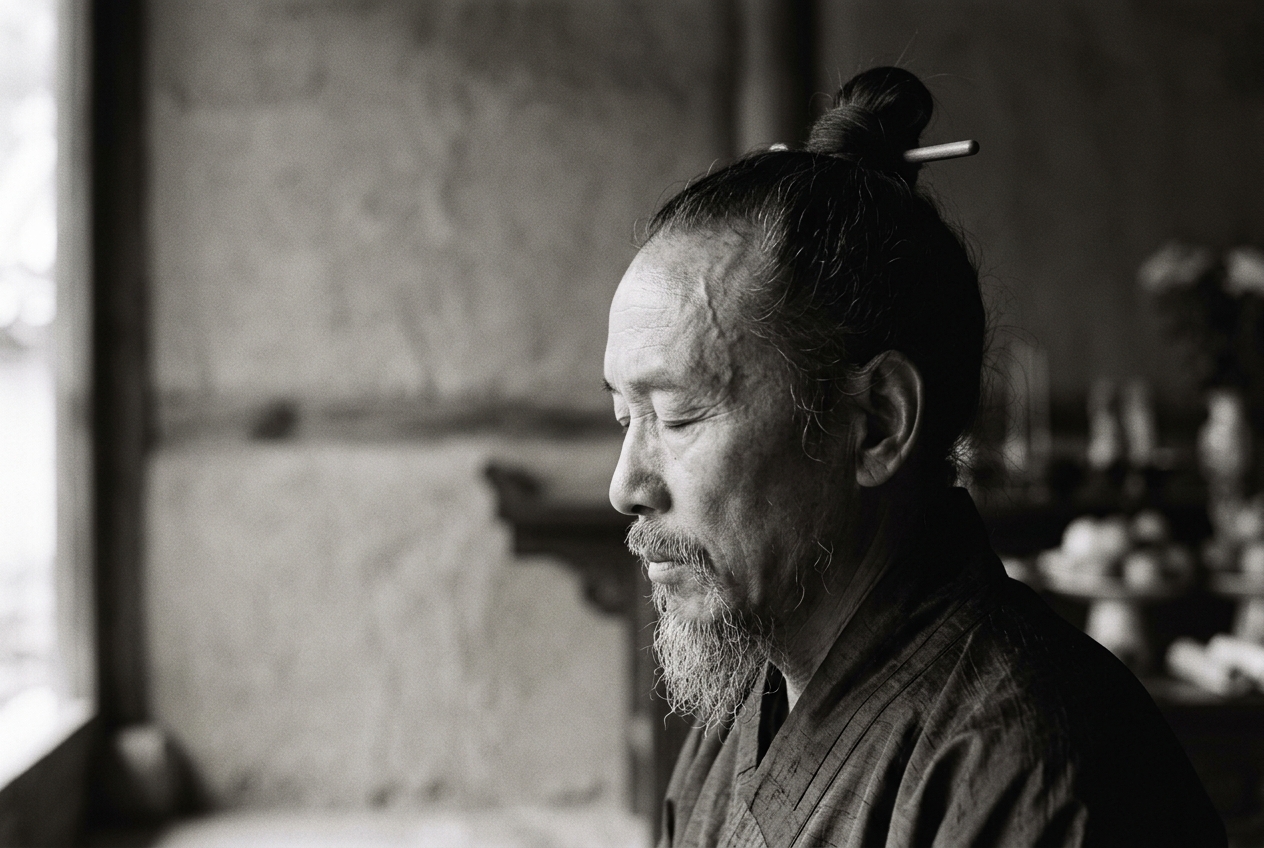
1. Establishing the Physical Architecture
Begin in a stable seated posture on a flat chair or meditation cushion, or stand in the classical Wuji stance with feet parallel and shoulder-width apart. Ensure your pelvis is neutrally positioned, allowing the lumbar spine to gently lengthen without flattening its natural curve. Suspend the crown of the head as if suspended by a fine silk thread from the vertex (Baihui, DU20), allowing the chin to retract microscopically. This subtle adjustment unweights the suboccipital junction at the base of the skull. Rest the tip of your tongue gently against the hard palate just behind the upper front teeth, bridging the Du Mai (Governing Vessel) and Ren Mai (Conception Vessel) meridians to facilitate closed-circuit bioelectric and energetic circulation.
2. Anatomical Localization and Tactile Contact
Locate Shenting (DU24) by tracing the sagittal midline of the cranium to a point exactly 0.5 cun (approximately the width of the interphalangeal joint of your thumb, or about half an inch) superior to the anterior hairline. If the hairline has receded, measure three cun superior to the glabella (the smooth prominence between the eyebrows). Place the soft pad of the middle or index finger directly upon this intersection, where the frontal belly of the occipitofrontalis muscle converges into the broad sheet of the galea aponeurotica. Maintain an exceptionally light contact pressure—between 5 and 10 grams—sufficient only to engage the superficial skin and superficial fascial layers without triggering defensive periosteal guarding.
3. Micro-Fascial Intention (Yi Dao Qi Dao)
Rather than applying mechanical force, apply the foundational Daoist principle of Yi Dao Qi Dao (意到氣到: "Where intention goes, vital energy follows"). Direct your conscious awareness into the microscopic space beneath your fingertip. Sense the fibrous tension of the frontalis fascia radiating laterally toward the temples. Without physical manipulation, hold the spatial intention of this tissue "melting" or widening outward, like warm water spreading across ice. As the local fascial tone softens, release your physical hand and rest it in your lap, maintaining pure, non-tactile mental focus on Shenting.
4. Synchronized Civil Breath (Wen Huo)
Engage the "civil fire" or gentle rhythmic respiration (Wen Huo, 文火). Inhale smoothly through the nose over a four-to-six-second count, guiding your somatic awareness up the posterior spine to Shenting. Do not force or hold the breath; allow the diaphragm to descend fully, creating a gentle expansion in the lower abdomen (Xia Dantian). On the exhalation, allow the awareness to glide down the anterior midline of the face, chest, and abdomen, anchoring the energetic momentum back into the lower belly. Maintain this effortless respiratory loop for 10 to 15 continuous cycles.
5. Turning the Light Inward (Hui Guang Fan Zhao)
Once the brow feels spacious, initiate the internal meditation practice known classically as Hui Guang Fan Zhao (回光返照, "Reversing the Light to Illuminate Within") and Cun Si (存思, "Focused Visualization"). Mentally draw the perceptual focus of both eyes backward from the physical forehead into the geometric center of the head—the Niwan Palace. Imagine your external visual focus dissolving into a soft, cool, luminous spherical space situated midway between the temples and behind the bridge of the nose. Rest within this internal sanctuary without narrative thought.
Sensory Markers of Successful Activation
- Thermal Vasodilation: A distinct sensation of gentle, spreading warmth across the forehead, temples, and vertex, reflecting localized microvascular perfusion.
- Fascial Unwinding: A sudden, palpable sensation of "dropping" or decompression behind the eyes and across the cranial vault, akin to removing a tight elastic headband.
- Fluidic Pulsation: A slow, rhythmic, hydrodynamic expansion and contraction synchronous with the primary respiratory mechanism of craniosacral flow.
- Shen Clarity: A spontaneous cessation of discursive internal dialogue, accompanied by profound emotional equilibrium and visual spaciousness.
Troubleshooting Common Errors
- Upward Energetic Stagnation (Qi Trapped in the Head): If you experience pressure, throbbing, or headache at the temples or crown, you are using excessive cognitive willpower (Zhu Huo, "Martial Fire"). Immediately cease upper-head concentration. Redirect your breath and mental focus entirely down to the Yongquan points (KID1) on the soles of your feet, exhaling deeply into the earth until cranial pressure normalizes.
- Excessive Ocular Strain: Beginners frequently tense the extraocular muscles while attempting to "look" at DU24. Ensure the physical eyeballs remain completely heavy, relaxed, and neutral within the orbital sockets, allowing the internal gaze to be purely mental rather than muscular.
- Mechanical Over-Compression: Pressing firmly on DU24 activates nociceptive reflexes in the supratrochlear and supraorbital nerves, causing reflex myofascial contraction. The contact must remain ethereal—a tactile whisper rather than an acupressure press.
Why It Works: Craniosacral Biomechanics and Neurobiology
The efficacy of releasing Shenting is rooted in the functional biomechanics of the cranial myofascial system and the neurobiology of the central nervous system. Modern biomedical research documented via the National Center for Biotechnology Information demonstrates that mental strain and psychological stress exhibit specific, measurable somatic correlates in the cranium.
Fascial Tensegrity and the Epicranial Aponeurosis
The human scalp is governed by an extensive continuous myofascial sheet comprising the frontalis muscle anteriorly, the occipitalis muscle posteriorly, and the fibrous epicranial aponeurosis spanning the calvaria. DU24 is situated at the precise mechanical transition zone where the dynamic muscular fibers of the frontalis interdigitate with the collagenous tensile matrix of the galea. Sustained cognitive focus, screen fixation, and psychological anxiety trigger involuntary hypertonicity of the frontalis, corrugator supercilii, and procerus muscles. Because the myofascial system operates as a continuous biotensegrity network, this anterior contraction pulls the entire galea forward, creating reciprocal compressive tension that radiates backward to the suboccipital muscles and the cervical spine.
The Dural Reciprocal Tension Membrane (Falx Cerebri)
The skull is not a rigid box, but a dynamic, micro-mobile structure linked by cranial sutures and an internal system of reciprocal tension membranes. The outermost meninx of the brain, the dura mater, forms the falx cerebri—a tough, sickle-shaped vertical partition that descends into the longitudinal fissure between the cerebral hemispheres.
Anteriorly, the falx cerebri anchors firmly to the internal frontal crest and the crista galli of the ethmoid bone, situated directly deep to the external surface coordinate of Shenting (DU24). Posteriorly, it attaches to the internal occipital protuberance and blends into the horizontal tentorium cerebelli.
When chronic stress induces frontalis contracture, the mechanical displacement alters the sutural compliance of the metopic and coronal sutures, transmitting restrictive vectors directly to the anterior anchorage of the falx cerebri. This dural torque impedes the natural rhythmic hydrodynamic pulsation of cerebrospinal fluid (CSF) and restricts micro-drainage through the superior sagittal venous sinus. By systematically relaxing the galea at DU24, the practitioner releases the anterior tether of the falx cerebri, restoring sagittal dural compliance and optimizing intracranial fluid dynamics.
Neurophysiology, Vagal Entrainment, and Cortical Rhythms
From an electroencephalographic perspective, focused intellectual problem-solving and hyper-vigilance correlate with elevated high-frequency beta-wave activity (18–30 Hz) localized in the dorsolateral prefrontal cortex. Somatic decompression of Shenting stimulates cutaneous receptive fields innervated by the supratrochlear and supraorbital branches of the ophthalmic nerve (CN V1), the first division of the trigeminal nerve.
Afferent trigeminal pathways project directly to the locus coeruleus and the nucleus tractus solitarii (NTS) in the brainstem, initiating the trigeminocardiac and oculocardiac reflexes. This stimulation triggers rapid autonomic down-regulation, shifting system-wide tone from sympathetic dominance to parasympathetic vagal entrainment. As confirmed by integrative protocols recognized by the World Health Organization Traditional Medicine framework, this parasympathetic shift downregulates prefrontal beta activity into coherent, slow-wave alpha (8–12 Hz) and theta (4–8 Hz) rhythms, fostering the physiological state of alert calmness essential for deep meditation.
Classical Lineage & Historical Context
The practice of decompressing Shenting and opening the Upper Dantian is not a modern somatic invention; it represents an unbroken lineage of internal alchemy (Neidan, 內丹) codified over millennia within the Daoist canon.
The Yellow Court Classic (Huangting Jing)
The foundational energetic topography of the human head was comprehensively documented in the Huangting Jing (黃庭經, The Yellow Court Classic), a central scripture of the Shangqing (Supreme Clarity) Daoist tradition attributed to Lady Wei Huacun (252–334 CE) during the Jin Dynasty. The Huangting Jing conceptualizes the cranium not as an anatomical void, but as an internal sacred landscape containing nine distinct energetic chambers, the central and most sovereign being the Niwan Gong (Mud Pill Palace).
The text emphasizes that the Shen cannot reside in a tumultuous, constricted vessel. Shenting—the "Spirit Courtyard"—is described as the grand antechamber through which celestial Qi enters and internal consciousness expands. When the courtyard is cluttered with emotional turbulence and physical tension, the inner chambers darken; when the courtyard is swept clean through quietude (Qingjing, 清靜), the spirit naturally settles into its throne, facilitating health and spiritual longevity.
The Secret of the Golden Flower (Taiyi Jinhua Zongzhi)
During the Tang and Song Dynasties, these esoteric principles were distilled into the practical Neigong methods of the Quanzhen (Complete Reality) school and its Longmen (Dragon Gate) branch. The seminal manual The Secret of the Golden Flower (Taiyi Jinhua Zongzhi, 太乙金華宗旨), attributed to Patriarch Lü Dongbin, provides explicit operational instructions for opening Shenting through the circular cultivation of light:
"The Golden Flower is the Elixir of Life... When the light is made to move in a circle, the forces of the whole body gather before its throne... You need only to let the light circulate; that is the most secret and wonderful operation."
In this alchemical context, the "Light" represents focused human attention and biophotonic nervous vitality. When directed outward through the senses, this energy dissipates into discursive thought and metabolic exhaustion. By applying Hui Guang Fan Zhao to DU24, the practitioner reverses the direction of the sensory currents, drawing the scattered rays of the spirit back through the courtyard of Shenting into the Niwan center. This process forms the physiological foundation of Lian Qi Hua Shen (煉氣化神, "Transmuting Vital Energy into Spirit") and Lian Shen Huan Xu (煉神還虛, "Transmuting Spirit back into Primordial Emptiness"). The National Qigong Association recognizes these historical practices as fundamental precursors to contemporary mind-body medicine and somatic cultivation.
Comparison of Somatic States: Constriction vs. Decompression
| Parameter | Constricted Spirit Courtyard (DU24) | Decompressed Spirit Courtyard (DU24) |
|---|---|---|
| Myofascial State | Hypertonic frontalis, retracted galea aponeurotica, compressed coronal suture | Hydrated, pliable galea; released frontal-occipital tensegrity axis |
| Dural Dynamics | Anterior tension on falx cerebri; restricted sagittal sinus drainage | Restored dural compliance; rhythmic craniosacral fluid pulsation |
| Brainwave Profile | Desynchronized, high-frequency Prefrontal Beta waves (18–30 Hz) | Synchronized Alpha (8–12 Hz) and Theta (4–8 Hz) brainwave coherence |
| Autonomic Tone | Sympathetic dominance, elevated cortisol, shallow clavicular breathing | Parasympathetic vagal activation, elevated HRV, deep diaphragmatic breath |
| Daoist Alchemical State | Scattered, agitated Shen; upward-rushing rebellious Qi (Ni Qi) | Anchored Shen in Niwan; harmonious descent of Qi into Lower Dantian |
Today's Practice Commitment
To translate these theoretical, anatomical, and historical insights into tangible neuro-somatic transformation, commit to the following five-minute laboratory with your own nervous system over the next 24 hours:
Tomorrow morning, prior to consuming your first cup of coffee or opening any digital screen, take a quiet seat in an upright chair. Dedicate precisely five minutes to the Shenting decompression sequence:
- Minute 1: Establish physical alignment, suspend the crown at DU20, rest your tongue on the upper palate, and place a single, feather-light finger upon Shenting (DU24).
- Minutes 2–3: Engage the Wen Huo civil breath, feeling the fibrous scalp tissues under your finger melt outward like warm water on ice, before resting your hand back in your lap.
- Minutes 4–5: Turn the inner gaze inward (Hui Guang), resting your attention in the quiet, spacious Niwan chamber in the center of your skull.
Observe your baseline mental clarity, the physical sensation around your eyes, and your emotional equilibrium as you transition into your daily responsibilities. By intentionally opening the Spirit Courtyard each day, you bridge classical Daoist internal alchemy and modern craniosacral biomechanics, cultivating an unshakeable foundation of radiant presence and somatic stillness amidst the demands of the modern world.