Kunlun Cavity Kunlun Mountains: Retromalleolar Fascial Decompression, Posterior Kinetic Chain Grounding, and Descending Bladder Yang Vectoring in Classical Neigong
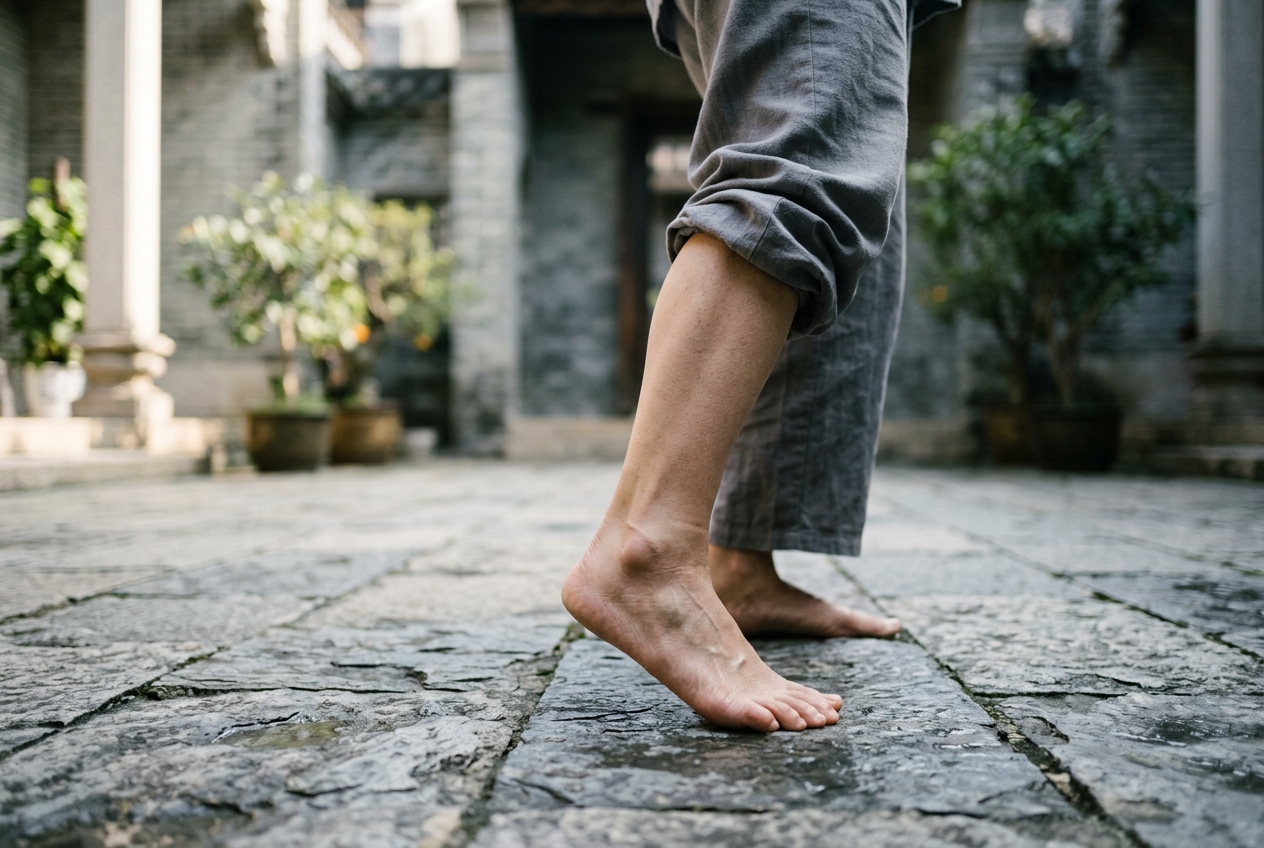
In the lexicon of Classical Chinese Medicine, this anatomical recess is designated as Kunlun (崑崙, codified as Bladder 60 or BL60), named after the sacred, cloud-capped mountain range regarded in classical cosmology as the fountainhead of all rivers. Categorized functionally as the Jing-River (經穴) and Fire-phase point of the Foot Taiyang Bladder meridian (足太陽膀胱經), Kunlun occupies a critical biomechanical and energetic junction where physiological circulation accelerates like a swift river. When properly decompressed during static standing meditation—known in Chinese martial traditions as Zhan Zhuang (站樁, "standing like a post")—and dynamic internal breath exercises (Daoyin), this point functions as a pressure-relief valve that descends pathogenic fire, resolves cranial congestion, and roots the entire structural frame.
Step-by-Step Practice Guide
To access the neurofascial and energetic potential of the Kunlun cavity without requiring manual acupuncture, you must cultivate refined somatosensory control over the retromalleolar space through postural alignment and synchronized respiration. Follow this systematic sequence:
1. Establishing the Triangular Foot Tripod
- Stance Architecture: Stand barefoot upon an even, firm surface. Position your feet parallel, spaced precisely the width of your acetabulofemoral (hip) joints. Ensure the lateral borders of your feet are aligned straight ahead, which often produces a slight, intuitive sense of being pigeon-toed for those accustomed to external hip rotation.
- Weight Distribution: Consciously map your weight into three distinct contact points on the plantar surface of each foot: 1. The center of the calcaneal tuberosity (the plantar heel base). 2. The fleshy ball below the first metatarsophalangeal joint (base of the big toe). 3. The lateral pad below the fifth metatarsophalangeal joint (base of the pinky toe).
- The Arch Vault: Verify that your weight is distributed 50% through the posterior calcaneus and 25% through each of the two anterior metatarsal heads. Do not grip the floor with your toes; keep them elongated and relaxed. This creates a dome-like suspension of the medial longitudinal arch, activating the foundational center known as Yongquan (湧泉, Kidney 1, the "Bubbling Well") while naturally liberating the lateral retromalleolar space.
2. Aligning the Posterior Kinetic Pillar (The Wuji Stance)
- Joint Decoupling: Release the extensor tone of your quadriceps to unlock the popliteal fossae behind the knees, directly softening the region of Weizhong (委中, BL40).
- Pelvic Neutralization: Allow your sacrum to descend vertically, as though a lead plumb-line were suspended from your coccyx toward the earth. Avoid aggressively tucking the pelvis; instead, allow the lumbar lordosis to gently flatten through the relaxation of the psoas and erector spinae muscles.
- Axial Decompression: Gently tuck the chin, allowing the suboccipital junction at the base of the skull to lengthen upward as if the vertex of the head (Baihui, 百會, DU20) were suspended from an overhead thread.
3. Engaging the Kunlun Siphon Through Dynamic Respiration
- The Inhalation Phase (Ascent and Expansion): Inhale slowly, smoothly, and silently through the nose over a 5-second count using diaphragmatic respiration (expanding the circumferential lower abdomen, flanks, and lumbar region). As the diaphragm contracts downward, feel an elastic line of tensile connection travel from the arch of the foot up through the medial legs into the lower abdomen.
- The Exhalation Phase (Descent and Cavity Mobilization): Exhale through the nose over a 7-second count. As the breath leaves the body, consciously relax the lateral ankles. Visualize the hollow depression between the lateral malleolus and the Achilles tendon expanding laterally and posteriorly, as if a tight drawstring around the ankle were released. Direct your somatic intent (Yi, 意) to guide excess heat, mental agitation, and cranial muscular tone down the length of the spine, through the calves, out through the Kunlun cavity, and deep into the calcaneus.
- Repetition: Maintain this standing meditation for 15 to 20 continuous minutes.
4. Common Beginner Mistakes and Precise Corrections
- Mistake 1: Calcaneal Eversion (Pronation Collapse). When practitioners allow the inner arches to collapse inward, the lateral malleolus impinges against the calcaneus, completely crushing the retromalleolar fossa and compressing the sural nerve and peroneal sheaths.
- Correction: Actively spread the fifth metatarsal head away from the first, lifting the lateral and medial arches to maintain an open, hollow space behind the outer ankle bone.
- Mistake 2: Genu Recurvatum (Knee Hyperextension). Locking the knees pulls the gastrocnemius taut, creating excessive passive tension in the Achilles tendon and mechanically shutting down the Kunlun gateway.
- Correction: Maintain a constant micro-flexion in the knees, imagining a soft sphere resting behind the popliteal crease.
- Mistake 3: Anterior Cranial Translation (Forward Head Posture). Allowing the chin to jut forward increases tension across the suboccipital triangle, reinforcing the very cranial Yang excess that Kunlun is meant to disperse.
- Correction: Retract the cervical spine slightly, feeling the occiput rise as the heels settle.
5. Somatosensory Milestones and Sensations
- Phase I (Minutes 1–5): A distinct sensation of heaviness and mechanical stability in the heels, accompanied by a noticeable drop in resting heart rate and the settling of racing thoughts.
- Phase II (Minutes 6–12): Micro-pulsations, pleasant warmth, or a mild tingling sensation radiating along the posterolateral margin of the calcaneus and ankle, signaling the activation of local microcirculation and sural nerve sensory afference.
- Phase III (Minutes 13–20): A subjective feeling of structural weightlessness in the cranium and shoulders, coupled with an expansive, cooling sensation across the temples and vertex—the somatic hallmark of successfully descending pathogenic cranial heat.
Why It Works: The Body Science
The clinical efficacy of the Kunlun cavity in traditional practice is mirrored by precise physiological, fascial, and neurological mechanisms recognized by contemporary biomedical science.
1. Topographical Anatomy and Fascial Architecture
Anatomically, Kunlun (BL60) is situated in the retromalleolar sulcus, directly bounded anteriorly by the posterior border of the lateral malleolus of the fibula and posteriorly by the lateral margin of the tendo calcaneus (Achilles tendon). This depression is sheathed by the deep crural fascia (fascia cruris), which forms specialized retinacula in this region—specifically the superior and inferior peroneal retinacula. These fibrous bands secure the tendons of the peroneus (fibularis) longus and peroneus brevis muscles as they traverse the lateral ankle to anchor under the plantar vault.
Deep within this retromalleolar adipose cushion lies the sural nerve (nervus suralis), formed by the union of the medial sural cutaneous nerve and the peroneal communicating branch, accompanied by the small saphenous vein (vena saphena parva). When postural tension is improperly managed, hypertonicity of the triceps surae compresses this neurovascular bundle against the fibular wall. Conversely, conscious opening of this space restores fluid dynamics within the synovia of the peroneal tendon sheaths and uncompresses the terminal sensory arborizations of the sural nerve.
2. The Superficial Back Line and Mechanotransduction
In the structural framework of myofascial anatomy, the Foot Taiyang Bladder meridian corresponds with extraordinary fidelity to the Superficial Back Line (SBL) described by contemporary biomechanists. The SBL is an uninterrupted kinetic continuum of fascia and muscle that spans from the plantar fascia and calcaneus, wraps around the Achilles tendon, ascends through the gastrocnemius, soleus, popliteal fascia, hamstrings, sacrotuberous ligament, thoracolumbar fascia, and erector spinae, and traverses over the epicranial aponeurosis (galea aponeurotica) to insert into the supraorbital ridge of the frontal bone.
Tension within this myofascial chain behaves according to the laws of structural tensegrity. Hypertonicity at the cranial pole (manifesting as tension headaches, suboccipital spasming, and ocular strain) reflects an upward accumulation of mechanical stress along the entire posterior continuum. Within this kinetic chain, the Kunlun cavity (BL60) forms a direct functional axis with two other major Bladder meridian nodal points: * Chengshan (BL57): Located at the inferior apex of the gastrocnemius muscle bellies, acting as the mid-calf tensile distributor. * Weizhong (BL40): Situated at the midpoint of the popliteal crease, serving as the posterior knee hinge and neurovascular crossroad.
       MYOFASCIAL CONTINUITY & NEURAL PATHWAYS
       =========================================================
       Structure            Anatomical Substrate        Meridian Equivalent
       ---------------------------------------------------------
       Plantar Interface    Plantar Fascia              Foot Taiyang Base
       Ankle Dampener       Retromalleolar Fossa        Kunlun (BL60)
       Mid-Calf Junction    Gastrocnemius Belly Apex    Chengshan (BL57)
       Popliteal Hinge      Popliteal Neurovasculature  Weizhong (BL40)
       Spinal Engine        Thoracolumbar Fascia        Bladder Meridian Shu Points
       Cranial Terminal     Suboccipital / Galea        Tianzhu (BL10) / Baihui
When an individual stands with the heels properly loaded and the retromalleolar space released, the tensile pull on the calcaneus shifts. This change triggers mechanotransduction signaling through the cellular matrix of the crural fascia, communicating an inhibitory relaxation wave upward through BL57, BL40, the thoracolumbar fascia, and into the suboccipital musculature. The mechanical load is grounded directly through the calcaneus into the earth, relieving the cervical spine of its stabilizing overdrive. Research cataloged in the National Center for Biotechnology Information and indexed across the PubMed Database has demonstrated that mechanical deformation of connective tissue layers during specific posturing and acupuncture mobilization triggers local cellular remodeling and systemic reductions in sympathetic tone.
3. Autonomic Regulation and Neural Siphoning
The Foot Taiyang meridian possesses a potent regulatory influence over the autonomic nervous system via the chain of Paravertebral Sympathetic Ganglia, which closely parallel the Bladder meridian Bei-Shu (Back-Shu) points. As the Jing-River (Fire) point of a Water meridian, BL60 is classically indicated to "clear heat, subdue wind, and lead fire downward."
From a neurophysiological perspective, excessive "cranial Yang" represents sympathetic nervous system hyperarousal, marked by elevated cortisol, peripheral vasoconstriction, elevated arterial blood pressure, and sustained contraction of the suboccipital and temporal musculature. Sustained, mindful stimulation of the sural nerve distribution and retromalleolar mechanoreceptors at BL60 inputs low-threshold somatosensory afferent signals into the S1–S2 spinal cord segments. This ascending input modulates the nucleus tractus solitarii within the brainstem, eliciting a robust parasympathetic reflex. The resulting systemic vasodilation cools the subjective sensation of cerebral congestion, down-regulates resting sympathetic outflow, elevates heart rate variability (HRV), and promotes instantaneous myofascial release across the cranial aponeurosis.
For global overviews of acupuncture mechanisms, consult the World Health Organization Traditional Medicine guidelines and the broader catalog of Acupuncture Points.
Classical Lineage & Context
The practical and theoretical foundations of the Kunlun cavity are rooted in early classical Chinese medical literature. The earliest authoritative description appears in the foundational Han Dynasty canon, the Huangdi Neijing (黃帝內經, The Yellow Emperor's Classic of Internal Medicine). In the Lingshu (靈樞, Miraculous Pivot), Chapter 2 ("Ben Shu"), Kunlun is explicitly codified as the Jing-River point of the Urinary Bladder channel:
"The Bladder originates at Zhiyin... and flows through Kunlun, which lies in the depression behind the external malleolus, where the channel Qi flows like a deep, powerful current."
The naming of the point (Kunlun, 崑崙) carries profound cosmological and esoteric significance in Daoist internal cultivation (Neigong, 內功). In classical Chinese geography and mythology, the Kunlun Mountain range represents the towering Western pillar supporting the heavens—the terrestrial axis connecting the celestial realm to the terrestrial plane. Daoist practitioners of the Shangqing and Complete Realization (Quanzhen) traditions adopted the human body as a microcosm (Neijing Tu), where the cranium was celebrated as the "Upper Kunlun" (the high mountain peaks touching Heaven) and the retromalleolar cavity was designated as the "Lower Kunlun" conduit.
According to these classical lineages, when mental overactivity or emotional turbulence causes vital energy (Qi) and blood (Xue) to surge rebelliously upward (Qi Ni), the practitioner suffers from "reversal heat"—dizziness, tinnitus, headaches, and psychological disquiet. To remedy this imbalance, the ancient masters developed Daoyin movements and standing alignments to open the Lower Kunlun gate, allowing the celestial mountain's energetic torrents to descend peacefully into the terrestrial reservoir of the feet.
During the late Qing Dynasty and the Republic era, this energetic wisdom was systematically integrated into the internal martial arts—most notably by Master Wang Xiangzhai (王袞齋, 1885–1963), the founder of Yiquan / Dachengquan. Wang stripped martial arts of superfluous choreography, placing central emphasis on the stationary standing posture of Zhan Zhuang. He taught that true internal power (Zheng Jin, 整勁, or unified whole-body kinetic force) is entirely dependent upon the structural integrity of the ankles.
In Wang Xiangzhai's lineage, collapsing the ankle or locking the Achilles tendon is considered a fatal structural flaw that severs connection with the ground. By maintaining what classical masters termed Song (鬆, deep, alert neurofascial release) within the Kunlun pocket, the internal martial artist achieves two vital objectives: structurally, the calcaneus becomes a responsive, shock-absorbing fulcrum that efficiently transmits ground-reaction forces into the upper limbs; energetically, the central nervous system remains calm and grounded even during intense physical confrontation. Additional contemporary resources and pedagogical standards can be explored through the National Qigong Association.
Today's Practice Commitment
To translate these anatomical and meridian principles into direct physiological benefit, integrate this focused 7-minute Kunlun decompression protocol into your daily routine:
- When: Tomorrow morning immediately upon rising, or in the late afternoon when mental fatigue and screen-induced neck tension are at their peak.
- Duration: Exactly 7 minutes of timed, uninterrupted standing meditation.
- Execution: 1. Stand barefoot on a firm floor, feet parallel and hip-width apart. 2. Set your foot tripod (50% calcaneus, 25% first metatarsal head, 25% fifth metatarsal head) and unlock your knees. 3. Soften your shoulders, lightly tuck your chin, and direct your breath deep into your lower abdomen using unforced nasal breathing. 4. Place 80% of your somatic attention directly into the hollow pockets between your outer ankle bones and your Achilles tendons (Kunlun / BL60). 5. With each 7-second exhalation, consciously "melt" these outer ankle hollows open, feeling an imaginary siphon drawing tension, vascular pressure, and mental static from the crown of your head down the spine and releasing it through your heels deep into the floor.
- Observation: As the timer concludes, step out of the stance and take three natural steps. Note the sensation of grounded lightness in your skull, the relaxation of your suboccipital muscles, and the stability of your feet upon the earth.