Yaoyangguan Cavity Lumbar Yang Gate: Lumbosacral Lordosis Decompression, Du Mai Yang Qi Conduction, and Posterior Pelvic Rooting in Classical Neigong
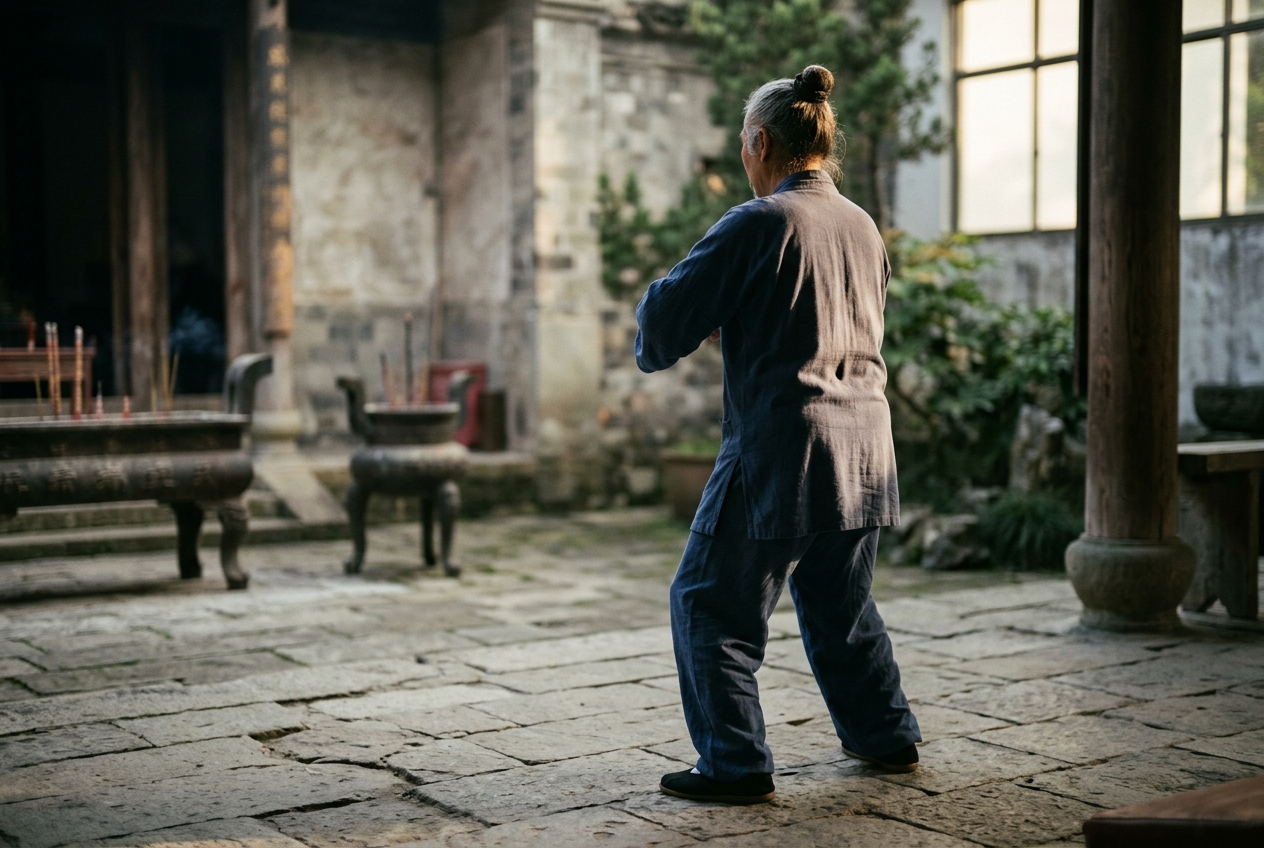
Within the framework of classical Neigong (internal skill) and Daoyin somatic cultivation, Yaoyangguan is far more than an isolated acupoint; it is the central kinetic pivot of the posterior torso. The lower back is naturally susceptible to compressive collapse. Bipedal human locomotion, compounded by modern sedentary sitting postures, habitually loads the lumbar vertebrae into a pattern of anterior pelvic tilt and facet joint impingement. When an internal martial artist or meditator performs the discipline of Song Yao, the objective is not to force the spine into a slouched, kyphotic bend, but to achieve a state of dynamic axial decompression.
By gently sinking the inguinal folds (Kua) and releasing the sacrococcygeal complex downward, the interspinous space at L4–L5 expands. This micro-separation unloads the posterior margins of the intervertebral disc, relieves compressive stress on the supraspinous and interspinous ligaments, and discharges chronic baseline spasm across the deep paraspinal musculature—chiefly the erector spinae (iliocostalis, longissimus, spinalis), the deep multifidi, and the lateral stabilizing sheets of the quadratus lumborum. By eliminating this structural pinch, Yaoyangguan transforms from a jammed gate into an open gateway, establishing a free conduit for Ground Reaction Forces (GRF) and bioelectric conduction to surge upward along the spinal axis.
       [ L3 Vertebra ]
              |
       [ L4 Vertebra ]
        ---\____/---   <-- Yaoyangguan (Du 3 / L4-L5 Interspinous Gap)
       [ L5 Vertebra ]
              |
       [ Sacral Base ]
Step-by-Step Postural Calibration Protocol: Zhan Zhuang Meditation
To awaken and decompress Yaoyangguan, somatic practitioners utilize Zhan Zhuang (站樁, "Standing Like a Stake"), an ancient upright standing meditation foundational to Chinese internal martial arts. Follow this progressive, step-by-step calibration to physically decompress the L4–L5 junction at home without teacher intervention.
1. Grounding the Base and Foot Stance
- Stand on a flat surface with your bare feet or thin-soled shoes parallel, placed exactly shoulder-width apart, measured from the outer contours of your deltoids to the outer edges of your feet.
- Distribute your body weight evenly across the "tripod" of each foot: the base of the first metatarsal (ball of the big toe), the base of the fifth metatarsal (ball of the little toe), and the calcaneus (heel center).
- Soften the soles of your feet to activate Yongquan (Kidney 1, "Bubbling Spring"), located in the central depression behind the balls of the toes. Ensure your toes remain relaxed, slightly clinging to the floor like the roots of a tree without curling or gripping spasmodically.
2. Sinking the Kua (The Inguinal Fold)
- Without bending forward at the waist, bend your knees slightly (approximately 15 to 20 degrees). The knees must track precisely in the vertical plane over the second and third toes; under no circumstances should the knees collapse inward (valgus) or flare excessively outward.
- "Sink the Kua" (Chen Kua): Imagine your hips are gently perching onto the edge of a tall barstool. This is not a squat; it is an inward yielding of the crease where the thighs meet the pelvis. The psoas major and iliacus muscles lengthen and release their forward grip on the lumbar spine.
3. Pelvic Suspension and Opening Yaoyangguan
- Align the crown of your head (Baihui, Du 20) as if suspended upward by an invisible silk thread, lengthening the cervical spine and gently tucking the chin.
- Allow your tailbone (Weilu) and sacrum to sink straight down under the pull of gravity.
- Initiate a subtle, micro-rotation of the pelvis: draw the pubic bone slightly upward toward the navel while letting the coccyx sink downward and forward.
- Monitor your lower back with your awareness: do not forcefully thrust the hips forward into a flat, rigid clench. Instead, feel the lumbar vertebrae gently unstack, filling out the inward arch until the lower back feels wide, flattened, and buoyant. This mechanical unlocking opens the Yaoyangguan gate.
4. Arm Carriage and Torso Integration
- Raise both arms in front of your chest at mid-sternum height in a generous circle, as if embracing the trunk of a broad cedar tree (Cheng Bao Zhuang).
- Keep the elbows slightly lower than the shoulders and dropped downward (Chen Jian Zhui Zhou).
- Allow the chest to hollow softly without caving inward (Han Xiong), enabling the shoulder blades (scapulae) to spread laterally and broaden across the upper back (Ba Bei). This upper-body expansion coordinates with the opening of the lower back, wrapping the entire torso in continuous elastic tension.
5. Breath Coordination and Lower Dantian Hydraulics
- Inhale slowly and silently through the nose for a count of four to five seconds. Direct the breath down to the lower abdomen (Dantian), located roughly two to three finger-widths below the navel and deep inside the pelvic basin.
- Feel the lower belly, the flanks, and the lumbar back expand simultaneously in a full 360-degree cylindrical expansion. As the breath expands into the back, visualize it pressing directly against the inner face of Yaoyangguan, gently widening the L4–L5 intervertebral space from the inside out.
- Exhale smoothly through the nose, maintaining the structural fullness and length of the spine without letting the lumbar vertebrae collapse back into a compressed arch.
       [Baihui (Du 20) Suspended Upward]
                       ^
                       |
               (Spinal Lengthening)
                       |
     <--- [Han Xiong Ba Bei: Broad Back] --->
                       |
        [Yaoyangguan (Du 3): Decompressed L4-L5]
                       |
          (Pelvis Drops as Plumb Line)
                       v
         [Weilu (Coccyx) Sinks to Earth]
                       |
        [Yongquan (K-1) Rooted in Ground]
Common Beginner Mistakes and Precise Corrections
| Beginner Error | Biomechanical Consequence | Somatic Correction |
|---|---|---|
| Sacral Collapse / Glute Clenching | Forcing an aggressive posterior pelvic tilt by squeezing the gluteus maximus, which jams the sacroiliac joint and flattens the thoracic spine unnaturally. | Release gluteal tension entirely. Allow the sacrum to drop via gravitational weight rather than muscular tucking. The sensation should feel like hanging, not clenching. |
| Knee Valgus (Inward Collapse) | Knees buckle inward toward the midline, destroying the lateral stability of the hip and twisting the meniscus. | Maintain "roundness in the crotch" (Yuan Dang). Press the lateral arches of the feet slightly down and engage the hip abductors so knees track directly above the second toe. |
| Hollow-Back Arching | Reverting to habitual hyper-lordosis; sticking the buttocks backward, which pinches the L4–L5 facet joints and compresses Yaoyangguan. | Soften the inguinal creases (Kua) deeper; drop the tailbone vertically toward the heels until the lower-back hollow flattens out smoothly. |
| Chest Breathing & Elevation | Inhaling into the apical upper lobes of the lungs, elevating the rib cage, and hyper-activating sympathetic scalene/trapezius tone. | Rest the tongue against the hard palate; exhale fully to drop the sternum. Direct all pressure downward into the pelvic floor and lower lumbar region. |
Palpable Sensations and Somatic Benchmarks
As you sustain this alignment for 10 to 20 minutes, several distinct physiological sensations will emerge: - Heaviness and Rooting (Chen): An unmistakable feeling that your legs have become dense, weighted pillars, rooted several feet beneath the ground. - Belt of Deep Lumbar Warmth (Wen Re): A spreading sensation of gentle, radiant heat traversing the lower back between Yaoyangguan and Mingmen (Du 4). This reflects vasodilation of microvascular capillary beds and paraspinal myofascial release. - Tingling and Bioelectric Pulsation (Zhen Gan): A subtle, bubbling, or electric vibration ascending the vertebral column toward the crown. In classical theory, this is the activation of the Du Mai channel; physiologically, it represents the release of chronic peripheral nerve compression and altered mechanoreceptive signaling. - Myofascial Spontaneous Unwinding (Song Dong): Subtle, involuntary micro-tremors in the deep stabilizer muscles of the hips and spine as chronic compensatory holding patterns let go.
Biomechanics and Fascial Science: The Anatomical Engine
The somatic efficacy of opening Yaoyangguan is directly grounded in modern musculoskeletal science, fascial tensegrity, and neurophysiology. When investigated through contemporary research available through the National Center for Biotechnology Information, the decompressive opening of the L4–L5 spinal segment interfaces with three primary physiological systems: myofascial tensegrity networks, kinetic ground reaction force propagation, and autonomic nervous system regulation.
1. The Thoracolumbar Fascia and Tensegrity Hydraulics
The posterior lumbar spine is wrapped in the Thoracolumbar fascia (TLF), an intricate, multi-layered retinacular structure that anchors the latissimus dorsi, gluteus maximus, transversus abdominis, and internal obliques. The posterior layer of the TLF attaches directly to the lumbar spinous processes and supraspinous ligaments, encapsulating Yaoyangguan within its retinacular architecture.
In hyper-lordotic posture, the posterior layer of the TLF is held in chronic passive slackness while the deep paraspinal tissues are chronically shortened and hypertonic. When the practitioner executes Song Yao by sinking the Kua and lengthening the sacrum, the TLF is placed under optimal longitudinal and transverse pretension. According to biotensegrity models, the human spine functions not as a static stack of weight-bearing bricks, but as a continuous-tension, discontinuous-compression structure. By decompressing the L4–L5 junction, tensile load is redistributed across the broader fascial matrix. This unloads the vertebral bodies, expands the intervertebral foramina, and frees the lumbar nerve roots from chronic mechanical irritation.
       [Latissimus Dorsi] <=============> [Gluteus Maximus]
                    \                     /
                     \   [ Posterior ]   /
                      -->[   Layer   ]<--
                         [  of TLF   ]
                              |
                    [Yaoyangguan (L4-L5)]
                              |
       [Transversus Abdominis] <=======> [Internal Obliques]
                   (Intra-Abdominal Pressure Hydraulic)
Furthermore, the simultaneous engagement of diaphragmatic breathing and lower abdominal expansion creates balanced Intra-Abdominal Pressure (IAP). As documented in biomechanical literature on spinal stabilization in PubMed Central, coordinated contraction of the respiratory diaphragm, pelvic floor, and transversus abdominis generates a hydraulic fluid ball within the abdominal cylinder. This hydraulic pressure pushes anteriorly against the abdominal wall and posteriorly against the anterior longitudinal ligament of the lumbar spine, pneumatically stabilizing the lumbar vertebrae from within without requiring compressive over-activation of the paraspinal musculature.
2. Kinetic Ground Reaction Force (GRF) Transmission
In the internal martial arts of Taijiquan and Xingyiquan, power is generated from the feet, directed through the waist, and expressed through the extremities (Fa Jin). If the lumbar spine is locked in hyper-lordosis, the L4–L5 and L5–S1 segments act as an energy sink—a structural kink in the kinetic chain. When ground reaction forces travel upward from the feet through the tibia, femur, and acetabulum into the pelvis, a jammed lumbar lordosis converts those vertical forces into destructive shear stress across the intervertebral discs and facet joints.
Kinetic Chain with Open Yaoyangguan:
[Ground Reaction Force]
   --> [Yongquan (K1)]
   --> [Tibia / Femur]
   --> [Sunk Kua / Pelvis]
   --> [Open Yaoyangguan (L4-L5 Decompressed)]
   --> [Spinal Tensegrity Column]
   --> [Upper Extremities / Baihui]
By flattening the lumbar arch and opening Yaoyangguan, the sacrum, lumbar, thoracic, and cervical curves transition from exaggerated sinusoidal bends into a lengthened, shock-absorbing dynamic spring. The force generated at the earth-foot interface passes unimpeded through the sacroiliac joint, traverses the L4–L5 gateway, and propagates directly up the vertebral column into the scapulae and arms with zero energy dissipation.
3. Autonomic Modulation and Neurofascial Signaling
The thoracolumbar fascia is densely innervated with sensory nerve endings, including high concentrations of Type III and Type IV mechanoreceptors, Ruffini corpuscles, and Pacinian corpuscles. Research highlighted by the National Library of Medicine reveals that sustained, gentle fascial stretching and slow diaphragmatic respiration stimulate these mechanoreceptors, which down-regulate sympathetic nervous system activity and induce broad systemic vagal tone.
The compression of L4–L5 in chronic postural lordosis maintains a state of perpetual low-grade sympathetic arousal by hyper-stimulating paraspinal nociceptive pathways and impeding venous and lymphatic return through the internal vertebral venous plexuses. Decompressing Yaoyangguan relieves this neural excitation, lowers resting heart rate, increases Heart Rate Variability (HRV), and shifts the central nervous system into a restorative parasympathetic state essential for internal cellular repair and energetic cultivation.
Classical Lineage and Energetic Anatomy
The technical mechanics of opening the lumbar gate are steeped in over two millennia of classical Chinese medical, Daoist, and internal martial arts literature. Within Daoist internal alchemy (Neidan), the human body is understood as an energetic landscape containing specific energetic blockages or barriers known as the Three Passes (San Guan, 三關) along the posterior Governing Vessel (Du Mai): 1. Weiluguan (尾閭關): The Tailbone Pass at the coccyx. 2. Jiajibang (夾脊關): The Spinal/Dorsal Pass between the shoulder blades, opposite the heart. 3. Yuzhenguan (玉枕關): The Jade Pillow Pass at the occiput and base of the skull.
                 [Baihui (Du 20) / Upper Dantian]
                               |
                   [Yuzhenguan: Jade Pillow] (Upper Pass)
                               |
                   [Jiaji: Spinal Center] (Middle Pass)
                               |
                   [Mingmen (Du 4) / Middle Dantian]
                               |
  ---> [Yaoyangguan (Du 3) / Lumbar Yang Gate: Primary Regulatory Gate] <---
                               |
                   [Weiluguan: Tailbone] (Lower Pass)
                               |
                   [Huiyin (Ren 1) / Pelvic Floor]
While Weiluguan constitutes the lower base of the energetic ascension, Yaoyangguan (Du 3) functions as the critical functional gatekeeper regulating the movement of Yang Qi from the lower reservoir to Mingmen (命門, Du 4, "The Gate of Vitality") and the kidneys. The name Yaoyangguan itself holds deep taxonomic significance: Yao (腰) means the lumbar region; Yang (陽) represents active, warming, ascending bio-metabolic energy; and Guan (關) denotes a strategic frontier checkpoint or fortified pass.
In the seminal foundation text of Chinese medicine, the Huangdi Neijing (黃帝內經, The Yellow Emperor's Classic of Internal Medicine, c. 1st century BCE), the Suwen and Lingshu treatises emphasize that the waist is the "Mansion of the Kidneys" (Yao zhe Shen zhi fu). If the waist is stiff, immobile, or collapsed, the kidney essence (Jing) cannot be transformed into dynamic functional Qi, leading to premature physical decay, coldness in the lower extremities, and lumbar vulnerability.
Later, in the 3rd century CE, the master physician Huangfu Mi composed the Zhenjiu Jiayi Jing (針灸甲乙經, The Systematic Classic of Acupuncture and Moxibustion), the earliest extant comprehensive manual of acupuncture points. Huangfu Mi systematically documented Yaoyangguan under the Du Mai, establishing its direct energetic sovereignty over disorders of lower-burner Yang deficiency, impotence, lower back pain with inability to bend or rotate, and cold pathogenic stagnation in the lower abdomen and joints.
In the lineage of Daoist Daoyin and the martial evolutions of Taijiquan (as codified in the Taijiquan Classics attributed to Wang Zongyue and Chang San-feng), this energetic theory became an operational physical requirement. The classics declare:
"The source of dynamic motion lies in the waist... If the waist cannot be loosened (Song), the Qi will not sink to the Dantian, the legs will be unstable, and the whole body will be clumsy and disordered."
When an adept maintains hyper-lordosis, the energetic current rising from Changqiang (Du 1) and Weilu hits a literal dead end at the compressed L4–L5 vertebrae. The Yang Qi pools and stagnates in the lower sacrum or leaks out through the lower extremities, causing coldness in the knees and feet, adrenal fatigue, and mental agitation. By actively sinking the Kua and opening Yaoyangguan, the energetic lock is released. The Yang Qi surges smoothly through the lower lumbar gate into Mingmen, igniting the true metabolic and alchemical fire that warms the entire physical organism and clears the pathway toward spiritual clarity.
Modern instructional organizations such as the National Qigong Association preserve these classical lineages, educating contemporary practitioners on how these structural adjustments form the irreplaceable baseline for authentic internal cultivation across all major Qigong schools, from Shaolin Yijinjing to Wudang Neidan.
Daily Practice Protocol
To integrate the opening of Yaoyangguan into your daily routine and reverse chronic postural compression, commit to the following structured, ten-minute practice protocol every morning before your first cup of coffee or seated workday.
The 10-Minute Morning Lumbar Awakening Sequence
+-------------------------------------------------------------------------------+
|                      DAILY 10-MINUTE CALIBRATION ROUTINE                      |
+-------------------------------------------------------------------------------+
|  Phase 1: Mobilization (0:00 - 2:00)                                          |
|  * Stand with feet shoulder-width, knees soft.                                |
|  * Execute slow, continuous Pelvic Clocks (gentle micro-rotations of the      |
|    pelvis around the vertical plumb line) to lubricate the L4-L5 disc.        |
|  * Inhale as the pelvis circles back; exhale as the sacrum drops downward.    |
+-------------------------------------------------------------------------------+
|  Phase 2: Postural Setting & Kua Sinking (2:00 - 4:00)                        |
|  * Set foot tripod on the ground; soften the soles (*Yongquan*).              |
|  * Sink the *Kua* by perching lightly backward onto the imaginary high stool.|
|  * Suspend *Baihui* (crown) toward the sky; drop the tailbone vertically.     |
|  * Place thumbs at L4-L5 to verify that the lumbar hollow has flattened.      |
+-------------------------------------------------------------------------------+
|  Phase 3: Zhan Zhuang Standing Immersion (4:00 - 9:00)                        |
|  * Raise arms into *Cheng Bao Zhuang* (Embracing the Tree).                   |
|  * Engage 360-degree Lower *Dantian* abdominal breathing.                     |
|  * With every inhalation, expand the breath into *Yaoyangguan*.               |
|  * With every exhalation, sink deeper into the ground while keeping the       |
|    crown suspended. Maintain static, effortless stillness.                    |
+-------------------------------------------------------------------------------+
|  Phase 4: Closure and Grounding (9:00 - 10:00)                                |
|  * Slowly lower your hands over your lower abdomen (palms overlapping).       |
|  * Straighten your knees smoothly without locking the joints.                 |
|  * Take three deep breaths, sealing the warmth and pressure in the Dantian.   |
|  * Step out lightly and walk for 30 seconds to integrate the new alignment.  |
+-------------------------------------------------------------------------------+
By dedicating just ten minutes each morning to decompressing the L4–L5 junction at Yaoyangguan, you will eliminate the primary kinetic bottleneck of the lower back, fortify the lumbar spine against degenerative disc strain, balance your autonomic nervous system, and establish an open energetic highway that fuels your body with resilient vitality throughout the day.