Taiyang Cavity Supreme Yang: Temporal Fascial Decompression, Sphenomandibular Tensegrity, and Cranial Neurovascular Modulation in Classical Neigong
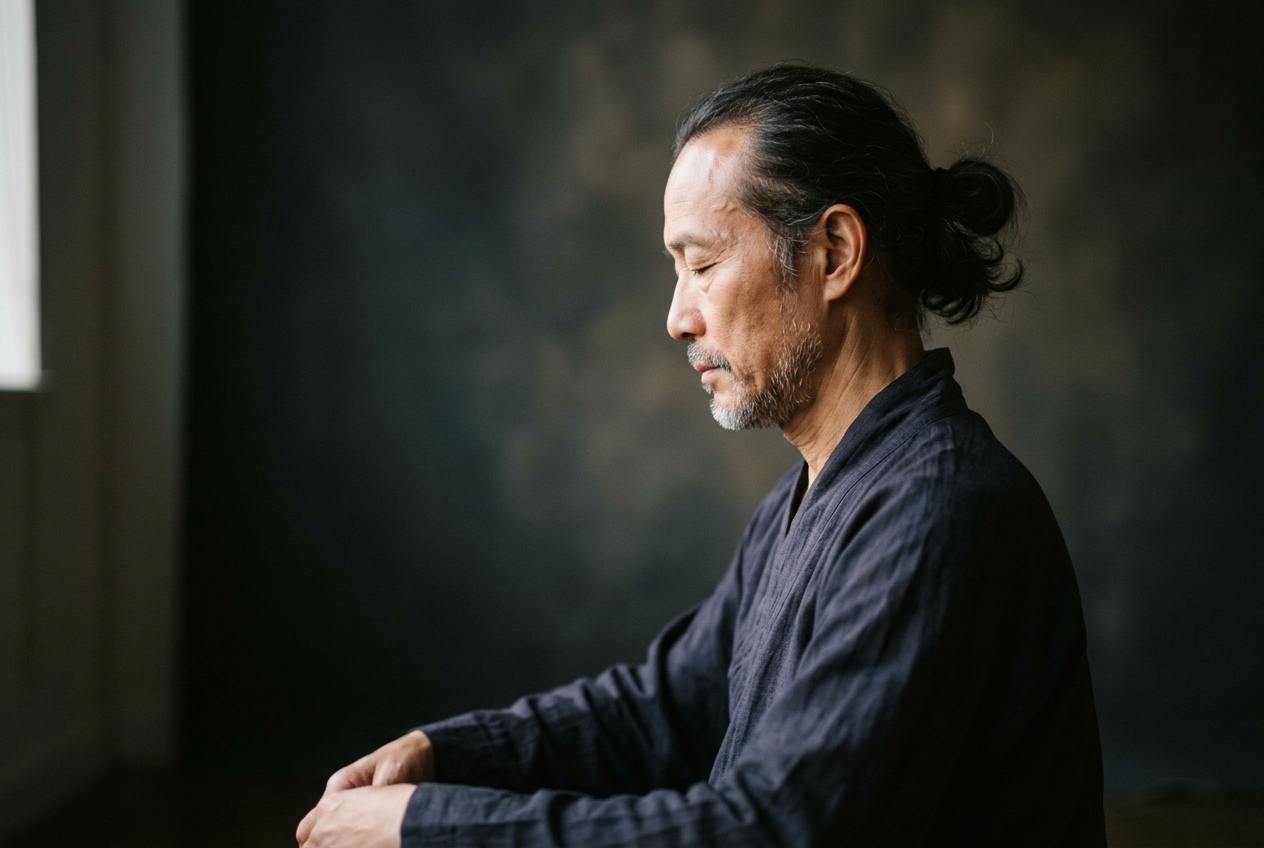
When mental stress, visual fixation, or emotional frustration arises, the body reflexively clenches the jaw, constricts the superficial temporal blood vessels, and tightens the fibrous sheets spanning the sides of the head. In traditional Chinese medical theory, this pattern manifests as an ascending surge of hyperactive Liver Yang (Ganyang shangkan, 肝陽上亢), which generates tension headaches, visual strain, dizziness, and cognitive agitation. By combining physical postural alignment, mindful jaw softening (Song He, 鬆頜), and focused mental intention (Yi, 意), the practitioner releases this temporal constriction. This somatic opening relieves tension across the cranial membrane system, calms the autonomic nervous system, and restores smooth microcirculation throughout the eyes and brain.
Step-by-Step Practice Guide: Locating, Decompressing, and Entraining EX-HN5
The following protocol integrates classical Daoist standing meditation (Zhan Zhuang) and seated alchemical cultivation. It is structured to systematically locate the Taiyang cavity, release the surrounding myofascial structures, and bioenergetically balance the cranial vault.
       [VERTEX / BAIHUI (DU-20)]
                 |
      (Suspension of the Crown)
                 |
       +---------+---------+
       |                   |
 [TAIYANG (EX-HN5)]   [TAIYANG (EX-HN5)]
 (Sphenosquamosal)    (Sphenosquamosal)
       |                   |
       +---------+---------+
                 |
         [SONG HE / JAW]
   (Temporomandibular Drop)
                 |
         [SONG KUA / HIP]
   (Pelvic Inguinal Sinking)
                 |
      [YONGQUAN (KIDNEY-1)]
     (Bubbling Well / Earth)
Phase 1: Postural Foundation and Structural Setting
- Choose Your Base: - Standing (Zhan Zhuang): Position your feet parallel and shoulder-width apart. Unlock your knees, sink your tailbone as if resting on the edge of a tall stool, and gently fold your inguinal creases (Song Kua, 鬆胯). Suspend the crown of your head from above (Baihui, DU-20) while maintaining a relaxed, lengthened cervical spine. - Seated Cultivation: Sit upright on the forward third of a firm cushion or chair with feet flat on the floor. Maintain a neutral pelvis, allowing your spine to rise naturally like a stack of golden coins without lumbar hyperextension.
- The Oral-Mandibular Seal (Song He): - Release the masseter and temporalis muscles by allowing your lower jaw to drop downward and slightly backward, creating roughly two to three millimeters of clearance between your upper and lower molars. - Rest the tip of your tongue against the upper alveolar ridge behind your incisors—the classical "Magpie Bridge" (Queqiao, 鵲橋)—forming an energetic circuit between the Du (Governing) and Ren (Conception) vessels while preventing swallowing spasms.
Phase 2: Topographical Landmarking of EX-HN5
- Locate the lateral canthus (outer corner) of each eye and the lateral extremity of each eyebrow.
- Trace your fingertips into the soft depression situated approximately one finger-breadth posterior to the midpoint between these two landmarks, within the temporal fossa.
- Gently palpate this tender, concave hollow. You will feel the fibrous edge of the temporalis muscle and a subtle arterial pulse from the anterior branch of the superficial temporal artery.
Phase 3: Bilateral Energetic Entrainment via Laogong (PC-8)
- Raise your arms smoothly, elevating your hands to temple level while keeping your shoulders dropped, axillae (armpits) hollowed as if holding small eggs, and elbows heavy.
- Hover the centers of your palms—the Laogong (PC-8, 勞宮) cavities—approximately two to three inches away from your bilateral Taiyang points, orienting the palms inward without making physical contact.
- Establish a steady, conscious focal loop: inhale into your lower abdomen (Xia Dantian), drawing breath deep into the pelvic basin; exhale and project gentle mental awareness (Yi) from the centers of your palms into the temporal cavities.
- Visualize the temporal hollows expanding horizontally outward, melting like warm honey, softening the suture lines beneath the skin.
Phase 4: Intentional Breath and Hydraulic Sinking
- Inhalation: Draw the breath in through your nose in a slow, silent wave. Feel the breath sink downward toward the lower abdomen, expanding the lumbar region (Mingmen, GV-4) without elevating the chest or tensing the clavicles.
- Exhalation: Release the breath smoothly. Simultaneously intend the tension trapped in the pterion and temporal fossa to descend through the neck, passing down the chest and spine, draining through the soles of your feet into the earth via the Yongquan (Kidney-1, 湧泉) points.
- Continue this cycle for twelve to twenty-four full, rhythmic breaths.
Common Somatic Errors and Clinical Corrections
| Somatic Malalignment | Physiological & Bioenergetic Consequence | Immediate Clinical Correction |
|---|---|---|
| Masseter and Pterygoid Clenching | Compresses the temporomandibular joint, pulling the sphenoid bone into torsion and locking the temporalis fascia. | Intentionally create space between upper and lower molars; soften the base of the tongue and let the chin draw slightly inward. |
| Cranial Over-Pressurization (Shang Qi) | Traps microvascular blood volume and energetic pressure in the vertex, causing throbbing temples, hypertension, and dizziness. | Shift conscious focus entirely away from the head down to the lower abdomen (Xia Dantian) and the soles of the feet (Yongquan). |
| Hyper-Convergent Ocular Straining | Tightens the extraocular rectus muscles and stimulates the ophthalmic division of the trigeminal nerve. | Unfocus the gaze; maintain a soft panoramic visual field (Ping Shen) through half-closed eyelids angled downward at 45 degrees. |
| Elevation of Scapulae / Clavicular Breathing | Traps tension in the upper trapezius and levator scapulae, impeding venous return through the internal jugular veins. | Drop the elbows, hollow the armpits, and ensure the breath moves the lower lateral ribs and pelvic floor rather than the upper chest. |
Perceptual Markers and Energetic Sensations
During successful decompression of the Taiyang cavity, practitioners commonly experience a sequence of distinct somatic feedback markers:
- Subtle Thermal Expansion (Warmth / Wen Re): A gentle, spreading warmth radiating across the lateral skull, indicating vasodilatation of the superficial temporal and middle meningeal arterial trees through reduced sympathetic vasospasm.
- Microvascular Tingling (Ma Gan): A fine, effervescent sensation across the scalp and lateral forehead, reflecting neural unburdening of the auriculotemporal and zygomaticotemporal nerves.
- Cranial De-densification (Spaciousness / Kong Ling): The distinct subjective sensation that the temporal bones are widening outward, alleviating the sensation of wearing a tight metallic band around the brow.
- Sub-occipital and Ophthalmic Release: Spontaneous moistening of the eyes, clear visual focus upon opening the eyelids, and a reflexive softening of the suboccipital musculature at the base of the skull (Fengchi, GB-20).
Neurovascular Physiology and Cranial Tensegrity
To understand why the conscious release of the Taiyang cavity yields profound systemic equilibrium, we must examine the intricate relationship between cranial osteology, myofascial tensegrity, and neurovascular pathways documented in biomedical literature indexed on PubMed.
       +-------------------------------------------------+
       |           TEMPORALIS FASCIA & MYOFASCIA         |
       +-----------------------+-------------------------+
                               |
                               v
       +-------------------------------------------------+
       |    PTERION JUNCTION (Frontal/Parietal/Sphenoid) |
       +-----------------------+-------------------------+
                               |
                               v
       +-------------------------------------------------+
       |  DURAL RECIPROCAL TENSION (Falx & Tentorium)    |
       +-----------------------+-------------------------+
                               |
                               v
       +-------------------------------------------------+
       |  TRIGEMINOVASCULAR NETWORK & AUTONOMIC CALM    |
       +-------------------------------------------------+
Tensegrity Mechanics at the Pterion and Sphenosquamosal Suture
Directly deep to the Taiyang point lies one of the most critical structural cross-roads of the human skull: the pterion, an H-shaped sutural confluence uniting the greater wing of the sphenoid, the squamous temporal bone, the frontal bone, and the parietal bone. The dense temporalis muscle originates across the temporal fossa and the overlying temporalis fascia, inserting onto the coronoid process of the mandible.
When a practitioner clenches their jaw or fixes their attention under psychological stress, the temporalis muscle exerts continuous isometric tension against the sphenosquamosal and coronal sutures. Because the sphenoid bone articulates with the occiput at the sphenobasilar synchondrosis (SBS)—the primary hydraulic pivot for craniosacral fluid dynamics—mechanical distortion at the pterion transmits shear stress through the reciprocal tension membrane system of the dura mater. This cranial dural system, comprising the falx cerebri and tentorium cerebelli, stiffens under chronic tension, restricting cerebral venous outflow, impinging microcirculation, and perpetuating a feedback loop of central nervous system excitation. Decompressing the Taiyang cavity releases the temporalis fascia, unbinding the sphenosquamosal junction and relieving dural strain throughout the intracranial vault.
       +--------------------+      +--------------------+
       |  SPHENOID BONE     |<---->|   TEMPORAL BONE    |
       |  (Greater Wing)    |      |  (Squamous Part)   |
       +---------+----------+      +----------+---------+
                 \                            /
                  \   SPHENOSQUAMOSAL        /
                   \     JUNCTION           /
                    +----------+-----------+
                               |
                               v
                    [TAIYANG CAVITY (EX-HN5)]
                               |
                               v
             [RECIPROCAL DURAL TENSION RELEASE]
             (Falx Cerebri & Tentorium Cerebelli)
Trigeminovascular Modulation and Ophthalmic Perfusion
The temporal region is densely innervated by peripheral branches of the trigeminal nerve (CN V)—specifically the zygomaticotemporal nerve (from the maxillary division, V2), the ophthalmic division (V1) via collateral pathways, and the auriculotemporal nerve (from the mandibular division, V3). Hyper-reactivity within this trigeminovascular complex triggers the local release of pro-inflammatory neuropeptides, such as Calcitonin Gene-Related Peptide (CGRP) and Substance P, precipitating neurogenic inflammation, perivascular edema, and the pulsatile cranial pain characteristic of vascular headaches.
Simultaneously, the ophthalmic artery—a primary branch of the internal carotid artery—supplies the central retinal artery and ciliary vessels. Vasospasm driven by elevated sympathetic tone diminishes capillary perfusion to the retina and optic nerve. By intentionally releasing the muscular tone around the Taiyang cavity and engaging parasympathetic tone through elongated exhalations, the practitioner suppresses trigeminovascular sensitization and stimulates endothelial nitric oxide (eNOS) production. This enhances ophthalmic microvascular perfusion, sharpens visual acuity, and soothes orbital pressure.
Autonomic Regulation and the Shaoyang Confluence
In classical channel theory, the temporal region represents the primary bioenergetic confluence of the Shaoyang (Lesser Yang) pivot, which encompasses the Hand Shaoyang Triple Burner (San Jiao, 手少陽三焦經) and Foot Shaoyang Gallbladder (Dan, 足少陽膽經) meridians. The Shaoyang network acts as an energetic hinge, regulating the transition between the body's exterior defensive systems and interior metabolic viscera.
When excessive emotional stress or intellectual strain agitates the Liver system, internal Wind and Fire rise unhindered along the Gallbladder pathway, pooling around the temporal fossa and vertex. Clinical frameworks recognized by the World Health Organization (WHO) highlight how targeting extra points such as Taiyang regulates local vascular dysfunction. Within Neigong, decompressing Taiyang functions as a hydraulic pressure-relief valve for the entire neuro-energetic framework: it anchors ascending Liver Yang, clears stagnant heat from the sensory orifices, and restores balanced parasympathetic tone via the vagus nerve and superior cervical ganglion plexus.
Classical Lineages and the Daoist Neigong Tradition
The strategic cultivation of the Taiyang cavity has occupied an essential role in classical Daoist self-cultivation for over a millennium. While the foundational meridian networks were codified in the seminal Han Dynasty medical text, the Huangdi Neijing (Yellow Emperor's Inner Classic), specialized extra points like Taiyang were refined by Daoist hermits, physicians, and martial adepts seeking to optimize somatic functioning during long periods of seated meditation (Jingzuo, 靜坐).
In the medieval formulations of the Shangqing (Highest Clarity, 上清) and later Quanzhen Longmen (Complete Reality Dragon Gate, 全真龍門派) traditions, the head was venerated as the "Palace of the Muddy Pellet" (Niwandong, 泥丸宮)—the upper alchemical vessel where Qi (vital breath) is transmuted into Shen (pure consciousness). Masters such as the Tang Dynasty physician-adept Sun Simiao (孫思邈) documented in his Beiji Qianjin Yaofang (Essential Formulas Worth a Thousand Pieces of Gold) that stagnant heat trapped within the lateral cranial gates obscured the "Inner Light" of the Shen, precipitating mental confusion, dream-disturbed sleep, and spiritual agitation.
       +-------------------------------------------------+
       |           SHANGQING & QUANZHEN LINEAGES         |
       |  (Transformation of Qi to Shen in Niwandong)    |
       +-----------------------+-------------------------+
                               |
                               v
       +-------------------------------------------------+
       |       INTERNAL MARTIAL ARTS (Neijia Quan)       |
       |     Taijiquan  *  Baguazhang  *  Xingyiquan     |
       +-----------------------+-------------------------+
                               |
                               v
       +-------------------------------------------------+
       |         UNIFIED SOMATIC STATE: "XU LING"        |
       |  (Empty, Nimble Crown with Grounded Foundation) |
       +-------------------------------------------------+
In the internal martial arts (Neijia Quan, 內家拳)—most notably Taijiquan, Baguazhang, and Xingyiquan—decompressing the temples was considered mandatory for preserving tactical clarity under physical duress. Martial classics warn against the perilous error of "rising fire" (Shang Huo), wherein an athlete clenches their jaw, fixes their gaze, and inadvertently traps kinetic tension in their temples. This structural fault stiffens the neck, slows reflexes, and renders the practitioner vulnerable to destabilization. By cultivating Xu Ling Ding Jin (虛靈頂勁, "suspending the crown with empty, nimble lightness") alongside conscious Taiyang decompression, the martial artist anchors their center of gravity into the pelvic basin while maintaining relaxed, panoramic visual awareness. The modern National Qigong Association continues to preserve these precise lineage teachings, validating how conscious somatic de-densification fosters profound physical and psychological resilience.
Today’s Practice Commitment: The Seven-Minute Reset
To bridge theoretical comprehension into felt somatic transformation, dedicate seven minutes today—either during a mid-afternoon cognitive slump or immediately before retiring to sleep—to execute this focused sequence:
- Minute 0:00 – 1:30 | Establishing the Structural Root: Sit or stand in quiet alignment. Drop the shoulders, suspend the crown (Baihui), unlock your hips (Song Kua), and soften your jaw (Song He), ensuring your molars do not make contact.
- Minute 1:30 – 3:30 | Direct Palpation and Myofascial Softening: Place the pads of your middle fingers lightly onto the Taiyang cavities. Perform nine slow, micro-rotations in an outward-and-backward trajectory, visualizing the dense fibers of the temporalis fascia melting like warm wax under gentle pressure.
- Minute 3:30 – 5:30 | Palm Hovering and Bioenergetic Entrainment: Withdraw your fingertips and hover the Laogong centers of your palms two inches away from your temples. Coordinate six deep, silent abdominal breaths: inhale into your lower belly; exhale and project cool, soothing intention (Yi) through the temporal fossa.
- Minute 5:30 – 7:00 | Sinking and Integration: Lower your hands to rest over your lower abdomen (left hand over right for women, right over left for men). Take three natural settling breaths, consciously draining all residual cranial pressure down into the earth through the soles of your feet.
Observe the immediate physiological shifts: the subtle moistening of your eyes, the release of tension along the back of your neck, and the calm, steady clarity returning to your mind.