Yifeng Cavity Wind Screen: Retroauricular Fascial Decompression, Mastoid-Mandibular Tensegrity, and Triple Burner Cranial Conduction in Classical Neigong
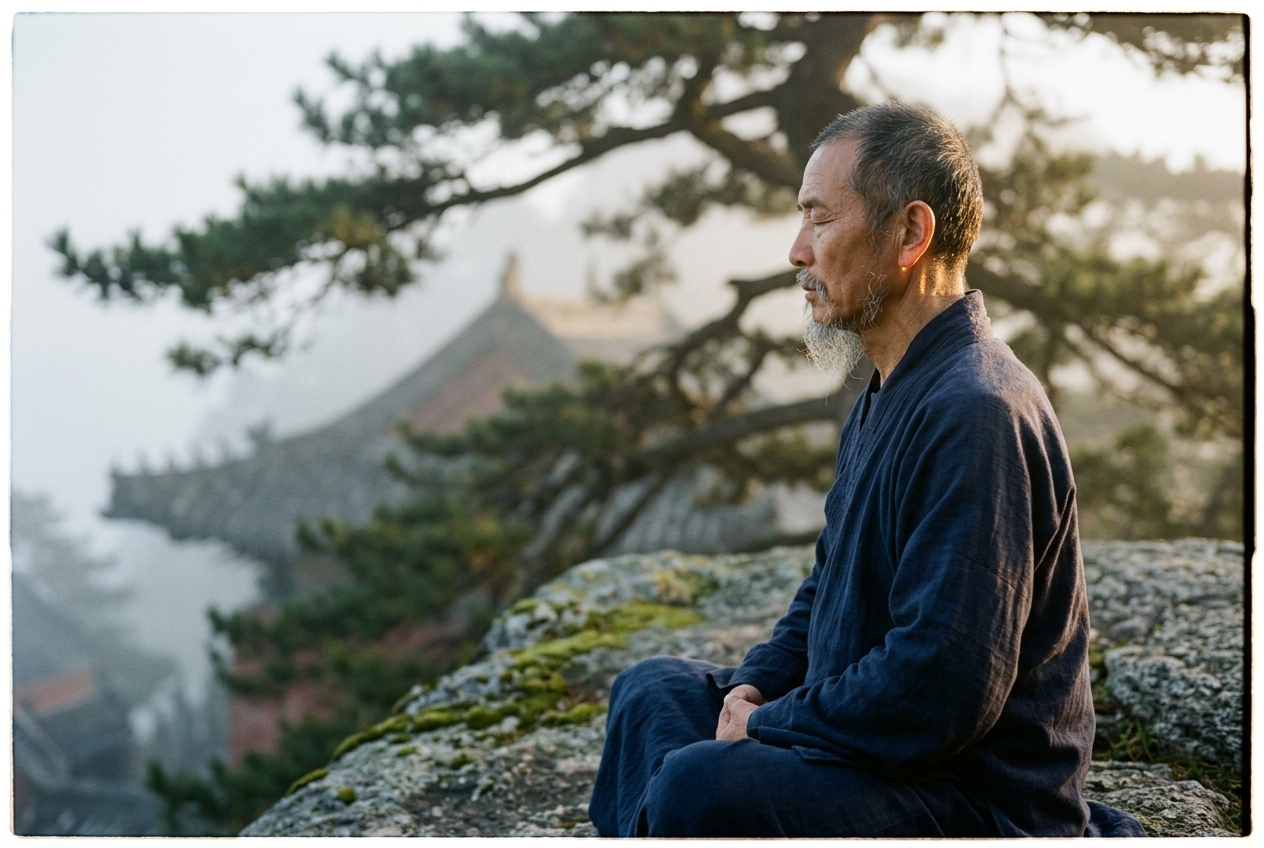
In plain terms, the practice involves aligning the spine and releasing the jaw so that the soft tissues around the ear canal, upper neck, and skull base can expand rather than remain compressed. When modern life forces our heads forward into computer monitors and mobile screens, the muscular and fascial tissues behind the jaw seize up. This creates a mechanical clamp over vital nerves and blood vessels that supply the inner ear, face, and brain.
By combining static standing postures (Zhan Zhuang), breath-coordinated movement (Daoyin), and gentle self-administered myofascial mobilization, we mechanically reopen this retroauricular space. In classical energetic terms, the Triple Burner—or San Jiao—governs the mobilization of metabolic fluids and primordial energy throughout the body's three burning chambers (chest, abdomen, and pelvis). Opening the Yifeng gate purges stagnant internal heat, dispels disruptive environmental "wind," and restores sensory clarity to the eyes, ears, and throat.
Step-by-Step Practice Guide
The cultivation of Yifeng integration encompasses two complementary modalities: an architectural standing posture to establish systemic tensegrity, followed by targeted seated Daoyin mobilization.
================================================================================
          SUMMARY SPECIFICATION: YIFENG (TB 17) SOMATIC PROTOCOL
================================================================================
Primary Point Location   : Retroauricular depression between mastoid process &
                           mandibular ramus, level with inferior earlobe margin.
Biomechanical Target     : Decompression of the stylomastoid foramen, investing
                           cervical fascia, and posterior digastric belly.
Neurological Correlate   : Facial Nerve (CN VII), Great Auricular Nerve (C2-C3).
Standing Core Dynamic    : Xu Ling Ding Jin (Suspended Crown) + Chin Retraction.
Seated Tactile Vector    : Anteromedial micro-traction (30-40% maximal load).
Primary Deqi Indicators : Warmth in tympanic cavity, eustachian depressurization.
================================================================================
Part I: Architectural Posture in Standing Meditation (Zhan Zhuang)
- Establish the Base: Stand with your feet parallel, spaced precisely shoulder-width apart, with your weight evenly distributed across the "nine points" of each foot (the heel, the ball beneath the big toe, the ball beneath the little toe, and the pads of all five toes). Unlock the knees without collapsing them inward, maintaining a subtle outward torque through the femurs to open the inguinal creases (Song Kua).
- Suspend the Vertex (Xu Ling Ding Jin): Imagine an unbroken silk thread attached to the uppermost vertex of your skull (Baihui, GV 20), drawing the crown upward toward the sky. Allow the sacrum to sink downward as if counterweighted, creating bi-directional axial elongation through the entire vertebral column.
- The Retroauricular Unfolding: Gently draw the point of the chin inward and slightly downward—not by flexing the neck, but by translating the entire cranium posterior-superiorly along the horizontal plane. This subtle movement, known in somatic disciplines as cervical axial retraction, immediately widens the suboccipital and retroauricular distance between the mastoid processes and the first cervical vertebra (atlas, C1).
- Mandibular Release: Deliberately relax the masseter and temporalis muscles. Let the lower jaw drop by 2 to 3 millimeters so that the upper and lower molars maintain no contact. Rest the tip of your tongue lightly against the hard palate just behind the upper incisors (the Magpie Bridge), establishing the classical anterior energetic circuit while slackening the suprahyoid musculature.
- Respiratory Coordination: Breathe exclusively through the nasal passages using diaphragmatic lower-abdominal respiration (Dantian breathing). On every inhalation, sense the pelvic floor relax downward and the lower abdomen gently swell in all directions. On every exhalation, observe a reciprocal wave of relaxation traveling up the spine, mentally directing the release of tension outward through the bilateral Yifeng cavities behind each ear. Maintain this posture for 10 to 15 minutes.
Part II: Seated Daoyin Mobilization and Myofascial Decompression
- Seated Posture: Sit upright on the anterior third of a firm chair with both feet flat on the floor and your spine self-supporting. Rest your elbows on a table or desk surface in front of you to eliminate shoulder and upper trapezius activation.
- Digital Engagement: Bring the soft fleshy pads of your middle fingers (supported from behind by the index fingers) into the bilateral Yifeng depressions directly behind the lobules of the ears.
- Phase One—Passive Ischemic Pressure: Without sliding across the skin, exert a gentle, steady force directed anteromedially (inward toward the center of the head and slightly forward toward the opposite eye). Use no more than 30% of your maximum strength. Hold this static engagement for 60 seconds while maintaining the jaw release.
- Phase Two—Kinetic Mobilization: While maintaining this sustained contact, slowly tilt your head backward by five degrees during an inhalation, feeling the hollow narrow slightly. Then, as you exhale slowly, nod the chin downward by ten degrees while opening the mouth wide, feeling the retroauricular space dramatically expand beneath your fingers. Repeat this synchronized movement for 9 smooth cycles.
- Phase Three—Micro-Circular Unwinding: Close the mouth gently. Perform 36 ultra-slow, microscopic circular rotations with your finger pads within the retroauricular fossa—18 clockwise, followed by 18 counter-clockwise—massaging the investing cervical fascia and the anterior margin of the sternocleidomastoid tendon.
Common Beginner Mistakes and Precise Corrections
- Mistake: Excessive Mechanical Force. Beginners often press aggressively into the hollow, attempting to dig beneath the skull base. This triggers a protective neuromuscular spasm of the posterior digastric and sternocleidomastoid muscles and risks bruising the underlying branches of the facial nerve. Correction: Reduce the pressure until it feels like resting the weight of a coin against the tissue. Decompression occurs through sustained duration and tissue softening, not blunt force.
- Mistake: Forward Head Creep. Allowing the chin to jut forward while massaging or standing collapses the retroauricular notch, physically pinching the stylomastoid outlet. Correction: Periodically touch the base of your skull to verify that the back of the neck feels long, flat, and buoyant, with the ears positioned vertically over the middle of the acromion processes of the shoulders.
- Mistake: Occlusal Clenching. Unconsciously clenching the jaw during meditation keeps the lateral pterygoid and temporomandibular joint in chronic spasm, neutralizing all therapeutic effects on the Yifeng cavity. Correction: Part the lips slightly and visualize your lower jaw as a heavy, waterlogged pendulum swinging freely beneath the skull.
Subjective Somatic Sensations (Deqi Phenomena)
When the Yifeng cavity is correctly engaged and decompressed, a distinct suite of physiological and bioenergetic signals emerges:
- Acoustic and Eustachian Clearance: A subtle clicking or popping sensation inside the middle ear cavity, immediately followed by an apparent widening of auditory acuity and a drop in baseline tinnitus or internal head noise.
- Thermal Radiation: A spreading sensation of gentle warmth that originates behind the earlobe and travels along two pathways: superiorly over the temporal bone toward the temples, and inferiorly down the lateral border of the neck.
- True Deqi (得氣): A profound, deeply seated dull ache (suan zhang, 酸脹) that feels simultaneously heavy, electrical, and relieving—distinct from sharp surface pain.
- Orbital and Suboccipital Unwinding: A spontaneous reflex relaxation of the eyes, characterized by increased tear production, softening of intraocular pressure, and a sensation as though the brainstem has settled into a spacious cranial vault.
Why It Works: The Body Science
The clinical and energetic potency of the Yifeng cavity is fully grounded in its intricate anatomical topography and neurovascular relationships.
Topographical and Musculoskeletal Architecture
The Yifeng depression is bounded anteriorly by the posterior margin of the ascending ramus of the mandible, posteriorly by the anterior border of the mastoid process of the temporal bone, and superiorly by the external acoustic meatus. Medially, deep within the fossa, lies the styloid process along with the attachments of the styloid apparatus: the stylohyoid, styloglossus, and stylopharyngeus muscles. The inferior floor of this anatomical space is traversed by the fleshy posterior belly of the digastric muscle, while the lateral boundary is overlaid by the strong tendon of the sternocleidomastoid (SCM) muscle and the dense, fibrous lamina of the superficial cervical investing fascia.
When chronic stress, poor ergonomics, or emotional bracing causes hypertonicity in the SCM, digastric, and masseter complexes, this delicate spatial recess collapses. The resulting biomechanical compression traps the underlying soft tissues against the unyielding bony margins of the temporal bone and mandibular ramus.
Neurovascular Decompression
Immediately deep to the Yifeng cavity lies the stylomastoid foramen, the narrow bony aperture through which the main trunk of the Facial Nerve (CN VII) emerges from the base of the skull before passing into the parotid gland to bifurcate into its terminal motor branches. Micro-tensions in the retroauricular fascia can exert compressive or tethering forces upon the epineurium of CN VII, leading to subclinical irritation, altered motor tone in the mimetic facial muscles, and facial stiffness.
Furthermore, the great auricular nerve (derived from the cervical plexus, C2–C3) ascends vertically across the superficial surface of the SCM directly through the Yifeng zone, providing primary sensory innervation to the auricle, the external acoustic meatus, and the skin overlying the parotid gland and mastoid area. Vascular structures intimately involved in this junction include the posterior auricular artery and vein, as well as perforating branches of the external carotid artery and the retromandibular venous drainage system.
Targeted fascial decompression of the Yifeng recess restores unhindered microvascular perfusion to the auditory apparatus, accelerates local lymphatic drainage into the superior deep cervical lymph nodes, and relieves mechanical entrapment of the cranial and cervical nerve trunks.
Tensegrity, Fascial Continuity, and Dural Mechanics
From the perspective of contemporary biotensegrity and myofascial anatomy, Yifeng serves as a major intersection along the Lateral Line and the Deep Front Line (as detailed in Thomas Myers' structural models). The cervical investing fascia that envelops the SCM is directly continuous superiorly with the parotid-masseteric fascia, the temporalis fascia, and the galea aponeurotica across the cranium.
Deep to the muscular layers, the craniocervical junction exhibits direct mechanical bridges between the suboccipital musculature (specifically the rectus capitis posterior minor) and the cranial dura mater—a connective tissue continuum known in modern literature as the myodural bridge. Hypertonicity at the retroauricular base transmits pathological mechanical tension directly to the spinal and cranial dura, contributing to tension headaches, elevated sympathetic autonomic tone, and restricted cerebrospinal fluid (CSF) pulsatile dynamics. Decompressing the Yifeng portal releases this lateral fascial band, restoring balanced reciprocal tension between the craniomandibular system and the cervical spine.
Autonomic and Auditory-Vestibular Equilibrium
The retroauricular region contains rich sensory arborizations that communicate with the auricular branch of the Vagus Nerve (CN X, historically termed Arnold's nerve) and the trigeminal-cervical complex. Mobilizing this region produces an immediate up-regulation of parasympathetic nervous system activity, observable via increased heart rate variability (HRV), slowed respiratory pacing, and lowered peripheral vascular resistance.
Simultaneously, normalizing tissue pressure around the stylomastoid and petrotympanic fissures relieves mechanical distortion of the cartilaginous portion of the Eustachian tube (pharyngotympanic tube). This optimizes middle-ear ventilation, equalizes intralabyrinthine fluid dynamics, and stabilizes the vestibular nuclei within the brainstem, providing clinical relief for positional vertigo, motion sensitivity, and dizziness. Peer-reviewed research accessible via the NCBI PubMed Central Repository continues to examine the therapeutic efficacy of stimulating TB 17 for peripheral facial paralysis, sensorineural tinnitus, and craniomandibular disorders.
Classical Lineage and Context
The historical foundation of the Yifeng cavity is embedded within the core canonical treatises of Chinese medicine and Daoist internal cultivation (Neidan).
================================================================================
          HISTORICAL CHRONOLOGY OF THE YIFENG (TB 17) GATEWAY
================================================================================
~200 BCE  : HUANGDI NEIJING (Yellow Emperor's Inner Classic)
            First mapping of the Hand Shaoyang San Jiao channel topology and
            its governance of systemic water pathways and cranial orifices.

282 CE    : ZHENJIU JIAYI JING (Huangfu Mi)
            First formal codification of "Yifeng" as a specific acupoint,
            detailing anatomical location behind the ear and clinical actions.

652 CE    : QIANJIN YAO FANG (Sun Simiao)
            Integration of retroauricular massage and acupressure into classical
            Yang Sheng (Life-Nourishing) Daoyin regimes for sensory preservation.

1601 CE   : ZHENJIU DACheng (Yang Jizhou)
            Definitive clinical compendium confirming Yifeng as the primary
            gate for dispelling external Wind-Heat and treating acute deafness.
================================================================================
The earliest theoretical framework appears in the Huangdi Neijing (The Yellow Emperor's Classic of Internal Medicine), compiled around the 2nd century BCE. The Lingshu (Spiritual Pivot) section delineates the trajectory of the Hand Shaoyang San Jiao channel, establishing that the meridian ascends the lateral aspect of the neck, wraps behind the ear through the retroauricular notch, enters directly into the ear canal, and re-emerges to terminate at the lateral corner of the eyebrow (Sizhukong, TB 23). The text emphasizes that the Shaoyang channel acts as the "pivot" (Shu, 樞) between the interior and exterior layers of the body, governing the harmonious transition between Yang and Yin energies.
The specific nomenclature Yifeng (翳風) was formally codified by the master physician Huangfu Mi in his seminal 282 CE work, the Zhenjiu Jiayi Jing (The Systematic Classic of Acupuncture and Moxibustion). The character Yi (翳) denotes a protective screen, fan, or canopy used to shield an imperial carriage from squalls; Feng (風) signifies the pathogenic concept of "Wind"—the primary external vector in Chinese medical pathology responsible for sudden, wandering, and destructive ailments such as acute paralysis, tremors, vertigo, and sensory loss. Thus, Yifeng was conceived not merely as a passive anatomical coordinate, but as an energetic fortress designed to intercept and neutralize pathogenic climatic factors before they penetrate the delicate sensory orifices (Shang Qiao, 上竅) of the head.
During the Tang Dynasty, the Daoist physician and alchemist Sun Simiao integrated Yifeng palpation into his Qianjin Yao Fang (Prescriptions Worth a Thousand Gold, 652 CE). Sun Simiao advocated for daily self-massage of the retroauricular sulcus within his Yang Sheng (Nourishing Life) regimens. He observed that regular gentle stimulation of this hollow preserved auditory acuity in old age, prevented cataracts, smoothed the complexion, and maintained the upward conduit for "Clear Yang" (Qing Yang) to nourish the brain, which classical Daoist medicine venerates as the "Sea of Marrow" (Sui Hai).
Today, international health authorities, including the World Health Organization Traditional Medicine Programme, recognize the standard localization and therapeutic scope of TB 17 within modern integrative health frameworks, while the National Qigong Association supports the preservation of these traditional somatic cultivation practices.
Clinical Precautions and Contraindications
While non-invasive somatic awareness and gentle myofascial mobilization of the Yifeng cavity are safe and restorative for most individuals, practitioners must observe the following physiological boundaries:
- Avoid Excessive Depth and Aggressive Point Loading: The stylomastoid foramen and the main trunk of the facial nerve sit within 1.5 to 2 centimeters of the surface in adult anatomy. Hard, sharp, or percussive pressure must never be applied to this hollow. Always use broad, soft finger pads and gentle, non-painful pressure.
- Carotid Sinus Proximity: The anterior triangle of the neck, situated just inferior-medial to the mandible, contains the carotid bifurcation and the carotid sinus baroreceptors. Ensure all pressure remains strictly posterior to the mandibular ramus and does not drift forward or downward onto the carotid artery, as compressing the sinus can induce immediate bradycardia, hypotension, or syncope.
- Infectious and Inflammatory Contraindications: Direct mechanical mobilization of the Yifeng space is strictly contraindicated in cases of:
- Acute bacterial or viral otitis media or externa (middle or outer ear infections).
- Acute mastoiditis (indicated by redness, heat, swelling, and severe tenderness over the mastoid bone).
- Active vesicular eruptions associated with Herpes zoster oticus (Ramsay Hunt syndrome).
- Acute, unexplained swelling or lymphadenitis of the deep cervical or parotid lymph nodes.
- Avascular and Aneurysmal Pathology: Individuals with known carotid or vertebral artery dissection risk, severe cervical atherosclerosis, or unstable aneurysms should completely avoid deep kinetic neck mobilization, practicing only passive, unweighted postural alignment in Zhan Zhuang Standing Meditation.
Today's Practice Commitment
Tomorrow morning, immediately after getting out of bed and before engaging with any digital screens, dedicate precisely seven minutes to integrating your Yifeng gateway:
- Minutes 0–3: Stand in parallel Zhan Zhuang alignment. Establish the crown suspension (Xu Ling Ding Jin), gently tuck the chin to open the suboccipital-retroauricular gap, drop the jaw so your teeth are parted, and breathe into your lower belly for 18 continuous nasal breaths.
- Minutes 3–6: Sit at your desk, rest your elbows on the surface, place your finger pads into the Yifeng hollows, and execute the three-phase Daoyin sequence: 60 seconds of gentle static pressure, followed by 9 breath-synchronized nod-and-open cycles, and concluding with 36 micro-circular unwinding rotations.
- Minute 6–7: Lower your arms to your lap, close your eyes, and sit in stillness. Observe the rush of warmth through your ears, the drop in cranial tension, and the refreshed clarity in your visual and auditory fields as you begin your day.