Yunmen Cavity Cloud Gate: Infraclavicular Fascial Decompression, Apical Pulmonary Expansion, and Upper-Limb Yin Meridian Conduction in Classical Neigong
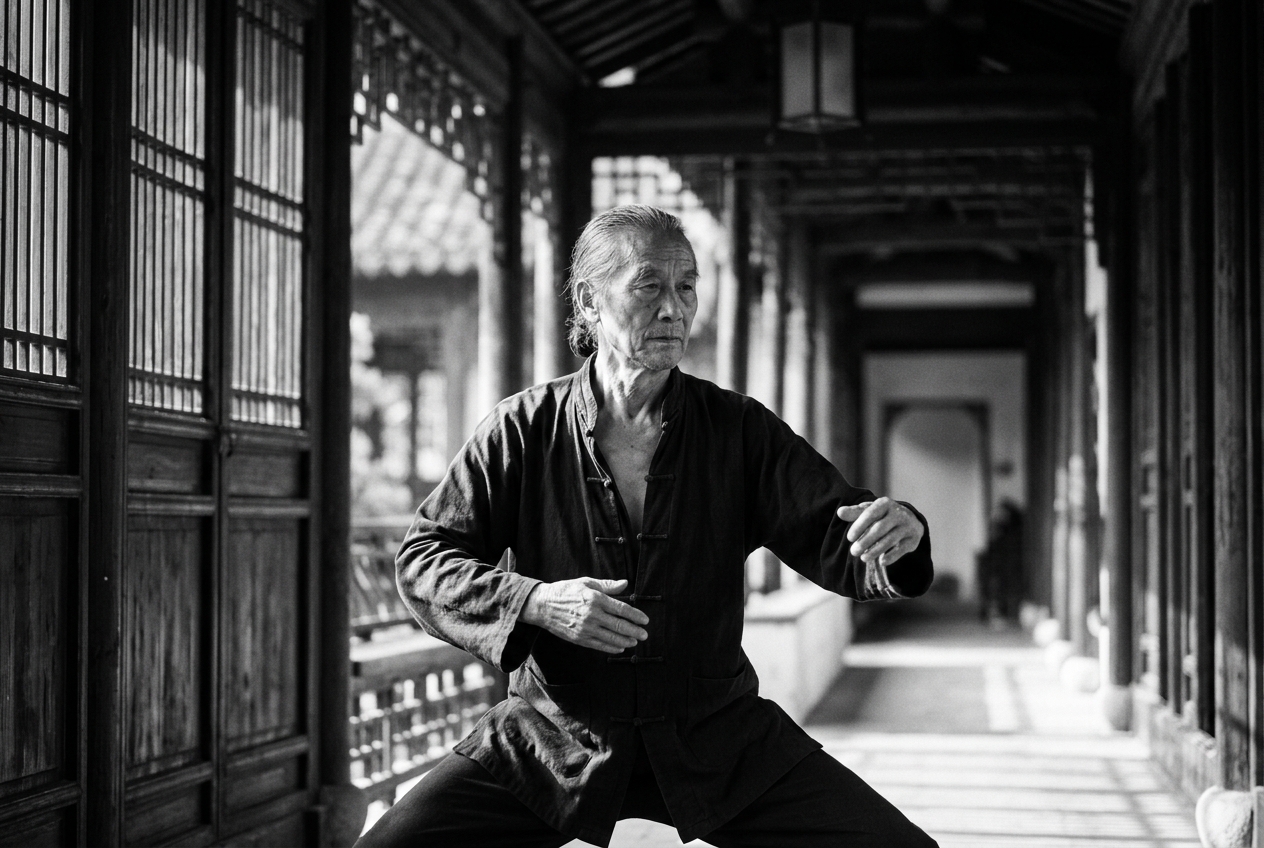
At its simplest, this practice is the deliberate, mindful opening of the upper chest's structural gateway—an ancient somatic discipline that unbinds restricted breathing, aligns the shoulder girdle, and restores fluid energetic vitality throughout the entire body. In contemporary sedentary life, hours spent hunched over keyboards and steering wheels pull the shoulders forward, collapse the ribcage, and lock the upper chest into a perpetual state of chronic contraction. This posture physically traps the breath in the throat and mechanically suffocates the natural expansion of the lungs. By learning how to systematically release this specific structural node through micro-adjustments and coordinated breathwork, you restore the body's natural tensegrity and allow your breathing to drop deeply and effortlessly into your lower abdomen.
In the classical lineage of Chinese medicine and internal cultivation, this anatomical crossroads is known as Yunmen (雲門), translated poetically as "Cloud Gate" and classified in clinical acupuncture as Lung 2 (LU2). It sits directly adjacent to Zhongfu (中府, "Central Treasury," LU1) as the supreme gateway through which atmospheric air (Qing Qi) and primordial breath (Qi) enter the twelve primary meridians. According to the foundational physiology of Traditional Chinese Medicine (TCM), the Lung governs the distribution of life energy and the misting of body fluids across the entire organism. When Cloud Gate is physically clamped shut by rounded shoulders and bound connective tissue, the descent of Lung Qi is obstructed, resulting in shallow breathing, upper-back fatigue, thoracic congestion, and systemic anxiety.
                  ANATOMICAL TOPOGRAPHY: YUNMEN (LU2)

   Acromion Process              Clavicle (Collarbone)
        \                             /
         \     [ Infraclavicular Fossa ]
          \               |
           +--------------*---------------+  <-- Coracoid Process
          /       ( YUNMEN / LU2 )         \
         /                |                 \
   Deltoid Muscle         |            Pectoralis Major
         \         Deltopectoral             /
          \           Groove                /
           \              |                /
                          v
               [ Hand-Taiyin Channel ]
               (Radial Pathway to Thumb)
Opening Cloud Gate is therefore not merely an exercise in stretching muscle; it is a foundational reset of the body's neuromuscular wiring. In the internal arts of Neigong (internal skill development) and Daoyin (guiding and pulling energy through movement), Cloud Gate serves as the functional hinge between the central axial skeleton and the peripheral energy channels of the upper limbs. By freeing this gate, we liberate the Hand-Taiyin Lung Meridian (Shoutaiyin Feijing) and its associated myofascial sinew channel (Jingjin), establishing an unbroken conduit of bioenergetic and vascular conduction from the chest core straight to the tips of the fingers.
THE STEP-BY-STEP PRACTICE GUIDE
Decompressing the Cloud Gate
The following protocol integrates classical Zhan Zhuang (standing post alignment), precise biomechanical de-rotation, and Ni Fu Shi Hu Xi (reverse abdominal breathing) into a repeatable, home-accessible method for liberating the clavipectoral space.
================================================================================
                    CLINICAL RESULT BOX: SOMATIC MARKERS
================================================================================
  TARGET SITE       : Infraclavicular Fossa & Deltopectoral Triangle (LU2)
  PRIMARY RELEASE   : Clavipectoral Fascia & Pectoralis Minor Entrapment
  SENSORY FEEDBACK  : Thermogenic warming along the radial forearm;
                      pulsatile tingling at the thumb nailbed (LU11);
                      sub-clavicular floating sensation; immediate deepening
                      of passive tidal inhalation volume.
================================================================================
Step 1: Foundation and Axial Alignment (Zhan Zhuang Stance)
- Stand with your feet parallel, exactly shoulder-width apart, with your toes pointing straight forward.
- Soften your knees by releasing the back of the knee joints, allowing your tailbone to sink vertically downward as if resting against a high barstool. Keep your lumbar spine gently flattened without forcing a posterior pelvic tilt.
- Suspend the crown of your head from above (Xu Ling Ding Jin), tucking your chin slightly inward to elongate the cervical vertebrae while softening your jaw and throat.
- Allow your arms to hang naturally at your sides, maintaining a rounded, hollow space under the armpits (Yuan Ye) as though you were holding a tender bird's egg beneath each arm.
Step 2: The Infraclavicular Unbinding Micro-Vector
- Locate the triangular depression of the deltopectoral groove just beneath the outer clavicular curve on both sides.
- Rather than pulling your shoulders backward (which causes compensatory lumbar arching), initiate a gentle, downward glide of the shoulder blades (scapulothoracic depression and lateral broadening). This embodies the classical maxim "Hollow the Chest and Pluck the Back" (Han Xiong Ba Bei).
- Simultaneously introduce a micro-rotation of three to five degrees of external rotation into the humerus (upper arm bone). Allow the inner elbow creases (Chize, LU5) to rotate subtly outward and forward, causing your thumbs to turn gently outward while your palms face obliquely forward.
- Feel the space beneath your collarbones widen laterally. Imagine a pair of sliding pocket doors at the top of your chest gently parting from the midline toward the shoulder points.
Step 3: Coordinated Breath Regulation (Reverse Abdominal Breathing)
- Inhale slowly and smoothly through your nose over a count of four to six seconds. As the air enters, gently draw your lower abdominal wall (the area two inches below your navel, known as the Lower Dantian) slightly inward and upward.
- As the lower abdomen draws inward, allow the internal pneumatic pressure to rise up the central core and blossom laterally beneath the collarbones, expanding the Yunmen cavities from the inside out without lifting the ribcage or tensing the neck muscles.
- Exhale smoothly through your nose over an equal count of four to six seconds. As you exhale, relax and release the lower abdominal wall outward while visualizing the breath and accumulated tension cascading downward like warm water, passing down the insides of both arms, through the thumbs, and grounding into the earth through the bubbling spring points (Yongquan, KI1) on the soles of your feet.
- Perform twelve complete, rhythmic breath cycles in this alignment.
Step 4: Dynamic Integration in Taiji Cloud Hands (Yun Shou)
- Shift seventy percent of your weight smoothly onto your right leg, turning your torso forty-five degrees to the right from the waist (Yao).
- Float your right hand upward to collarbone height, palm facing inward toward your chest, while your left hand settles at lower-belly height, palm facing downward.
- As your right hand glides horizontally across your chest line, maintain explicit somatic awareness on keeping the right Yunmen cavity hollow and broad. Do not allow the forward reaching of the arm to collapse the deltopectoral triangle.
- At the apex of the movement, gently rotate the right wrist so the palm faces outward, synchronizing the wrist rotation with a conscious external micro-glide of the right shoulder blade. Notice the clear, unobstructed line of pull running from the infraclavicular hollow through the biceps, down the radial border of the forearm, and into the thumb.
- Transition your weight to the left leg and repeat the sequence seamlessly on the left side, maintaining continuous, unbroken circularity.
================================================================================
                    DIAGNOSTIC & CORRECTION MATRIX
================================================================================
  COMMON ERROR           BIOMECHANICAL FAULT      SOMATIC CORRECTION
  -----------------------------------------------------------------------------
  Military Chest Thrust  Hyperlordosis; retracted   Broaden interscapular space;
                         rhomboids pinching spine   sink sternum 3mm downward.

  Shoulder Shrugging     Upper trapezius over-      Drop elbows downward;
                         activation on inhalation   visualize weights on elbows.

  Axillary Pinching      Adduction of upper arm     Float upper arm away from ribs;
                         crushing armpit space      maintain "egg in armpit."

  Breath Stagnation      Apical gasping using       Initiate inhalation from the
                         sternocleidomastoids       lower abdominal core floor.
================================================================================
When this alignment is executed accurately, you will immediately observe distinctive sensory indicators: a distinct rush of thermal warmth spreading from the sub-clavicular hollow downward through the forearm, an effervescent prickling or buzzing sensation at the radial corner of the thumb nailbed (Shaoshang, LU11), and a profound neurological sensation of release, marked by an involuntary, spontaneous sigh as your diaphragm drops deeper than usual.
BIOMECHANICAL PROOF
Why It Works: The Western Physiological Mechanics
The effectiveness of opening the Yunmen cavity is grounded in human functional anatomy, peripheral neurology, and fascial tensegrity. When we examine this region under the lens of modern medicine, we find that Yunmen precisely corresponds to the deltopectoral triangle—also known clinically as the infraclavicular or Mohrenheim’s fossa—bounded superiorly by the clavicle, laterally by the deltoid muscle, and medially by the clavicular head of the pectoralis major.
                   NEUROVASCULAR & FASCIAL ARCHITECTURE

                     [ Clavicle / Subclavius ]
                                 |
                    { Clavipectoral Fascia }
                     /           |          \
                    v            v           v
             [Cephalic Vein] [Thoraco-   [Lateral Pectoral
             (Venous Return)  acromial    Nerve & Brachial
                              Artery]     Plexus Branches]
                                 |
                   [ Pectoralis Minor Tendon ]
                                 |
                     ( Coracoid Attachment )
Directly beneath this muscular threshold lies the clavipectoral fascia, a strong, fibrous sheet that invests the subclavius and pectoralis minor muscles before merging inferiorly with the axillary fascia. In individuals suffering from postural distortion—specifically upper crossed syndrome—the pectoralis minor becomes chronically hypertonic and shortened, pulling the coracoid process anteriorly and inferiorly. This structural collapse creates a mechanical choke-point that entraps the vital neurovascular structures passing directly beneath it.
The clavipectoral sheet is pierced by three critical structures: the cephalic vein, the thoracoacromial artery and veins, and the lateral pectoral nerve. Furthermore, directly deep to the pectoralis minor tendon lies the neurovascular bundle of the axilla, which includes the axillary artery and vein as well as the cords and terminal branches of the brachial plexus (specifically the lateral cord, the musculocutaneous nerve, and the median nerve).
When the shoulder collapses forward into anterior humeral translation, the clavipectoral fascia thickens and tightens, exerting abnormal mechanical compression on the brachial plexus and restricting venous drainage through the cephalic vein. This micro-entrapment manifests as thoracic outlet syndrome symptoms: numbness, tingling along the radial forearm and hand, muscular fatigue, and coldness in the extremities.
================================================================================
                      PHYSIOLOGICAL MECHANISM SUMMARY
================================================================================
  PATHOLOGY               COMPONENTS AFFECTED       PHYSIOLOGICAL IMPACT
  -----------------------------------------------------------------------------
  Fascial Entrapment      Clavipectoral fascia,     Restricted axillary transit,
                          Pectoralis minor tendon   thoracic outlet compression.

  Vascular Stasis         Cephalic vein,            Impaired upper-limb venous
                          Thoracoacromial trunk     return, local tissue edema.

  Neural Irritation       Brachial plexus cords,    Radial/median nerve paresthesia,
                          Lateral pectoral nerve    loss of fine motor tone.

  Pleural Restriction     Sibson's fascia,          Ventilation-perfusion (V/Q)
                          Suprapleural membrane     mismatch at pulmonary apices.
================================================================================
By executing the precise micro-adjustments of scapulothoracic depression combined with subtle humeral external rotation, the distance between the sternum and the coracoid process is maximized. This mechanical vector lifts the clavipectoral roof off the underlying neurovascular bundle. The cephalic vein is immediately mobilized, dramatically accelerating venous return from the upper extremity and lowering localized tissue pressure. Simultaneously, the compression on the lateral cord of the brachial plexus is abolished, allowing unobstructed neural transmission along the median and radial pathways—explaining the instantaneous sensation of tingling and thermal conductivity experienced by practitioners.
At the respiratory and pulmonary level, decompressing the infraclavicular fossa directly relieves mechanical tension on the suprapleural membrane (Sibson’s fascia), which caps the apex of the lung as it extends above the level of the first rib. Sedentary chest-breathing creates rigid tension in the scalene muscles and Sibson's fascia, mechanically compressing the apical segments of the upper lung lobes. Opening Yunmen allows the lung apices to expand fully during the terminal phase of inhalation, optimizing the pulmonary ventilation-perfusion ratio ($V/Q$ matching) across the highly vascularized apical tissue, as documented in biomedical respiratory research accessible via NCBI PubMed.
From the perspective of myofascial tensegrity, as pioneered in modern biomechanics, the pathway of the Hand-Taiyin Lung Meridian corresponds almost identically to the Deep Front Arm Line (DFAL). The DFAL originates at the ribs three, four, and five via the pectoralis minor, wraps through the clavipectoral fascia, tracks along the biceps brachii, courses through the radial periosteum, and terminates at the lateral styloid process and the thenar muscles of the thumb.
When the clavipectoral node at Yunmen is tethered, the entire kinetic chain of the arm is compromised. Liberating this single anatomical crossroads restores continuous, elastic fascial recoil throughout the entire upper extremity, transforming the arm into a resilient, shock-absorbing whip in internal martial arts while optimizing autonomic nervous system balance via increased vagal tone and diaphragmatic excursion.
LINEAGE AND LORE
Classical Lineage and Historical Context
The anatomical and energetic significance of the Cloud Gate has been venerated across two millennia of classical Daoist and medical literature. The earliest authoritative description of Yunmen appears in the foundational canon of Chinese medicine, the Huangdi Neijing (Yellow Emperor's Inner Classic), composed between the Warring States period and the Han Dynasty. In the Lingshu (Spiritual Pivot), Chapter 10 ("Meridian Vessels"), the Lung channel of Hand-Taiyin is described as originating internally in the Middle Dantian (the stomach/spleen earth center), descending to encircle the large intestine, looping back upward past the cardiac orifice, traversing the diaphragm, and entering the lungs. From this deep visceral core, the channel emerges onto the external body surface specifically at the infraclavicular fossa:
"The Lung Hand-Taiyin vessel emerges at Zhongfu and ascends to Yunmen, situated in the depression below the clavicle, six cun lateral to the midline... Here the upper vapors assemble like clouds before spreading across the four limbs."
— Huangdi Neijing Lingshu, Chapter 10
The naming of Yunmen (Cloud Gate) is deeply rooted in Daoist cosmology and macro-microcosmic correspondence. In classical philosophy, the atmospheric dynamics of the earth mirror the internal physiology of the human body. Clouds are born from the interaction of terrestrial moisture (the digestive extraction of food essence, Gu Qi, by the Spleen) rising into the atmospheric sky (the upper thoracic cavity governed by the Lungs). The Lungs, designated in the Huangdi Neijing Suwen as the "Prime Minister" (Xiang Fu Zhi Guan), preside over the regulation of all bodily water channels (Tong Diao Shui Dao). The Yunmen cavity represents the heavenly gateway where these vital internal clouds condense into pure, revitalizing dew, which is then dispersed downward throughout the meridian network to moisten the joints, sinews, and organs.
                    COSMOLOGICAL QI METABOLISM

          [ Celestial Sky / Lungs ] (Upper Dantian / Thorax)
                     |
               ( YUNMEN / LU2 )  <-- "The Cloud Gate"
                     |
            [ Descending Dew of Qi ]
                     |
                     v
   [ Terrestrial Earth / Spleen ]  ==> Ascending Vapor (Gu Qi)
   (Middle Dantian / Digestion)
In the ancient physical cultivation systems discovered in the famous Daoyin Tu (Guiding and Pulling Chart) silk scroll, unearthed from the Han Dynasty Mawangdui tombs dating to 168 BCE, numerous illustrated figures demonstrate postures specifically designed to open the deltopectoral and axillary spaces. Figures depicted in postures such as "Extending the Chest" and "Spreading the Crane’s Wings" explicitly illustrate the lateral rotation of the shoulders and the hollowing of the chest to stretch the clavipectoral corridor, serving as historical precursors to modern medical Qigong recognized today by organizations such as the World Health Organization Traditional Medicine and the National Qigong Association.
During the Jin Dynasty, the renowned Daoist alchemist, physician, and scholar Ge Hong (283–343 CE) emphasized in his seminal text, the Bao Puzi (The Master Who Embraces Simplicity), that longevity and spiritual clarity depend entirely upon the unhindered flow of the breath through the three thoracic portals. Ge Hong noted that when the chest is hardened by external emotional agitation or physical rigidity, the spirit (Shen) becomes agitated and the vital breath stagnates at the throat and collarbones.
Centuries later, the Quanzhen (Complete Reality) Daoist internal alchemy traditions incorporated specific standing postures (Zhan Zhuang) into their monastic training precisely to release the clavipectoral matrix, recognizing that without the opening of Cloud Gate, the true internal descent of energy to the Lower Dantian remains impossible.
DAILY SOMATIC INTEGRATION
Today's Practice Commitment
To transform these anatomical and energetic insights into permanent structural change, commit to the following five-minute reset protocol tomorrow morning before drinking your first coffee or checking your phone:
================================================================================
                   5-MINUTE MORNING YUNMEN RESET PROTOCOL
================================================================================
  TIME        PHASE                     ACTION & SOMATIC FOCUS
  -----------------------------------------------------------------------------
  0:00-1:00   Topographical Palpation   Gently massage both infraclavicular
                                        fossae with circular fingertip pressure.

  1:00-3:00   Zhan Zhuang Static Open   Assume Wuji stance; execute external
                                        humeral micro-rotation; broaden chest.

  3:00-4:30   Reverse Breath Wave       Conduct 9 breath cycles; draw Lower
                                        Dantian inward; expand Yunmen laterally.

  4:30-5:00   Integration & Release     Allow arms to hang loose; observe warm
                                        pulsations in the thumbs and deep ease.
================================================================================
As you step away from this practice and move through your daily life, maintain a subtle, background awareness of your Cloud Gates. Whenever you catch yourself slumping toward a screen or feeling the constriction of situational stress, do not force your shoulders back with rigid tension.
Instead, simply soften your sternum, glide your shoulder blades laterally, and let the sliding doors of your upper chest float open. In that single, effortless micro-adjustment, the clavipectoral tension dissolves, the physiological compression lifts, and the breath once again flows unobstructed through the Cloud Gate.