Jiquan Cavity Highest Spring: Axillary Fascial Decompression, Brachial Plexus Mobilization, and Heart Channel Origin Conduction in Classical Neigong
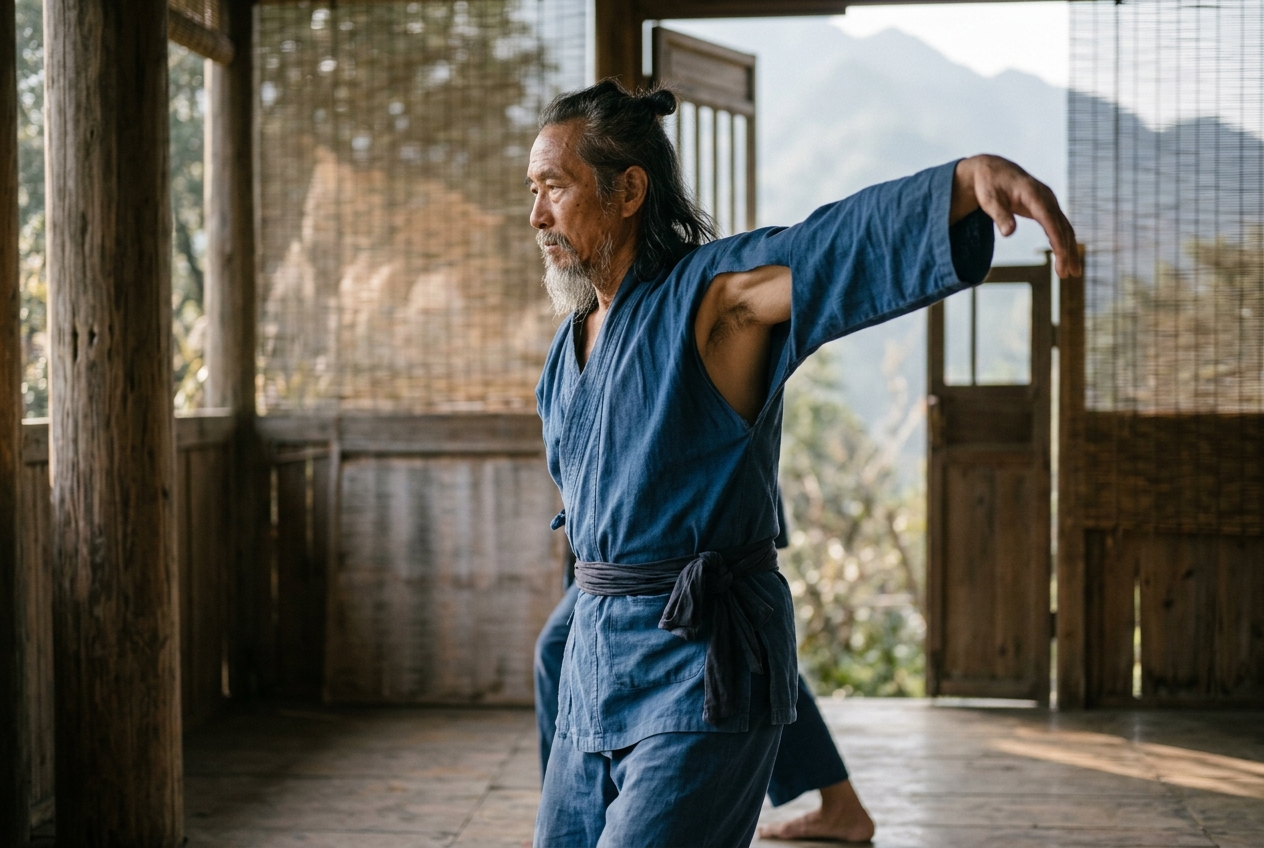
Rather than treating the armpit as an inert crease where the limb meets the trunk, classical internal arts view the axillary space as a dynamic, three-dimensional dome. When this dome collapses under the weight of modern postural habits—such as prolonged hunching over keyboards or slumped driving—the vital highway running into the arm is mechanically choked. By learning how to systematically decompress and cultivate the Jiquan cavity through posture, breath, and micro-movement, you restore structural balance across the upper body, open thoracic circulation, relieve pressure on major nerve bundles, and calm an overactive, anxious nervous system.
                       [ VERTICAL AXIS / BAcluster ]
                                     |
                          ( Cervical Spine / C5-T1 )
                                     |
                     +---------------+---------------+
                     |                               |
             [ Clavicle / Pectoral ]         [ Scapular Glide ]
                     |                               |
                     +-------> { JIQUAN (HT1) } <----+
                               ( Axillary Apex )
                                     |
                     +---------------+---------------+
                     |                               |
            [ Neurovascular Flow ]          [ Myofascial Web ]
         (Brachial Plexus & Artery)      (Gerdy's Ligament & Tensegrity)
                     |                               |
                     v                               v
             [ SHAOHAI (HT3) ]              [ Thoracic Expansion ]
                     |                               |
                     v                               v
             [ SHENMEN (HT7) ]              [ Grounded Shen (Spirit) ]
1. Classical Etiology and Topographical Anatomy
To understand why Jiquan holds such a revered place in both acupuncture and internal martial arts, one must examine its complex topographical anatomy. Located at the zenith of the axillary fossa, Jiquan lies medially adjacent to the pulsating axillary artery, situated at the apex of a four-sided anatomical pyramid.
                  ANATOMICAL PYRAMID OF THE AXILLA

                           APEX (Cervicoaxillary Canal)
                                 [ Jiquan / HT1 ]
                                      / \
                                     /   \
                                    /     \
             ANTERIOR WALL         /       \        POSTERIOR WALL
          (Pectoralis Major/Minor)/         \    (Subscapularis, Latissimus,
          & Clavipectoral Fascia /           \    Teres Major)
                                /             \
                               /               \
            MEDIAL WALL       /_________________\      LATERAL WALL
        (Serratus Anterior &                     (Intertubercular Sulcus
         Upper Thoracic Ribs)                      of Humerus)
                                     BASE
                             (Axillary Skin & Fascia)
The structural boundaries of this axillary pyramid dictate its profound mechanical sensitivity:
- Apex: The cervicoaxillary canal, bounded by the clavicle anteriorly, the superior border of the scapula posteriorly, and the first rib medially.
- Anterior Wall: Formed by the pectoralis major and minor muscles, cushioned beneath the robust clavipectoral fascia and the subclavius muscle.
- Posterior Wall: Formed by the scapula clad in the subscapularis muscle superiorly, and the broad sheets of the latissimus dorsi and teres major inferiorly.
- Medial Wall: Formed by the convex contours of the first four thoracic ribs and the intercostal spaces, overlaid by the interdigitating slips of the serratus anterior muscle.
- Lateral Wall: A narrow vertical strip corresponding to the intertubercular (bicipital) sulcus of the humerus, where the pectoralis major, latissimus dorsi, and teres major tendons insert.
Suspended directly within this apex is the axillary sheath, a tough, fibrous sleeve continuous with the prevertebral layer of the deep cervical fascia. Within this sheath travel the terminal cords and branches of the brachial plexus (originating from spinal roots C5–T1), the axillary artery, and the axillary vein.
Crucially, the floor of this vault is tethered upward by the suspensory ligament of the axilla, historically termed Gerdy's ligament. This fascial partition branches from the clavipectoral fascia, wraps the pectoralis minor, and descends to anchor into the dome-like axillary fascia. When the shoulder joint is mechanically misaligned, Gerdy’s ligament tightens like a cinch-strap, pulling the fascial dome upward, constricting the lumen of the axillary sheath, and compressing the median, ulnar, and radial nerve paths.
2. Biomechanical Tensegrity and Fascial Decompression
In classical internal mechanics, the human body is not viewed as a stack of bricks resting under gravity, but as a dynamic biotensegrity system—a structural framework composed of rigid compression struts (bones) suspended within a continuous network of elastic tension cables (the myofascial matrix). For an in-depth perspective on these structural dynamics, see the principles of architectural tensegrity.
        POSTURAL ENTRENCHMENT                     SOMATIC RECONSTRUCTION
        ("Pinched Axilla")                         ("Kong Xie" / Hollowing)

[ Upper Trapezius Hypertonus ]            [ Suspended Crown (Baihui) ]
                  |                                         |
     [ Clavicle Elevated / Tilted ]            [ Clavicle Level / Floated ]
                  |                                         |
     [ Pectoralis Minor Shortened ]            [ Serratus Anterior Engaged ]
                  |                                         |
     [ Axillary Dome Crushed ]                 [ 3D Axillary Expansion ]
                  |                                         |
     [ Neurovascular Entrapment ]              [ Unimpeded Venous Return ]
When an individual adopts a chronic slumped posture, a cascade of structural failure occurs: 1. The humerus internally rotates and translates forward. 2. The pectoralis minor contracts and hypertonifies, dragging the coracoid process anteriorly and inferiorly. 3. The scapula tilts anteriorly and wings outward, losing its stable glide across the thoracic wall. 4. The axillary space undergoes functional collapse, producing what somatic practitioners call the "Pinched Axilla Syndrome."
This compression exerts mechanical pressure against the axillary vein and the deep lymphatic vessels draining the upper extremity. Because venous and lymphatic flow relies entirely on low-pressure differentials and muscular/fascial pumping mechanisms, chronic pinching of the axilla generates fluid stasis in the arm, reduces microcirculation to the hand, and irritates the adjacent ulnar and median nerve pathways.
The practice of Kong Xie counters this collapse through three-dimensional fascial decompression. Rather than pulling the arms away from the body using the deltoids or shrugging the shoulders upward with the upper trapezius, the practitioner engages the lower fibers of the serratus anterior and the latissimus dorsi.
This creates a gentle outward and downward anchoring of the scapula while the humeral head is suspended centrally within the glenoid fossa. The axillary pyramid is gently inflated from within, releasing tension on Gerdy’s ligament, freeing the brachial cords, and turning the axilla into an open, resilient conduit for movement and fluid dynamics.
3. TCM Channel Dynamics and Shen Regulation
In Traditional Chinese Medicine, Jiquan is celebrated as the entry point and primary wellspring of the Heart meridian (手少阴心经, Shou Shaoyin Xinjing). The internal pathway of this meridian originates deep in the physiological Heart organ, traverses the diaphragm to communicate with the Small Intestine, and sends an ascending branch through the throat to the eye. The main energetic conduit surfaces at Jiquan in the center of the armpit before descending along the anteromedial aspect of the arm, passing through Shaohai (HT3) at the medial elbow, traversing Shenmen (HT7) at the wrist crease, and terminating at Shaochong (HT9) at the radial corner of the little fingernail.
       ===============================================================
       THE SHAOYIN ENERGETIC CIRCUIT: FROM AXILLA TO DIGIT TERMINUS
       ===============================================================

[ HEART DEEP AXIS ]  --> Internal branch emerges through the diaphragm
               |
               v
         { JIQUAN / HT1 }   --> Apex of Axilla: Entry Point, clears Stagnation
               |
               v (Anteromedial brachium / ulnar nerve line)
         { SHAOHAI / HT3 }  --> Medial Epicondyle: He-Sea Point, cools Fire
               |
               v (Anterior forearm / flexor carpi ulnaris)
         { SHENMEN / HT7 }  --> Wrist Crease: Yuan-Source Point, anchors Shen
               |
               v
        { SHAOCHONG / HT9 } --> Tip of Fifth Digit: Jing-Well Point
In classical clinical texts such as the Zhenjiu Jiayi Jing (Systematic Classic of Acupuncture and Moxibustion), Jiquan is indicated for: * Xiong Bi (Chest Bi-syndrome, manifesting as angina, precordial constriction, and full sensation in the ribs). * Cardiac arrhythmias, palpitations, and shortness of breath exacerbated by emotional strain. * Coldness, numbness, and motor impairment of the upper limbs. * Severe psycho-emotional agitation, chronic insomnia, and panic states.
The profound psycho-emotional influence of Jiquan is rooted in the classical understanding of Shen (神), the spiritual awareness and cognitive clarity housed within the Heart. When emotional stress, trauma, or unrelenting mental activity causes Heart Qi to become agitated or constrained, pathological Heat accumulates in the upper chest. This internal fire agitates the Shen, producing restlessness, racing thoughts, and sleep disturbance.
Because Jiquan sits directly over the thoracic inflow and outflow of the pericardial and cardiac beds, physical or energetic stagnation here prevents excess heat from dissipating. Cultivating the Jiquan cavity acts as an energetic release valve. Opening the armpits clears stagnation from the chest (Kuan Xiong Li Qi), vents accumulated heat along the arm, and draws turbulent energy downward into the lower Dantian (the core center of gravity in the lower abdomen), allowing the Shen to settle into quietude.
4. Step-by-Step Neigong Cultivation Protocol
The following method outlines the progressive cultivation of Jiquan within classical Zhan Zhuang (Standing Stake Meditation) and dynamic Daoyin breathing.
                ZHAN ZHUANG POSTURAL ALIGNMENT

                      ( Baihui / DU20 ) <-- Crown Suspended Upward
                             |
                     [ Relaxed Cervical ]
                             |
            +----------------+----------------+
            |                                 |
      ( Sunk Shoulders )               ( Sunk Shoulders )
            |                                 |
      { Open Axillae }                 { Open Axillae }
       [ Kong Xie ]                     [ Kong Xie ]
            |                                 |
            +--------( Rounded Arms )---------+
                             |
                   [ Collapsed Chest / Hanxiong ]
                             |
                   ( Lower Dantian Breathing )
                             |
                    [ Sunk Kua / Pelvis ]
                             |
                    ( Soft Knees / Song )
                             |
                 ( Yongquan / KD1 Rooting )
Step 1: Establishing the Root and Crown Suspension
- Stand with your feet parallel, precisely shoulder-width apart. Rest your weight evenly across the bottoms of your feet, feeling the Yongquan point (Kidney 1, located in the depression behind the ball of the foot) anchor softly into the earth.
- Soften your knees without letting them collapse inward. Allow your pelvis to settle naturally, as if sitting lightly on the edge of a high stool, flattening the lumbar curve without tucking the tailbone aggressively.
- Gently lift the crown of your head from Baihui (Governing Vessel 20) toward the ceiling, allowing your chin to draw slightly inward so the back of your neck lengthens effortlessly.
Step 2: Sculpting the Axillary Dome (Cheng Bao Zhuang)
- Slowly raise both arms in front of your chest as if embracing the trunk of a broad cedar tree. Your fingertips point toward one another, roughly six inches apart, aligned with the center of your sternum (Tanzhong / Ren 17).
- Apply the classical maxim Chen Jian Zhui Zhou (沉肩坠肘): Sink the Shoulders and Drop the Elbows. The elbows must always hang slightly lower than the wrists, and the shoulders must remain completely flat and broad.
- Activate Kong Xie: Ensure there is a hollow space roughly the size of a fist or a small grapefruit between the medial aspect of your upper arm and your lateral rib cage.
- Check that your shoulder blades are gliding broadly across your back rather than pinching together.
Step 3: Respiration-Driven Fascial Expansion
- Inhale slowly and silently through your nose for a count of four. Guide the breath down into the lower abdomen, then feel the breath expand three-dimensionally into the lateral rib cage and mid-back.
- As the lateral ribs expand, feel how the tissue at the very center of your armpit (Jiquan) stretches gently open like an unfolding umbrella.
- Exhale smoothly through your nose for a count of six. As the breath empties, do not let the armpits collapse. Maintain the hollow shape through light structural tone, feeling a gentle warmth or weight settling downward into your lower abdomen.
Step 4: Micro-Spiraling Conduction (Chan Si Jin)
- At the end of the exhalation, initiate a microscopic outward spiral of your humerus: rotate your upper arm outward by a single millimeter while keeping your palms oriented toward your chest.
- Direct your mind’s focus (Yi) from the open hollow of Jiquan, down the inside of your upper arm through the medial crease of your elbow (Shaohai / HT3), along the inner forearm to the pisiform bone of your wrist (Shenmen / HT7), and out through the tip of your little finger (Shaochong / HT9).
- Repeat this breathing and energetic circulation for 15 to 30 continuous breath cycles.
SENSORY MILESTONES: What You Should Feel
- Thermogenic Waves: A distinct sensation of warmth radiating from the armpit down the medial arm into the palms, signaling the release of vascular tone and improved microvascular perfusion.
- Bioelectric Tingling (Deqi): A fine, champagne-like effervescence or tingling running along the ulnar edge of the forearm into the fourth and fifth fingers, indicating neural decompression of the brachial cords.
- Thoracic Lightness: A sensation of decompression across the middle of the chest, accompanied by an involuntary drop in breathing rate and an ease in taking deep, full breaths.
- Psychic Settling: A spontaneous slowing of racing thoughts, accompanied by a heavy, grounded feeling in the lower abdomen and feet.
5. Common Compensations and Diagnostic Corrections
When learning to open Jiquan, practitioners frequently fall into predictable biomechanical traps. Use this diagnostic matrix to troubleshoot your alignment:
                           DIAGNOSTIC MATRIX

=============================================================================
ERROR IDENTIFIED         BIOMECHANICAL FAULT        SOMATIC CORRECTION CUE
=============================================================================
1. Shoulder Shrugging    Upper trapezius and       "Float the elbows outward
   (Clavicular Lift)     levator scapulae take     while melting the shoulder
                         over axillary abduction   blades down toward the
                                                   back pockets of your jeans."
-----------------------------------------------------------------------------
2. Humeral Over-         Upper arms pulled too     "Imagine a cushion of air
   Abduction             far out, pinching the     supporting the elbow from
   (Chicken Wings)       posterior capsule         below; keep elbows heavy."
-----------------------------------------------------------------------------
3. Scapular Winging      Loss of serratus tone;    "Broaden the space between
   (Collapsing Ribs)     scapulae pinch backward   the shoulder blades; wrap
                         toward the spine          the armpits forward."
-----------------------------------------------------------------------------
4. Collapsed Elbow       Elbows sag inward,        "Maintain a circular arc;
   Angle (<90 degrees)   compressing the ulnar     never let the arm angle
                         groove at HT3             crease sharply."
=============================================================================
Detailed Diagnostic Drills:
- The Wall Glide Test: Stand with your back flat against a wall, heels four inches away. Place the back of your head, mid-back, and sacrum on the wall. Raise your arms into the embrace posture. If your shoulders lift toward your ears or your low back arches away from the wall, your pectoralis minor and latissimus are tight. Lower your arms slightly until your spine rests flat against the wall, then focus entirely on breathing into the axillae.
- The Silk Thread Check: Have a partner gently place their fingertip inside your axillary fossa while you are in standing posture. If their finger feels an unyielding, muscular tension, you are using the deltoids to hold your arm up. Relax the outer arm until the tissue in the center of the armpit feels soft, resilient, and elastic, like a trampoline.
6. Why It Works: The Body Science
The physiological benefits of cultivating Jiquan align closely with modern neuroanatomy, hemodynamic science, and fascial research:
      +-------------------------------------------------------------+
      |               AUTONOMIC & HEMODYNAMIC CASCADE               |
      +-------------------------------------------------------------+
      |                                                             |
      |   [ Decompression of Axilla (Kong Xie) ]                    |
      |                 |                                           |
      |                 +--> [ Relieves Cervicothoracic Ganglia ]   |
      |                 |          |                                |
      |                 |          v                                |
      |                 |    [ Downregulates Sympathetic Outflow ]  |
      |                 |          |                                |
      |                 |          v                                |
      |                 |    [ Increases Heart Rate Variability ]   |
      |                 |                                           |
      |                 +--> [ Decompresses Axillary Vein & Lymph ] |
      |                 |          |                                |
      |                 |          v                                |
      |                 |    [ Accelerates Interstitial Drainage ]  |
      |                 |                                           |
      |                 +--> [ Mobilizes Brachial Plexus Cords ]    |
      |                            |                                |
      |                            v                                |
      |                      [ Eliminates Peripheral Entrapment ]   |
      |                                                             |
      +-------------------------------------------------------------+
Autonomic Downregulation and Vagal Modulation
The axillary apex is located near the sympathetic trunk and the cervicothoracic (stellate) ganglion, which regulates cardiac chronotropic drive (heart rate) and peripheral vascular resistance. Chronic elevation and anterior translation of the shoulder girdle compresses this sympathetic outflow tract, contributing to sustained sympathetic tone, shallow apical breathing, and reduced Heart Rate Variability (HRV).
Decompressing the axilla removes mechanical irritation from these pathways, encouraging a shift toward parasympathetic dominance via the vagus nerve. Clinical research on mind-body practices indexed on the National Center for Biotechnology Information confirms that postural adjustments paired with slow diaphragmatic breathing significantly improve autonomic balance and cardiovascular efficiency.
Hemodynamic and Lymphatic Drainage
The axillary vein and its tributaries—including the cephalic, basilic, and subscapular veins—constitute the sole venous drainage route for the upper extremity and lateral thoracic wall. Furthermore, the axillary lymph nodes filter roughly 75% of all lymphatic fluid originating from the chest, breast, and arm.
Because the lymphatic system lacks a central pump, it relies on rhythmic fluctuations in surrounding tissue pressure. The expansive diaphragmatic breathing of Daoyin, coordinated with the open architecture of Kong Xie, creates an effective suction pump (the thoracic respiratory pump), accelerating venous return and preventing inflammatory fluid accumulation.
Neurodynamics and Fascial Shear Planes
The brachial plexus nerves must slide smoothly through their fascial sheaths during movement. Postural collapse causes the clavipectoral fascia and Gerdy's ligament to adhere to the epineurium of the median, ulnar, and radial nerves.
Opening the Jiquan cavity re-establishes healthy fascial shear planes, restoring glide to the nervous system and relieving subclinical entrapments that frequently manifest as tension, tingling, or pain down the arm.
7. Classical Lineage and Historical Context
The systematic cultivation of the axillary cavity and the Heart meridian is documented across the classical lineage of Chinese medicine and internal cultivation.
                      HISTORICAL LINEAGE OF DAOIST DAOYIN

          [ 2nd Century BCE: Mawangdui Daoyin Tu ]
          Early depictions of expansive arm positions opening the axillary vault.
                            |
                            v
          [ 1st Century CE: Huangdi Neijing (Lingshu) ]
          Foundational mapping of the Hand Shaoyin Meridian and Jiquan (HT1).
                            |
                            v
          [ 4th Century CE: Ge Hong (Baopuzi) ]
          Integration of postural hollowing and breath circulation in early Neidan.
                            |
                            v
          [ 7th Century CE: Sun Simiao (Qianjin Yaofang) ]
          Formalization of Daoyin exercises to purge chest heat and regulate Shen.
                            |
                            v
          [ 17th Century to Present: Internal Martial Arts & Global Medicine ]
          Synthesis in Taijiquan, Baguazhang, and modern somatic applications
          recognized by the World Health Organization and National Qigong Association.
The earliest systematic map of these pathways appears in the Huangdi Neijing (Yellow Emperor's Inner Classic, compiled c. 1st century BCE). In the Lingshu (Spiritual Pivot), Chapter 10, the Heart meridian is outlined starting from the heart organ, emerging through Jiquan, and traveling to the tip of the small finger. The text warns that whenever this channel is blocked, the patient suffers from "cardiac pain, dry throat, thirst with desire to drink, yellowing of the eyes, and pain along the inner aspect of the arm."
During the Eastern Jin Dynasty, the Daoist physician and alchemist Ge Hong (283–343 CE) described in his Baopuzi (The Master Who Embraces Simplicity) how specific somatic stances can prevent illness and extend life. Ge Hong emphasized that Qi cannot circulate if the "four gates and eight cavities" of the body remain compressed. The two axillae comprise the crucial upper two of these "Eight Cavities" (Ba Xu).
In the Tang Dynasty, Sun Simiao (581–682 CE), revered as the King of Medicine, detailed specific Daoyin movements in his Beiji Qianjin Yaofang (Essential Formulas for Emergencies Worth a Thousand Pieces of Gold) to vent pathogenic heat from the heart. These exercises utilized wide, rounded arm postures to stretch the fascia of the armpits, directly influencing the Heart and Pericardium channels.
Today, these methods remain central to major schools of internal martial arts—such as Taijiquan, Baguazhang, and Xingyiquan—and are preserved by organizations like the National Qigong Association and recognized within integrative medicine frameworks by the World Health Organization.
8. Today's Practice Commitment: The Five-Minute Axillary Re-Set
To experience the benefits of opening the Jiquan cavity, commit to this five-minute protocol daily for the next seven days. Perform it first thing in the morning, or immediately after a long period of sitting at a desk.
       ===============================================================
                       THE 5-MINUTE DAILY RE-SET PROTOCOL
       ===============================================================

       [ MINUTE 0:00 - 1:00 ] --> POSTURAL EMBRACE
                                  Set up Zhan Zhuang stance. Root into
                                  Yongquan (KD1), lengthen Baihui (DU20),
                                  and place imaginary eggs in both armpits.

       [ MINUTE 1:00 - 3:30 ] --> THREE-DIMENSIONAL BREATHING
                                  Inhale (4s): Expand ribs & axillary domes.
                                  Exhale (6s): Keep axillae open, sink Qi.
                                  Perform 15 continuous cycles.

       [ MINUTE 3:30 - 4:30 ] --> MICRO-SPIRAL CONDUCTION
                                  Apply slight outward humeral rotation.
                                  Trace awareness: Jiquan -> Shaohai ->
                                  Shenmen -> Tip of pinky finger.

       [ MINUTE 4:30 - 5:00 ] --> CLOSING & INTEGRATION
                                  Lower hands to rest over lower Dantian.
                                  Take three deep settling breaths.
                                  Notice the residual warmth and clarity.
       ===============================================================
As you step away from the practice and return to your daily activities, carry this somatic memory with you. Whenever you notice stress accumulating in your chest, your breathing becoming shallow, or your shoulders creeping toward your ears, pause for a moment. Remember the fragile egg resting beneath each arm. Soften, open the hollows of your armpits, let the "Highest Spring" flow freely, and feel your physical structure and your mind settle into effortless balance.