Powernews Section Archive

Quantum Computing Series Archive

Page 2 of 11
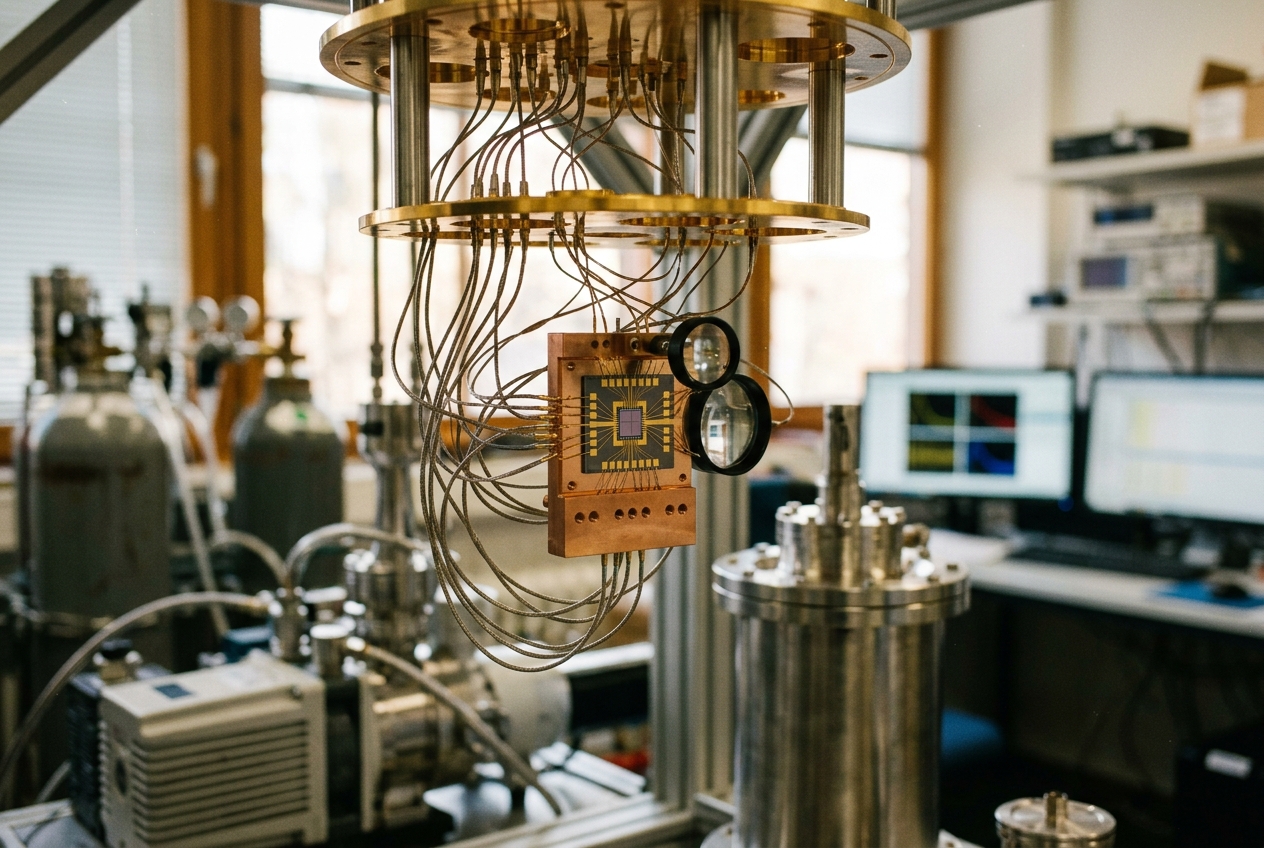
Haah's Code: Structuring 3D Topological Memory, Fracton Excitations, and Glassy Self-Correction
QUANTUM COMPUTING

Haah's Code: Structuring 3D Topological Memory, Fracton Excitations, and Glassy Self-Correction

Every morning, the global financial system quietly trusts that a single magnetic hard drive platter will not forget its numbers. When a classical hard drive records a binary zero or one, it flips the magnetic orientation of millions of microscopic iron atoms. If stray thermal vibrations cause a few of those atoms to jiggle out of alignment, the collective magnetic field of their neighbors immediately snaps them back into line. This is passive self-correction: the physical laws of ferromagnetism preserve information naturally, without an external software program needing to inspect every atom every microsecond.

⚡ 6,732 Tokens • $0.00 Cost
Eigenstate Thermalization Hypothesis: Resolving Quantum Chaos, Ergodicity, and Thermal Equilibrium in Isolated Many-Body Systems
QUANTUM COMPUTING

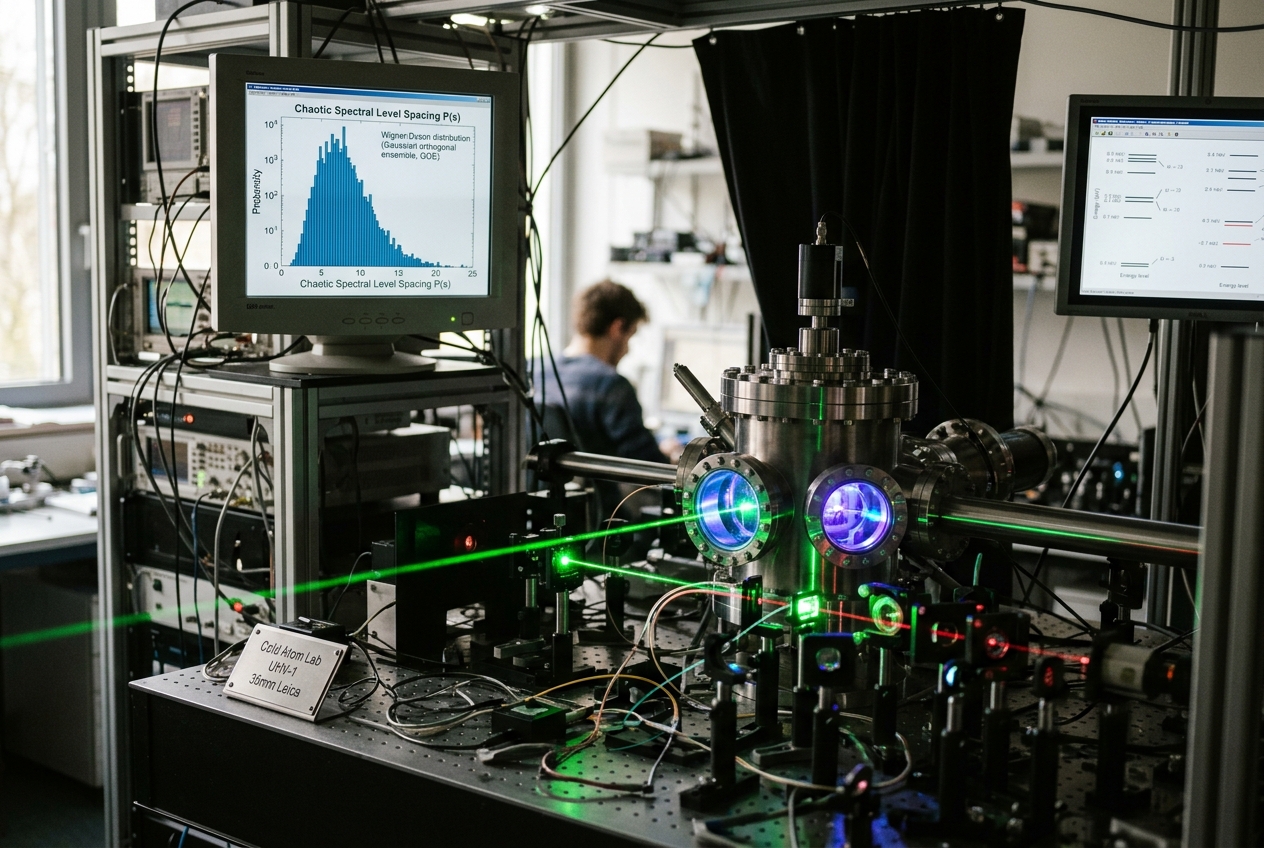
Eigenstate Thermalization Hypothesis: Resolving Quantum Chaos, Ergodicity, and Thermal Equilibrium in Isolated Many-Body Systems

Every morning across the globe, billions of people entrust their financial livelihoods, confidential communications, and medical records to encrypted digital vaults. The security architectures shielding this data rely on a comforting classical truth: information, once written, remains intact unless deliberately overwritten or degraded by external noise. Yet, in the microscopic basement of physics, a far deeper and more unsettling game is being played. When a quantum system computes, it performs an intricate dance of pure information. But if left to its own devices, a complex quantum system performs a vanishing act: it swallows its own past, dispersing organized information across millions of entangled microscopic coordinates until no local measurement can ever recover it.

⚡ 6,775 Tokens • $0.00 Cost
Quantum Decoupling Theorem: Unifying Channel Capacities, State Merging, and Information Locking Via Haar-Random Unitaries
QUANTUM COMPUTING

Quantum Decoupling Theorem: Unifying Channel Capacities, State Merging, and Information Locking Via Haar-Random Unitaries

The encryption safeguarding your financial transactions, medical records, and state secrets relies on mathematical assumptions—specifically, that factoring massive prime numbers or calculating discrete logarithms is too difficult for classical supercomputers. A large-scale quantum computer will one day render those assumptions obsolete. Yet the true revolution underway in quantum physics is not merely about breaking classical codes; it is about establishing a form of communication so fundamentally secure that not even an adversary with infinite computing power could extract a single bit of intelligence.

⚡ 5,208 Tokens • $0.00 Cost
Bravyi-Gosset-König Theorem: Proving Unconditional Quantum Advantage in Constant-Depth Circuits
QUANTUM COMPUTING

Bravyi-Gosset-König Theorem: Proving Unconditional Quantum Advantage in Constant-Depth Circuits

``` COMPLEXITY THEORY | THE BRAVYI-GOSSET-KÖNIG THEOREM A landmark mathematical proof has demonstrated that quantum computers possess an inherent, unconditional advantage over classical machines—not through raw clock speed or heuristic approximations, but by fundamentally shattering the geometric limits of classical information flow. ```

⚡ 5,904 Tokens • $0.00 Cost
Amplitude Damping Channel: Modeling Energy Relaxation, Spontaneous Emission, and Non-Unitary State Dissipation
QUANTUM COMPUTING

Amplitude Damping Channel: Modeling Energy Relaxation, Spontaneous Emission, and Non-Unitary State Dissipation

> ### CORE PHENOMENOLOGICAL PRINCIPLE > The **Amplitude Damping Channel** represents the canonical completely positive trace-preserving (CPTP) open-system quantum operation modeling irreversible energy loss, spontaneous decay, and non-unitary dissipation from an excited quantum state $|1\rangle$ to the ground state $|0\rangle$ through coupling with a reservoir.

⚡ 8,407 Tokens • $0.00 Cost
Unambiguous State Discrimination: Achieving Zero-Error Measurement and Establishing the Ivanovic-Dieks-Peres Limit
QUANTUM COMPUTING

Unambiguous State Discrimination: Achieving Zero-Error Measurement and Establishing the Ivanovic-Dieks-Peres Limit

The encryption securing your bank accounts, medical records, and national power grids currently rests on a mathematical truce: classical computers simply lack the time to calculate the prime factors of colossal numbers. In the emerging quantum era, that truce is dissolving. Yet the true revolution of quantum technology is not merely that it calculates faster; it is that it redefines what it means to acquire knowledge about physical reality. When information is encoded into the delicate, indivisible states of single photons or isolated atoms, reading that information is no longer a passive act of inspection. It is a physical intervention governed by the immutable laws of nature.

⚡ 7,767 Tokens • $0.00 Cost
← Previous Page Page 2 / 11 Next Page →