XZZX Surface Code: Tailoring Topological Fault Tolerance to Biased Noise Architectures
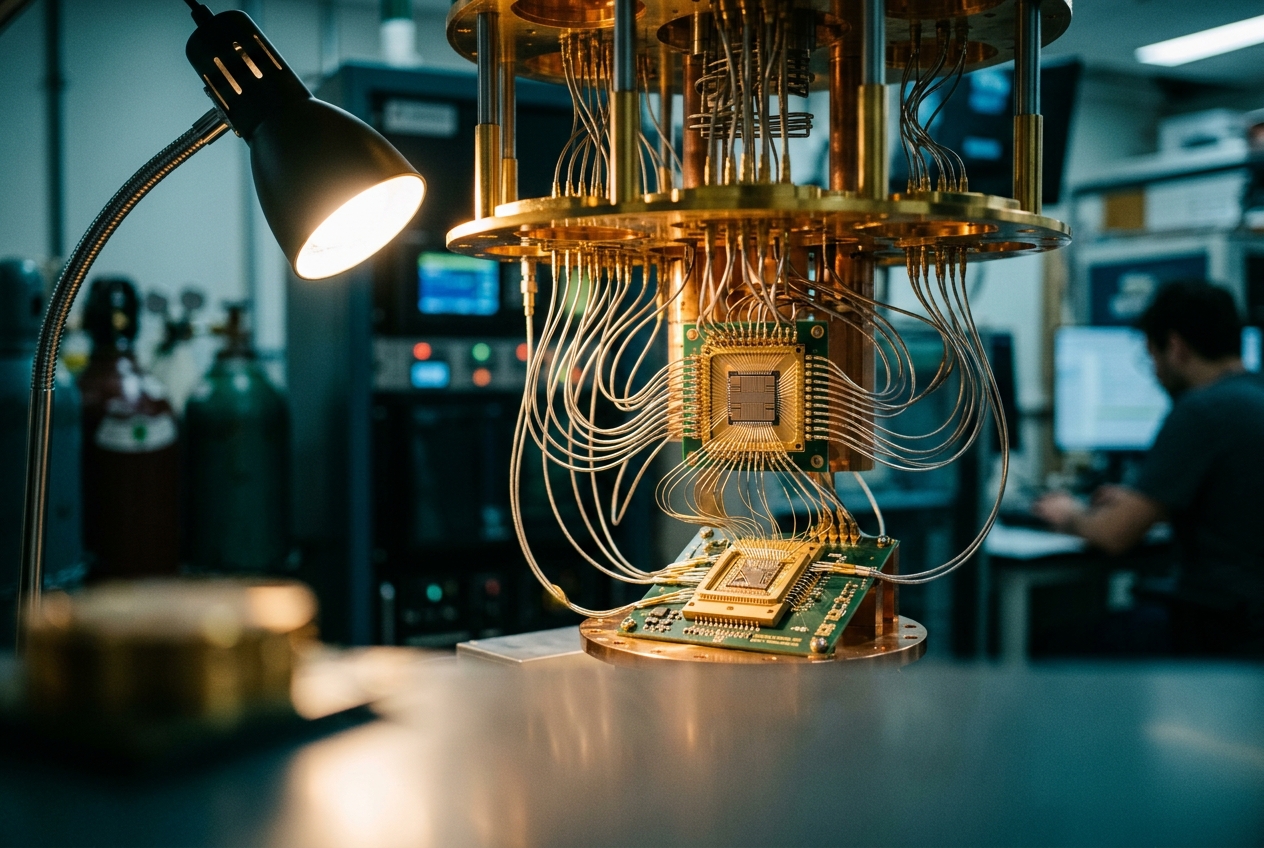
The cryptographic bedrock securing global financial networks, classified communication channels, and sovereign infrastructure rests upon mathematical problems—principally integer factorization and discrete logarithms—that would take conventional supercomputers millennia to unravel. A fault-tolerant quantum computer running Shor’s algorithm could dismantle these safeguards in a matter of hours. Yet, the physical reality of building such a machine has long collided with an unforgiving adversary: quantum decoherence.
Quantum bits (qubits) are exquisitely fragile, reacting violently to infinitesimal thermal fluctuations, magnetic whispers, and control imperfections. For decades, the dominant theoretical shield against this fragility has been the planar surface code. However, standard surface codes suffer from a crippling blind spot: they treat all quantum errors symmetrically, despite the fact that in nearly every physical quantum processor, phase-flip errors outnumber bit-flip errors by orders of magnitude.
Enter the XZZX surface code. By introducing an elegant topological twist to the standard arrangement of quantum checks, the XZZX architecture transforms two-dimensional error percolation into uncoupled, one-dimensional problem sets. Without requiring a single change to the physical wiring of superconducting grids or trapped-ion arrays, this code exploits the intrinsic "bias" of quantum noise, shattering historic threshold limits and charting an accelerated path toward practical quantum computation.
1. Opening Hook — Why You Should Care
In the pursuit of functional quantum computing, the greatest bottleneck is not quantum supremacy over artificial benchmark algorithms, but quantum survival. The quantum state of a physical qubit degrades within fractions of a millisecond. If we cannot correct these errors faster than they accumulate, any quantum algorithm will collapse into meaningless statistical white noise long before it can simulate a single complex molecule or optimize a pharmaceutical compound.
The orthodox blueprint for error correction requires thousands of physical qubits working in concert simply to protect one single "logical" unit of quantum data. Under standard error-correction frameworks, the error rate of individual physical hardware components must sit comfortably below a strict 1% ceiling—a threshold that has pushed fabrication, cryogenic engineering, and microwave control to the absolute brink of physical limits.
       CONVENTIONAL APPROACH                          XZZX ARCHITECTURE
  +-------------------------------+             +-------------------------------+
  | Symmetric Error Assumption    |             | Biased Noise Exploitation     |
  | Bit flips (X) == Phase (Z)    |             | Phase flips (Z) >> Bit (X)    |
  | 2D Error Percolation Networks |   ======>   | 1D Confined Diagonal Strings  |
  | Threshold capped at ~1%       |             | Threshold pushes toward 50%   |
  | Massive physical qubit overhead|            | Drastically reduced overhead  |
  +-------------------------------+             +-------------------------------+
The discovery of the XZZX surface code changes the economic and physical calculus of this endeavor. By aligning the software architecture of error correction with the physical asymmetries of hardware noise, the XZZX code enables systems with relatively high error rates to achieve full fault tolerance. In doing so, it effectively reduces the hardware requirements for fault tolerance by up to an order of magnitude, pulling the timeline for life-saving molecular discovery and quantum-secure materials science years closer to the present.
2. The Idea in Plain English
To understand why the XZZX code represents such a radical departure, consider the humble coin. In a classical computer, a bit is a coin sitting flat on a table: it is either heads ($0$) or tails ($1$). The only error that can occur is a bit flip—an environmental disturbance that knocks the coin over to reveal the opposite face.
A quantum bit, however, is not resting on the table; it is spinning on its edge. This introduces two distinct ways the state can fail: 1. The Bit-Flip (Pauli-X Error): The coin is knocked completely upside down, swapping its axis of rotation. 2. The Phase-Flip (Pauli-Z Error): The coin continues to spin upright, but an invisible drag changes the timing and rhythm of its rotation without knocking it over.
          BIT FLIP (X Error)                       PHASE FLIP (Z Error)
         Coin is knocked over                     Rotation axis is shifted
           (Axis Inverted)                             (Phase Dragged)
                 |                                           |
                 v                                           v
            [  |  ]                                     (  \~/  )
            [  v  ]                                     (  /~\  )
      Relatively Infrequent                        Dominates Real Hardware
In the natural world, keeping a spinning coin from being knocked over is relatively straightforward, but preventing tiny fluctuations in its rotational rhythm is extraordinarily difficult. In physical platforms—such as superconducting circuits, quantum dots, and bosonic cavities—phase-flip errors occur hundreds or thousands of times more frequently than bit-flip errors. Physicists quantify this asymmetry using the noise bias ratio ($\eta$):
$$\eta = \frac{p_z}{p_x + p_y}$$
Here, $p_z$ represents the probability of a phase-flip error, while $p_x$ and $p_y$ denote the probabilities of bit-flip and combined bit-phase errors. When $\eta = 0.5$, the noise is completely unbiased (depolarizing), whereas $\eta \gg 1$ defines a high-bias noise regime.
For decades, standard quantum error correction architectures treated $X$ and $Z$ errors as twin siblings that required identical 2D defensive grid layouts. Standard codes spread checks across two dimensions, meaning an avalanche of phase-flips could snake across the entire chip, forming catastrophic error paths. The XZZX code reorganizes the checks so that phase errors are cordoned off along narrow, one-dimensional diagonal corridors. Instead of searching for an error in a vast two-dimensional labyrinth, the quantum operating system only needs to look down straight lines, making error detection dramatically simpler and far more resilient.
3. How It Actually Works — The Mechanics
To appreciate the mathematical elegance of the XZZX surface code, one must first look at the traditional Calderbank-Shor-Steane (CSS Surface Code) architecture, pioneered in the seminal work on topological quantum memory.
The Standard Rotated CSS Surface Code
In a standard rotated surface code, physical data qubits sit on the vertices of a square lattice. The code stabilizes quantum information by repeatedly measuring two distinct types of multi-qubit parity checks on alternating plaquettes (faces): * $X$-type stabilizers: $S_X = X \otimes X \otimes X \otimes X$, which detect phase-flip ($Z$) errors. * $Z$-type stabilizers: $S_Z = Z \otimes Z \otimes Z \otimes Z$, which detect bit-flip ($X$) errors.
When a single $Z$ error strikes a data qubit, it anti-commutes with the $X$-stabilizers adjacent to it, flipping the measurement outcome of those stabilizers from $+1$ to $-1$. These $-1$ signals are known as syndrome defects.
As multiple $Z$ errors accumulate, they form a connected chain on the lattice. The syndrome defects appear only at the endpoints of this chain. In the standard CSS code, a chain of $Z$ errors can propagate in any direction across the two-dimensional lattice. If the chain connects two opposing boundaries of the chip, it corrupts the logical qubit irreversibly. Because errors can branch and percolate across 2D space, the code fails as soon as the physical error rate exceeds approximately 10.9% under phenomenological noise models, and around 1% under full circuit-level simulations.
   STANDARD CSS CODE: 2D PERCOLATION             XZZX CODE: 1D CONFINEMENT

     (X)---(X)---(X)---(X)                       (XZZX)       (XZZX)
      |     |     |     |                            \             \
     (X)---[Z]---[Z]---(X)   <- 2D Spreading          [Z]           [Z]  <- 1D Chain
      |     |     |     |                               \             \
     (X)---[Z]---(X)---(X)                              [Z]           [Z]
                                                          \             \
   [Syndromes spread across 2D plane]             [Syndromes confined to 1D lines]
The XZZX Stabilizer Formulation
The XZZX surface code, formalized by Ataides et al. in Nature Communications (2021), abandons the division between pure $X$-plaquettes and pure $Z$-plaquettes. Instead, every single bulk check operator on the rotated grid is identical in structure, defined by a cyclic alternating tensor product:
$$S_p = X_1 Z_2 Z_3 X_4$$
In this formulation, the operator acts on the four data qubits surrounding plaquette $p$, ordered cyclically (for example, top-left $X$, top-right $Z$, bottom-right $Z$, bottom-left $X$).
                     (Q1) -------- [X] -------- (Q2)
                       |                          |
                       |                          |
                      [Z]       PLAQUETTE        [Z]
                       |         (XZZX)           |
                       |                          |
                     (Q4) -------- [X] -------- (Q3)
1D Syndrome Confinement: Taming the Phase Monster
The foundational breakthrough of the XZZX check operator is how it interacts with biased noise. Consider what happens when a pure dephasing channel inflicts a Pauli-$Z$ error on data qubit $i$:
- If the operator acting on qubit $i$ in a neighboring plaquette is $Z$, the error commutes with it ($Z Z = Z Z$). No syndrome is triggered.
- If the operator acting on qubit $i$ in a neighboring plaquette is $X$, the error anti-commutes with it ($Z X = -X Z$). The stabilizer flips its measurement to $-1$.
Because the $X$ operators in the XZZX plaquette are positioned exclusively along one diagonal (e.g., top-left and bottom-right) and the $Z$ operators lie along the opposite diagonal, a single $Z$ error can only trigger stabilizers along a single diagonal axis.
If a contiguous string of $Z$ errors occurs along that diagonal, the intermediate stabilizers commute with the pair of errors, leaving syndrome defects strictly at the two ends of the diagonal string. Most importantly, a $Z$ error cannot turn a corner. It cannot branch into the orthogonal diagonal direction because it has no mathematical overlap with the $Z$-operators in that orientation.
================================================================================
           SYNDROME DEFECT GENERATION UNDER HIGH-BIAS NOISE (Z-ERRORS)
================================================================================

Diagonal Axis 1 (Active)                   Diagonal Axis 2 (Inactive)
          [Syndrome -1]                                [Syndrome +1]
               \                                            /
               (Z)  <-- Data Qubit Phase Error             /
                 \                                        /
                 (Z)                                     /
                   \                                    /
               [Syndrome -1]                           /

  *Result: The 2D syndrome graph collapses into independent 1D linear tracks.*
================================================================================
By decoupling the 2D surface into a set of non-interacting, one-dimensional repetition codes for phase errors, the XZZX code renders 2D error clustering impossible under pure dephasing.
The Threshold Revolution and the 50% Hashing Limit
In quantum information theory, the fault-tolerant threshold is the critical physical error rate below which scaling up the size of the code exponentially suppresses the logical failure rate. In unbiased noise ($\eta = 0.5$), the XZZX code performs identically to the standard rotated surface code, exhibiting a phenomenological threshold of roughly $p_{\text{th}} \approx 10.9\%$.
However, as the noise bias $\eta$ increases, the behavior of the two codes diverges radically: * In the standard surface code, the threshold improves only marginally as $\eta \to \infty$, capping out near $10.9\%$ because the $X$-stabilizers still form a 2D network vulnerable to phase-error clustering. * In the XZZX surface code, the threshold climbs monotonically with $\eta$. In the limit of pure dephasing noise ($\eta \to \infty$), the threshold for the XZZX code reaches the theoretical maximum:
$$p_{\text{th}}(\eta \to \infty) = 50\%$$
A threshold of 50% indicates that even if half of all physical data qubits suffer phase corruptions, the code can restore the stored logical state without loss of fidelity. This saturates the fundamental coherent information hashing bound for uncorrelated quantum channels.
Decoding the Anisotropic Syndrome Graph
Detecting errors is only half the battle; the quantum control layer must infer the most likely error configuration from the syndrome defects in real-time. Because the syndrome graph of the XZZX code under biased noise is highly anisotropic (preferentially directed along one diagonal), decoding algorithms must be specifically tailored to avoid misidentifying 1D chains as 2D clusters.
                           SYNDROME DECODING FLOW

   +-----------------------------------------------------------------------+
   |                  Raw Readout: Syndrome Defects (-1)                   |
   +-----------------------------------------------------------------------+
                                      |
                                      v
   +-----------------------------------------------------------------------+
   |            Stage 1: 1D Matching / Cluster Growth                      |
   |   - Solve 1D syndrome strings along uncoupled diagonal tracks          |
   |   - Decimates the primary phase-flip (Z) noise component              |
   +-----------------------------------------------------------------------+
                                      |
                                      v
   +-----------------------------------------------------------------------+
   |            Stage 2: 2D Correction Matching (Residual X & Y)           |
   |   - Match remaining cross-track defect pairs caused by bit flips       |
   |   - Utilizes tailored Minimum-Weight Perfect Matching (MWPM)          |
   +-----------------------------------------------------------------------+
                                      |
                                      v
   +-----------------------------------------------------------------------+
   |                 Final Pauli Frame Update & Correction                 |
   +-----------------------------------------------------------------------+
- Tailored Minimum-Weight Perfect Matching (MWPM): Traditional decoders, such as the blossom algorithm implemented in PyMatching, construct an isotropic graph where edge weights correspond to Euclidean distances between defects. In an anisotropic XZZX setting, the edge weights along the dephasing diagonal are scaled down proportionally to the noise bias ($\sim \ln(\eta)$), forcing the decoder to match defects along 1D strings before considering cross-diagonal paths.
- Tailored Union-Find (UF) Decoders: For ultra-fast hardware decoding (essential for keeping pace with sub-microsecond superconducting cycle times), Union-Find decoders grow cluster boundaries around defects. Anisotropic Union-Find algorithms grow clusters exclusively along the 1D diagonal strings during early iterations, fusing clusters across the orthogonal axis only when rare bit-flip ($X$) syndromes are confirmed.
Hardware Co-Design: Platforms with Natural Noise Bias
The theoretical power of the XZZX code is realized when paired with physical qubit architectures engineered to exhibit massive intrinsic noise bias ($\eta > 10^2$ to $10^4$).
+---------------------------+---------------------------+---------------------------+
|      KERR-CAT QUBITS      |     FLUXONIUM CIRCUITS    |     DUAL-RAIL BOSONS      |
+---------------------------+---------------------------+---------------------------+
| Stabilized via non-linear | Biased inductive shunts   | Encodes quantum states in |
| Kerr interactions in      | exponentially suppress    | photon pairs across two   |
| superconducting cavities. | charge relaxation, leaving| coupled cavities, converts|
| Bit flips suppressed by   | pure flux dephasing as the| photon loss into erasure  |
| photon phase-space barrier| only significant error.   | errors with high bias.    |
+---------------------------+---------------------------+---------------------------+
- Kerr-Cat Qubits: By driving a superconducting microwave resonator with a non-linear Kerr medium, the system stabilizes two coherent states of opposite phase ($\lvert \alpha \rangle$ and $\lvert -\alpha \rangle$). Flipping between these states requires tunneling through a phase-space energy barrier, suppressing bit flips exponentially with the photon number $|\alpha|^2$, yielding natural biases exceeding $\eta = 10^4$.
- Fluxonium Qubits: Operating at high magnetic flux bias, the large inductance of the fluxonium circuit isolates the computational levels from charge-noise relaxation, ensuring that bit flips are rare while dephasing dominates.
- Dual-Rail Photonic & Cavity Qubits: In bosonic systems, encoding a qubit across two distinct modes allows photon loss to be flagged immediately as an "erasure" error, transforming the remaining unflagged noise into an almost pure dephasing channel.
4. Real-World Applications Today
The transition from standard isotropic codes to biased-tailored architectures like XZZX is actively reshaping the roadmaps of major industrial and academic quantum computing initiatives between 2024 and 2026.
1. Superconducting Cat-Qubit Processors (Alice & Bob / Inria)
- The Organization: French quantum hardware developer Alice & Bob, working in close collaboration with the Inria Research Center.
- The Project: Building fault-tolerant quantum computers based on cat qubits integrated with tailored topological architectures.
- The Quantum Advantage: By engineering their superconducting circuits to suppress bit flips at the component level, Alice & Bob use the XZZX code to handle the residual dephasing noise. This strategy cuts the physical-to-logical qubit ratio from roughly $1,000:1$ down to under $50:1$, vastly accelerating the timeline for building a machine capable of calculating the energy surfaces of complex enzymes.
2. Biased Bosonic Cavity Quantum Memories (Yale / AWS Center for Quantum Computing)
- The Organization: The AWS Center for Quantum Computing at the California Institute of Technology, alongside academic labs at Yale University.
- The Project: Micro-architectural development of hybrid architectures that couple superconducting transmons to high-$Q$ acoustic or electromagnetic cavity resonators.
- The Quantum Advantage: AWS's fault-tolerant architecture whitepapers explicitly prioritize biased-noise architectures. By pairing high-bias acoustic memories with XZZX error-correction routines, AWS aims to perform fault-tolerant syndrome measurements with substantially fewer CNOT gates, dramatically reducing hardware footprint and cross-talk noise.
                           REAL-WORLD DEPLOYMENT PIPELINE

    PHYSICAL LAYER                INTERMEDIATE LAYER              LOGICAL LAYER
  [ Kerr-Cat Cavity ]            [ XZZX 1D Syndrome Engine ]     [ Fault-Tolerant Qubit ]
  Suppress Bit Flips   ======>   Correct 1D Dephasing     =====>  Reliable Execution of
  (Hardware Level)               (Architectural Level)            Shor's / VQE Algorithms
3. Superconducting Quantum Circuit Scaling (Google Quantum AI & IBM Quantum)
- The Organization: Google Quantum AI and IBM Quantum.
- The Project: Exploring dynamic stabilizer reassignment on planar square lattices (such as the Sycamore and Heron processors).
- The Quantum Advantage: Because the XZZX code operates on a standard rotated square grid identical to that used for traditional surface codes, organizations like IBM and Google can deploy XZZX decoding schemes purely through software reconfiguration. They can apply the code without fabricating new chips, instantly boosting error thresholds on processors with asymmetric $T_1$ (relaxation) and $T_2^*$ (dephasing) coherence times.
4. Continuous-Variable Photonic Architectures (Xanadu)
- The Organization: Xanadu Quantum Technologies.
- The Project: Fault-tolerant cluster state generation using continuous-variable optical squeezers and GKP (Gottesman-Kitaev-Preskill) states.
- The Quantum Advantage: Optical squeeze states exhibit an intrinsic asymmetry: quadrature displacement noise is heavily biased along one variable. Implementing XZZX-type topological tracking across Xanadu’s photonic cluster states allows optical fault tolerance to be achieved with significantly less photon squeezing than was previously deemed mandatory.
5. What This Means for You
For anyone outside the cleanrooms of quantum hardware laboratories, the XZZX surface code might initially seem like an obscure exercise in topological linear algebra. Yet, its practical consequences will directly affect our digital and physical landscape:
- The Timeline for Post-Quantum Cryptography: The advent of high-threshold biased codes means a cryptographic-breaking quantum machine will require tens of thousands of physical qubits, rather than the millions once estimated. The timeline for when legacy RSA and ECC encryption schemes become obsolete has moved forward. The transition to post-quantum cryptographic standards (such as lattice-based cryptography approved by NIST) is no longer a distant theoretical priority—it is an immediate operational mandate for protecting your personal banking, health records, and communications.
================================================================================
                    IMPACT ON CRYPTOGRAPHIC MIGRATION TIMELINES
================================================================================
  Traditional Surface Code Estimates:
  [===========================================================>] ~2035-2040
  (~1,000,000 Physical Qubits Required)

  Biased XZZX Code + Hardware Co-Design:
  [=====================================>] ~2028-2032
  (~50,000 Physical Qubits Required)
================================================================================
-
Catalysts, Clean Energy, and Drug Discovery: The primary barrier to simulating the Haber-Bosch nitrogen-fixation process (which consumes roughly 1–2% of the world's total energy supply for fertilizer production) or designing targeted molecular drugs is the exponential complexity of quantum chemistry. By significantly lowering the physical qubit overhead required for error correction, the XZZX code accelerates the delivery of practical quantum chemistry simulations, bringing cheaper pharmaceuticals and carbon-neutral chemical alternatives to market years ahead of prior projections.
-
Consumer Computing Speeds: Quantum computers will never replace your laptop or smartphone for everyday tasks. Instead, they will act as specialized cloud supercomputing nodes. Accelerating the deployment of fault-tolerant machines via XZZX error correction means optimization problems in global supply chains, financial risk modeling, and machine learning model architectures will reach quantum acceleration far sooner than expected.
6. Today's Takeaway
================================================================================
                             KEY CONCEPT SUMMARY
================================================================================
  "The XZZX surface code proves that in quantum mechanics, working WITH
   your hardware's physical flaws is infinitely more powerful than pretending
   those flaws do not exist. By reshaping 2D error percolation into 1D
   tracks, it turns quantum noise asymmetry from an engineering headache
   into a generational breakthrough."
================================================================================
The defining lesson of the XZZX surface code is that elegance in physics often comes from embracing asymmetry rather than enforcing artificial balance. For decades, the quantum information community treated bit flips and phase flips as equal threats, paying an immense price in physical qubit overhead.
By taking a standard square grid and simply alternating $X$ and $Z$ checks across each plaquette, the XZZX code converts messy, two-dimensional phase error clusters into orderly, independent, one-dimensional strings. In doing so, it elevates the theoretical error threshold to the absolute limit of 50%, transforming what was once considered a debilitating physical vulnerability into the very foundation of scalable, fault-tolerant quantum computing.
Authoritative References and Deep Dives
- Nature Communications: The XZZX Surface Code (Ataides et al., 2021)
- Wikipedia: Topological Surface Codes
- IBM Quantum Learning: Quantum Error Correction Fundamentals
- MIT OpenCourseWare: Quantum Computation & Information Science
- Physical Review Letters: Fault-Tolerant Quantum Memory Under Biased Noise