Quantum Decoupling Theorem: Unifying Channel Capacities, State Merging, and Information Locking Via Haar-Random Unitaries
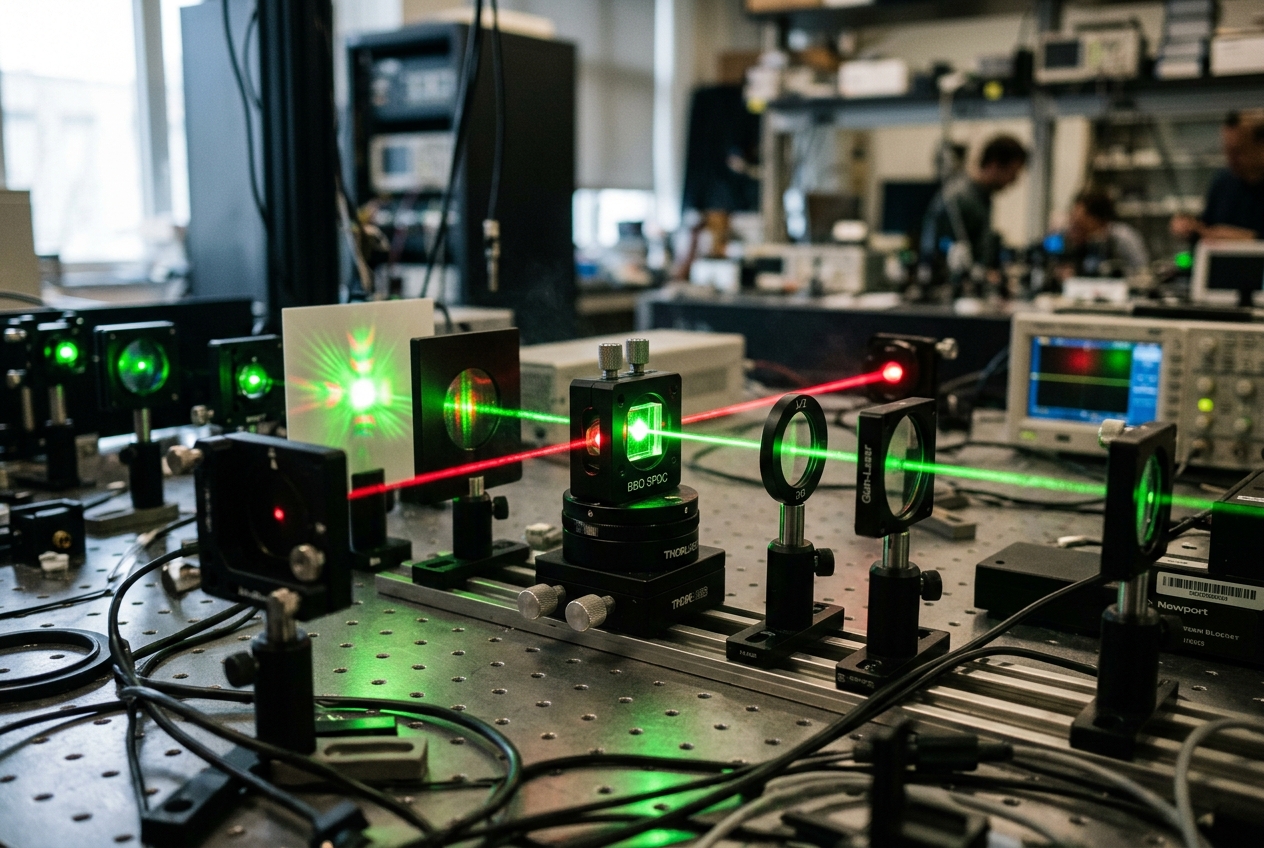
At the very heart of this modern cryptographic and communicative revolution lies an astonishing mathematical principle known as the Quantum Decoupling Theorem. Decoupling reveals something deeply counterintuitive about how nature handles secrets: to protect quantum information from a hostile environment, you do not build impenetrable classical firewalls. Instead, you deliberately scramble the information through randomized quantum operations until it is completely severed—or decoupled—from the surrounding universe. Once the environment holds nothing but pure, uncorrelated static, the laws of quantum mechanics guarantee that the pristine secret has arrived safely in the hands of your intended recipient.
Regarded by mathematical physicists as the master engine of quantum information theory, the decoupling theorem has spent the past two decades quietly unifying disparate branches of modern science. It provides the mathematical blueprint for transmitting quantum states across noisy optical fibers, explains how future distributed quantum supercomputers will merge information, and even resolves deep paradoxes regarding how matter and radiation evaporate across the event horizons of black holes.
1. The Idea in Plain English
To understand decoupling, consider a physical analogy. Imagine you have written a top-secret message on a sheet of paper. If an adversary steals even a quarter of that sheet, they might piece together critical words or signatures. Classical information is localized: if you drop a letter into an open room, fragments of meaning linger everywhere.
Now imagine instead that you pass that paper through a sophisticated quantum scrambler. The scrambler does not destroy the information; it redistributes every syllable across hundreds of thousands of microscopic particles using quantum entanglement. Next, you randomly divide the resulting cloud of particles: 40% are discarded into the environment (where an eavesdropper might collect them), while 60% are gathered by your intended receiver.
Common sense suggests that the eavesdropper, possessing 40% of the physical particles, must have learned roughly 40% of your secret. In the quantum realm, this intuition is entirely false. If the scrambling operation was sufficiently uniform, the particles gathered by the eavesdropper will exhibit a mathematical state of maximum entropy—pure, uniform randomness. From the perspective of the eavesdropper, their collection of particles contains literally zero information about the original message. It is statistically indistinguishable from background thermal noise.
The Conservation Law of Quantum Secrecy
In quantum physics, information cannot be duplicated (the no-cloning theorem) nor can it simply vanish. This implies an ironclad conservation law known as the monogamy of entanglement. If a scrambling process ensures that the environment is completely decoupled from your message—holding zero correlations with it—then all of the correlations and information must, by mathematical necessity, be concentrated entirely within the remaining particles held by your legitimate receiver.
In quantum mechanics, a fundamental unit of information—the qubit—is not a simple binary switch that is either 0 or 1. It is a state that can exist in a superposition of both states simultaneously until measured. When multiple qubits become entangled, their collective reality cannot be described by looking at individual pieces in isolation. Decoupling leverages this collective entanglement: by rotating and mixing the quantum states through a randomized unitary transformation, we sever the correlations between the message and any unintended observer.
2. How It Actually Works — The Mechanics
To transform this intuition into a rigorous engineering framework, researchers led by Renato Renner, Andreas Winter, and Patrick Hayden formalized the Quantum Decoupling Theorem. The theorem addresses a concrete setup: we begin with a quantum system $A$ that shares entanglement with a reference system $R$ (our sacred secret) and an environment $E$. We apply a global scrambling operation—a unitary rotation $U$—to system $A$, and then partition $A$ into two subsystems: a portion $B$ that we discard to the environment, and a preserved portion $A_1$.
The fundamental question is: How large must the discarded portion $B$ be before the environment $E$ learns nothing about the reference $R$?
The mathematical answer is formulated using the trace distance, denoted by $|\cdot|_1$, which measures the operational indistinguishability between two quantum states. If the trace distance between an eavesdropper’s actual quantum state and an idealized, uncorrelated state is near zero, no physical measurement can distinguish the eavesdropper's data from worthless noise.
The expected error of decoupling across all possible random scrambling rotations is bounded by a remarkably compact inequality:
$$\mathbb{E}{U \sim \mu{\text{Haar}}} \left| \rho_{A_1 E}(U) - \tau_{A_1} \otimes \rho_E \right|1 \le 2^{-\frac{1}{2} \left[ H{\min}^\epsilon(A|E)_\rho - \log |B| \right]} + 2\epsilon$$
In plain language, this inequality calculates the average distance between the real joint state of the preserved system and environment ($\rho_{A_1 E}$) and a completely decoupled state ($\tau_{A_1} \otimes \rho_E$, where $\tau_{A_1}$ is a completely random, maximally mixed state). It predicts that the trace distance drops exponentially toward zero the moment the size of the discarded partition $\log |B|$ balances the existing uncertainty in the system.
Here, $H_{\min}^\epsilon(A|E)$ represents the smooth conditional min-entropy, an information-theoretic quantity that measures how much genuine, extractable quantum randomness exists in system $A$ from the viewpoint of someone observing system $E$. If this entropy is large, only a modest amount of scrambling is required to decouple the systems completely.
The Engine of Proof: The Swap Trick and Unitary 2-Designs
To prove this theorem without evaluating infinitely complex integrals by brute force, mathematicians utilize an elegant technique known as the Swap trick. Evaluating the trace distance directly across a continuum of transformations is notoriously difficult. However, by exploiting the mathematical identity $\text{Tr}(X^2) = \text{Tr}((X \otimes X) \mathbb{S})$, where $\mathbb{S}$ is the permutation operator that swaps two identical copies of a quantum system, the calculation of quantum purity is transformed into evaluating permutations on duplicate state spaces.
When averaging these swaps over the Haar measure—the uniform mathematical distribution over all conceivable rotations in quantum state space—the integration collapses into simple combinations of the identity and swap operators via Schur-Weyl duality:
$$\int_{\mathcal{U}(d)} (U \otimes U) M (U^\dagger \otimes U^\dagger) \, d\mu(U) = \alpha \, \mathbb{I} + \beta \, \mathbb{S}$$
This reveals a profound computational insight: you do not need true, infinite physical randomness to achieve decoupling. A physical scrambler only needs to mimic the first two statistical moments of the Haar measure—a structure known as a unitary 2-design. Efficient, discrete quantum circuits composed of simple logic gates (such as random Clifford circuits) achieve the exact same decoupling power in practice, making the theorem physically actionable in real laboratory devices.
3. The Generative Engine of Quantum Shannon Theory
Because decoupling establishes the exact boundary where an eavesdropper or noise bath becomes blind to a message, it acts as a foundational generative engine. By tuning the parameters of the decoupling inequality, researchers can derive the most famous channel-coding theorems in quantum science:
- The Lloyd-Shor-Devetak (LSD) Theorem: Formulated through pioneering work accessible on MIT OpenCourseWare, this theorem defines the ultimate rate at which pristine quantum information can be sent through a noisy communication channel. Decoupling proves the LSD theorem by treating the channel's noise mechanism as the discarded system $B$. If the input is scrambled such that the noise bath decouples from the message, all quantum states arrive error-free at the other end.
- Quantum State Merging: Imagine two distributed quantum processors, Alice and Bob, each holding parts of a widely entangled quantum state. State merging determines how many classical bits Alice must send Bob to transfer her full state to him. Decoupling reveals that if their shared conditional entropy is negative, Alice does not need to pay a communication cost; instead, she and Bob gain net entanglement during the transfer.
- Information Locking and Cryptographic Privacy: In classical cryptography, hiding a 1,000-bit secret requires a 1,000-bit key. In quantum systems, decoupling proves that a minuscule 10-qubit key applied to a scrambled state can mathematically "lock" an arbitrary volume of information. Without that tiny key, the adversary's state is completely decoupled from the data, revealing nothing.
4. Real-World Applications Today (2024–2026)
Decoupling is no longer confined to blackboard proofs; it is actively shaping cutting-edge research across world-leading technology institutes and industrial laboratories:
| Field & Focus | Institution / Enterprise | Mechanism | Quantum Advantage |
|---|---|---|---|
| Distributed Quantum Cloud Computing | IBM Quantum & Qiskit Research | Quantum state merging via pseudo-random Clifford circuits | Enables direct linking of modular quantum processing units (QPUs) across cryogenic cables with minimal classical overhead. |
| Fault-Tolerant Quantum Error Correction | Google Quantum AI & Harvard University | Randomized benchmarking & 2-design syndrome extraction | Rapidly decouples logical qubits from local thermal noise baths, preserving computational coherence across thousands of cycles. |
| Unconditional Cryptographic Verification | Max Planck Institute of Quantum Optics | Smooth min-entropy decoupling bounds in QKD networks | Provides mathematical guarantees that fiber-optic side-channel eavesdroppers hold zero extractable key information. |
| Black Hole Scrambling & Holography | Caltech & Institute for Advanced Study | Hayden-Preskill protocol modeling fast-scrambling horizons | Formulates how quantum information thrown into a black hole is rapidly decrypted and radiated through Hawking emissions. |
At IBM Quantum, engineers are deploying randomized compiling techniques rooted in decoupling theory to mitigate coherent gate errors. By injecting pseudorandom unitary gates into quantum circuits, systematic hardware noise is transformed into uncorrelated, stochastic noise that is easily decoupled and removed.
In theoretical astrophysics, as documented in peer-reviewed analyses in Nature, the decoupling theorem solved the famous Hayden-Preskill thought experiment. If you toss a secret diary into an old black hole that has already radiated half its mass, the black hole acts as an optimal quantum scrambler. Decoupling proves that an outside observer collecting just a few subsequent photons of Hawking radiation can instantly reconstruct the entire diary—a discovery that fundamentally reshaped modern quantum gravity and holography.
5. What This Means for You
While the mathematics of smooth min-entropies and unitary designs may belong to high-level physics, the practical consequences of decoupling directly affect our daily digital lives.
First and foremost, decoupling provides the mathematical backbone for true post-quantum security. Classical encryption algorithms can always be broken by future advancements in mathematical algorithms or computing hardware. In contrast, quantum cryptographic systems designed under decoupling theorems are protected by the geometry of physical law. When data is transmitted via a decoupling-secured quantum link, eavesdropping is not merely "computationally intractable"—it is physically impossible, as no correlations exist in the adversary's domain to be computed.
Furthermore, this principle paves the way for a secure, distributed Quantum Internet. In the coming decades, sensitive molecular simulations for drug design, proprietary financial portfolio optimizations, and private artificial intelligence queries will run on cloud-based quantum mainframes. Decoupling protocols will allow users to submit computational tasks to remote supercomputers in a state of complete blindness: the cloud server processes the quantum computation without its internal processors ever possessing the state information required to reconstruct what it is computing.
6. Today's Takeaway
If you remember one thing about the quantum decoupling theorem, let it be this: in the quantum world, the most effective way to safeguard a secret is not to hide it behind a barrier, but to disperse it so thoroughly through random quantum scrambling that it ceases to exist in any single part of the environment. Decoupling turns apparent chaos into absolute privacy, proving that when an unwanted observer is left with pure randomness, the complete and uncorrupted truth is guaranteed to arrive wherever you choose to send it.