Gentle Measurement Lemma: Bounding State Disturbance Under High-Probability Quantum Measurements
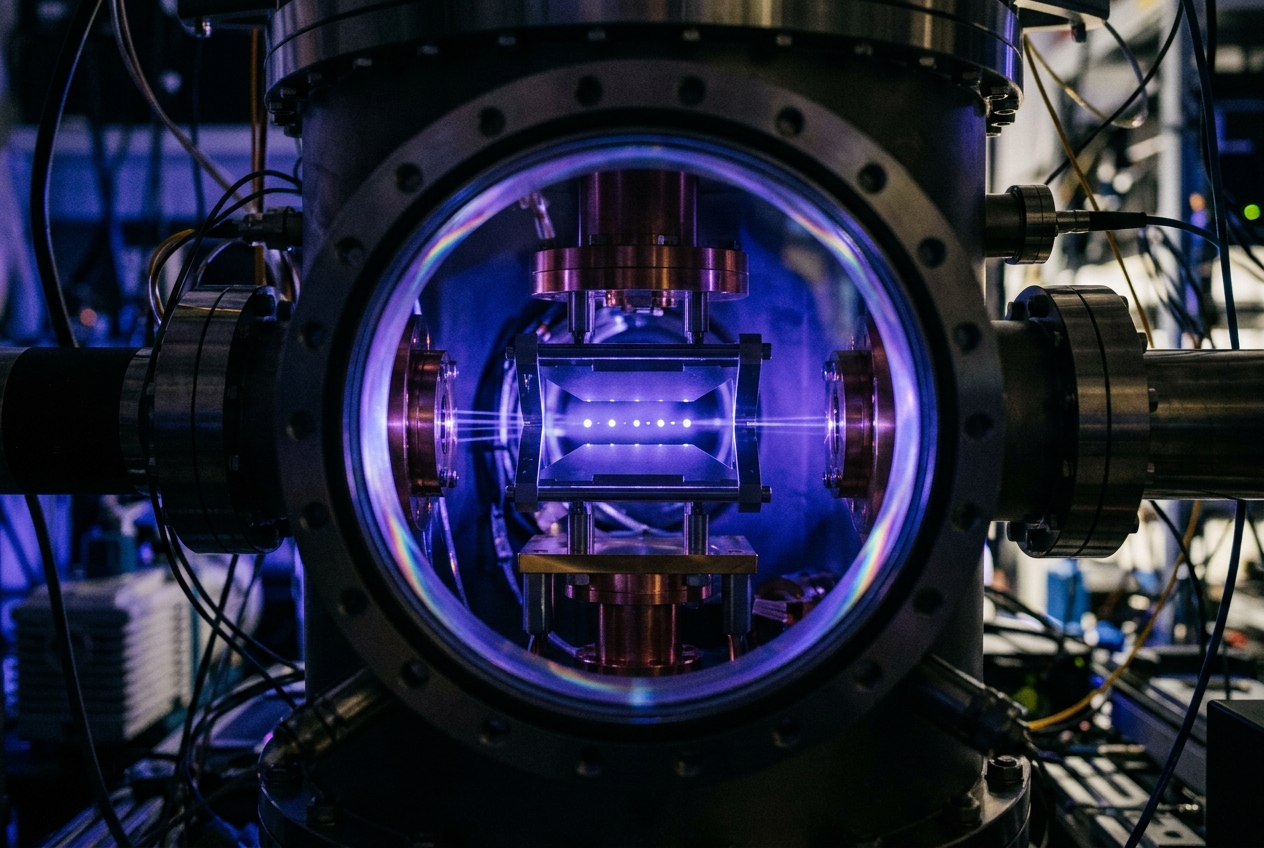
The encryption protocols that safeguard global commerce, protect sovereign intelligence, and secure your personal bank accounts rest upon a fragile foundation of mathematical complexity. A contemporary supercomputer would require millions of years to factor a 2048-bit RSA integer; a fault-tolerant quantum computer running Shor’s algorithm could accomplish the task in an afternoon. Yet, for decades, the greatest theoretical hurdle to realizing this immense computational paradigm was not merely building physical hardware, but overcoming an apparently immutable law of the microscopic world: the destructive act of observation itself.
In classical computing, checking the value of a bit stored on a silicon transistor is entirely benign. You can read a voltage ten billion times without altering the charge trapped in the capacitor. In the quantum realm, however, elementary physics textbooks have long taught a brutal dogma: to measure a quantum state is to annihilate its delicate nature. A single photon or trapped ion existing in a fragile superposition of possibilities, once struck by a detector, collapses irreversibly into an arbitrary classical outcome, erasing all unmeasured information.
If every measurement were an existential death sentence for quantum data, how could a quantum computer ever verify intermediate results, decode complex communications, or recycle precious cryptographic keys? The answer lies in one of the most profound and elegant discoveries in theoretical physics: the Gentle Measurement Lemma. This mathematical principle demonstrates that if a quantum measurement is configured such that a specific outcome is overwhelmingly likely to occur, the measurement disturbs the underlying quantum state almost not at all. Far from being a blunt sledgehammer that shatters reality, quantum measurement can be transformed into a feather-light brush—allowing quantum processors to extract vital intelligence while leaving the underlying quantum wavefunction intact.
2. The Idea in Plain English
To understand why the Gentle Measurement Lemma revolutionized quantum information theory, one must first dismantle the orthodox myth of wavepacket collapse.
In popular culture, a quantum bit—or qubit—is often described as a spinning coin. While spinning on a tabletop, it is neither purely heads nor tails, but a dynamic blend of both. The traditional view of quantum mechanics, formalized by John von Neumann in 1932, treats measurement as an iron hand slamming down on the spinning coin. The coin is instantly forced flat against the table. The continuous, shimmering rotational energy is violently arrested, and all information about the coin's prior tilt, velocity, and trajectory is destroyed forever. This is known in physics as a projective measurement.
Now imagine an entirely different physical scenario. Suppose you have a suspended soap bubble floating in the air. If you strike the bubble with a dry needle, the surface tension ruptures instantaneously: the bubble vanishes into a spray of microscopic droplets. But suppose instead that you gently blow a faint stream of humid air near the bubble, or illuminate it with a low-intensity, non-absorbing laser beam to detect its shadow on a distant screen. If the bubble is already located precisely where your detector expects it to be, the optical reflection confirms its presence without exerting enough radiation pressure to burst the soap film. The bubble continues its gentle drift through space, undisturbed.
In quantum mechanics, this delicate interaction is governed by a framework known as a Positive Operator-Valued Measure (POVM). A POVM element is a generalized mathematical sensor. Instead of demanding an absolute, all-or-nothing projection onto a rigid coordinate axis, a POVM allows for "soft" or "partial" measurements.
The core intuition of the Gentle Measurement Lemma is straightforward: information extraction is proportional to surprise. If your quantum apparatus asks a question to which the quantum state almost certainly answers "yes," the act of confirming that "yes" imparts virtually zero back-action onto the state. The quantum state passes through the detector almost completely unperturbed, retaining its superpositions, its phase relationships, and its quantum entanglement.
3. How It Actually Works — The Mechanics, Geometry, and Mathematical Foundations
To formalize this intuition, we turn to the foundational work of Andreas Winter (1999), subsequently refined by Tomohiro Ogawa and Hiroshi Nagaoka (2007). Their mathematical formulation established the exact quantitative boundary between measurement probability and physical state disturbance.
The Formal Setting and Lüders Update Rule
Consider an arbitrary quantum system whose physical configuration is described by a density operator $\rho$ (a positive semi-definite matrix with trace equal to one, acting on a complex Hilbert space $\mathcal{H}$). We subject this state to a generalized measurement containing an effect operator $A$, satisfying the algebraic bounds:
$$0 \le A \le I$$
where $I$ denotes the identity operator. The operator $A$ corresponds to detecting a specific physical property. The fundamental Born rule of quantum mechanics dictates that the probability $P(A)$ of obtaining the measurement outcome associated with $A$ is given by the trace of their matrix product:
$$\operatorname{Tr}(A\rho) \ge 1 - \varepsilon$$
Here, $\varepsilon \in [0, 1]$ represents the measurement's error margin—the tiny probability that the test fails to detect the expected property. When $\varepsilon$ is extraordinarily small, the state $\rho$ is said to pass the measurement test with near certainty.
When the measurement yields the outcome corresponding to $A$, the state transforms according to the generalized Lüders update rule, producing a post-measurement density operator $\rho'$:
$$\rho' = \frac{\sqrt{A}\rho\sqrt{A}}{\operatorname{Tr}(A\rho)}$$
+-----------------------------------------------------------------------------------------+
|                               THE GENTLE MEASUREMENT LEMMA                              |
|                                                                                         |
|  Let ρ be a quantum density operator and let A be a POVM measurement operator such     |
|  that 0 ≤ A ≤ I. If the measurement outcome occurs with probability:                    |
|                                                                                         |
|                              Tr(Aρ) ≥ 1 - ε                                            |
|                                                                                         |
|  Then the post-measurement state ρ' is bounded in trace distance by:                   |
|                                                                                         |
|                       ||ρ - ρ'||₁ ≤ 2√ε                                                 |
|                                                                                         |
|  and satisfies the fidelity lower bound:                                                |
|                                                                                         |
|                         F(ρ, ρ') ≥ 1 - ε                                                |
+-----------------------------------------------------------------------------------------+
Deriving the Perturbation Bound
The distance between the original quantum state $\rho$ and the post-measurement state $\rho'$ is measured using the trace distance, denoted $|\rho - \rho'|_1 = \operatorname{Tr}|\rho - \rho'|$. In quantum information theory, trace distance has a direct operational meaning: it represents the maximum possible statistical difference between the two states under any physical experiment imaginable. If the trace distance between two states is at most $\delta$, no detector can distinguish between them with a probability advantage greater than $\delta / 2$.
The proof of the Gentle Measurement Lemma proceeds by decomposing the total disturbance into two manageable components: the unnormalized operator difference and the normalization scalar.
First, consider the unnormalized post-measurement state $\tilde{\rho} = \sqrt{A}\rho\sqrt{A}$. By applying the triangle inequality to the trace distance, we separate the comparison into:
$$|\rho - \rho'|_1 \le |\rho - \tilde{\rho}|_1 + |\tilde{\rho} - \rho'|_1$$
The second term accounts purely for the normalization constant $\lambda = \operatorname{Tr}(A\rho) \ge 1 - \varepsilon$. Since $\rho' = \tilde{\rho}/\lambda$, we have:
$$|\tilde{\rho} - \rho'|_1 = \operatorname{Tr}(\tilde{\rho}) \left| 1 - \frac{1}{\lambda} \right| = \lambda \left( \frac{1 - \lambda}{\lambda} \right) = 1 - \lambda \le \varepsilon$$
To bound the first term $|\rho - \tilde{\rho}|_1$, we employ the non-commutative Cauchy-Schwarz inequality for matrix operators. Expressing the difference as $\rho - \sqrt{A}\rho\sqrt{A} = (I - \sqrt{A})\rho + \sqrt{A}\rho(I - \sqrt{A})$, and exploiting the operator inequality $(I - \sqrt{A})^2 \le I - A$ for $0 \le A \le I$, we arrive at the geometric relation:
$$|\rho - \sqrt{A}\rho\sqrt{A}|_1 \le 2 \sqrt{\operatorname{Tr}((I - A)\rho)} \le 2\sqrt{\varepsilon}$$
Combining these bounds demonstrates that the total state disturbance is strictly bounded by $2\sqrt{\varepsilon}$. When $\varepsilon \to 0$, the trace distance collapses to zero at the rate of $\sqrt{\varepsilon}$.
Simultaneously, evaluating the Uhlmann fidelity $F(\rho, \rho') = \left(\operatorname{Tr}\sqrt{\sqrt{\rho}\rho'\sqrt{\rho}}\right)^2$ yields a direct fidelity guarantee:
$$F(\rho, \rho') \ge \operatorname{Tr}(A\rho) \ge 1 - \varepsilon$$
This proves that the overlap between the initial quantum state and the measured quantum state remains nearly absolute.
       Geometric View in Hilbert Space:

                |ψ⟩ (Original State)
                 ^
                 | \  Angle θ ~ O(√ε)
                 |   \
                 |     v
                 +-------> |ψ'⟩ = √A|ψ⟩ / ||√A|ψ⟩|| (Post-Measurement State)
                 |
                 +----------------------------------> Subspace ker(A) (Orthogonal)
The Non-Commutative Frontier: Sen’s Union Bound
In classical probability theory, Boole’s union bound is an indispensable tool: if you have a sequence of $k$ possible failure events, each occurring with probability at most $\varepsilon$, the total probability that at least one failure occurs is bounded by the simple linear sum $k\varepsilon$.
In the quantum domain, this classical intuition historically collapsed. If you perform a sequence of $k$ distinct measurements governed by operators $A_1, A_2, \dots, A_k$, the operators generally do not commute:
$$[A_i, A_j] = A_i A_j - A_j A_i \ne 0$$
Because the operators do not commute, applying the first measurement $A_1$ alters the basis, which could theoretically rotate the quantum state into an orientation that triggers a catastrophic failure during the second measurement $A_2$.
In 2012, computer scientist Pranab Sen achieved a historic breakthrough by formulating the Quantum (Non-Commutative) Union Bound. Sen proved that if a quantum state $\rho$ satisfies $\operatorname{Tr}(A_i \rho) \ge 1 - \varepsilon$ for each individual operator $A_i$ in a sequence of $k$ tests, then sequentially applying the tests $A_1, A_2, \dots, A_k$ yields a final state whose cumulative disturbance is bounded by:
$$|\rho - \rho_{\text{final}}|1 \le 2\sqrt{k\sum{i=1}^k \varepsilon_i}$$
Sen’s lemma demonstrated that non-commutativity does not cause exponential instability. As long as each individual measurement is sufficiently gentle, a quantum system can undergo an extended cascade of sequential measurements without losing its coherence.
4. Real-World Applications Today
The Gentle Measurement Lemma and its sequential extensions are not mere theoretical curiosities. Between 2024 and 2026, they have become foundational mathematical engines powering quantum communications, computational complexity, state tomography, and physical hardware engineering.
+----------------------------------------------------------------------------------------------------+
|                               LANDMARK APPLICATIONS ACROSS QUANTUM SCIENCE                         |
|                                                                                                    |
|  1. HSW Sequential Decoding     --> Transmitting data at the Holevo channel capacity limit.        |
|  2. QMA Witness Recycling       --> Reusing uncloneable quantum cryptographic proof states.        |
|  3. Shadow Tomography           --> Predicting thousands of quantum observables from few samples.  |
|  4. Cavity QED / cQED Readout   --> Non-destructive photon counting and dispersive qubit readout.  |
+----------------------------------------------------------------------------------------------------+
1. Quantum Communications and the Holevo-Schumacher-Westmoreland (HSW) Theorem
- Institutions: MIT OpenCourseWare Quantum Information Lab, Max Planck Institute for Quantum Optics.
- The Challenge: Transmitting classical messages across a noisy quantum channel (such as a fiber-optic cable carrying entangled photons) at the maximum possible information transmission rate, known as the Holevo capacity.
- The Gentle Advantage: The HSW theorem states that messages can be encoded as dense quantum codewords. However, decoding requires the receiver to test the received quantum state against an exponential dictionary of potential codewords ($2^{nR}$ possibilities). Classically, testing a hypothesis destroys the signal. By employing sequential gentle measurements, the receiver can test the incoming photon state against codeword after codeword. If the state does not match codeword $j$, the gentle nature of the test leaves the photon unaffected, allowing the receiver to proceed sequentially until the correct codeword is identified without corrupting the signal.
2. Witness Recycling in Quantum Complexity (QMA and Quantum Interactive Proofs)
- Institutions: Caltech Institute for Quantum Information and Matter (IQIM), University of Waterloo (Institute for Quantum Computing).
- The Challenge: In the quantum analogue of the class NP—known as Quantum Merlin-Arthur (QMA)—an untrusted prover (Merlin) sends a delicate, multi-qubit quantum state $|\psi\rangle$ (a "quantum witness") to a verifier (Arthur) to prove the solution to an exponentially hard problem. Because the No-Cloning Theorem strictly forbids copying an arbitrary quantum state, Arthur cannot duplicate the witness to run multiple verification checks.
- The Gentle Advantage: If Arthur utilizes standard projective measurements, his first check consumes the witness, leaving him vulnerable to deception if multiple properties must be validated. Using the Gentle Measurement Lemma, Arthur executes high-probability verification subroutines gently. Because the state is preserved with high fidelity, Arthur can recycle the single physical witness across dozens of successive verification rounds, dramatically reducing the communication overhead of quantum zero-knowledge proofs.
3. Sample-Efficient Shadow Tomography
- Institutions: Google Quantum AI, Harvard Quantum Initiative.
- The Challenge: Fully characterizing an unknown $n$-qubit quantum state $\rho$ (full state tomography) requires measuring a number of experimental copies that scales exponentially with the system size ($2^n$), creating an intractable bottleneck for verifying 50-to-1000-qubit processors.
- The Gentle Advantage: Formulated by Scott Aaronson and expanded through classical shadows, shadow tomography allows researchers to accurately predict the expectation values of $M$ different physical observables using only poly($n, \log M$) copies of the state. The Gentle Measurement Lemma is the underlying mathematical engine: a single copy of a 100-qubit processor state can be measured against a sequence of carefully calibrated POVMs, extracting predictive "shadows" of multiple physical observables without collapsing the state between iterations.
4. Cavity QED and Dispersive Readout in Superconducting Qubits
- Institutions: IBM Quantum, Yale Quantum Institute, Laboratoire Kastler Brossel (ENS Paris).
- The Challenge: Reading out the state of a superconducting transmon qubit or counting the exact number of microwave photons trapped inside a superconducting cavity without absorbing or destroying the photons.
- The Gentle Advantage: In circuit quantum electrodynamics (cQED), experimentalists couple a transmon qubit to a microwave readout cavity detuned far from the qubit’s resonance frequency. This configuration, known as the dispersive regime, implements a physical realization of a gentle measurement. Instead of absorbing photons, the apparatus measures a tiny state-dependent frequency shift in the microwave carrier wave. As documented in publications across Nature and Physical Review Letters, this enables Quantum Non-Demolition (QND) readout, allowing engineers to track quantum errors in real-time without halting the processor's active computation.
5. What This Means for You
To anyone outside a physics laboratory, quantum mechanics can often seem like an esoteric exercise in mathematical abstraction. Yet the Gentle Measurement Lemma directly underpins the engineering principles that will shape twenty-first-century digital life.
Consider the security of your future medical records, financial data, and digital identity. In the coming decade, classical cryptography will transition to a global Quantum Internet, where sensitive information is distributed using quantum key distribution (QKD) and protected by quantum error correction.
In long-distance quantum networks, optical signals degrade over fiber cables. Classical networks use amplifiers to read, boost, and retransmit the bits. But you cannot amplify a quantum signal because copying it is physically impossible. Instead, quantum networks rely on quantum repeaters—devices that perform gentle, non-destructive entanglement swaps and parity checks.
Without the mathematical assurance that these monitoring checks can be performed without corrupting the underlying quantum payloads, intercontinental quantum communication would be physically impossible. Every time a future quantum computer runs a simulation to design room-temperature superconductors or synthesize life-saving cancer therapeutics, it will execute millions of gentle parity measurements per second, quietly preserving the integrity of the computation while keeping physical noise at bay.
6. Today’s Takeaway
The central revelation of the Gentle Measurement Lemma is that observation in the quantum world is not inherently destructive; destruction is merely the price of ignorance. When a quantum measurement asks a question whose answer is nearly certain, nature allows us to extract that confirmation while inflicting almost zero disturbance on the physical state. By bounding state perturbation to a factor of twice the square root of the failure probability, this mathematical masterpiece transforms quantum measurement from an uncontrollable collapse into a precise, non-destructive instrument—unlocking sequential communications decoding, witness recycling in quantum cryptography, and fault-tolerant computing across the global quantum frontier.