Haah's Code: Structuring 3D Topological Memory, Fracton Excitations, and Glassy Self-Correction
Quantum computers possess no such luxury. The fragile superposition states that give quantum algorithms their extraordinary computational power—allowing them to simulate complex molecular chemistry, optimize planetary-scale logistics, and potentially dismantle the RSA cryptographic infrastructure protecting the modern internet—are vulnerable to the slightest whisper of environmental heat. Today’s leading quantum processors, developed by institutions such as IBM Quantum Research, must perform an exhausting, continuous routine known as active error correction. Auxiliary "syndrome" qubits are measured hundreds of thousands of times per second to detect and patch quantum bit-flips and phase-flips before they ruin the calculation.
If quantum information is ever to scale beyond specialized laboratory cryostats into practical, scalable technologies, we must discover materials that can store quantum states passively. In 2011, while investigating the fundamental limits of physical information storage, mathematical physicist Jeongwan Haah introduced a revolutionary theoretical model that shocked the physics community: Haah’s Cubic Code. By arranging quantum bits within a three-dimensional crystal lattice governed by fractal geometry, Haah demonstrated that quantum errors could be frozen into immobility. In doing so, he cracked open an entirely new domain of condensed matter physics known as fracton topological order.
1. The Idea in Plain English: From Wandering Strings to Fractal Cages
To understand why building a self-correcting quantum memory is so profoundly difficult, we must first picture how a quantum bit differs from a classical bit. A classical bit is like a coin resting flat on a table: it is unambiguously heads or tails. A quantum bit, or qubit, is like a coin spinning dynamically on its edge. It can exist in a continuous blend of possibilities, and disturbing its delicate axis of rotation destroys the quantum information encoded within it.
In modern quantum error correction, we do not store a delicate piece of information in a single physical qubit. Instead, we distribute that single logical piece of information across a vast, interwoven fabric of hundreds of physical qubits using what physicists call a stabilizer code.
The standard workhorse of the field is the two-dimensional surface code, originally conceptualized in the foundational studies of topological quantum memory at MIT OpenCourseWare Quantum Physics. Picture a two-dimensional checkerboard where qubits sit on every intersection. When environmental heat strikes one of the qubits, it creates a pair of localized energetic defects known as anyons.
Herein lies the fatal flaw of two-dimensional quantum architectures: once created, these anyons are connected by invisible mathematical "strings" that have zero physical tension. It costs a small burst of energy to create the two defect endpoints, but it costs absolutely zero additional energy to walk them across the entire checkerboard. As environmental heat nudges these particles around, they wander freely across the two-dimensional plane. When an anyon wanders all the way from one side of the chip to the other, it cuts a silent swath through the encoded data, executing a fatal logical error without leaving any localized energy penalty behind. Thus, at any temperature above absolute zero, a 2D surface code inevitably decays over time unless an active external computer continuously monitors and clears the defects.
Physicists knew that in a hypothetical four-dimensional universe, quantum information could protect itself. In four spatial dimensions, the errors in a topological code are not point-like particles at the ends of strings; they are expanding two-dimensional bubbles. Just like blowing up a soapy bubble requires continuous energy to stretch its surface tension, expanding a quantum error in 4D requires an energy cost that grows steadily with the area of the bubble. The four-dimensional memory has an impenetrable macroscopic energy barrier that naturally suppresses thermal errors.
For years, a fundamental question haunted quantum information theory: Can a quantum memory achieve passive stability in our three-dimensional physical universe?
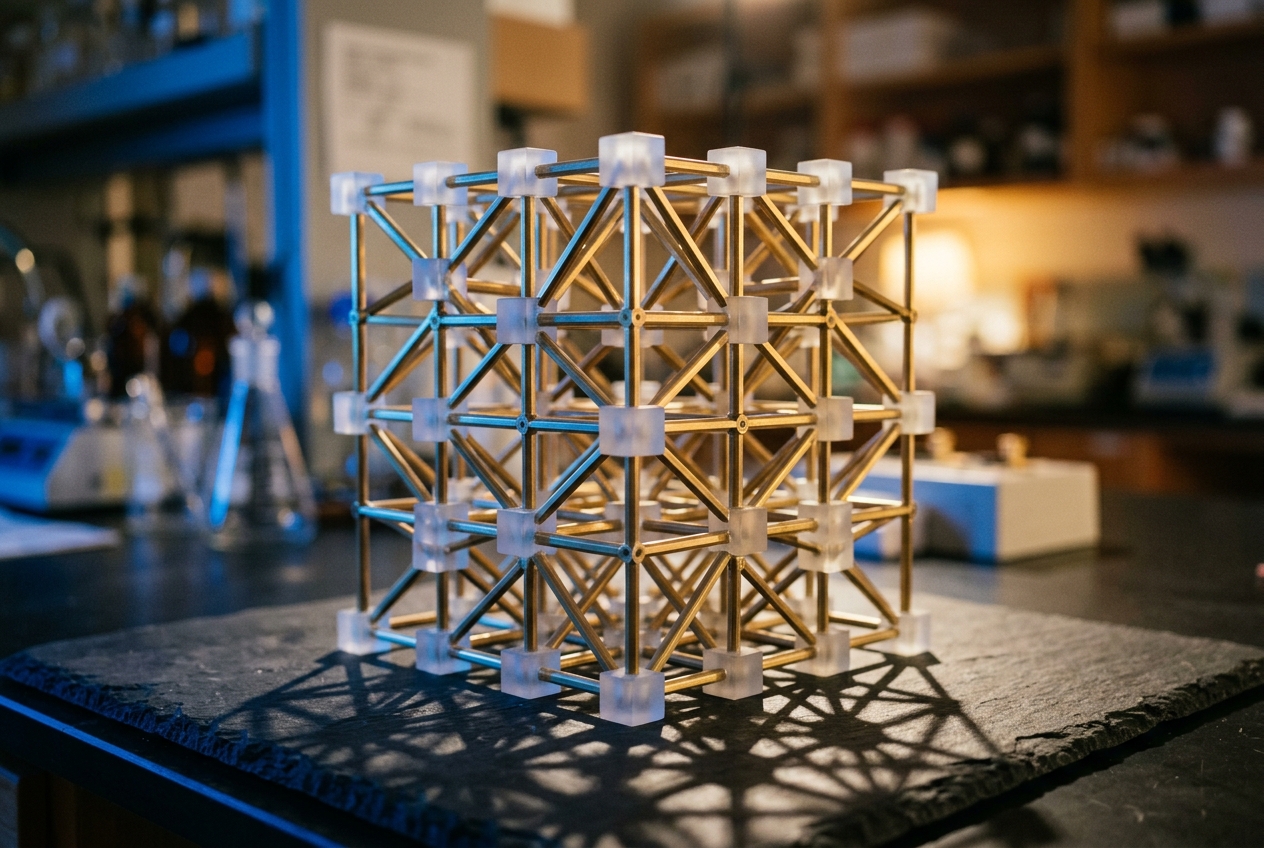
Haah’s answer was as brilliant as it was unexpected. Instead of designing a code where errors are point particles that move along lines, or membranes that grow along planes, he engineered a 3D lattice where errors are trapped in a self-similar fractal web. If environmental heat flips a qubit in Haah's code, it creates four point defects arranged at the corners of a tetrahedron. If you attempt to push one of these defects to an adjacent site, it refuses to move alone; it branches into four new defects. Trying to move those creates sixteen more.
The defects cannot move unless they spawn an exponentially growing, branching tree of energy-consuming excitations—a structure mimicking the famous Sierpinski fractal triangle. Because moving an error requires paying an escalating energy toll at every step, the defects are effectively locked in place. Physicists termed these immobile quantum excitations fractons.
2. How It Actually Works: The Mechanics of Fracton Topological Order
To see the engine under the hood, we must look at how qubits and their checks are algebraically organized on a three-dimensional cubic lattice. In Haah’s code, every corner vertex of a 3D grid does not hold just one qubit, but two distinct physical qubits.
The code belongs to the family of stabilizer codes, which are defined by a collection of local quantum measurements (stabilizers) that must all yield a positive outcome (+1) when the memory is uncorrupted. If an error occurs, one or more stabilizers flip to a negative outcome (-1), creating an energetic defect that flags the presence of noise.
To mathematically express these interactions across three-dimensional space without drowning in trillions of individual matrix terms, Haah used the elegant language of Laurent polynomial rings over the two-element Galois field $\mathbb{F}_2 = {0, 1}$. In this algebraic representation, shifting a position by one step in the $x$, $y$, or $z$ direction corresponds to multiplying by the algebraic variables $x$, $y$, or $z$. A value of $1$ represents the presence of an interaction, and arithmetic is evaluated modulo 2 (where $1 + 1 = 0$).
Each unit cube in the lattice hosts two complementary stabilizer checks: an $X$-type stabilizer measuring quantum phase alignments, and a $Z$-type stabilizer measuring quantum bit alignments. The mathematical matrix describing which Pauli operators act on the two qubits across the eight corners of the cube is defined by a pair of generator polynomials:
$$G(x,y,z) = \begin{pmatrix} 1 + x + y + z & 1 + x y + y z + z x \ 1 + x^{-1}y^{-1} + y^{-1}z^{-1} + z^{-1}x^{-1} & 1 + x^{-1} + y^{-1} + z^{-1} \end{pmatrix}$$
This algebraic matrix encodes the exact spatial blueprint of the stabilizer. The first row defines the $X$-type stabilizer check, and the second row defines the $Z$-type stabilizer check. The terms with negative exponents ($x^{-1}, y^{-1}, z^{-1}$) represent the dual spatial inversion that guarantees that all $X$ checks and $Z$ checks commute with one another everywhere across the lattice—the foundational requirement for any valid stabilizer quantum code.
The Impossibility of Isolated Motion
What happens when an unwanted environmental fluctuation strikes this system? In a standard 2D surface code, applying a simple line of Pauli flip operators transfers an anyon from point $A$ to point $B$ while leaving the path between them completely free of energy defects.
In Haah's code, the polynomial structure prevents this entirely. There is no one-dimensional string operator in the algebra. When you multiply local operators together along a straight line, the algebraic terms do not cancel along the line. Instead, defects spill out sideways into the third dimension.
To separate a set of fracton defects by a distance $L$ without leaving a trail of high-energy defects across the lattice, the quantum operations must be applied over a discrete fractal operator whose spatial support matches a three-dimensional Sierpinski tetrahedron. The number of non-zero terms in this operator does not scale linearly with distance; it scales with the Hausdorff dimension of the fractal, $d_f = \log_2(4) = 2$.
Because any attempt to move a single fracton from one location to another forces the system to pass through intermediate configurations containing multiple branching defects, the energy barrier $\Delta E$ encountered during the translation process scales with the logarithm of the separation distance $L$:
$$\Delta E(L) = c \log_2 L + O(1)$$
In this logarithmic scaling equation, $c$ is a positive physical constant determined by the coupling strength of the cubic Hamiltonian, and $L$ is the linear width of the cubic quantum memory chip.
This logarithmic energy barrier produces a profound physical consequence known as glassy relaxation dynamics. In conventional physical systems, the time it takes for thermal noise to randomize stored data follows the classic Arrhenius law, depending only on a fixed energy barrier. But in Haah's cubic code, as the physical size of the crystal $L$ increases, the thermal relaxation time $\tau$ (the effective lifetime of the quantum memory) increases as a power law of the system size:
$$\tau(L, T) \sim \tau_0 L^{\frac{c}{k_B T}}$$
Here, $T$ is the environmental temperature, $k_B$ is the Boltzmann constant, and $\tau_0$ is the microscopic timescale of local atomic fluctuations.
At low temperatures, as the exponent $\frac{c}{k_B T}$ becomes large, doubling the physical dimensions of the lattice dramatically amplifies the memory's lifespan. While Haah's code is not an absolute self-correcting memory in the infinite thermodynamic limit ($L \to \infty$ at fixed non-zero temperature, where an infinite system would eventually cross the logarithmic barrier), for realistic, finite-sized hardware it provides an extraordinary degree of passive thermal shielding completely unattainable in two dimensions.
3. Real-World Applications Today (2024–2026)
Although Jeongwan Haah discovered the cubic code as a purely mathematical construct in mathematical physics, its principles have rippled across experimental laboratories and theoretical computer science departments worldwide. Between 2024 and 2026, several key frontiers have emerged:
1. 3D Neutral-Atom Quantum Processors
- Institutions: Harvard University, QuEra Computing, and the National Institute of Standards and Technology (NIST).
- The Mission: Using optical tweezers—highly focused laser beams—researchers are now suspending hundreds of neutral rubidium and ytterbium atoms in fully reconfigurable three-dimensional cubic grids rather than flat 2D chips.
- The Quantum Advantage: In 2D chips, physical wires and control lines quickly become congested as qubit counts grow. 3D neutral-atom architectures can natively interact across all three spatial coordinates via laser-induced Rydberg states. By programming multi-qubit interactions across elementary cubes, experimentalists can study 3D topological codes directly, evaluating whether 3D geometric protections reduce the need for active error-correction cycles.
2. High-Rate Quantum Low-Density Parity-Check (qLDPC) Codes
- Institutions: IBM Quantum Research, Yale University, and Inria.
- The Mission: Modern error-correction architectures are moving away from brute-force 2D surface codes toward high-rate quantum Low-Density Parity-Check (qLDPC) codes, such as bivariate bicycle codes.
- The Quantum Advantage: Haah’s breakthrough proved that the mathematics of multivariate polynomial rings ($\mathbb{F}_2[x,y,z]$) provides an immensely powerful tool for discovering novel codes. Building on this polynomial formalism, IBM and academic partners have designed codes that store dozens of protected logical qubits within just a few hundred physical qubits, reducing physical hardware overhead by over 90% compared to standard planar surface codes.
3. Synthetic Fracton Simulators and Quantum Materials
- Institutions: Max Planck Institute for the Physics of Complex Systems and the University of Colorado Boulder.
- The Mission: Synthesizing exotic quantum phases of matter governed by fracton constraints using superconducting circuit arrays (such as fluxonium and transmon networks) and trapped-ion systems.
- The Quantum Advantage: Standard quantum states are prone to rapid thermalization—they heat up and lose their quantum characteristics within fractions of a millisecond. By engineering synthetic systems with fracton topological order, researchers have observed "prethermalization" and severely arrested thermalization rates, opening new pathways for solid-state batteries and dissipationless quantum energy transport.
4. Solid-State Multi-Layer Spin Qubits
- Institutions: QuTech (TU Delft) and RIKEN Center for Quantum Computing.
- The Mission: Fabricating multi-layer semiconductor quantum dot arrays in silicon-germanium ($\text{Si/SiGe}$) heterostructures.
- The Quantum Advantage: Planar semiconductor spin qubits suffer from cross-talk and limited physical connectivity. By stacking quantum dots vertically across multiple functional layers, researchers are emulating multi-body stabilizer interactions in physical solid-state devices, working toward compact, semi-passive quantum memory registers that remain stable inside standard dilution refrigerators.
4. What This Means for You: The Path to Practical Quantum Advantage
It is easy to view quantum memory as an abstract puzzle for mathematical physicists, but the stakes directly touch the future of human technology.
The greatest bottleneck preventing quantum computers from solving life-changing problems—such as designing room-temperature superconductors, synthesizing new classes of antibiotics, or optimizing green fertilizer production to reduce global carbon emissions—is the staggering cost of active error correction.
Under current two-dimensional surface code methods, running an algorithm that requires 1,000 flawless quantum operations requires building a machine with nearly 1,000,000 physical qubits. Each of those physical qubits must be wired to high-speed classical electronics that constantly monitor the system, generating enormous thermal loads and requiring massive data bandwidth.
If fracton-inspired passive and semi-passive quantum memories can be realized in scalable materials, that equation changes completely. A quantum processor could store intermediate calculations in a solid-state topological memory bank that protects itself through the geometric laws of its own lattice, just like a hard drive platter does today.
For the average citizen, this transition from active, brute-force error correction to geometrically protected topological hardware will mark the difference between quantum computing remaining an exotic, billion-dollar cloud utility accessible only to tech giants, and becoming a transformative, widespread reality that accelerates medical discovery, materials design, and global logistics.
5. Today's Takeaway
Further Reading & Authoritative References
- Physical Review Letters — Topological Quantum Memory
- Nature Physics — Fracton Topological Order
- IBM Quantum Research Documentation & Code Architecture
- MIT OpenCourseWare — Quantum Information Processing
- Wikipedia — Quantum Error Correction and Stabilizer Formalisms
- arXiv Quantum Physics — Haah's Local 3D Stabilizer Code Without String Logical Operators