Fibonacci Anyons: Achieving Universal Topological Quantum Computation Through Non-Abelian Braiding and Golden Ratio Fusion Rules
1. Opening Hook — Why You Should Care
The global digital infrastructure rests upon a paradox: our most secure data vaults are protected by mathematical riddles that nature can easily unravel if we learn how to compute using her fundamental rules. Today, the RSA encryption shielding international banking, sovereign communications, and medical registries relies on the classical impossibility of factoring vast integers into their prime constituents. A standard supercomputer would require millions of years to break a single 2048-bit key. A mature quantum computer running Shor’s algorithm could accomplish the feat in an afternoon.
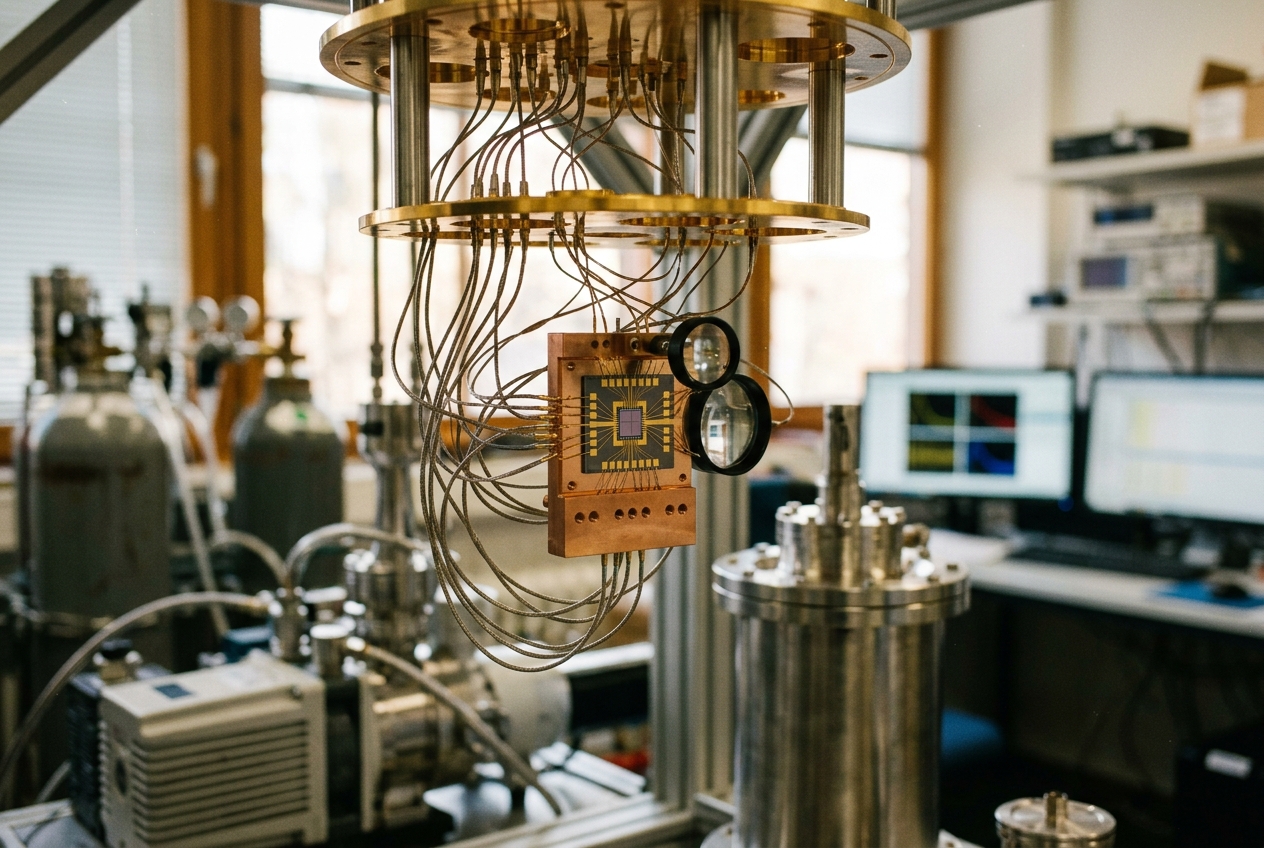
Yet, despite billions of dollars of investment and decades of laboratory breakthroughs, the quantum machines currently sitting in cryostats around the world remain fragile contraptions. Today’s quantum processors are plagued by noise. Stray thermal vibrations, microscopic electromagnetic fluctuations, and cosmic rays disrupt the fragile quantum states of standard physical qubits, causing calculations to degrade in microseconds. To protect a single "logical" qubit of clean data, current engineering roadmaps demand thousands of messy "physical" qubits running continuous, resource-draining error-correction cycles.
There is, however, an entirely different paradigm—one that does not merely fight noise with brute force, but designs noise immunity directly into the fabric of two-dimensional spacetime. This is the realm of topological quantum computation. At the apex of this architectural frontier sit exotic quasiparticles known as Fibonacci anyons. If physicists can successfully domesticate these mathematical entities, we will not need millions of noisy error-correction loops. The hardware itself will be naturally impervious to local errors, unlocking a stable computational canvas capable of simulating molecular chemistry, redesigning pharmaceutical discovery, and cracking centuries-old optimization problems with geometric elegance.
2. The Idea in Plain English
To understand what makes a Fibonacci anyon unique, one must first understand why ordinary particles fail to store protected quantum information.
In conventional computing, information is local. A bit is a voltage level at a specific point on a silicon chip; if stray radiation alters that voltage, the bit flips from zero to one, corrupting the memory. Traditional quantum bits (qubits) are even more vulnerable: imagine balancing a coin on its edge while the floor beneath you constantly shakes. The slightest shudder causes the coin to fall flat.
Topological computing replaces this precarious balance by storing information not in a single localized particle, but in the collective, global configuration of an entire system.
Consider a physical analogy: imagine attempting to write a secret message by drawing lines in loose sand versus tying a series of overhand knots in a thick silk ribbon. If a gust of wind blows through the room, the drawing in the sand is erased instantly. The knot in the ribbon, however, remains intact. You can shake the ribbon, heat it, or stretch it; unless you physically sever the cord or deliberately untie it, the knot persists. The information is stored topologically—in the global twist and winding of the thread—rather than in any single atom of the silk.
In the three-dimensional universe we inhabit, all fundamental particles belong to one of two families: bosons (such as photons of light) or fermions (such as electrons and quarks). When you swap the positions of two identical electrons in three dimensions, their collective quantum mathematical wave is multiplied by a simple factor of $-1$. When you swap two identical photons, the wave is multiplied by $+1$. If you swap them a second time, completing a full $360^\circ$ loop around each other, the state returns to precisely where it started.
However, when electrons are trapped in an ultra-thin, two-dimensional plane and cooled near absolute zero, the rules of physics change. In two dimensions, particles are no longer restricted to being bosons or fermions; they can be anyons—quasiparticles whose exchange statistics can yield any arbitrary phase or geometric transformation.
When these anyons are moved around one another over time, their trajectories trace out three-dimensional worldlines in spacetime (two spatial dimensions plus one time dimension). These worldlines wrap around each other, forming braids. The quantum state of the system is determined entirely by the topology of these braids. Local noise cannot untie a braid that spans across space and time.
Among all possible varieties of anyons, Fibonacci anyons are the ultimate prize. Most anyons are "Abelian," meaning that swapping particle A around particle B produces only an overall numerical phase factor, which is insufficient for universal computation. Other anyons, like Majorana zero modes, are "non-Abelian" (meaning the order of swaps changes the final state), but their braiding operations can only perform a restricted subset of quantum logic gates. Fibonacci anyons, by contrast, possess non-Abelian exchange properties so mathematically rich that simply braiding them around one another allows a programmer to perform any conceivable quantum calculation without ever needing external, error-prone patches.
3. How It Actually Works — The Mechanics
To see why Fibonacci anyons occupy this singular throne, we must examine the mathematical machinery that governs their behavior: fusion rules, non-integer quantum dimensions, topological consistency matrices, and dense braid representations.
The Fibonacci Fusion Algebra and the Golden Ratio
A topological phase of matter is defined by its collection of topological charges (or particle types). The Fibonacci anyon model is remarkably minimalist: it contains only two distinct particle species: the trivial vacuum state (denoted as $1$, representing the absence of any topological excitation) and a single non-trivial anyonic excitation, denoted by the Greek letter $\tau$ (tau).
When two particles are brought together, their topological charges combine through a process called fusion. In an ordinary system, combining two identical particles yields a deterministic result. But in the non-Abelian Fibonacci model, bringing two $\tau$ anyons together can yield either the vacuum $1$ or another $\tau$ anyon. This probabilistic, multi-channel outcome is written as a formal fusion rule:
$$\tau \times \tau = 1 + \tau$$
This simple relation dictates the entire computational space. If you assemble a chain of $N$ identical Fibonacci anyons, the total number of available quantum states (the dimension of the degenerate ground-state manifold) does not grow as a power of two like conventional qubits ($2^N$). Instead, it grows according to the famous Fibonacci sequence: $1, 1, 2, 3, 5, 8, 13, 21 \dots$
As the number of anyons $N$ increases toward infinity, the effective dimensionality contributed by each individual anyon approaches a specific limit, known as its quantum dimension ($d_\tau$). Because fusing two $\tau$ anyons yields one vacuum channel (dimension $1$) and one $\tau$ channel (dimension $d_\tau$), we can equate their mathematical weights directly:
$$d_\tau^2 = 1 + d_\tau \implies d_\tau = \frac{1 + \sqrt{5}}{2} = \phi \approx 1.6180339887...$$
The quantum dimension of a Fibonacci anyon is precisely the Golden Ratio ($\phi$).
Because the quantum dimension is an irrational number ($1.618\dots$), a single isolated Fibonacci anyon cannot be described as an independent quantum system with a whole integer number of states. Information cannot reside inside a single anyon; it is non-locally distributed across the non-Abelian fusion tree of the entire collective system. A local perturbation cannot inspect or corrupt a fraction of a quantum state.
Fusion Tree for Multiple Fibonacci Anyons:

τ       τ       τ       τ       τ
    \     /         \     /       /
     \   /           \   /       /
      (x₁)            (x₂)      /
        \              /       /
         \            /       /
             (x₃)            /
               \            /
                \          /
                    (Total)

Where intermediate charges x_i ∈ {1, τ} define the protected topological qubit basis.
Consistency in the Tapestry: Pentagon and Hexagon Relations
When multiple anyons fuse, the order in which we group adjacent particles should not affect the underlying physical reality. Transforming between different fusion sequences is achieved via a unitary basis transformation known as the $F$-matrix (or topological 6j-symbol).
For Fibonacci anyons, the non-trivial change of basis when three $\tau$ anyons fuse into a final $\tau$ charge is governed by a specific, exact $2 \times 2$ unitary matrix:
$$F^{\tau\tau\tau}_\tau = \begin{pmatrix} \phi^{-1} & \phi^{-1/2} \ \phi^{-1/2} & -\phi^{-1} \end{pmatrix} = \begin{pmatrix} \frac{\sqrt{5}-1}{2} & \sqrt{\frac{\sqrt{5}-1}{2}} \ \sqrt{\frac{\sqrt{5}-1}{2}} & -\frac{\sqrt{5}-1}{2} \end{pmatrix}$$
To guarantee that any arbitrary sequence of basis re-associations yields mathematically identical results, the $F$-matrices must satisfy Mac Lane’s Pentagon Equation, a foundational consistency condition from category theory that ensures all five possible associations of four anyons commute seamlessly.
Similarly, when two anyons are braided (swapped in spacetime), the system undergoes a unitary transformation represented by the $R$-matrix. When two $\tau$ anyons with intermediate fusion channel $1$ or $\tau$ are exchanged, they accumulate distinct topological phase shifts ($R^{\tau\tau}1 = e^{i 4\pi / 5}$ and $R^{\tau\tau}\tau = e^{-i 3\pi / 5}$).
The interplay between braiding ($R$) and fusing ($F$) is locked into place by the Hexagon Equations. Together, the pentagon and hexagon consistency relations fully determine the topological quantum field theory (specifically, the $SU(2)_3$ Chern-Simons-Witten theory), ensuring that the physical operations depend solely on the knot topology of the worldlines and zero percent on their microscopic execution speed, path shape, or environmental temperature.
       Mac Lane's Pentagon Consistency Axiom:

                 ( ( (1 2) 3 ) 4 )
                   /           \
               F  /             \  F
                 v               v
         ( (1 2) (3 4) )     ( (1 (2 3)) 4 )
                |                   |
              F |                   | F
                v                   v
         ( 1 (2 (3 4)) ) <---- ( 1 ( (2 3) 4 ) )
                            F
       Every path through the fusion space commutes exactly!
The Universality Gold Standard: Breaking the Clifford Barrier
Why are Fibonacci anyons considered the holy grail compared to other topological candidates, such as the Majorana zero modes pursued by classical hardware initiatives?
The answer lies in computational universality:
- The Majorana/Ising Barrier: Majorana zero modes belong to the Ising anyon class. When Majorana modes are braided, their braid group representations generate only the Clifford group of quantum gates (such as the Hadamard, Phase, and CNOT gates). According to the celebrated Gottesman-Knill Theorem, quantum circuits composed purely of Clifford operations can be efficiently simulated on an ordinary classical laptop. They lack the capacity for quantum speedup. To achieve universal computation, an Ising architecture must inject non-topological "magic states" from the outside and clean them through an excruciatingly resource-heavy process called magic state distillation, sacrificing much of the topological hardware advantage.
- Fibonacci Universality: Fibonacci anyons break through the Clifford barrier effortlessly. The braid group representations generated by the non-Abelian $F$- and $R$-matrices are topologically dense in $SU(2)$ (the special unitary group of all single-qubit rotations).
By weaving three or more Fibonacci anyon worldlines around each other in specific geometric patterns, one can approximate any arbitrary single-qubit or multi-qubit unitary rotation to exponential precision.
Compiling an algorithm into a physical braid is solved via the Solovay-Kitaev theorem: any target quantum logic gate can be translated into an optimal "braid word"—a sequence of clockwise and counterclockwise anyonic swaps—whose length scales only logarithmically with the desired error tolerance. With Fibonacci anyons, universality is native, intrinsic, and clean.
+------------------------------------+------------------------------------+
|        ISING / MAJORANA ANYONS     |          FIBONACCI ANYONS          |
+------------------------------------+------------------------------------+
| • Braiding generates Clifford      | • Braiding is mathematically       |
|   group only.                      |   DENSE in SU(2).                  |
| • NOT universal on its own.        | • INTRINSICALLY UNIVERSAL.         |
| • Requires noisy "Magic State      | • No magic state distillation      |
|   Distillation" for universal T-   |   needed; arbitrary gates compiled |
|   gates.                           |   purely via geometric braiding.   |
+------------------------------------+------------------------------------+
4. Real-World Applications Today
While the mathematics of Fibonacci anyons is mature, the experimental race to engineer, verify, and manipulate these exotic quasiparticles has accelerated dramatically between 2024 and 2026 across several leading quantum physics hubs:
1. Fractional Quantum Hall Systems at Filling Factor $\nu = 12/5$
- Institutions: Research consortia at Purdue University and the Max Planck Institute for Solid State Research.
- The Effort: Ultra-clean two-dimensional electron gases hosted in gallium arsenide (GaAs) heterostructures are cooled to sub-millikelvin temperatures and exposed to perpendicular magnetic fields exceeding 10 Tesla. At the delicate fractional quantum Hall plateau $\nu = 12/5$ (the particle-hole conjugate of the second Landau level $\nu = 2 + 2/5$), theoretical models predict that excitations correspond precisely to the $k=3$ Read-Rezayi state, whose quasiparticles are non-Abelian Fibonacci anyons.
- Plain-Language Advantage: Proving non-Abelian statistics at $\nu = 12/5$ would provide the first natural condensed matter home for Fibonacci anyons, yielding topological memory channels that operate directly on electronic charge transport.
2. Neutral-Atom Optical Tweezer Arrays Simulating Chiral Spin Liquids
- Institutions: Harvard University in partnership with QuEra Computing.
- The Effort: Using hundreds of neutral rubidium and cesium atoms held in dynamic laser optical tweezers, researchers construct artificial quantum spin liquids. By tuning Rydberg blockade interactions and driving the system with programmable laser pulses, these arrays can be driven into chiral topological phases that simulate non-Abelian anyonic excitations without requiring extreme magnetic fields.
- Plain-Language Advantage: Rydberg simulators bypass the material defects of semiconductor crystals by assembling artificial quantum matter atom-by-atom, allowing researchers to physically program and visualize anyonic braiding operations in real time.
3. Bilayer Fractional Chern Insulators in Twisted Moiré Materials
- Institutions: Condensed matter laboratories at MIT and Stanford University.
- The Effort: By stacking two-dimensional sheets of graphene or transition metal dichalcogenides (TMDs) at precise "magic angles," physicists create artificial moiré superlattices. In 2024–2026, these materials demonstrated fractional quantum anomalous Hall effects—topological states that arise spontaneously at zero external magnetic field. Theorists and experimentalists are actively targeting non-Abelian fractional Chern insulator states whose low-energy effective field theories match the Fibonacci fusion algebra.
- Plain-Language Advantage: Eliminating the need for massive, liquid-helium-cooled superconducting electromagnets brings topological hardware one step closer to deployable solid-state microchips.
4. Topological Quantum Software & Compilation Frameworks
- Institutions: Microsoft Quantum and the IBM Quantum Learning open-source ecosystem.
- The Effort: Computer scientists are developing topological compilers that convert high-level quantum algorithms (such as quantum phase estimation for drug molecules) into the shortest possible geometric braid patterns across multi-anyon trees.
- Plain-Language Advantage: These compilers prove that once Fibonacci anyon hardware is synthesized, existing quantum software algorithms can be executed with orders-of-magnitude fewer physical operations than conventional circuit architectures.
5. What This Means for You
For the non-physicist, the saga of the Fibonacci anyon might seem like an abstract exercise in high-dimensional geometry. But its success or failure will directly shape the technological landscape of the 21st century.
Consider the development of clean energy and medicine. Today, synthesizing ammonia for agricultural fertilizer consumes roughly 1–2% of the entire world's energy supply via the century-old Haber-Bosch process, which requires extreme temperatures and pressures. Nitrogen-fixing bacteria in the roots of plants perform this exact chemical reaction at room temperature using a specialized enzyme called nitrogenase. Classical supercomputers cannot simulate the quantum electron interactions inside the active core of nitrogenase because the calculation scales exponentially beyond the memory of any binary machine.
A conventional quantum computer could theoretically solve this, but the millions of noise-induced errors make the calculation crash before finishing. A topological quantum computer built with Fibonacci anyons could run this multi-hour chemical simulation without breaking a single knot of logic. Cracking the secret of nitrogenase could revolutionize global food security and slash global carbon emissions.
Closer to home, the timeline of your personal cybersecurity is directly tied to this physics. The transition to post-quantum cryptography is currently underway worldwide because engineers anticipate the eventual arrival of fault-tolerant quantum machines. Fibonacci anyons represent the ultimate realization of that threat—and simultaneously the ultimate platform for designing unhackable quantum communication networks.
6. Today's Takeaway
Further Reading & Authoritative Resources
- Explore foundational topological states in the Nature Physics Topological Quantum Computing Overview.
- Study particle statistics on Wikipedia's Anyon Encyclopedia Entry.
- Dive into topological field theory and quantum information on MIT OpenCourseWare.
- Learn modern quantum circuit design at IBM Quantum Learning.
- Review topological hardware roadmaps at Microsoft Quantum Computing.