Twin-Field Quantum Key Distribution: Overcoming the Fundamental Repeaterless Rate-Distance Limit in Optical Networks
1. Opening Hook — Why You Should Care
Every encrypted transaction that safeguards the modern world—from real-time banking clearances and diplomatic cables to medical registries and national power grid controls—currently travels under an invisible death sentence. Modern digital security relies on asymmetric mathematical algorithms, such as RSA and elliptic-curve cryptography, which depend on the computational difficulty of factoring immense prime numbers or computing discrete logarithms. A classical supercomputer would require millions of years to unravel these codes. A fault-tolerant quantum computer running Shor's algorithm, however, could dissolve those same defenses in a matter of minutes.
Hostile state actors and advanced cyber-syndicates are already harvesting vast troves of encrypted global traffic in anticipation of that day. This "harvest now, decrypt later" strategy means that secrets transmitted across standard telecommunications networks today are already compromised in reserve.
The long-heralded antidote is quantum key distribution (QKD), a paradigm rooted in the foundational laws of quantum mechanics rather than mathematical unproven complexity. In a quantum network, information is encoded onto individual photons. Because measuring an unknown quantum state inevitably disturbs it, any eavesdropper attempting to intercept the cryptographic key instantly introduces detectable errors, exposing the intrusion before any classified data is transmitted.
Yet, for three decades, quantum cryptography faced a seemingly insurmountable physical barrier: the exponential attenuation of light inside standard optical fiber. Photons travelling through glass cables scatter and absorb; after a few hundred kilometers, virtually no signal survives. Amplifiers cannot be used because copying an unknown quantum state is forbidden by the no-cloning theorem. Consequently, quantum communication was trapped inside local metropolitan clusters. The maximum distance an unamplified, point-to-point quantum signal could travel seemed permanently capped by a mathematical law known as the Pirandola-Laurenza-Ottaviani-Banchi (PLOB) bound.
That was until a conceptual revolution emerged: Twin-Field Quantum Key Distribution (TF-QKD). By completely reimagining how photons interfere across optical fibers, TF-QKD shattered this fundamental physical limit. It turned an impossible engineering roadblock into a viable intercity quantum backbone, fundamentally altering the race to secure our digital future.
2. The Idea in Plain English
To understand the genius of Twin-Field quantum cryptography, consider the fundamental limitation of traditional quantum channels through a simple physical analogy.
Imagine two people, Alice and Bob, standing on opposite sides of a vast, stormy lake, hundreds of miles apart. In conventional quantum key distribution—such as the classic BB84 protocol—Alice attempts to send a fragile, glowing glass marble (a single photon) across the water to Bob. As the distance grows, the waves inevitably smash the marble. If Alice sends millions of marbles, only a tiny fraction reaches the other shore. At 500 kilometers, the attenuation of commercial optical glass is so severe that Bob might have to wait centuries just to detect a single intact marble.
For years, researchers assumed the only way to double the transmission distance was to build a full "quantum repeater"—an extraordinarily complex, speculative device equipped with quantum memories capable of storing, correcting, and teleporting quantum states along the chain.
Twin-Field QKD bypasses the need for quantum memories through an ingenious architectural pivot. Instead of Alice trying to throw a marble all the way to Bob, both Alice and Bob simultaneously shoot a gentle ripple across the lake toward a tiny island directly in the middle, where an independent observer named Charlie is stationed.
When two water ripples meet at the island, they undergo wave interference: * If the peaks of both ripples hit the island at the exact same instant, they combine to form a single, double-height wave (constructive interference). * If the peak of Alice's ripple arrives precisely as the trough of Bob's ripple lands, the two cancel each other out, leaving the water completely calm (destructive interference).
Alice and Bob each adjust the timing—the optical phase—of their outgoing laser pulses to represent a binary digit (a 0 or a 1). At the central island, Charlie has a detector that registers when a combined splash occurs. Crucially, Charlie’s detector does not know which party sent the photon; it only registers the collective interference pattern of the two pulses.
Because Charlie’s station is placed halfway between the senders, Alice's light and Bob's light only have to travel half the total distance. Halving the physical distance through an optical fiber does not merely halve the signal loss—it reduces the signal loss by an exponential square root. Even better, Charlie does not need to be trusted. Even if Charlie is an adversary trying to spy on the communication, he cannot determine whether Alice sent a 0 and Bob sent a 0, or Alice sent a 1 and Bob sent a 1. He only observes the interference signature. By openly announcing which detector clicked, Charlie enables Alice and Bob to distill an identical, perfectly secret key between themselves while leaving any eavesdropper with zero usable information.
3. How It Actually Works — The Mechanics
To appreciate the mathematical and physical breakthrough of TF-QKD, we must first examine the impenetrable ceiling that governed quantum communication for decades: the fundamental capacity limit of unrepeatered quantum channels.
The PLOB Bound: The Linear Loss Barrier
In 2017, a landmark paper by Stefano Pirandola, Riccardo Laurenza, Carlo Ottaviani, and Stefano Banchi established the ultimate theoretical limit on the rate at which secret keys can be exchanged across a lossy, unrepeatered optical channel. Known as the PLOB bound, it dictates that for any point-to-point quantum link characterized by an optical channel transmittance $\eta$ (the probability that a photon survives the trip from sender to receiver), the secret key capacity $C_{\text{PLOB}}$ is strictly bounded:
$$C_{\text{PLOB}}(\eta) = -\log_2(1 - \eta) \approx 1.44 \eta \quad (\text{for } \eta \ll 1)$$
In standard telecom optical fiber, light attenuation follows Beer-Lambert absorption, causing transmittance $\eta$ to decay exponentially with physical distance $L$:
$$\eta = 10^{-\frac{\alpha L}{10}}$$
Here, $\alpha$ represents the fiber attenuation coefficient (typically $\sim 0.18\text{ to }0.20\text{ dB/km}$ in standard silica fiber at the standard $1550\text{ nm}$ telecom window).
In conventional point-to-point protocols—such as BB84, Einstein-Podolsky-Rosen entanglement distribution (E91), and modern decoy-state schemes—every bit of secret key requires a photon emitted by Alice to survive the complete channel distance $L$ to Bob's detector. Consequently, the secret key generation rate $R$ scales linearly with transmittance:
$$R_{\text{linear}} \sim O(\eta)$$
At a distance of $500\text{ km}$ with $\alpha = 0.2\text{ dB/km}$, the total channel loss is $100\text{ dB}$, meaning $\eta = 10^{-10}$. For every 10 billion photons Alice transmits, only one reaches Bob. Under the PLOB bound, the secret key rate drops to negligible fractions of a bit per second, rendering continental-scale point-to-point quantum encryption physically impossible.
The Twin-Field Scaling Law
Introduced in a pioneering 2018 study led by Marco Lucamarini and colleagues in Nature, Twin-Field QKD fundamentally altered this scaling relationship. Instead of relying on two-photon coincidence detection or full photon transmission across distance $L$, TF-QKD operates on single-photon interference at a central, untrusted detection hub (Charlie) located at distance $L/2$.
When Alice and Bob each launch a weak coherent state pulse toward Charlie, the channel transmittance across each arm is $\sqrt{\eta}$. The single-photon detection event at Charlie occurs when either Alice or Bob contributes a single photon that interferes at Charlie's 50:50 beam splitter. Because only one photon is required to traverse half the distance, the probability of obtaining a successful detection event scales with the square root of total transmittance:
$$R_{\text{TF}} \sim O(\sqrt{\eta})$$
This shift from $O(\eta)$ to $O(\sqrt{\eta})$ fundamentally halves the effective fiber loss in decibels. A $100\text{ dB}$ optical link behaves like a $50\text{ dB}$ link, boosting the key rate by five orders of magnitude ($100,000\times$) and enabling quantum key distribution over distances that previously demanded non-existent quantum repeaters.
================================================================================
          PHYSICAL BOTTLENECK VS. TWIN-FIELD BREAKTHROUGH
================================================================================
Distance (km)   Channel Loss (dB)   BB84 Rate Scaling O(η)   TF-QKD Scaling O(√η)
--------------------------------------------------------------------------------
 100 km          20 dB               10⁻²                     10⁻¹
 300 km          60 dB               10⁻⁶                     10⁻³
 500 km         100 dB               10⁻¹⁰                    10⁻⁵
 800 km         160 dB               10⁻¹⁶                    10⁻⁸
================================================================================
The Protocol Step-by-Step
The operational lifecycle of TF-QKD relies on precise state preparation, phase randomization, and decoy-state verification:
- State Preparation and Phase Randomization: Alice and Bob utilize independent, continuous-wave lasers locked to the same optical frequency. For each time slot, they generate weak coherent pulses $|\alpha e^{i(\theta_A + \phi_A)}\rangle$ and $|\alpha e^{i(\theta_B + \phi_B)}\rangle$. The angles $\theta_A, \theta_B \in [0, 2\pi)$ are continuous random phases applied to guarantee information-theoretic security against coherent eavesdropping attacks, while $\phi_A, \phi_B \in {0, \pi}$ represent the encoded cryptographic bit values ($0$ or $1$).
- Decoy-State Modulation: To guard against photon-number-splitting attacks—where an eavesdropper (Eve) selectively steals excess photons from multi-photon laser pulses—Alice and Bob randomly vary their pulse intensities between signal ($\mu$), decoy ($\nu$), and vacuum ($0$) levels.
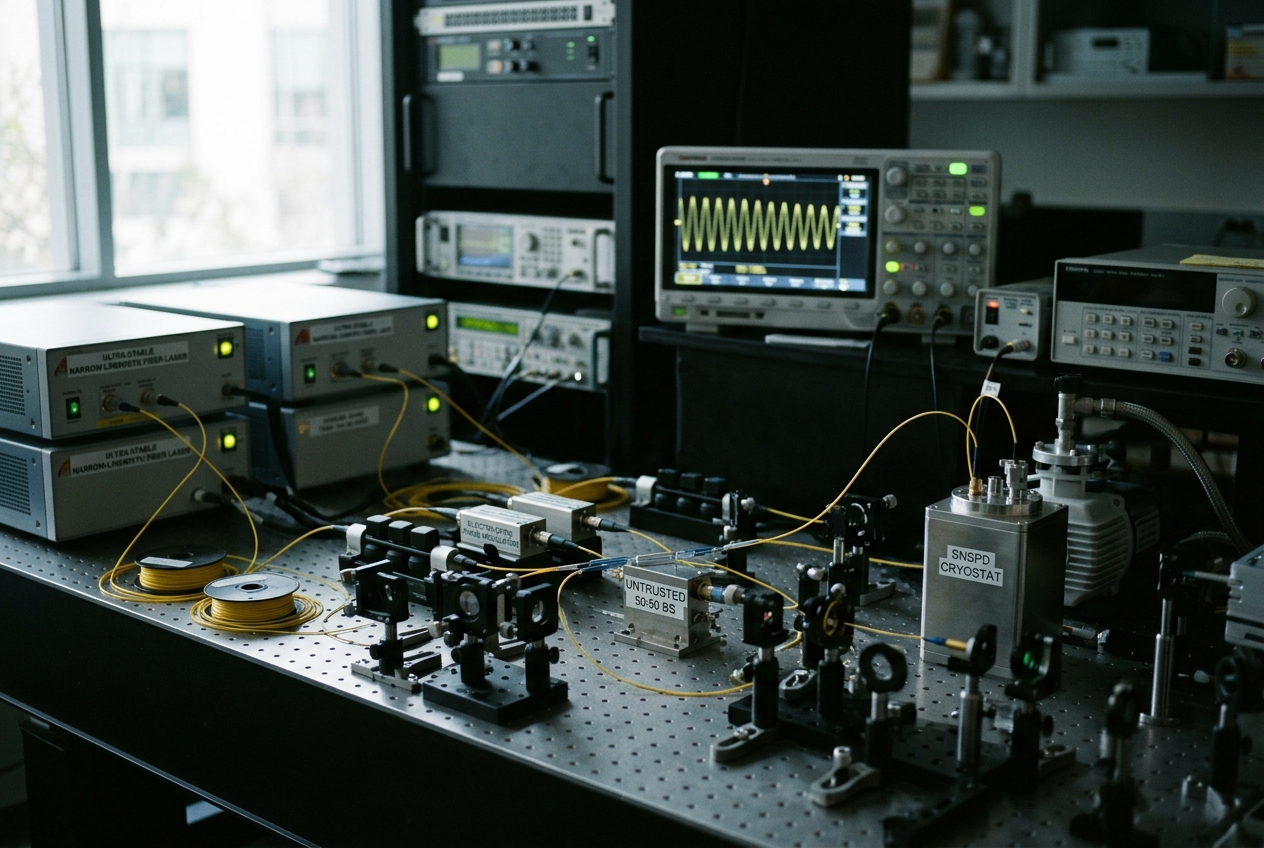
- Single-Photon Interference at Charlie: The optical pulses travel through fiber channels of length $L/2$ and meet at Charlie's central 50:50 beam splitter. The beam splitter has two output ports monitored by superconducting nanowire single-photon detectors ($D_0$ and $D_1$). * If Alice and Bob share identical bit phases ($\phi_A = \phi_B$) and matching random phases ($\theta_A = \theta_B$), the optical fields interfere constructively at $D_0$ and destructively at $D_1$. * If their phases are opposed ($\phi_A \neq \phi_B$), destructive interference directs the photon to $D_1$.
- Sifting and Parameter Estimation: Charlie publicly announces the arrival time of each detection event and which detector fired ($D_0$ or $D_1$). Alice and Bob then announce their phase slices $\theta_A, \theta_B$ and intensity choices. They retain only those instances where their random phases matched within an acceptable tolerance window ($\theta_A \approx \theta_B$).
- Error Correction and Privacy Amplification: Alice and Bob calculate the quantum bit error rate (QBER) across their sifted data, evaluate the decoy-state statistics to rigorously bound Eve's potential information, apply classical error correction to eliminate discrepancies, and execute privacy amplification to distill a pristine, mathematically secure secret key.
Engineering Obstacles: The Battle for Optical Coherence
While the theoretical framework of TF-QKD is mathematically pristine, implementing it in the real world represents one of the most demanding technical challenges in modern experimental physics. Achieving single-photon interference between two independent laser sources separated by hundreds of kilometers of buried fiber requires stabilizing optical wave parameters down to microscopic tolerances.
- Ultra-Narrow Linewidth Lasers & Optical Phase Locking: Alice and Bob cannot simply use off-the-shelf telecommunications lasers. Their independent lasers must maintain mutual phase coherence across hundreds of kilometers. This is achieved using ultra-stable optical cavities and optical phase-locked loops (OPLL), or by disseminating a continuous optical reference tone from Charlie to both Alice and Bob to lock their local oscillators to sub-kilohertz linewidths.
- Fiber-Induced Phase Drift Compensation: Buried optical fiber expands and contracts with micro-degree temperature fluctuations and acoustic vibrations from vehicular traffic and seismic noise. A temperature change of just one-thousandth of a degree over a $100\text{ km}$ fiber shifts the optical path length by hundreds of optical cycles, completely scrambling the phase relationship between Alice and Bob's pulses. Modern TF-QKD systems deploy high-speed active phase-compensation systems that interleave strong reference training pulses between quantum pulses, dynamically correcting phase drifts thousands of times per second.
- Wavelength Synchronization and Polarization Control: The optical frequencies of Alice and Bob’s pulses must match within a few megahertz, and their polarization states must be actively aligned using automated polarization controllers at Charlie's station to ensure maximal interference visibility.
4. Real-World Applications Today
Between 2024 and 2026, Twin-Field QKD transitioned from an ambitious laboratory experiment into a foundational architecture for national and transcontinental quantum communications. Major research laboratories and industrial consortia are actively deploying TF-QKD across multiple domains:
================================================================================
                    KEY GLOBAL IMPLEMENTATIONS & FIELD TRIALS
================================================================================
Institution / Consortium       Domain                       Milestone / Advantage
--------------------------------------------------------------------------------
USTC / QuantumCTek             Transcontinental Backbones   1,002 km fiber record;
(China)                                                     Repeaterless intercity link

Toshiba Europe & BT            Critical Infrastructure      Multiplexed TF-QKD on
(United Kingdom)                                            commercial DWDM metro fibers

EuroQCI / European Quantum     Sovereign Metrology & Data   Inter-capital secure mesh;
Communication Initiative                                    Untrusted relay topology

MIT Lincoln Lab & NRL          Tactical Defense Networks    Hybrid free-space/fiber
(United States)                                             resilient command links
================================================================================
1. Transcontinental Quantum Backbones: USTC and QuantumCTek
- The Organization: The University of Science and Technology of China (USTC), in collaboration with quantum networking firm QuantumCTek.
- The Objective: Overcoming the distance limitations of terrestrial fiber to connect megacities across eastern and central Asia without relying on physically vulnerable trusted relay nodes.
- The Quantum Advantage: Prior to TF-QKD, connecting cities separated by $1,000\text{ km}$ required dozen of "trusted nodes"—physical relay stations where quantum keys were decrypted into plaintext and re-encrypted. If an adversary compromised a single relay station, the entire chain collapsed. In a series of breakthrough experiments culminating in field trials exceeding $1,002\text{ km}$ of ultra-low-loss fiber, USTC implemented sending-or-not-sending (SNS) TF-QKD variants. By turning all intermediate stations into untrusted measurement hubs, they established the world’s first long-haul, mathematically secure quantum communication link that remains impervious to physical node tampering.
2. High-Capacity Commercial Telecom Coexistence: Toshiba Europe & British Telecom
- The Organization: Toshiba Europe's Quantum Information Group (Cambridge) in partnership with British Telecom (BT).
- The Objective: Deploying long-distance quantum security directly over existing commercial telecommunications fiber networks carrying terabits of live commercial internet traffic.
- The Quantum Advantage: Standard quantum keys are easily drowned out by the noise (Raman scattering) generated by high-power classical data streams sharing the same glass fiber. Toshiba successfully demonstrated TF-QKD operating over hundreds of kilometers of commercial telco fiber alongside dense wavelength division multiplexing (DWDM) channels. By deploying ultra-narrow optical bandpass filters and dual-band phase-locking stabilization, they proved that financial institutions in London can exchange quantum keys with data centers across the UK without leasing dedicated "dark fiber," saving millions in infrastructure costs.
3. Sovereign Secure Infrastructure: EuroQCI and European National Metrology Institutes
- The Organization: The European Quantum Communication Initiative (EuroQCI), coordinated alongside metrological institutions like Germany’s Physikalisch-Technische Bundesanstalt (PTB) and the UK’s National Physical Laboratory (NPL).
- The Objective: Building an integrated European quantum communication network to shield government communications, energy grids, and air traffic control systems from state-sponsored cyberattacks.
- The Quantum Advantage: European cross-border connectivity requires traversing complex international boundaries where no single nation wants to host a "trusted" decryption node on foreign soil. TF-QKD solves this sovereign trust dilemma: Charlie's measurement hub can be situated in an intermediary border country without ever possessing the cryptographic keys, allowing independent European capitals to establish direct, unhackable sovereign keys across hundreds of kilometers.
4. Defense and Strategic Command Networks: MIT Lincoln Laboratory and US Naval Research Laboratory
- The Organization: MIT Lincoln Laboratory and the US Naval Research Laboratory (NRL), under programs supported by DARPA.
- The Objective: Providing high-assurance command-and-control links between strategic defense installations, naval command centers, and distributed sensor networks.
- The Quantum Advantage: Modern defense networks demand key generation rates robust against electronic warfare and physical sensor compromise. By leveraging phase-matching QKD (PM-QKD) architectures, researchers are building resilient point-to-multipoint networks where remote outposts can continuously refresh cryptographic ciphers over long-haul links, ensuring defense communication remains secure even under severe electronic countermeasures.
5. What This Means for You
It is easy to view quantum key distribution as an abstract domain of laser physics and optical laboratories, distant from daily life. In truth, the deployment of Twin-Field QKD provides the missing infrastructural link that directly safeguards personal privacy, economic stability, and national security in the 21st century.
Consider your personal healthcare data. Today, medical science is sequencing human genomes and assembling lifelong digital health profiles. Unlike a credit card number, which can be cancelled and reissued following a data breach, your unique genetic sequence cannot be changed. If a foreign adversary or criminal organization intercepts an encrypted copy of your genomic data today, classical encryption may protect it for five or ten years. But once large-scale quantum computers become operational, that encrypted file will be unlocked, exposing your hereditary health vulnerabilities, predispositions, and biological identity for the rest of your life.
By enabling quantum keys to traverse long distances between regional hospital networks and centralized cloud servers without vulnerable middleman nodes, Twin-Field QKD provides true forward secrecy. A key generated via single-photon interference is protected by the laws of quantum physics: it cannot be decrypted retrospectively, no matter how powerful future computers become.
The same principle protects the core utilities of civil society. The electronic routing protocols that keep water filtration plants operating, balance the electrical grid, and execute the global transactions that stock supermarket shelves all depend on authenticated, long-distance communication backbones. TF-QKD ensures that as the world transitions into the quantum computing era, our critical infrastructure will not be vulnerable to sudden collapse.
6. Today's Takeaway
THE ESSENTIAL LESSON: Twin-Field Quantum Key Distribution resolved quantum communication's most devastating bottleneck—the exponential decay of light known as the PLOB bound—by proving that two senders do not need to transmit a photon across the entire length of an optical fiber. By having Alice and Bob each send a pulse across half the distance to interfere at an untrusted central relay, TF-QKD scales the secret key rate with the square root of channel transmittance, $O(\sqrt{\eta})$, effectively doubling the reach of fiber networks in decibels and unlocking practical, intercity quantum encryption without requiring complex quantum repeaters.
Further Reading & Authoritative Resources
- Explore the seminal foundational paper by Lucamarini et al. on Twin-Field QKD in Nature.
- Review the fundamental physical limits of unrepeatered channels via the PLOB Capacity Bound on arXiv.
- Learn the principles of single-photon states and quantum optics through MIT OpenCourseWare's Quantum Optical Communication.
- Discover hands-on quantum circuit implementations and cryptographic simulations with IBM Quantum Learning.
- Read a comprehensive overview of protocols on the Quantum Key Distribution Wikipedia Reference.