Eigenstate Thermalization Hypothesis: Resolving Quantum Chaos, Ergodicity, and Thermal Equilibrium in Isolated Many-Body Systems
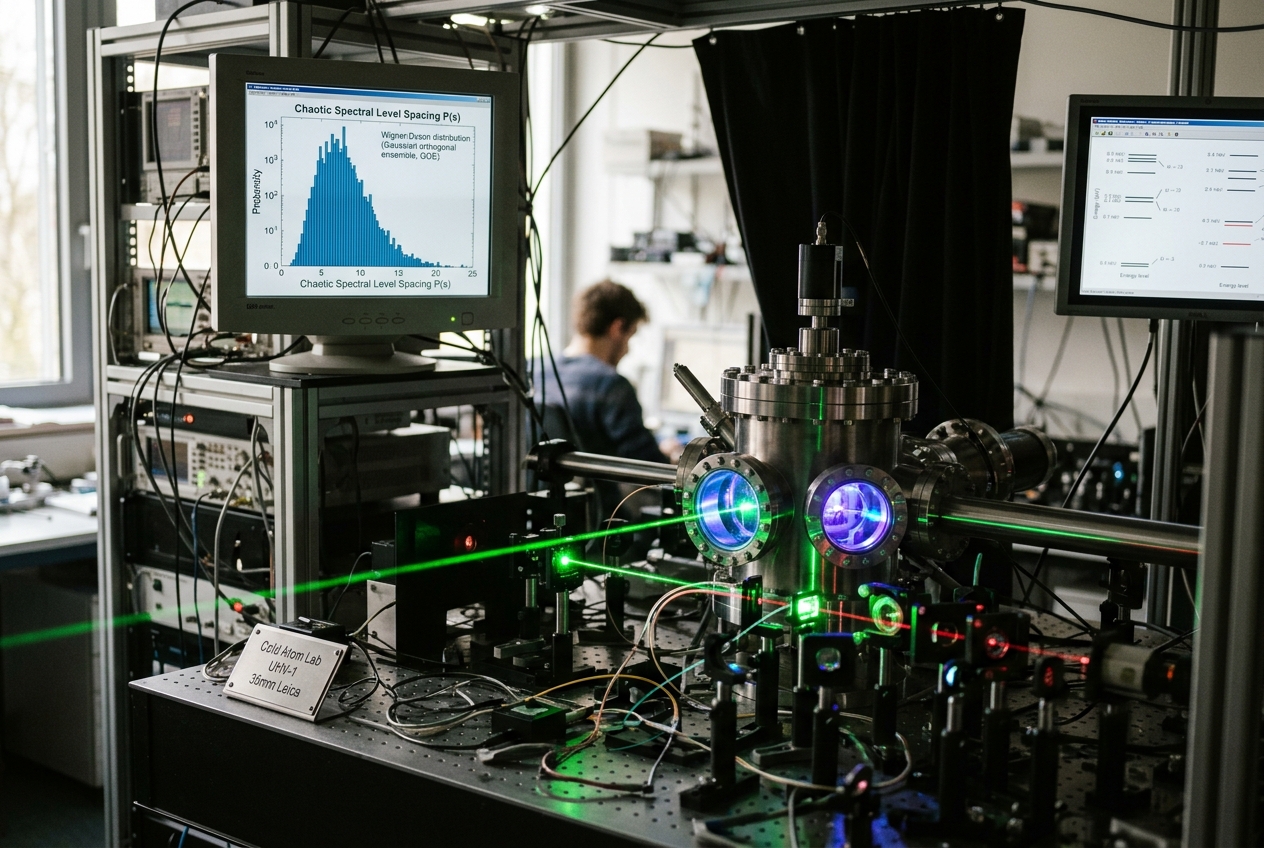
To engineers racing to construct the first fault-tolerant quantum processors at institutions like IBM Quantum and Google Quantum AI, this phenomenon looks like an existential enemy. It is the quantum equivalent of heat death—an internal, self-inflicted scrambling where pristine quantum states degrade into what appears to be useless thermal noise. Yet this process occurs even when a quantum machine is completely isolated from the outside universe, perfectly shielded from the warm, chaotic vibrations of the surrounding laboratory.
For nearly a century, theoretical physicists were haunted by a paradox at the heart of this process: how can a system governed by strictly reversible, information-preserving quantum laws behave like a warm, forgetful steam engine? The modern answer is found in one of the most profound insights in modern theoretical physics: the Eigenstate Thermalization Hypothesis (ETH). By peering into the mathematical anatomy of ETH, physicists have discovered not only why quantum systems naturally erase their own histories, but also how rare exceptions—known as quantum scars and many-body localized states—allow us to stop the clock on thermodynamic decay.
The Idea in Plain English: The Solitary Heat Bath
To understand why quantum thermalization is a paradox, imagine dropping a single droplet of crimson dye into a perfectly sealed, frictionless aquarium filled with still water.
In our everyday classical world, the drop slowly blooms, branches, and diffuses until the entire tank turns an indistinguishable, faint translucent pink. Classical thermodynamics explains this through statistical mechanics: the dye molecules randomly collide with trillions of water molecules, redistributing their kinetic energy until the system reaches its maximum entropy state—thermal equilibrium. If you only look at a thimbleful of water from the corner of the tank, all memory of where the droplet originally fell has been completely erased.
Now consider the quantum version of this experiment. According to the foundational postulates taught in advanced physics curricula on MIT OpenCourseWare, the time evolution of any closed quantum system is governed strictly by the Schrödinger equation. This equation is rigorously unitary, which is the physicist’s term for fundamentally lossless and reversible. In a unitary universe, quantum information is never destroyed. If you had access to the exact mathematical wave function of the entire universe, you could run the film backward at any moment and reconstruct the exact initial state of the droplet with absolute mathematical precision.
================================================================================
                    THE CLASSICAL VS. QUANTUM HEAT PARADOX
================================================================================
 Classical View:  System + External Reservoir  -->  Exchange Heat  --> Equilibrium
 Quantum View:    Isolated Unitary System      -->  No Reservoir   --> ???
 ETH Solution:    Subsystem A + Environment B  -->  B acts as A's Reservoir
================================================================================
Here lies the profound puzzle: If an isolated quantum system can never truly lose information, how can it ever settle into a dull, unchanging thermal equilibrium? Where does the heat come from if there is no outside furnace?
The Eigenstate Thermalization Hypothesis resolves this dilemma with an audacious proposition: the system acts as its own heat bath.
When a complex quantum system evolves, information does not vanish from reality; rather, it hides within intricate, non-local quantum correlations—entanglement—spread across the entire many-body system. If you isolate any small subregion of the system, that subregion is continually interacting with and entangled with the vast remainder of the system. The rest of the system acts as an internal thermal reservoir for the subregion.
Even more remarkably, ETH asserts that thermalization does not require an intricate dynamical averaging over thousands of different quantum states over time. Instead, thermal equilibrium is baked directly into every single individual energy eigenstate of the system. Each stationary energy level of a chaotic quantum system already contains, within its microscopic structure, the complete statistical properties of a thermal state.
How It Actually Works: The Mechanics of Quantum Chaos
To grasp how this works under the hood, we must look at how quantum states evolve in time. When a quantum system is prepared in an initial state $|\psi(0)\rangle$, it can be written as a superposition of the system's stationary energy states—its energy eigenstates, denoted by $|n\rangle$, each possessing a discrete energy $E_n$. As time progresses, each component eigenstate ticks at its own characteristic frequency, dictated by Planck’s constant:
$$|\psi(t)\rangle = \sum_n c_n e^{-i E_n t / \hbar} |n\rangle$$
When an experimentalist measures a physical observable—such as the magnetization of a single atom, the local electrical current, or the density of particles in a tiny patch of space—they calculate the expectation value of an operator $\hat{O}$. Expanding this expectation value reveals two distinct contributions:
$$\langle \hat{O}(t) \rangle = \sum_n |c_n|^2 O_{nn} + \sum_{n \neq m} c_m^* c_n e^{-i(E_n - E_m)t/\hbar} O_{mn}$$
Look closely at this equation. The first term represents the time-independent diagonal components ($O_{nn}$), while the second term represents the off-diagonal components ($O_{mn}$) which oscillate perpetually with phase frequencies proportional to the energy gaps $(E_n - E_m)$.
For the system to relax to a steady thermal value that does not fluctuate chaotically forever, two conditions must occur: 1. The oscillating off-diagonal terms must dephase and cancel one another out through destructive interference. 2. The remaining diagonal sum must match the standard prediction of classical statistical mechanics (the microcanonical ensemble average) at the corresponding total energy.
In the 1990s, physicists Josh Deutsch and Mark Srednicki formalized these requirements into the celebrated Deutsch-Srednicki Ansatz. This formula defines the exact mathematical matrix structure of any local physical observable when expressed in the basis of chaotic energy eigenstates:
$$O_{mn} = \bar{O}(E) \delta_{mn} + e^{-S(E)/2} f_O(E, \omega) R_{mn}$$
+-------------------------------------------------------------------------------+
|                       THE SREDNICKI ETH ANSATZ DECONSTRUCTED                 |
|                                                                               |
|   O_mn  =   \bar{O}(E) \delta_mn   +   e^{-S(E)/2} * f_O(E, \omega) * R_mn     |
|             \__________________/       \_________/   \____________/   \___/   |
|                      |                      |               |           |     |
|               DIAGONAL TERM                 |          SPECTRAL         |     |
|            Microcanonical Mean         EXPONENTIAL     RESPONSE     RANDOM    |
|             Smooth function of         SUPPRESSION    Fluctuation-  GAUSSIAN  |
|               average energy           Entropy S(E)   Dissipation   VARIABLE  |
+-------------------------------------------------------------------------------+
This elegant expression is the cornerstone of modern quantum thermodynamics. Let us break down its components:
1. The Diagonal Foundation: $\bar{O}(E) \delta_{mn}$
The first term governs the diagonal matrix elements ($m = n$). The Kronecker delta $\delta_{mn}$ ensures this term only contributes when the two states are identical. Here, $\bar{O}(E)$ is a smooth, continuous function of the average energy $E = (E_m + E_n)/2$.
Crucially, this means that two adjacent energy eigenstates with virtually identical total energies will yield almost identical expectation values for any local measurement. An individual eigenstate $|n\rangle$ does not look like a sterile, zero-temperature mathematical construct; it exhibits the exact same physical properties as a microcanonical statistical ensemble averaged over an astronomical number of states at energy $E$.
2. The Entropic Shield: $e^{-S(E)/2}$
The off-diagonal terms ($m \neq n$) describe quantum transitions, fluctuations, and matrix overlaps between distinct energy states. These terms are multiplied by an exponential damping factor: $e^{-S(E)/2}$, where $S(E)$ is the thermodynamic microcanonical entropy of the entire system.
Because entropy scales proportionally with the physical size of the system (the number of particles $N$), the quantity $e^{-S(E)/2}$ shrinks exponentially as the system grows. In a modest cluster of just 100 interacting qubits, this suppression factor is already smaller than $10^{-15}$. This guarantees that the fluctuating off-diagonal noise in macroscopic systems is suppressed to near-absolute zero, rendering macroscopic thermalization exceptionally stable.
3. The Response Envelope and Quantum Chaos: $f_O(E, \omega) R_{mn}$
The remaining terms dictate the fine-grained dynamics of how the system relaxes toward equilibrium. The variable $\omega = E_m - E_n$ represents the energy difference (or frequency) between the two states. The function $f_O(E, \omega)$ is a smooth spectral envelope linked directly to the system’s linear response functions and the fluctuation-dissipation theorem.
Meanwhile, $R_{mn}$ represents a zero-mean, unit-variance random variable—either real or complex depending on whether the system respects time-reversal symmetry.
This pseudo-random character is where quantum chaos enters the frame. In the 1970s, Michael Berry formulated what is now known as Berry’s Conjecture, suggesting that the high-energy wavefunctions of classically chaotic systems behave like isotropic Gaussian random fields. When many quantum particles interact chaotically, their energy levels repel one another according to the Wigner-Dyson level statistics of Random Matrix Theory (RMT). The energy spectrum behaves not like a collection of independent, uncoordinated clocks (which produce a Poisson distribution of energy levels), but like a rigidly correlated matrix of random numbers that actively resists degenerate states.
When ETH Breaks Down: Scars, Localization, and Integrability
While the Eigenstate Thermalization Hypothesis describes the vast majority of interacting quantum systems, its true power is illuminated by the exceptional systems that defy it. When ETH fails, a quantum system stubbornly refuses to forget its past.
================================================================================
                     THE SPECTRUM OF QUANTUM THERMALIZATION
================================================================================
   Chaotic / Ergodic (ETH)     Many-Body Localized (MBL)     Quantum Many-Body Scars
   -----------------------     -------------------------     -----------------------
   • Wigner-Dyson statistics   • Poisson level statistics    • Mixed spectral statistics
   • Complete thermalization   • Zero thermalization         • Periodic coherent revivals
   • Fast information scramble • Local integrals of motion   • Atypical non-thermal states
   • Universal heat death      • Permanent quantum memory    • Protected subspace dynamics
================================================================================
1. Integrable Systems
In one-dimensional physics, certain idealized models—such as the 1D Heisenberg spin chain or the Lieb-Liniger Bose gas—possess an infinite ladder of conserved quantities. Solvable via mathematical techniques like the Bethe ansatz, these systems are constrained by infinite conservation laws. They cannot explore their available phase space uniformly and instead relax to a non-thermal state described by a Generalized Gibbs Ensemble (GGE).
2. Many-Body Localization (MBL)
If you introduce strong, disordered magnetic fields or random impurities into an interacting quantum system, the particles can become completely trapped by destructive quantum interference. This phenomenon, known as Many-Body Localization (MBL), breaks ETH completely. The system develops an extensive set of emergent local integrals of motion (LIOMs). Even at infinite temperature, an MBL system will preserve the memory of its initial configuration indefinitely, acting as a natural insulator of both heat and information.
3. Quantum Many-Body Scars (QMBS)
In 2017, a team of physicists using a 51-atom programmable quantum simulator at Harvard University observed something that sent shockwaves through the physics community. As reported in Nature, when they initialized a chain of neutral atoms in an alternating pattern and let it evolve, the system refused to thermalize. Instead, the quantum state repeatedly dephased and spontaneously reassembled itself, oscillating back and forth like an undamped pendulum.
This marked the discovery of Quantum Many-Body Scars. Unlike MBL systems, which are disordered throughout, scarred systems are entirely clean and generally chaotic. The overwhelming majority of their energy eigenstates obey ETH and thermalize normally.
However, embedded within this dense sea of chaotic states lies a tiny, equally spaced ladder of "atypical" eigenstates that possess anomalously low entanglement entropy. If a quantum system is prepared in a state that overlaps predominantly with these scarred states, it bypasses the thermal abyss, exhibiting long-lived periodic quantum revivals.
Real-World Applications Today
The study of quantum thermalization and its violations is no longer an abstract pencil-and-paper exercise. Between 2024 and 2026, understanding ETH has become one of the most practical engineering requirements in advanced quantum technology.
+-----------------------------------------------------------------------------------+
|                        FRONTIERS OF THERMALIZATION RESEARCH                       |
+-------------------------+---------------------------------------------------------+
| DOMAIN                  | ACTIVE PLAYERS & QUANTUM ADVANTAGE                      |
+-------------------------+---------------------------------------------------------+
| Neutral Atom Simulators | QuEra Computing & Harvard University                    |
|                         | Exploiting Rydberg blockade to engineer scarred         |
|                         | subspaces for ultra-stable quantum simulation.          |
+-------------------------+---------------------------------------------------------+
| Superconducting Qubits  | Google Quantum AI & IBM Quantum                         |
|                         | Mapping Out-of-Time-Ordered Correlators (OTOCs) to      |
|                         | prevent chaotic crosstalk and thermalization on-chip.   |
+-------------------------+---------------------------------------------------------+
| Quantum Metrology       | Max Planck Institute of Quantum Optics                  |
|                         | Harnessing non-thermal scar states to generate stable    |
|                         | multi-particle entanglement for atomic clocks.          |
+-------------------------+---------------------------------------------------------+
| Exotic Materials Design | MIT & Materials Project                                 |
|                         | Simulating non-ergodic electron transport in strange     |
|                         | metals and unconventional superconductors.              |
+-------------------------+---------------------------------------------------------+
1. Neutral Atom Quantum Computing (QuEra Computing & Harvard)
- The Initiative: Neutral atom processors trap individual rubidium or cesium atoms in arrays of optical tweezers, manipulating their interactions using laser excitation into highly excited Rydberg states.
- The Quantum Advantage: By utilizing the "Rydberg blockade" mechanism—which prevents adjacent atoms from simultaneously being excited—engineers can natively construct scarred Hamiltonians. QuEra and academic collaborators are using these non-thermal subspaces to execute multi-qubit gates that are naturally insulated from thermal decoherence, eliminating significant error-correction overhead during quantum simulation routines.
2. Superconducting Processor Characterization (Google Quantum AI)
- The Initiative: On multi-qubit superconducting platforms like Google’s Sycamore and IBM's Heron, researchers are measuring Out-of-Time-Ordered Correlators (OTOCs) to track the exact speed at which quantum information scrambles across the chip.
- The Quantum Advantage: As quantum processors scale beyond 1,000 qubits, parasitic interactions between neighboring circuits can induce unintended chaotic thermalization, ruining computational fidelity. By benchmarking circuits against ETH predictions, Google engineers can detect "thermal leaks" across the chip architecture and dynamically re-route quantum circuits through non-ergodic pathways.
3. Precision Quantum Metrology (Max Planck Institute of Quantum Optics)
- The Initiative: Researchers in Germany are engineering quantum many-body scars to enhance the precision of atomic clocks and magnetic field sensors.
- The Quantum Advantage: Standard quantum sensors degrade when particles collide and interact, as chaotic many-body interactions quickly wash out phase sensitivity. By locking the atomic sensor into a scarred dynamical trajectory, the particles interact strongly without thermalizing, sustaining large-scale entangled states (such as Greenberger-Horne-Zeilinger states) that operate near the fundamental Heisenberg limit of measurement precision.
4. Materials Discovery for Room-Temperature Superconductors (MIT)
- The Initiative: Condensed matter theorists at MIT are using ETH-defying models to study strongly correlated electron systems, such as twisted bilayer graphene and nickelate superconductors.
- The Quantum Advantage: In exotic materials known as "strange metals," electrons dissipate energy at the fastest rate allowed by quantum mechanics—the Planckian dissipation limit. By understanding where the boundary between ETH-compliant chaotic transport and non-ergodic localized transport lies, materials scientists can computationally screen candidate crystalline lattices capable of conducting electricity with zero resistance at higher temperatures.
What This Means for You
To anyone outside a cleanroom laboratory, the mathematics of energy eigenbasis matrices might seem disconnected from daily life. Yet the Eigenstate Thermalization Hypothesis touches the core boundary between the digital present and the quantum future.
Consider what limits today’s technology. The battery in your smartphone drains because classical electrical currents inevitably dissipate energy as thermal waste heat into the environment. The silicon microchips powering our data centers are reaching hard thermal barriers—they cannot run any faster without melting their microscopic circuitry.
================================================================================
                    WHY ETH MATTERS FOR THE REAL WORLD
================================================================================
   Classical Limitation           ETH / Quantum Physics Solution
   --------------------           ------------------------------
   Heat dissipation in chips  ->  Coherent, non-ergodic quantum information routing
   Volatile computer RAM      ->  Non-thermal quantum memories with zero refresh power
   Decoherence in sensors     ->  Entanglement protected by Many-Body Scars
   Battery material limits    ->  Materials simulated via non-thermal quantum models
================================================================================
Quantum technologies promise an era of computation where information processing can, in principle, operate with breathtaking thermodynamic efficiency. But that future hinges entirely on our ability to master the internal heat engine of the quantum world: * If we want quantum computers that can simulate personalized cancer treatments, discover room-temperature conductors, or optimize global logistics networks, we must master the off-diagonal terms of ETH. * We must learn how to design synthetic quantum matter that resists the natural urge to erase its own memory.
When you lock your phone or access your bank account in the coming decades, the cryptography protecting your life will likely be verified by quantum processors whose stability is guaranteed by the deliberate avoidance of quantum chaos. The line between a functional quantum supercomputer and an expensive useless heater is drawn entirely by the laws of the Eigenstate Thermalization Hypothesis.
Today's Takeaway
The Eigenstate Thermalization Hypothesis reveals nature’s ultimate magic trick: an isolated quantum system does not need an outside environment to experience heat, because every individual stationary state of energy already contains an entire microcanonical universe within itself. While quantum chaos relentlessly drives complex matter to scramble its past into local thermal amnesia, our newfound ability to discover and engineer non-thermal exceptions—from many-body localization to quantum scars—is handing humanity the keys to freeze thermodynamic time and preserve pristine quantum information for the technologies of tomorrow.