Unambiguous State Discrimination: Achieving Zero-Error Measurement and Establishing the Ivanovic-Dieks-Peres Limit
Consider a fundamental dilemma facing tomorrow's quantum networks. Suppose an interceptor—or a legitimate receiver—is sent an encrypted message encoded across quantum states that are fundamentally incompatible with one another. If forced to make an immediate, definitive guess on every single quantum bit, the receiver will inevitably make errors, introducing noise that instantly betrays their presence or corrupts the data. But what if the receiver could choose a different strategy altogether? What if, instead of gambling on an uncertain outcome, the receiver could perform a measurement that guarantees absolute, one-hundred-percent mathematical certainty whenever it delivers an answer, buying that infallibility by reserving the right to occasionally announce: "The measurement was inconclusive"?
This counter-intuitive technique is known in quantum physics as Unambiguous State Discrimination (USD). It represents one of the most profound departures from classical information theory ever conceived: trading the certainty of getting an answer for the absolute certainty of being correct when an answer is given. Understanding how USD works reveals not only the operational vulnerabilities and strengths of protocols like the B92 quantum key distribution protocol, but also illuminates the deep geometric boundaries that separate the quantum world from our everyday classical intuition.
1. The Idea in Plain English: Shadows, Keys, and the Price of Certainty
In our everyday macroscopic world, distinguishing between two objects is straightforward because observing an object does not alter its physical configuration. If someone places either a brass house key or an iron padlock key into a velvet-lined box, you can open the box, shine a flashlight upon the key, and determine its shape with arbitrary precision. If the two keys are slightly similar, you need only polish your magnifying glass or increase the illumination to eliminate any residual ambiguity. The two classical physical states are mutually exclusive and strictly distinguishable.
In the quantum realm, physical states do not behave like distinct solid keys. Instead, imagine that the sender projects the shadow of an unseen geometric sculpture onto a frosted glass screen. If the sender selects one of two distinct orientations—say, a state pointing vertically or a state tilted at an acute forty-five-degree angle—the resulting quantum states are said to be non-orthogonal.
The bedrock principle of quantum mechanics asserts that no physical measurement can deterministically differentiate two non-orthogonal states with absolute reliability in a single trial. If you attempt a conventional measurement—the kind pioneered by the physicist Carl Helstrom in the late 1960s, known as Minimum-Error Discrimination—the detector acts like a forced-choice judge in a courtroom. It must return a verdict: either State A or State B. While Helstrom's mathematical framework minimizes the statistical frequency of mistakes, wrong verdicts are mathematically unavoidable. An intrinsic rate of false positives is baked into the fabric of space and time.
Unambiguous State Discrimination completely upends this paradigm. Formulated independently by Mirko Ivanovic, Dennis Dieks, and Asher Peres between 1987 and 1988, USD asks a radically different question: Can we design a detector that never, under any circumstance, identifies State A as State B or State B as State A, even if it sometimes fails to identify either?
The answer is an emphatic yes. USD constructs a specialized filter that allows the quantum system to either declare the exact identity of the state with zero probability of error, or gracefully fail by stating that the test was inconclusive. You never receive a lie; you only occasionally receive an apology.
2. How It Actually Works — The Mechanics of Inconclusive Perfection
To understand how a physical instrument can achieve zero error on non-orthogonal states, we must look beyond standard textbook measurements and enter the rich mathematical landscape of generalized quantum measurements.
In an elementary physics curriculum, quantum measurements are typically taught as simple "projective" operations—often called von Neumann measurements. In a two-dimensional quantum bit (a qubit), a projective measurement is like a physical fork in the road with exactly two mutually perpendicular exits. If the incoming state does not perfectly align with one of the exits, the measurement forces it to randomly collapse into one of the two paths, destroying the original nuance of the state and generating classification errors.
To implement USD, physicists must break free of this two-path limitation by using a Positive Operator-Valued Measure (POVM). A POVM allows a quantum detector to possess more outcomes than the physical dimensions of the system being tested. For a single qubit, instead of having only two detection channels, we construct an apparatus with three distinct detection ports: 1. Port 1 ($E_1$): Fires exclusively if the state is definitely State 1. 2. Port 2 ($E_2$): Fires exclusively if the state is definitely State 2. 3. Port 0 ($E_0$): Fires when the apparatus cannot reach a definitive conclusion.
+-------------------------------------------------------------------------+
|                THE CORE POVM COMPLETENESS FORMULATION                   |
+-------------------------------------------------------------------------+
| Every generalized quantum measurement must satisfy the fundamental     |
| completeness relation, ensuring that the total probability of all       |
| possible outcomes sums precisely to unity (100%):                       |
|                                                                         |
|                        E₁ + E₂ + E₀ = I                                 |
|                                                                         |
| where I is the identity operator, and E₁, E₂, E₀ are positive semi-     |
| definite operators acting on the system's state space.                  |
+-------------------------------------------------------------------------+
The Geometry of Zero Error
How do we guarantee that Port 1 never clicks when State 2 is fed into the machine? The trick is a brilliant application of geometric nullification.
In linear algebra, if you want an operator to register nothing when exposed to a specific vector, you orient that operator so that it is strictly perpendicular (orthogonal) to that vector. Therefore, the detection operator $E_1$ is deliberately aligned to be completely perpendicular to the mathematical vector representing State 2. When State 2 enters the apparatus, its projection onto $E_1$ is identically zero. It cannot make Port 1 fire.
By exact symmetry, the detection operator $E_2$ is aligned to be completely perpendicular to State 1, guaranteeing that State 1 can never cause Port 2 to fire.
However, because State 1 and State 2 were not perpendicular to each other to begin with, the vector perpendicular to State 2 is not parallel to State 1! The physical operators $E_1$ and $E_2$ cannot span the entire space on their own without violating the laws of quantum probability. To keep the total probability from exceeding 100%, the physical universe demands the insertion of a balancing operator: the inconclusive failure operator, $E_0$.
The Ivanovic-Dieks-Peres (IDP) Limit
When the two candidate states are prepared with equal likelihood, what is the maximum achievable probability that our detector successfully identifies the state without ever making a mistake?
This foundational threshold is known as the Ivanovic-Dieks-Peres (IDP) bound. By optimizing the mathematical weights of the POVM operators to minimize the weight of the failure operator $E_0$, one derives the optimal success probability:
+-------------------------------------------------------------------------+
|                  THE IVANOVIC-DIEKS-PERES (IDP) BOUND                   |
+-------------------------------------------------------------------------+
| For two pure quantum states |ψ₁⟩ and |ψ₂⟩ occurring with equal prior     |
| probabilities, the maximum probability of unambiguous identification is:|
|                                                                         |
|                    P_succ = 1 - |⟨ψ₁|ψ₂⟩|                               |
|                                                                         |
| where |⟨ψ₁|ψ₂⟩| represents the absolute inner product (the geometric    |
| overlap or "closeness") between the two quantum state vectors.           |
+-------------------------------------------------------------------------+
The physical meaning of this formula is stark: - If the two states are completely orthogonal (perpendicular), their overlap $|\langle\psi_1|\psi_2\rangle|$ is zero, yielding a success probability of $P_{\text{succ}} = 1 - 0 = 1$ (100% certainty, identical to classical physics). - If the two states are mathematically identical, their overlap is 1, and the success probability drops to $P_{\text{succ}} = 1 - 1 = 0$—the machine will return "inconclusive" 100% of the time, correctly reflecting the impossibility of distinguishing identical entities. - For any intermediate overlap, the probability of obtaining a perfect, error-free answer is strictly bounded by the geometric distance between the states.
Extending to Complex Ensembles: The Chefles Criterion
What happens when an encryption scheme or communications protocol uses more than two states, or when states appear with unequal prior probabilities?
In 1998, physicist Anthony Chefles established the universal mathematical condition for unambiguous discrimination: an ensemble of known quantum states can be unambiguously discriminated if and only if the state vectors are linearly independent. If a set of states is linearly dependent—meaning one state can be expressed as a linear combination of the others—it is physically impossible to construct a zero-error POVM, even if one is willing to tolerate an inconclusive rate of 99.9%.
When states appear with unequal prior probabilities, analytical symmetry breaks down. Quantum information theorists solve these generalized discrimination problems using Semidefinite Programming (SDP)—a convex optimization technique that computes the exact optimal geometry of ${E_1, E_2, \dots, E_n, E_0}$ across multi-dimensional state spaces.
Physical Realization via Neumark's Dilation
How do experimental physicists construct a three-outcome measurement on a two-dimensional photon in an actual laboratory? A physical photon polarized at some angle cannot simply be split into three mutually orthogonal directions within its two-dimensional polarization plane.
The solution lies in Neumark's Dilation Theorem (often transliterated as Naimark's Theorem), introduced by the Soviet mathematician Mark Naimark. The theorem proves that any generalized POVM measurement in a given Hilbert space can be physically realized as a standard, textbook projective measurement in a larger, higher-dimensional Hilbert space.
+-------------------------------------------------------------------------+
|                  NEUMARK DILATION INTERACTION COUPLING                  |
+-------------------------------------------------------------------------+
| By coupling the primary target state |ψ⟩ to an auxiliary probe system   |
| called an "ancilla" (|0⟩_anc), a global unitary transformation U maps   |
| the combined state into a three-dimensional physical trajectory:        |
|                                                                         |
|   U (|ψ⟩ ⊗ |0⟩_anc) = √(1 - s) |ϕ_target⟩ ⊗ |0⟩_anc + √s |e_fail⟩ ⊗ |1⟩_anc |
|                                                                         |
| where s is a tunable scaling parameter matching the state overlap,      |
| separating conclusive paths from the inconclusive failure mode.         |
+-------------------------------------------------------------------------+
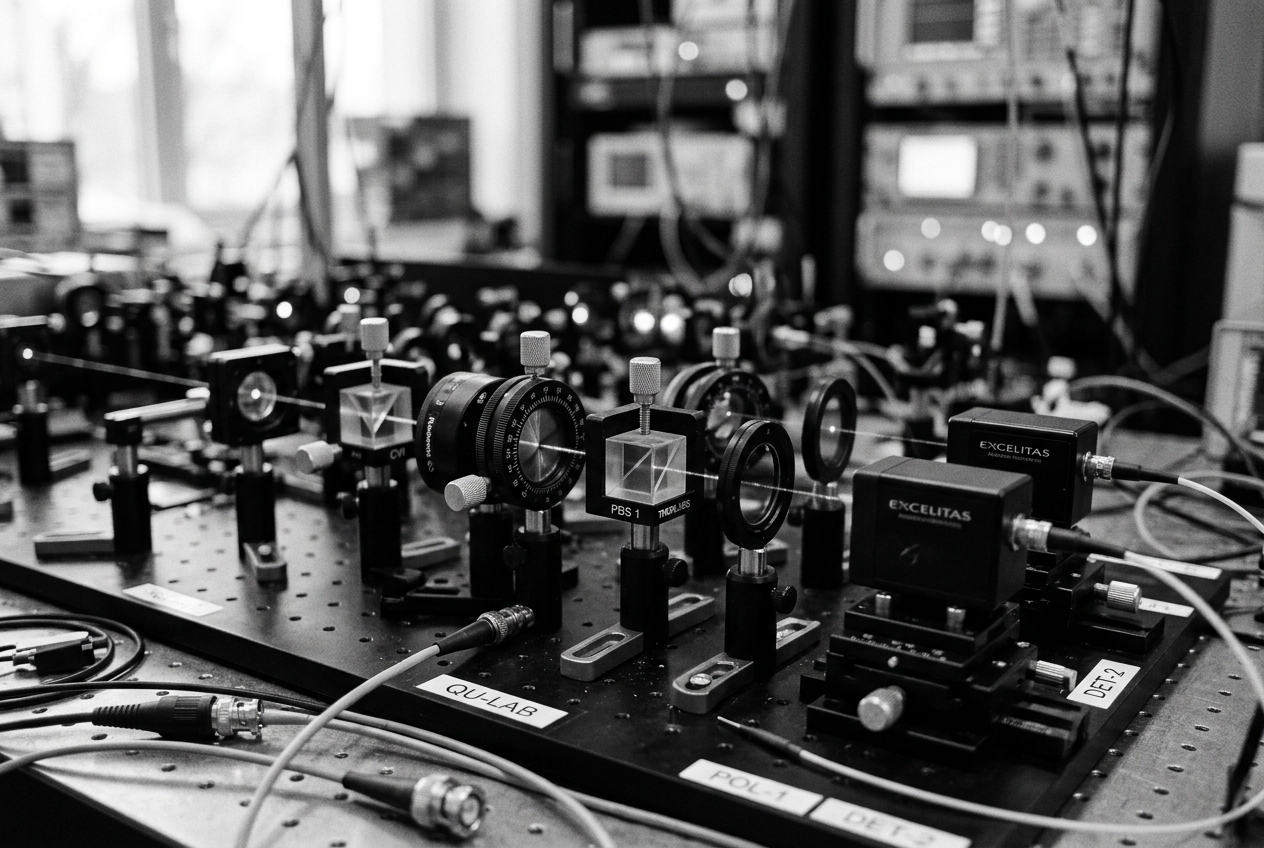
In an optics laboratory, this coupling is achieved using linear-optical elements such as calcite beam-displacers, half-wave plates, and polarization-dependent beam splitters. The polarization of the photon is entangled with its spatial trajectory (the ancilla degree of freedom). The single photon is directed toward three distinct single-photon avalanche photodiodes (APDs). A click at Detector 1 certifies State 1 with mathematical purity; a click at Detector 2 certifies State 2; and a click at Detector 0 tells the researcher that the measurement has failed.
3. Real-World Applications Across Science and Industry
Unambiguous state discrimination is far more than a mathematical curiosity; it is a foundational analytical tool and operational technique across several cutting-edge domains of quantum technology.
1. Quantum Cryptanalysis and the B92 Protocol
In 1992, Charles Bennett introduced the B92 protocol for Quantum Key Distribution (QKD), which utilizes two non-orthogonal states to securely negotiate cryptographic keys between two parties, traditionally called Alice and Bob.
Organizations such as Toshiba Europe and ID Quantique rigorously model eavesdropping threats using USD mechanics. If an eavesdropper, Eve, taps into the optical fiber line, she can apply an optimal USD measurement to every intercepted photon.
Whenever Eve obtains an inconclusive result ($E_0$), she simply absorbs the photon and tells Bob that the optical fiber suffered natural signal attenuation (loss). When she obtains a conclusive result ($E_1$ or $E_2$), she forwards a pristine, perfectly fabricated quantum state to Bob. By doing so, Eve learns a fraction of the cryptographic key with zero error, without introducing the phase and bit-flip errors that would typically alert security administrators. Understanding the IDP bound allows cryptographers to calculate the exact channel loss threshold below which a quantum line remains secure against optimal eavesdropping.
2. Quantum Photonic Computing and State Filtering
In optical quantum computing platforms developed by innovators like Quandela and Xanadu, quantum gates are executed by interfering single photons within complex micro-machined silicon photonic chips.
A persistent challenge in optical quantum computing is "state contamination"—where imperfect quantum dot emitters occasionally emit distorted, non-orthogonal optical wavepackets or unwanted multi-photon states. Photonic architectures use ancilla-assisted USD filters to act as deterministic quantum gatekeepers. By discarding ambiguous states via the inconclusive failure channel, the processor guarantees that only mathematically pure quantum states proceed into downstream entangling circuits, drastically suppressing logical error rates during quantum error correction routines.
3. High-Security Quantum Digital Signatures
Researchers at Heriot-Watt University and the University of Geneva have deployed USD in experimental Quantum Digital Signature (QDS) networks. Unlike standard classical signatures, which can theoretically be forged if an adversary cracks the underlying mathematical algorithm, QDS provides information-theoretic security rooted in the laws of quantum mechanics.
USD measurements allow receiving nodes in a multi-party distributed network to verify message authenticity with absolute certainty. When a cryptographic signature passes through the receiver's USD detector and registers a conclusive hit, the recipient possesses a physical guarantee that the signature was generated by the authorized sender and has not been forged or tampered with in transit.
4. Zero-False-Alarm Quantum Metrology and Sensing
At institutions like the National Institute of Standards and Technology (NIST), quantum sensors measure ultrasensitive physical quantities—such as minuscule variations in magnetic fields or gravitational gradients—using nitrogen-vacancy (NV) centers in diamond and trapped ions.
In mission-critical monitoring scenarios (such as detecting microscopic structural fractures in aerospace components or monitoring atomic-scale phase transitions), a false alarm can trigger catastrophic false positives or unnecessary shutdowns. Quantum metrologists configure sensor readouts using unambiguous state discrimination POVMs. By setting the detector to register transitions only via conclusive USD channels, the sensor entirely eliminates false alarms, translating experimental uncertainty entirely into harmless, identifiable inconclusive cycles.
4. What This Means for You: The Architecture of Future Trust
It is easy to view quantum mechanics as an abstract playground of paradoxes, isolated in academic laboratories and cryostats cooled to near absolute zero. But the principles underpinning Unambiguous State Discrimination will directly shape the infrastructure of our digital future.
Consider our contemporary world of data security. When you authenticate a transaction, transmit confidential health data, or communicate over encrypted messaging channels, you are relying on statistical probability: the assumption that an adversary has not found a clever algorithmic shortcut to reverse-engineer your private key. Classical security is a game of odds.
+-------------------------------------------------------------------------+
|                  PARADIGM SHIFT: CLASSICAL VS. QUANTUM                  |
+-------------------------------------------------------------------------+
|  CLASSICAL REASONING:                                                   |
|  "We have forced an answer on every sample, accepting an unseen,        |
|   unavoidable background rate of statistical errors and false alarms."  |
|                                                                         |
|  UNAMBIGUOUS QUANTUM DISCRIMINATION:                                    |
|  "We refuse to guess. We accept that some data will be declared         |
|   inconclusive, guaranteeing that every accepted outcome is pristine."  |
+-------------------------------------------------------------------------+
The realization of the Quantum Internet—currently being engineered across Europe, North America, and Asia—replaces statistical guesswork with physical laws. Unambiguous State Discrimination provides the mathematical blueprint for this transition. It proves that in a world governed by quantum mechanics, we do not have to accept an unseen margin of error. We can construct systems that identify errors before they happen, isolate compromised channels, and guarantee unforgeable digital trust.
For non-physicists, the broader lesson of USD is even more profound. In our modern rush to deploy artificial intelligence and algorithmic classifiers that produce assertive, confident predictions even when they are completely wrong, quantum physics offers a humbling counterweight. There are physical limits to what can be known from a single observation, and the most sophisticated strategy is not to guess with forced confidence, but to know precisely when to say "I don't know."
5. Summary of Discrimination Paradigms
To synthesize how USD fits into the broader taxonomy of quantum measurement strategies, the table below contrasts the fundamental approaches to distinguishing two non-orthogonal quantum states:
| Metric / Dimension | Classical Inspection | Minimum-Error Discrimination (Helstrom) | Unambiguous State Discrimination (IDP) |
|---|---|---|---|
| Measurement Type | Passive Observation | Standard Projective Measurement | Generalized POVM (via Neumark Dilation) |
| Allowed Outcomes | 2 Definitive Answers | 2 Forced Choices (State 1 or State 2) | 3 Outcomes (State 1, State 2, or Inconclusive) |
| Error Rate on Answers | Exactly Zero | Inevitable; bounded by Helstrom Bound | Strictly Zero ($P_{\text{error}} = 0$) |
| Inconclusive Rate | Zero (Always yields an answer) | Zero (Forced to guess every trial) | $P_{\text{fail}} = |
| Primary Limitation | Inapplicable to single quantum states | Introduces bit flips and false positives | High failure rate when states are very close |
| Primary Domain | Everyday Classical Objects | Maximum throughput communications | Zero-tolerance quantum security & B92 QKD |
For deeper explorations of quantum measurement theory and hands-on demonstrations of quantum state preparation, explore the open resources provided by MIT OpenCourseWare's Quantum Optical Communication and the interactive algorithms on IBM Quantum Learning.
6. Today's Takeaway
Unambiguous State Discrimination teaches us that quantum mechanics does not merely place limits on human knowledge—it provides a precise mathematical recipe for perfection. While nature strictly prohibits the deterministic separation of non-orthogonal quantum states, it grants us a remarkable alternative: by expanding our measurement apparatus into higher dimensions through Neumark dilation, we can completely eliminate false positives at the cost of occasional inconclusive results. In quantum information theory, true power lies not in eliminating uncertainty, but in mastering where that uncertainty falls.