Mutually Unbiased Bases: Maximizing Measurement Incompatibility and Optimal State Tomography in Finite Hilbert Spaces
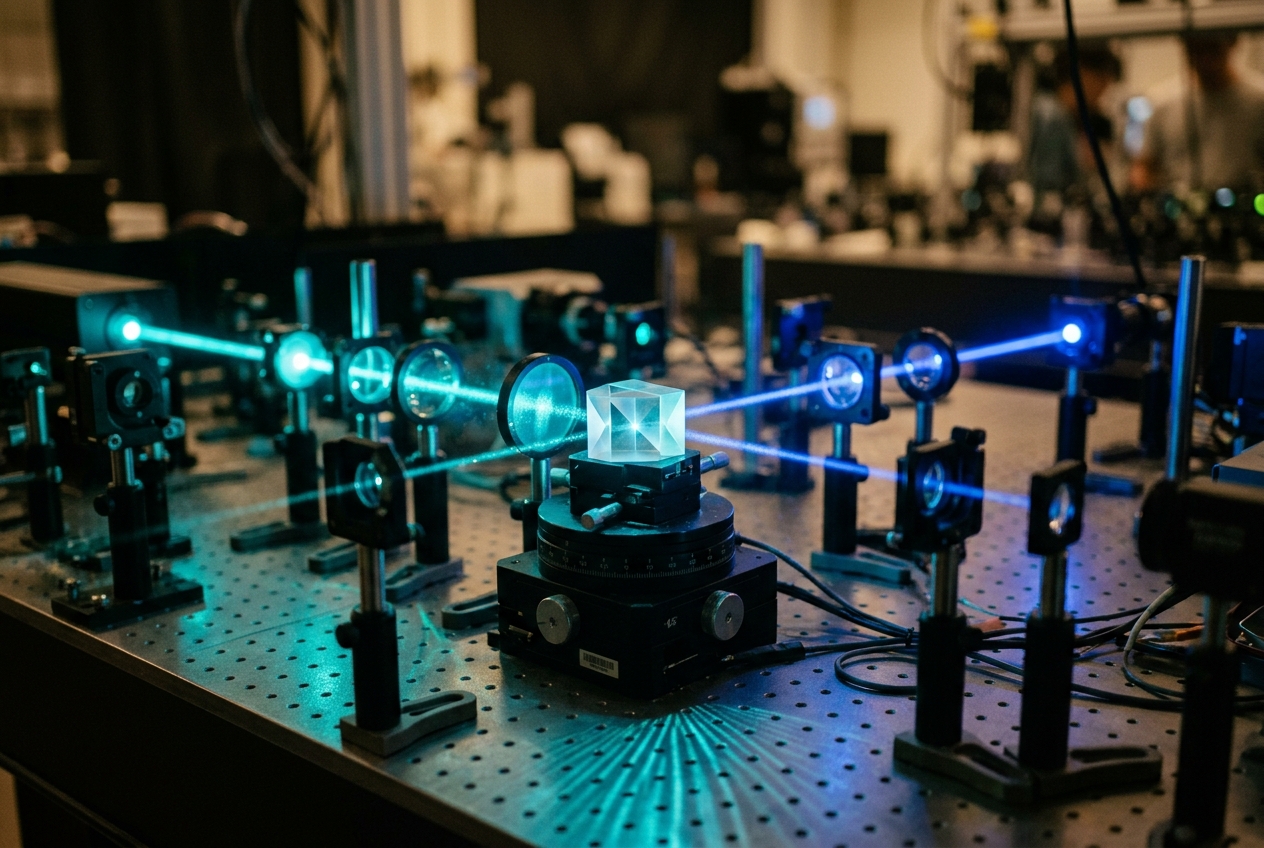
Every cryptographic exchange securing our planetary digital infrastructure—from interbank wire transfers and classified government memos to the private credentials stored in your smartphone—rests on a fragile computational assumption. We assume that factoring extraordinarily large integers or solving discrete logarithms is too difficult for classical computers to accomplish in human lifetimes. Yet, the advent of scalable quantum processors is systematically dismantling those mathematical moats. In response, physicists and engineers are turning to the immutable laws of nature to forge unbreakable cryptographic protocols. At the very center of this defensive revolution sits a geometric structure known as Mutually Unbiased Bases (MUBs).
To master mutually unbiased bases is to understand how quantum mechanics enforces its most famous rule: that gaining complete knowledge of one physical attribute completely erases all knowledge of another. By engineering quantum systems into multidimensional geometric configurations where every measurement perspective is maximally blind to all others, physicists can extract the maximum possible diagnostic information about an unknown quantum state, certify cryptographic keys with unmatched noise tolerance, and expose any eavesdropper who dares to observe the channel.
1. Opening Hook — Why You Should Care
Imagine a bank vault whose lock does not rely on a secret numerical code, but on the trajectory of light itself. If an intruder attempts to inspect the lock mechanism, the simple act of looking alters the physical state of the combination, permanently corrupting the key and triggering an immediate alarm. This is not science fiction; it is the operational premise of Quantum Key Distribution.
However, ordinary quantum cryptography—operating on simple two-level systems known as qubits—is vulnerable to real-world optical loss, detector noise, and eavesdropping attacks that exploit slight statistical imbalances. If an eavesdropper learns even a subtle bias in how a photon's polarization is measured, quantum security compromises begin to accumulate.
To build communication channels that are resilient against advanced quantum adversaries, researchers must scale beyond two-dimensional qubits into higher-dimensional quantum systems called qudits. In these multi-level systems, data is encoded not merely as 0 or 1, but across high-dimensional states such as orbital angular momentum or spatial modes of photons. The entire security, state tomography, and error-verification framework of high-dimensional quantum information relies on an elegant mathematical question: How many radically independent perspectives can exist within a given dimension before the laws of mathematics forbid any more?
The answer determines the ultimate speed, fidelity, and cryptographic security of quantum communication networks worldwide.
2. The Idea in Plain English
Before diving into algebraic constructions, consider a tangible physical analogy: a sculptor examining a multi-faceted geometric crystal in a dark room using a single beam of light.
If the sculptor shines the light directly onto the flat front face of the crystal, they obtain a sharp, high-contrast shadow that reveals everything about that specific surface. Now, suppose the sculptor wants a second perspective that tells them absolutely nothing about the front face, distributing the shadow with uniform, featureless intensity across the wall. To achieve this, the light must be repositioned to an angle that is maximally incompatible with the first.
       [Perspective A: Z-Basis]              [Perspective B: X-Basis]
       Complete certainty on state           Uniform dispersion across all outcomes
            |0⟩ -> 100% Probability              |0⟩ -> 50% |+⟩  /  50% |-⟩
In ordinary classical physics, examining an object from one angle never destroys information about other angles. In quantum physics, however, state space behaves like a collection of interlocking measurement perspectives. An orthonormal basis is simply a complete set of standard reference markers—a coordinate system—used to measure a quantum system.
Two measurement bases are described as mutually unbiased when choosing to measure in the first basis leaves the outcome of any measurement in the second basis completely and uniformly random. If a quantum particle is prepared in a definite state of the first basis, an observer measuring it in the second basis will find that every single outcome has an identical probability of occurring.
There is no favoritism, no bias, and no residual hint. This condition represents maximal complementarity: total knowledge in one measurement domain guarantees absolute ignorance in the other.
3. How It Actually Works — The Mechanics
The Overlap Condition and Geometric Orthogonality
In a finite $d$-dimensional quantum system (a Hilbert space $\mathbb{C}^d$), a physical measurement is represented by a set of mutually perpendicular, unit-length quantum states called an orthonormal basis. Let us denote one such basis as $\mathcal{E} = {|e_1\rangle, |e_2\rangle, \dots, |e_d\rangle}$ and a second basis as $\mathcal{F} = {|f_1\rangle, |f_2\rangle, \dots, |f_d\rangle}$.
The mathematical criterion for mutual unbiasedness is defined by the transition probability between any state in the first basis and any state in the second basis. For all possible indices $i$ and $j$ running from $1$ through $d$, the squared modulus of their inner product must equal the inverse of the dimension:
$$|\langle e_i | f_j \rangle|^2 = \frac{1}{d}$$
This equation states that if a quantum system is prepared in the definite state $|e_i\rangle$, a measurement carried out in basis $\mathcal{F}$ yields outcome $|f_j\rangle$ with probability exactly $1/d$. Because this probability is identical for all $j \in {1, \dots, d}$, the measurement returns maximal entropy—pure randomness.
For a single qubit ($d = 2$), the state space is visualized as the surface of the three-dimensional Bloch sphere. The standard computational basis corresponds to the North and South poles (the Pauli-Z measurement). The two additional bases correspond to the East-West axis (Pauli-X) and the North-South lateral axis (Pauli-Y). In this three-dimensional representation, the three mutually unbiased bases form three mutually perpendicular spatial axes. A measurement along the Z-axis projects any equatorial state onto an equal-probability split of fifty percent up and fifty percent down.
                      |0⟩ (Z+)
                         |
                         |   / |+i⟩ (Y+)
                         |  /
                         | /
     |-⟩ (X-) -----------+----------- |+⟩ (X+)
                        /|
                       / |
             |-i⟩ (Y-) / |
                         |
                       |1⟩ (Z-)
        Three orthogonal axes in 3D Bloch Space = 3 MUBs for d=2
In dimension $d$, the theoretical maximum number of such mutually unbiased bases that can ever be constructed pairwise is $d + 1$. For a two-level qubit ($d = 2$), this gives $2 + 1 = 3$ bases: the familiar Pauli $X$, $Y$, and $Z$ observables.
Algebraic Construction in Prime and Prime-Power Dimensions
The problem of constructing a full set of $d + 1$ mutually unbiased bases is fundamentally algebraic. When the dimension $d$ is a prime number $p$ (such as 2, 3, 5, 7, 11) or a prime power $p^n$ (such as 4, 8, 9, 16), mathematicians and physicists can construct the maximal set of $d + 1$ MUBs using the algebraic machinery of Galois fields $\mathrm{GF}(p^n)$ and the discrete Heisenberg-Weyl group.
For a prime dimension $d = p$, we define two unitary operators: the shift operator $X$ and the clock operator $Z$. The shift operator cyclically permutes the standard basis vectors modulo $p$, while the clock operator applies a position-dependent phase shift proportional to the $p$-th root of unity. These generalized Pauli operators satisfy the discrete Weyl commutation relation:
$$Z X = \omega X Z, \quad \text{where } \omega = e^{2\pi i / p}$$
To build the full collection of $p + 1$ bases, we construct $p$ distinct operator families of the form $X Z^k$ (where the integer exponent $k$ runs from $0$ through $p - 1$), along with the original clock operator $Z$. Each of these $p + 1$ operators generates a set of mutually commuting eigenvectors that form an orthonormal basis. Because the operators generate distinct non-overlapping cyclic subgroups, the resulting $p + 1$ bases are guaranteed to be mutually unbiased to one another.
When scaling to prime powers $d = p^n$, simple modular arithmetic is insufficient. Instead, one constructs generalized Pauli operators over the finite algebraic field $\mathrm{GF}(p^n)$ using field traces. By mapping field elements into discrete phase-space operators, the quantum state space can be tessellated into a set of $d + 1$ discrete straight lines (rays) passing through the origin of a $d \times d$ discrete phase space grid, generating exactly $d + 1$ complete, mutually unbiased measurement perspectives.
The Enigma of Dimension Six: Quantum Physics' Unsolved Geometry
While the prime and prime-power cases were solved completely during the late 20th century, composite dimensions that are not prime powers remain one of the most famous open problems in quantum mathematics.
The smallest composite non-prime-power dimension is $d = 6$ ($2 \times 3$). If the prime-power formula held universally, a 6-dimensional quantum system would possess $6 + 1 = 7$ mutually unbiased bases. However, after decades of intensive analytical proofs, group-theoretic investigations, and high-precision numerical searches, physicists have only ever discovered 3 mutually unbiased bases in dimension six.
+-------------------------------------------------------------------------+
|                  THE COMPOSITE DIMENSION CONUNDRUM                      |
|                                                                         |
|  Dimension (d)       Type               Max MUBs Known   Upper Bound   |
|  ---------------------------------------------------------------------  |
|  d = 2               Prime                    3               3         |
|  d = 3               Prime                    4               4         |
|  d = 4 (2^2)         Prime Power              5               5         |
|  d = 5               Prime                    6               6         |
|  d = 6 (2 x 3)       Composite (Non-Power)    3               7 (OPEN!) |
|  d = 7               Prime                    8               8         |
|  d = 8 (2^3)         Prime Power              9               9         |
+-------------------------------------------------------------------------+
This structural impasse shares deep historical roots with Leonhard Euler's 1779 "36 Officers Problem," which asked whether 36 officers of six different ranks and from six different regiments could be arranged in a $6 \times 6$ square such that no rank or regiment was repeated in any row or column. Euler conjectured it was impossible; in 1901, Gaston Tarry proved that no pair of orthogonal Latin squares of order 6 exists.
In quantum mechanics, mutually unbiased bases correspond to a non-commutative, continuous generalization of mutually orthogonal Latin squares. Exhaustive numerical searches running over supercomputing clusters have placed bounds on the existence of a fourth MUB in dimension 6, demonstrating that if a fourth basis exists, its vectors must deviate from the required overlap of $1/6$ by less than numerical precision limits ($10^{-14}$). The consensus among theoretical physicists is that the maximum number of MUBs for $d = 6$ is strictly 3, yet a rigorous analytical proof remains elusive.
Information Bounds and Optimal Quantum State Tomography
Why does the existence of a complete set of $d + 1$ MUBs matter so fundamentally to quantum theory? The answer lies in entropic uncertainty and quantum state tomography.
In classical probability, uncertainty is quantified by Shannon entropy. In quantum systems, the total uncertainty across different measurement perspectives is constrained by entropic uncertainty relations. For any two mutually unbiased bases $\mathcal{A}$ and $\mathcal{B}$, the Maassen-Uffink inequality establishes that the sum of the measurement entropies $H(\mathcal{A}) + H(\mathcal{B})$ is strictly bounded from below:
$$H(\mathcal{A}) + H(\mathcal{B}) \ge \log_2 d$$
When a complete set of $d + 1$ MUBs exists, this relation generalizes into an exact sum rule across all bases. The total uncertainty across all $d + 1$ perspectives reaches a global minimum that cannot be breached by any physical state, providing an absolute mathematical measure of quantum non-locality.
This mathematical structure makes MUBs the optimal engine for Quantum State Tomography—the process of reconstructing the unknown density matrix $\rho$ of a quantum state from experimental data.
A $d$-dimensional density matrix is characterized by $d^2 - 1$ real independent parameters. Measuring a single basis provides $d - 1$ independent probabilities (since the probabilities must sum to 1). Therefore, to completely determine the state without measuring redundant information, an experimenter needs:
$$(d + 1) \times (d - 1) = d^2 - 1 \text{ independent parameters}$$
A complete set of $d + 1$ MUBs supplies precisely these $d^2 - 1$ orthogonal projection operators. Because the measurement operators are mutually unbiased, their cross-correlation matrix is maximally isotropic. Reconstructing an unknown quantum state using a full set of MUBs minimizes the statistical error variance across the reconstructed density matrix, achieving the theoretical Cramér-Rao limit for state estimation.
When mapped onto discrete phase space, the probabilities obtained from measuring these $d + 1$ MUBs correspond directly to marginal distributions of the Discrete Wigner Function, establishing an exact bridge between quantum wavefunctions and quasiprobability distributions in phase space.
4. Real-World Applications Today
The abstract mathematics of finite fields and Hilbert space geometry powers cutting-edge quantum hardware and protocol engineering today.
1. High-Dimensional Quantum Key Distribution (QKD)
- Institutions: Toshiba Europe, University of Ottawa Quantum Photonics Laboratory.
- The Objective: Transmitting secure encryption keys across atmospheric and optical fiber channels using high-dimensional photons (qudits encoded via orbital angular momentum or time-bin structures).
- The Quantum Advantage: Standard qubit-based QKD (like the BB84 protocol) can tolerate an error rate of at most 11% before an eavesdropper could theoretically possess full information. By transitioning to high-dimensional qudits using complete sets of MUBs, researchers push this error threshold above 20%. Because each photon carries $\log_2 d$ bits of data rather than a single bit, transmission throughput increases while providing mathematically proven resistance against eavesdropping.
2. Precision Quantum State Tomography on QPU Platforms
- Institutions: IBM Quantum, National Institute of Standards and Technology (NIST).
- The Objective: Characterizing gate noise, crosstalk, and state preparation fidelity across multi-qubit quantum processors without incurring exponential measurement overhead.
- The Quantum Advantage: By organizing multi-qubit measurement circuits into mutually unbiased bases generated via Clifford group operations, engineers perform tomography with zero measurement redundancy. This dramatically reduces the total number of physical circuit executions needed to verify high-fidelity quantum operations.
3. Discrete Phase-Space Imaging & Quantum Diagnostics
- Institutions: Max Planck Institute for the Science of Light, University of Oxford Quantum Technology Hub.
- The Objective: Directly mapping non-classical features (such as negative quasi-probabilities) in discrete variable quantum systems.
- The Quantum Advantage: Using discrete Heisenberg-Weyl groups to sample along MUB trajectories, researchers directly reconstruct discrete Wigner functions. Observing negative values in these reconstructed Wigner functions provides unambiguous, certified proof of contextuality—the fundamental quantum resource that enables quantum computers to outperform classical machines.
4. Certified Device-Independent Quantum Random Number Generation
- Institutions: Quantinuum, University of Geneva.
- The Objective: Generating provably unpredictable, tamper-proof random numbers for high-assurance cybersecurity and scientific simulations.
- The Quantum Advantage: By measuring entangled qudits across alternating mutually unbiased bases, systems can continuously verify that outputs satisfy tight entropic uncertainty bounds. If an adversary attempts to bias the hardware or intercept the outcomes, the entropic sum across the MUB measurements immediately drops, exposing the compromise in real time.
5. What This Means for You
It is easy to view high-dimensional Hilbert spaces and Galois fields as remote mathematical abstractions. In practice, they form the bedrock of the next generation of global data security.
Within the next decade, financial networks, national intelligence backbones, and healthcare databases will transition toward quantum-secure architectures. When you perform an online transaction or store medical records in the quantum era, the privacy of your data will not rely on an algorithm that can be cracked by an unexpected mathematical breakthrough. Instead, it will be guaranteed by the physical reality of measurement complementarity:
Because an unauthorized eavesdropper cannot simultaneously orient their detectors across mutually unbiased bases, any attempt to snoop inevitably introduces measurable, irreversible physical noise into the communication line. If that noise crosses the theoretical threshold derived from MUB uncertainty relations, the network instantly severs the connection before a single byte of your personal data is decrypted. The abstract geometry of quantum state space becomes your personal digital vault.
6. Today's Takeaway
The Core Principle: Mutually Unbiased Bases represent the ultimate mathematical expression of quantum incompatibility. In a space of $d$ dimensions, two measurement frames are mutually unbiased when certainty in one guarantees pure, uniform randomness in the other. Where complete sets of $d + 1$ bases exist, they eliminate measurement redundancy, minimize error in state reconstruction, and establish impenetrable security thresholds for high-dimensional quantum cryptography.
Authoritative References and Further Reading
- Deep dive into the algebraic foundation of state vectors on MIT OpenCourseWare Quantum Physics.
- Explore foundational papers on operator theory and MUBs in Physical Review Letters.
- Learn how high-dimensional quantum states are benchmarked at IBM Quantum Documentation.
- Read recent experimental qudit communication results published in Nature Physics.
- Consult the comprehensive reference entry on Mutually Unbiased Bases at Wikipedia.