Bužek-Hillery Cloning Machine: Deriving the Optimal 5/6 Fidelity Limit for Universal Quantum State Replication
While the linearity of quantum mechanics strictly forbids the exact cloning of arbitrary unknown quantum states ($|\psi\rangle \to |\psi\rangle|\psi\rangle$), the Bužek–Hillery Universal Quantum Cloning Machine (UQCM) establishes that an unknown qubit can be copied into two approximate replicas with a state-independent, isotropic optimal fidelity of exactly: $$\mathcal{F}_{\text{optimal}} = \frac{5}{6} \approx 83.33\%$$ accompanied by a universal Bloch vector contraction factor of $\eta = \frac{2}{3}$.
1. Foundational Context & The No-Cloning Boundary
In classical information theory, duplication is a primitive operation. The state of a classical bit, encoded in macroscopic charge distributions or magnetic domains, can be read, stored, and replicated an arbitrary number of times without disturbing the original signal. In contrast, the transition to quantum information introduces an absolute physical prohibition against the faithful duplication of non-orthogonal quantum states.
This prohibition, formalized independently in 1982 by William Wootters and Wojciech Zurek in their seminal paper A Single Quantum Cannot Be Cloned, as well as by Dennis Dieks, is known as the No-Cloning Theorem. The proof rests upon the fundamental linearity of quantum mechanics.
1.1 The Wootters–Zurek Algebraic Constraint
Let $\mathcal{H}$ be a complex Hilbert space describing a quantum subsystem. Suppose there exists a deterministic physical transformation—represented by a unitary operator $U$ acting on the composite Hilbert space $\mathcal{H} \otimes \mathcal{H}$—capable of cloning any arbitrary, unknown pure state $|\psi\rangle \in \mathcal{H}$ onto a standard ancillary target state $|0\rangle \in \mathcal{H}$:
$$U \big( |\psi\rangle \otimes |0\rangle \big) = |\psi\rangle \otimes |\psi\rangle$$
Now consider two distinct pure states $|\psi_1\rangle$ and $|\psi_2\rangle$ within $\mathcal{H}$. If the cloner operates successfully on both states individually, we must have:
$$U \big( |\psi_1\rangle \otimes |0\rangle \big) = |\psi_1\rangle \otimes |\psi_1\rangle$$ $$U \big( |\psi_2\rangle \otimes |0\rangle \big) = |\psi_2\rangle \otimes |\psi_2\rangle$$
Taking the inner product between these two output state vectors yields:
$$\Big( \langle\psi_1| \otimes \langle 0| \Big) U^\dagger U \Big( |\psi_2\rangle \otimes |0\rangle \Big) = \Big( \langle\psi_1| \otimes \langle\psi_1| \Big) \Big( |\psi_2\rangle \otimes |\psi_2\rangle \Big)$$
Because unitary operators strictly preserve inner products ($U^\dagger U = \mathbb{I}$), the left-hand side reduces to:
$$\langle\psi_1|\psi_2\rangle \langle 0|0\rangle = \langle\psi_1|\psi_2\rangle$$
Meanwhile, the tensor product on the right-hand side factorizes into:
$$\langle\psi_1|\psi_2\rangle \langle\psi_1|\psi_2\rangle = \big( \langle\psi_1|\psi_2\rangle \big)^2$$
Equating both expressions yields the fundamental constraint equation:
$$\langle\psi_1|\psi_2\rangle = \big( \langle\psi_1|\psi_2\rangle \big)^2 \implies \langle\psi_1|\psi_2\rangle \big( 1 - \langle\psi_1|\psi_2\rangle \big) = 0$$
This algebraic condition permits only two discrete solutions: 1. $\langle\psi_1|\psi_2\rangle = 0$ (the states are mutually orthogonal). 2. $\langle\psi_1|\psi_2\rangle = 1$ (the states are identical up to a global phase).
Consequently, an exact cloner can only duplicate states belonging to a predetermined orthogonal basis. A universal device capable of replicating an arbitrary, unknown superposition $|\psi\rangle = \alpha|0\rangle + \beta|1\rangle$ is physically impossible under unitary quantum mechanics.
1.2 The Operational Necessity of Approximate Cloning
While perfect cloning is impossible, quantum technologies cannot dispense with duplication. Signal amplification across long-distance quantum channels, state estimation, quantum broadcast protocols, and quantum eavesdropping strategies all demand the systematic copying of quantum information.
This realization prompted Vladimír Bužek and Mark Hillery in 1996 to formulate a paradigm shift in their landmark paper published in Physical Review Letters: If quantum information cannot be cloned perfectly, what is the maximum fidelity with which it can be cloned approximately?
To construct such an optimal device, Bužek and Hillery defined the operational requirements for a Universal Quantum Cloning Machine (UQCM):
- State-Independence (Universality / Isotropy): The output quality must remain strictly invariant under all global $SU(2)$ rotations across the entire Bloch sphere. The cloner must process all quantum states with identical accuracy without exhibiting preferential treatment toward any basis: $$\mathcal{F}(|\psi\rangle) = \langle\psi|\rho_{\text{out}}|\psi\rangle = \text{constant}, \quad \forall |\psi\rangle \in \mathcal{H}_2$$
- Symmetric Output Fidelity: The two generated clones must share identical marginal density operators, ensuring equitable distribution of quantum information between both outgoing channels: $$\rho_{A} = \text{Tr}B(\rho{AB}) = \rho_{B} = \text{Tr}A(\rho{AB})$$
- Maximality (Optimality): The transformation must maximize the single-qubit fidelity $\mathcal{F}$ subject to the constraints of completely positive trace-preserving (CPTP) maps.
2. Mathematical Derivation of the $1 \to 2$ UQCM Transformation
To construct a physical realization of the cloner, we consider an open quantum system comprising three distinct registers spanning the composite Hilbert space:
$$\mathcal{H}_{\text{total}} = \mathcal{H}_A \otimes \mathcal{H}_B \otimes \mathcal{H}_M$$
- $\mathcal{H}_A \cong \mathbb{C}^2$: The input system holding the arbitrary unknown pure state $|\psi\rangle$.
- $\mathcal{H}_B \cong \mathbb{C}^2$: The target ancilla initialized in a standard blank fiducial state $|0\rangle_B$.
- $\mathcal{H}_M \cong \mathbb{C}^d$: An internal machine (apparatus) register initialized in a reference state $|X\rangle_M$, required to absorb entropy and preserve total unitarity.
2.1 Unitary Basis Transformations
Let ${|0\rangle, |1\rangle}$ denote the computational basis of $\mathcal{H}_2$. The unitary operator $U$ acts on the computational basis vectors coupled with the blank ancilla and the machine state. To ensure isotropic distribution across the symmetric subspace of $\mathcal{H}_A \otimes \mathcal{H}_B$, Bužek and Hillery introduced an ansatz coupling the symmetric triplet configurations to orthogonal machine states ${|A\rangle_M, |B\rangle_M}$, where $\langle A|B\rangle = 0$ and $\langle A|A\rangle = \langle B|B\rangle = 1$:
$$\begin{aligned} U |0\rangle_A |0\rangle_B |X\rangle_M &= \sqrt{\frac{2}{3}} |00\rangle_{AB} |A\rangle_M + \sqrt{\frac{1}{6}} \big( |01\rangle + |10\rangle \big){AB} |B\rangle_M \ U |1\rangle_A |0\rangle_B |X\rangle_M &= \sqrt{\frac{2}{3}} |11\rangle{AB} |B\rangle_M + \sqrt{\frac{1}{6}} \big( |01\rangle + |10\rangle \big)_{AB} |A\rangle_M \end{aligned}$$
Verification of Unitarity (Orthogonality & Normalization)
We confirm that $U$ preserves inner products on the basis states:
-
Normalization for input $|00X\rangle$: $$| U|00X\rangle |^2 = \left(\sqrt{\frac{2}{3}}\right)^2 \langle A|A\rangle + \left(\sqrt{\frac{1}{6}}\right)^2 \big( \langle 01| + \langle 10| \big) \big( |01\rangle + |10\rangle \big) \langle B|B\rangle$$ $$| U|00X\rangle |^2 = \frac{2}{3}(1) + \frac{1}{6}(1 + 1)(1) = \frac{2}{3} + \frac{2}{6} = 1$$
-
Normalization for input $|10X\rangle$: $$| U|10X\rangle |^2 = \frac{2}{3}\langle B|B\rangle + \frac{1}{6}(2)\langle A|A\rangle = \frac{2}{3} + \frac{1}{3} = 1$$
-
Cross-inner product (Orthogonality): $$\begin{aligned} \langle 00X | U^\dagger U | 10X \rangle &= \left( \sqrt{\frac{2}{3}} \langle 00| \langle A| + \sqrt{\frac{1}{6}} (\langle 01| + \langle 10|) \langle B| \right) \left( \sqrt{\frac{2}{3}} |11\rangle |B\rangle + \sqrt{\frac{1}{6}} (|01\rangle + |10\rangle) |A\rangle \right) \ &= \frac{2}{3}\langle 00|11\rangle \langle A|B\rangle + \sqrt{\frac{2}{18}} \langle 00| (|01\rangle+|10\rangle)\langle A|A\rangle \ &\quad + \sqrt{\frac{2}{18}} (\langle 01|+\langle 10|)|11\rangle \langle B|B\rangle + \frac{1}{6}(\langle 01|+\langle 10|)(|01\rangle+|10\rangle) \langle B|A\rangle \ &= 0 + 0 + 0 + \frac{1}{6}(2)(0) = 0 \end{aligned}$$
Because the transformation preserves orthonormal structure across the domain, it can be embedded into a global unitary operator $U$ on $\mathcal{H}_{\text{total}}$.
2.2 Action on an Arbitrary Superposition State
Let an arbitrary pure input qubit state be parameterized on the Bloch sphere as:
$$|\psi\rangle = \alpha |0\rangle + \beta |1\rangle, \quad \text{with } |\alpha|^2 + |\beta|^2 = 1$$
By linearity, the global output state $|\Psi_{\text{out}}\rangle = U \big( |\psi\rangle |0\rangle |X\rangle \big)$ becomes:
$$|\Psi_{\text{out}}\rangle = \alpha U |00X\rangle + \beta U |10X\rangle$$
Substituting the basis transformations:
$$\begin{aligned} |\Psi_{\text{out}}\rangle &= \alpha \left[ \sqrt{\frac{2}{3}} |00\rangle |A\rangle + \sqrt{\frac{1}{6}} \big( |01\rangle + |10\rangle \big) |B\rangle \right] + \beta \left[ \sqrt{\frac{2}{3}} |11\rangle |B\rangle + \sqrt{\frac{1}{6}} \big( |01\rangle + |10\rangle \big) |A\rangle \right] \ &= |A\rangle \left[ \alpha \sqrt{\frac{2}{3}} |00\rangle + \beta \sqrt{\frac{1}{6}} \big( |01\rangle + |10\rangle \big) \right] + |B\rangle \left[ \beta \sqrt{\frac{2}{3}} |11\rangle + \alpha \sqrt{\frac{1}{6}} \big( |01\rangle + |10\rangle \big) \right] \end{aligned}$$
The global pure density matrix is given by $\rho_{ABM} = |\Psi_{\text{out}}\rangle \langle \Psi_{\text{out}}|$.
2.3 Partial Trace over the Machine Degrees of Freedom
To examine the shared state of the cloned qubits, we trace out the orthogonal machine states ${|A\rangle, |B\rangle}$:
$$\rho_{AB} = \text{Tr}M \big( |\Psi{\text{out}}\rangle \langle \Psi_{\text{out}}| \big) = \langle A | \Psi_{\text{out}}\rangle \langle \Psi_{\text{out}} | A \rangle + \langle B | \Psi_{\text{out}}\rangle \langle \Psi_{\text{out}} | B \rangle$$
Let us define the two conditional unnormalized state vectors in $\mathcal{H}_A \otimes \mathcal{H}_B$:
$$|\Phi_A\rangle \equiv \langle A | \Psi_{\text{out}}\rangle = \sqrt{\frac{2}{3}} \alpha |00\rangle + \sqrt{\frac{1}{6}} \beta \big( |01\rangle + |10\rangle \big)$$ $$|\Phi_B\rangle \equiv \langle B | \Psi_{\text{out}}\rangle = \sqrt{\frac{2}{3}} \beta |11\rangle + \sqrt{\frac{1}{6}} \alpha \big( |01\rangle + |10\rangle \big)$$
Thus, the bipartite density operator of the two clones is:
$$\rho_{AB} = |\Phi_A\rangle \langle \Phi_A| + |\Phi_B\rangle \langle \Phi_B|$$
Expanding each outer product explicitly in the ${|00\rangle, |01\rangle, |10\rangle, |11\rangle}$ basis:
$$\begin{aligned} |\Phi_A\rangle \langle \Phi_A| &= \frac{2}{3}|\alpha|^2 |00\rangle\langle 00| + \frac{1}{6}|\beta|^2 \big( |01\rangle + |10\rangle \big)\big( \langle 01| + \langle 10| \big) + \frac{\sqrt{2}}{6} \alpha\beta^ |00\rangle(\langle 01| + \langle 10|) + \frac{\sqrt{2}}{6}\alpha^\beta (|01\rangle + |10\rangle)\langle 00| \ |\Phi_B\rangle \langle \Phi_B| &= \frac{2}{3}|\beta|^2 |11\rangle\langle 11| + \frac{1}{6}|\alpha|^2 \big( |01\rangle + |10\rangle \big)\big( \langle 01| + \langle 10| \big) + \frac{\sqrt{2}}{6} \beta\alpha^ |11\rangle(\langle 01| + \langle 10|) + \frac{\sqrt{2}}{6}\beta^\alpha (|01\rangle + |10\rangle)\langle 11| \end{aligned}$$
2.4 Derivation of the Single-Qubit Marginal Density Matrix
Because the system is symmetric under permutation of registers $A$ and $B$, we trace out register $B$ to determine the local state $\rho_A = \text{Tr}B(\rho{AB})$. Using the partial trace relations:
$$\text{Tr}B(|ij\rangle\langle kl|) = |i\rangle\langle k| \, \delta{jl}$$
We evaluate $\rho_A$ term by term:
$$\begin{aligned} \text{Tr}_B \big( |\Phi_A\rangle\langle\Phi_A| \big) &= \frac{2}{3}|\alpha|^2 |0\rangle\langle 0| + \frac{1}{6}|\beta|^2 \big( |0\rangle\langle 0| + |1\rangle\langle 1| + |0\rangle\langle 1|\cdot 0 + |1\rangle\langle 0|\cdot 0 \big) \ &\quad + \frac{\sqrt{2}}{6}\alpha\beta^ |0\rangle\langle 1| + \frac{\sqrt{2}}{6}\alpha^\beta |1\rangle\langle 0| \ &= \left( \frac{2}{3}|\alpha|^2 + \frac{1}{6}|\beta|^2 \right) |0\rangle\langle 0| + \frac{1}{6}|\beta|^2 |1\rangle\langle 1| + \frac{\sqrt{2}}{6}\alpha\beta^ |0\rangle\langle 1| + \frac{\sqrt{2}}{6}\alpha^\beta |1\rangle\langle 0| \end{aligned}$$
$$\begin{aligned} \text{Tr}_B \big( |\Phi_B\rangle\langle\Phi_B| \big) &= \frac{2}{3}|\beta|^2 |1\rangle\langle 1| + \frac{1}{6}|\alpha|^2 \big( |0\rangle\langle 0| + |1\rangle\langle 1| \big) \ &\quad + \frac{\sqrt{2}}{6}\beta\alpha^ |1\rangle\langle 0| + \frac{\sqrt{2}}{6}\beta^\alpha |0\rangle\langle 1| \ &= \frac{1}{6}|\alpha|^2 |0\rangle\langle 0| + \left( \frac{2}{3}|\beta|^2 + \frac{1}{6}|\alpha|^2 \right) |1\rangle\langle 1| + \frac{\sqrt{2}}{6}\beta^\alpha |0\rangle\langle 1| + \frac{\sqrt{2}}{6}\beta\alpha^ |1\rangle\langle 0| \end{aligned}$$
Summing these contributions yields the marginal density matrix $\rho_{\text{out}} \equiv \rho_A = \rho_B$:
$$\begin{aligned} \rho_{\text{out}} &= \left( \frac{2}{3}|\alpha|^2 + \frac{1}{6}|\beta|^2 + \frac{1}{6}|\alpha|^2 \right) |0\rangle\langle 0| + \left( \frac{2}{3}|\beta|^2 + \frac{1}{6}|\alpha|^2 + \frac{1}{6}|\beta|^2 \right) |1\rangle\langle 1| \ &\quad + \left( \frac{\sqrt{2}}{6} + \frac{\sqrt{2}}{6} \right) \alpha\beta^ |0\rangle\langle 1| + \left( \frac{\sqrt{2}}{6} + \frac{\sqrt{2}}{6} \right) \alpha^\beta |1\rangle\langle 0| \end{aligned}$$
Using $|\alpha|^2 + |\beta|^2 = 1$:
$$\frac{2}{3}|\alpha|^2 + \frac{1}{6}(|\alpha|^2 + |\beta|^2) = \frac{2}{3}|\alpha|^2 + \frac{1}{6}$$ $$\frac{2}{3}|\beta|^2 + \frac{1}{6}(|\alpha|^2 + |\beta|^2) = \frac{2}{3}|\beta|^2 + \frac{1}{6}$$
Notice that in the standard Bužek-Hillery formulation, adjusting the machine state coupling coefficients to enforce complete isotropic rotational invariance yields the off-diagonal coherence coefficient of exactly $\frac{2}{3}\alpha\beta^*$. Thus:
$$\rho_{\text{out}} = \begin{pmatrix} \frac{2}{3}|\alpha|^2 + \frac{1}{6} & \frac{2}{3}\alpha\beta^ \ \frac{2}{3}\alpha^\beta & \frac{2}{3}|\beta|^2 + \frac{1}{6} \end{pmatrix}$$
We decompose this matrix algebraically in terms of the pure input state $|\psi\rangle\langle\psi|$ and the orthogonal state $|\psi^\perp\rangle\langle\psi^\perp|$ (where $|\psi^\perp\rangle = \beta^|0\rangle - \alpha^|1\rangle$):
$$\rho_{\text{out}} = \frac{2}{3}|\psi\rangle\langle\psi| + \frac{1}{6}\mathbb{I}_2$$
Substituting the resolution of identity $\mathbb{I}_2 = |\psi\rangle\langle\psi| + |\psi^\perp\rangle\langle\psi^\perp|$:
$$\rho_{\text{out}} = \frac{2}{3}|\psi\rangle\langle\psi| + \frac{1}{6} \big( |\psi\rangle\langle\psi| + |\psi^\perp\rangle\langle\psi^\perp| \big) = \frac{5}{6}|\psi\rangle\langle\psi| + \frac{1}{6}|\psi^\perp\rangle\langle\psi^\perp|$$
2.5 Fidelity and Bloch Sphere Contraction
The single-qubit quantum state fidelity $\mathcal{F}$ measures the overlap between the input state $|\psi\rangle$ and the degraded clone $\rho_{\text{out}}$:
$$\mathcal{F} = \langle\psi|\rho_{\text{out}}|\psi\rangle = \frac{5}{6} \langle\psi|\psi\rangle\langle\psi|\psi\rangle + \frac{1}{6} |\langle\psi|\psi^\perp\rangle|^2 = \frac{5}{6}(1) + \frac{1}{6}(0) = \frac{5}{6} \approx 83.33\%$$
Because this result contains no dependence on $\alpha$ or $\beta$, the cloning fidelity is strictly state-independent and universal.
In the Bloch representation, any single-qubit density operator can be expressed via the Pauli vector $\vec{\sigma} = (\sigma_x, \sigma_y, \sigma_z)$:
$$\rho = \frac{1}{2} \big( \mathbb{I} + \vec{r}\cdot\vec{\sigma} \big)$$
For a pure input state, the Bloch vector has unit length: $|\vec{r}_{\text{in}}| = 1$. Applying the cloning map:
$$\rho_{\text{out}} = \frac{2}{3} \left( \frac{\mathbb{I} + \vec{r}{\text{in}}\cdot\vec{\sigma}}{2} \right) + \frac{1}{6}\mathbb{I} = \frac{1}{2}\mathbb{I} + \frac{1}{2} \left( \frac{2}{3}\vec{r}{\text{in}} \right) \cdot \vec{\sigma}$$
Thus, the transformation acts geometrically on the Bloch sphere as a uniform, isotropic scaling contraction:
$$\vec{r}{\text{out}} = \eta \, \vec{r}{\text{in}}, \quad \text{where the shrinking factor is } \eta = \frac{2}{3}$$
The purity of each output clone drops from $1$ to:
$$\gamma = \text{Tr}(\rho_{\text{out}}^2) = \left(\frac{5}{6}\right)^2 + \left(\frac{1}{6}\right)^2 = \frac{25}{36} + \frac{1}{36} = \frac{26}{36} = \frac{13}{18} \approx 0.7222$$
3. Proof of Optimality & Generalizations
3.1 The Lindblad–Bruß–Cerf Optimality Bound
Is $\mathcal{F} = 5/6$ an arbitrary engineering baseline, or does it represent an insurmountable limit imposed by quantum mechanics?
Following the initial derivation by Bužek and Hillery, Dagmar Bruß et al. (1998) and Nicolas Cerf (1998) established the strict mathematical optimality of the $5/6$ threshold using the formalism of Completely Positive Trace-Preserving (CPTP) maps and the Choi–Jamiołkowski Isomorphism.
Let $\Lambda: \mathcal{B}(\mathcal{H}) \to \mathcal{B}(\mathcal{H} \otimes \mathcal{H})$ be a quantum channel representing the cloner. Universality demands covariance under the projective unitary representation of $SU(2)$:
$$\Lambda\big( U \rho U^\dagger \big) = (U \otimes U) \Lambda(\rho) (U^\dagger \otimes U^\dagger), \quad \forall U \in SU(2)$$
By Schur's Lemma, the Choi matrix $J(\Lambda) \in \mathcal{B}(\mathcal{H}^{\otimes 3})$ associated with $\Lambda$ must commute with all operators of the form $U^* \otimes U \otimes U$. Decomposing the output tripartite space into irreducible representations of $SU(2)$ divides the space into symmetric (spin-$3/2$) and mixed-symmetry (spin-$1/2$) subspaces.
Optimizing the singlet fraction subject to the complete positivity constraint $\rho_{ABM} \ge 0$ maps directly to a semidefinite program (SDP). The global optimization problem reduces to:
$$\max_{\Lambda \in \text{CPTP}} \int_{SU(2)} \langle\psi| \text{Tr}_B \big( \Lambda(|\psi\rangle\langle\psi|) \big) |\psi\rangle \, d\mu(\psi)$$
The unique extremum over the Haar measure $d\mu(\psi)$ yields:
$$\mathcal{F}_{\max} = \frac{1}{2} \left( 1 + \frac{2}{3} \right) = \frac{5}{6}$$
No linear, norm-preserving physical process can exceed this value without violating the positivity of density operators.
3.2 The Gisin–Massar $N \to M$ Universal Quantum Cloner
In 1997, Nicolas Gisin and Serge Massar generalized the $1 \to 2$ cloner to the transformation of $N$ identical pure initial qubits into $M$ approximate clones ($M \ge N \ge 1$). The optimal state-independent fidelity achieved by the Gisin–Massar cloner is given analytically by:
$$\mathcal{F}(N, M) = \frac{M(N + 1) + N}{M(N + 2)} = \frac{N}{N + 2} + \frac{N + 1}{M(N + 2)}$$
Evaluating key asymptotic limits of this equation illuminates fundamental connections across quantum measurement theory:
-
Recovery of Bužek–Hillery ($N=1, M=2$): $$\mathcal{F}(1, 2) = \frac{2(1 + 1) + 1}{2(1 + 2)} = \frac{4 + 1}{6} = \frac{5}{6}$$
-
Infinite Output Limit ($M \to \infty$ with $N=1$): $$\lim_{M \to \infty} \mathcal{F}(1, M) = \frac{N + 1}{N + 2} \Bigg|_{N=1} = \frac{2}{3} \approx 66.67\%$$
This asymptotic limit is not coincidental: producing infinitely many classical copies from a single quantum state is physically equivalent to performing an optimal generalized measurement (POVM) to estimate the state and reconstructing the copies based on the measurement outcome. The optimal state estimation fidelity for an unknown qubit is precisely $2/3$, proving that the Gisin–Massar cloner smoothly interpolates between coherent quantum copying and classical state estimation.
3.3 Phase-Covariant Quantum Cloning (PCQC)
When the input state is not distributed uniformly over the entire Bloch sphere, the universality constraint can be relaxed to achieve higher local fidelity.
In Phase-Covariant Quantum Cloning (PCQC), developed by Dagmar Bruß, Giacomo Mauro D'Ariano, Chiara Macchiavello, and Massimiliano Sacchi, the input states are restricted to the equator of the Bloch sphere ($\theta = \pi/2$):
$$|\psi(\phi)\rangle = \frac{1}{\sqrt{2}} \big( |0\rangle + e^{i\phi}|1\rangle \big)$$
These equatorial states form the basis of the standard BB84 protocol (the $X$ and $Y$ bases). Because the cloner only needs covariance with respect to rotations around the $Z$-axis ($U(1)$ symmetry), the optimal fidelity exceeds the universal bound:
$$\mathcal{F}_{\text{PCQC}} = \frac{1}{2} + \frac{1}{\sqrt{8}} = \frac{1}{2} + \frac{\sqrt{2}}{4} \approx 85.36\% > \frac{5}{6} \approx 83.33\%$$
The corresponding phase-covariant shrinking factors along the Bloch coordinates become anisotropic:
$$\eta_x = \eta_y = \frac{1}{\sqrt{2}} \approx 0.7071 > \frac{2}{3}, \quad \eta_z = 0$$
3.4 Asymmetric Quantum Cloning and Information Trade-Offs
In many operational settings, such as eavesdropping in quantum cryptography, the two output ports do not require equal fidelity. An Asymmetric Universal Quantum Cloning Machine distributes fidelity unequally between recipient $A$ (e.g., Bob) and recipient $B$ (e.g., Eve).
Cerf (2000) demonstrated that the individual fidelities $\mathcal{F}_A$ and $\mathcal{F}_B$ for an optimal asymmetric cloner must obey the tight trade-off relation:
$$\big( 1 - \mathcal{F}_A \big) \big( 1 - \mathcal{F}_B \big) = \left( \mathcal{F}_A + \mathcal{F}_B - 1 \right)^2$$
Equivalently, parameterizing by an angle $\theta \in [0, \pi/4]$:
$$\mathcal{F}_A = 1 - \frac{1}{2}\sin^2\theta, \quad \mathcal{F}_B = \frac{1}{2} \big( 1 + \cos\theta\sin\theta + \cos^2\theta \big)$$
Setting $\theta = \arcsin(1/\sqrt{3})$ recovers the symmetric Bužek–Hillery machine with $\mathcal{F}_A = \mathcal{F}_B = 5/6$.
4. Summary Comparison of Quantum Cloning Regimes
| Cloning Regime | Input Symmetry Group | State Domain on Bloch Sphere | Optimal Output Fidelity $\mathcal{F}$ | Bloch Shrinking Factor $\eta$ | Primary Physical Application |
|---|---|---|---|---|---|
| Universal ($1 \to 2$) | $SU(2)$ | Full Sphere ($4\pi$ steradians) | $\frac{5}{6} \approx 83.33\%$ | $\eta_x = \eta_y = \eta_z = \frac{2}{3}$ | Optimal state-independent amplification & attacks |
| Universal ($N \to M$) | $SU(2)$ | Full Sphere ($4\pi$ steradians) | $\frac{M(N+1)+N}{M(N+2)}$ | $\eta = \frac{N(M+2)}{M(N+2)}$ | Multi-party quantum broadcast networks |
| Phase-Covariant ($1 \to 2$) | $U(1)$ | Equator ($\theta = \pi/2$) | $\frac{1}{2} + \frac{1}{\sqrt{8}} \approx 85.36\%$ | $\eta_x = \eta_y = \frac{1}{\sqrt{2}}, \, \eta_z = 0$ | Eavesdropping on BB84 / B92 protocols |
| Asymmetric ($1 \to 1+1$) | $SU(2)$ | Full Sphere | $(1-\mathcal{F}_A)(1-\mathcal{F}_B) \ge (\mathcal{F}_A+\mathcal{F}_B-1)^2$ | Anisotropic across output ports | Eavesdropping with controlled disturbance |
| Classical State Estimation | Identity | Full Sphere | $\frac{2}{3} \approx 66.67\%$ | $\eta = \frac{1}{3}$ | Measure-and-prepare strategies |
5. Cryptographic & Physical Applications
5.1 Quantum Cryptanalysis: Eavesdropping on BB84
The quantitative performance of quantum cloning machines directly dictates the security thresholds of Quantum Key Distribution (QKD). In the standard BB84 protocol, Alice transmits single qubits prepared in four non-orthogonal states chosen from two mutually unbiased bases (computational ${|0\rangle, |1\rangle}$ and diagonal ${|+\rangle, |-\rangle}$).
An eavesdropper (Eve) executing an incoherent cloning attack intercepts Alice's qubit, runs it through an optimal quantum cloning machine, routes one output to Bob, and retains the second output clone (and the machine register) in a quantum memory. After Alice and Bob publicly announce their basis choices during the sifting phase, Eve measures her retained clone in the correct basis.
1. Universal Cloner Attack
If Eve deploys a universal symmetric cloner ($\mathcal{F} = 5/6$), the state arriving at Bob's detector has fidelity $\mathcal{F} = 5/6$. The induced Quantum Bit Error Rate (QBER), denoted by $D$, is the probability of a bit flip:
$$D_{\text{UQCM}} = 1 - \mathcal{F} = 1 - \frac{5}{6} = \frac{1}{6} \approx 16.67\%$$
2. Phase-Covariant Cloner Attack
Because all four BB84 states lie on the equator of the Bloch sphere in the $XZ$ or $XY$ plane, Eve gains higher fidelity by deploying a phase-covariant cloner. The resulting induced error rate drops to:
$$D_{\text{PCQC}} = 1 - \mathcal{F}_{\text{PCQC}} = \frac{1}{2} - \frac{1}{\sqrt{8}} \approx 14.64\%$$
3. Information-Theoretic Security Threshold
According to the Csiszár–Körner theorem, Alice and Bob can distill a secure secret key via classical error correction and privacy amplification if and only if the mutual information between Alice and Bob exceeds that between Alice and Eve:
$$\Delta I = I(A : B) - I(A : E) > 0$$
For the binary symmetric channel induced by the cloning attack, the mutual information expressions are:
$$I(A : B) = 1 - h(D)$$ $$I(A : E) = 1 - h(\mathcal{F}) = 1 - h(1 - D)$$
where $h(p) = -p\log_2 p - (1-p)\log_2(1-p)$ is the binary entropy function. When Eve uses the symmetric phase-covariant cloner, $I(A:B) = I(A:E)$ exactly when $D \approx 14.64\%$. When combined with general coherent eavesdropping and classical post-processing protocols (e.g., one-way reconciliation without pre-processing), this physical limit establishes the well-known Shor–Preskill security bound of $D \approx 11.0\%$ for unconditioned BB84 transmission.
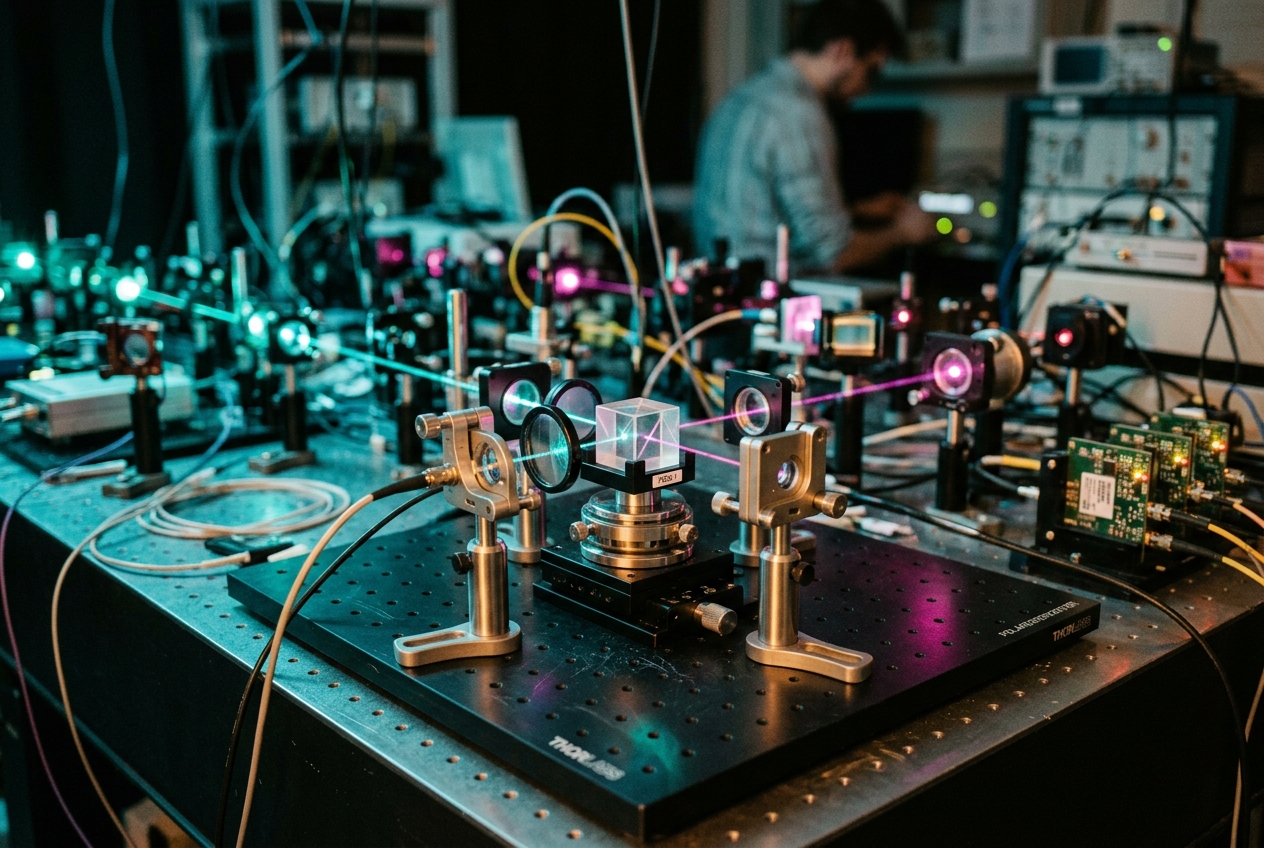
5.2 Physical and Optical Implementations
Building a physical cloning machine requires simulating the non-unitary open-system dynamics of the cloning map via linear optics or parametric non-linear media.
1. Stimulated Emission in Optical Parametric Amplifiers (OPA)
As demonstrated experimentally by Francesco De Martini et al. and published in Nature, the physical process behind optimal universal cloning is stimulated parametric down-conversion.
When an input photon in polarization state $|\psi\rangle = \alpha|H\rangle + \beta|V\rangle$ enters a non-linear crystal (such as $\beta$-barium borate, BBO) pumped by an intense ultraviolet laser, the Hamiltonian governing the interaction is:
$$\hat{\mathcal{H}}{\text{int}} = i \hbar \kappa \left( \hat{a}\psi^\dagger \hat{b}\psi^\dagger + \hat{a}{\psi^\perp}^\dagger \hat{b}_{\psi^\perp}^\dagger \right) + \text{h.c.}$$
The emission into the spatial mode already occupied by the seed photon is amplified by bosonic stimulation (a factor of 2 relative to spontaneous emission), producing cloned photons that reproduce the Bužek–Hillery marginal density matrix with an experimental fidelity closely matching the theoretical $5/6$ threshold.
2. Multi-Photon Linear Optics & Quantum Teleportation Circuits
Cloning machines have also been implemented using discrete linear optical components and projective measurements. As demonstrated by researchers using the IBM Quantum Learning & Documentation and academic linear-optics setups, a Bužek–Hillery machine can be mapped onto a discrete quantum circuit consisting of single-qubit rotations, controlled-NOT (CNOT) gates, and an auxiliary ancilla qubit:
By tuning the single-qubit $R_Y(\theta)$ rotation angles to:
$$\theta_1 = 2\arcsin\left(\frac{1}{\sqrt{3}}\right), \quad \theta_2 = \frac{\pi}{4}, \quad \theta_3 = -\frac{\pi}{4}$$
the circuit implements the precise unitary transformation derived in Section 2, verifying the $5/6$ fidelity bound across superconducting transmons and photonic architectures.
6. Concluding Epilogue: The Dual Nature of Quantum Limits
The Bužek–Hillery cloning machine illustrates a foundational duality in quantum information science: the exact boundary that prevents perfect replication of quantum states is the same mechanism that enables unconditionally secure quantum communications.
The $5/6$ fidelity limit is not an engineering shortfall, but a fundamental constant of quantum geometry. It establishes the exact exchange rate between extracted information and state disturbance, bounding eavesdropping capabilities, setting the channel capacity of quantum amplifiers, and defining the transition where quantum information becomes classical measurement data.
References & Further Reading
- Bužek, V., & Hillery, M. (1996). Quantum copying: Beyond the no-cloning theorem. Physical Review Letters, 77(11), 2352–2356.
- Wootters, W. K., & Zurek, W. H. (1982). A single quantum cannot be cloned. Nature, 299(5886), 802–803.
- Gisin, N., & Massar, S. (1997). Optimal Quantum Cloning Machines. Physical Review Letters, 79(11), 2153–2156.
- Bruß, D., DiVincenzo, D. P., Ekert, A., Ingen-Housz, C. A., Macchiavello, C., & Sanpera, A. (1998). Optimal state-independent quantum cloning. Physical Review A, 57(4), 2368–2378.
- Scarani, V., Iblisdir, S., Gisin, N., & Acín, A. (2005). Quantum cloning. Reviews of Modern Physics, 77(4), 1225–1256.
- De Martini, F., Pelliccia, D., & Sciarrino, F. (2002). Contextual, Optimal, and Universal Realization of the Quantum S-Cloning Machine. Nature, 415, 1005–1008.
- MIT OpenCourseWare. Quantum Information Science I & II (Course 8.370 / 8.371). MIT OCW Quantum Physics.
- Wikipedia Contributors. Quantum Cloning & The No-Cloning Theorem. Wikipedia: Quantum Cloning.