Bravyi-König Theorem: Bounding Fault-Tolerant Transversal Gates Across Spatial Dimensions in Topological Codes
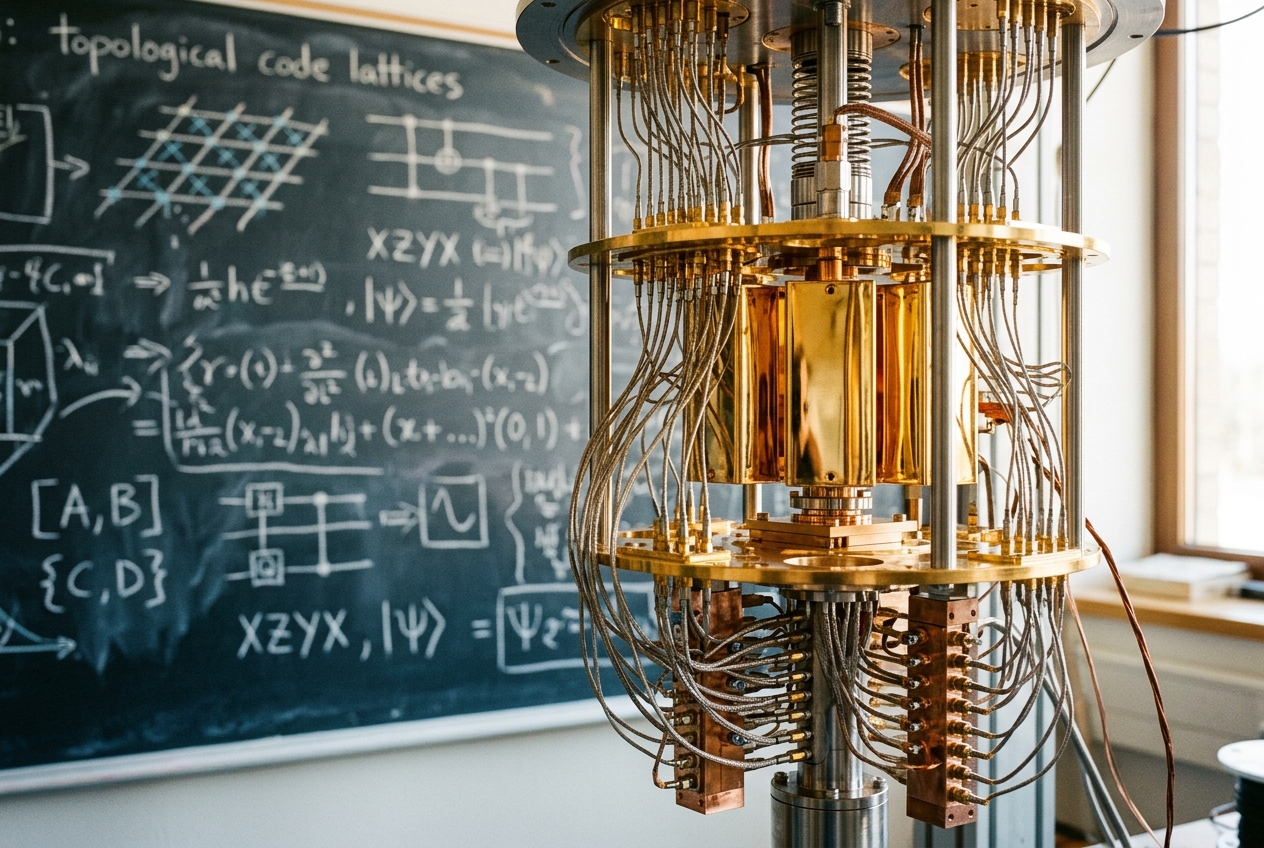
The encryption securing global financial networks, classified state communications, and sovereign digital infrastructures relies on mathematical problems—such as integer factorization and elliptic-curve discrete logarithms—that would take conventional supercomputers millions of years to unravel. A large-scale, fault-tolerant quantum computer running Shor’s algorithm could dismantle these cryptosystems within a few hours. Yet, the physical reality of building such a machine encounters a profound physical and mathematical barrier: quantum information is fragile, and the spatial geometry of our physical universe strictly constrains how we can manipulate protected quantum data without destroying it.
For decades, the central dream of quantum computing was simple: assemble a lattice of physical qubits, encode protected logical qubits non-locally across them, and manipulate those logical qubits using "transversal" operations—applying simple, simultaneous quantum gates qubit-by-qubit. Transversal gates are the holy grail of fault tolerance because they act as absolute firewalls against noise; an error on one physical qubit cannot cascade or infect its neighbors.
However, nature imposes a hard ceiling. In 2013, physicists Sergey Bravyi and Robert König formulated a mathematical theorem that revealed an inescapable trade-off between the spatial dimension of a quantum chip and the computational complexity of the error-protected operations it can natively execute. Understanding the Bravyi-König theorem explains why today's leading quantum processors cannot simply compute their way to universality on flat two-dimensional silicon chips without paying an enormous tax in physical hardware.
1. The Idea in Plain English: Firewalls, Geometry, and the Dimensional Trap
To understand why quantum error correction is bound by geometry, consider how information is stored and manipulated. In classical computing, a bit is a macroscopic switch: either definitively open or closed, zero or one. If noise flips a switch, a simple majority-vote circuit—storing three copies of the bit—can detect and fix the error.
A quantum bit, or qubit, cannot be cloned or measured directly without collapsing its fragile superposition of states. Instead, quantum systems distribute a single piece of logical information across the entangled states of many physical qubits, much like an intricate jigsaw puzzle where no individual piece reveals the picture. This is the foundation of quantum error correction on Nature.
   Physical Qubit Array (Lattice)              Transversal Gate Action (No Cross-Talk)
   +-----+     +-----+     +-----+              +-----+     +-----+     +-----+
   | q_1 |     | q_2 |     | q_3 |              | U_1 |     | U_2 |     | U_3 |
   +-----+     +-----+     +-----+              +-----+     +-----+     +-----+
      |           |           |                    |           |           |
      v           v           v                    v           v           v
   [ Error on q_1 stays confined to q_1 ]       [ Independent local operations ]
When an error strikes a physical qubit (such as a random thermal fluctuation or stray magnetic field), the error-correcting code uses local measurements—known as syndrome measurements—to identify and correct the fault without disturbing the encoded logical state.
The primary challenge arises when we want to calculate. To perform a computation, we must apply quantum logic gates to our encoded information. If a multi-qubit gate requires qubits to interact directly across the chip, a single hardware defect can propagate like a wildfire across the entire logical block, overwhelming the error-correcting code and destroying the computation.
The ideal defense is a transversal gate. A transversal gate applies independent, single-qubit operations in parallel to each physical qubit in a code block. Because no two physical qubits interact during the gate, an error on physical qubit $i$ can never propagate to physical qubit $j$. It is the ultimate fault-tolerant operation: a perfectly distributed calculation with zero risk of catastrophic error cascades.
While Eastin and Knill established that universal transversal computing is universally impossible, they left a critical architectural question unanswered: What operations are permitted transversally if our qubits live on a realistic, geometrically local physical chip?
This is where the Bravyi-König theorem delivers its decisive verdict: The level of computational power accessible via transversal gates is strictly bounded by the spatial dimension $D$ of the physical lattice.
- On a flat, two-dimensional quantum chip ($D=2$), transversal gates can never reach beyond the second level of the Clifford hierarchy—confining the system strictly to the non-universal Clifford group.
- To execute a non-Clifford gate transversally (such as the indispensable $T$-gate), the quantum code must physically exist in at least three spatial dimensions ($D=3$).
2. The Clifford Hierarchy and Spatial Locality: Mathematical Foundations
To formalize the theorem, we must examine the algebraic structure of quantum gates alongside the spatial layout of physical qubit arrays, as explored in advanced curricula such as MIT OpenCourseWare Quantum Information Science.
                 ===========================================
                 THE CLIFFORD HIERARCHY: P_1 ⊂ P_2 ⊂ P_3 ...
                 ===========================================

Level 1 (P_1): Pauli Group
       ----------------------------------------------------
       G_1 = { I, X, Y, Z }^⊗n
       (Bit-flips, phase-flips, error identification bases)
                              |
                              v
       Level 2 (P_2): Clifford Group
       ----------------------------------------------------
       G_2 = { H, S, CNOT, CZ }
       Normalizer of Pauli Group: U P_1 U† ⊆ P_1
       (Efficiently simulable classically via Gottesman-Knill)
                              |
                              v
       Level 3 (P_3): Universal Non-Clifford Domain
       ----------------------------------------------------
       G_3 = { T-gate (π/8), CCZ, CS, Toffoli }
       U P_1 U† ⊆ P_2
       (Unlocks universal fault-tolerant quantum computation)
The Clifford Hierarchy Defined Recursively
The Clifford hierarchy, introduced by Eric Rains, Peter Shor, and colleagues, is a nested sequence of quantum unitary operator sets $\mathcal{P}_1 \subset \mathcal{P}_2 \subset \mathcal{P}_3 \subset \dots \subset \mathcal{P}_k$, defined inductively by how they transform Pauli operators under conjugation:
- Level 1 ($\mathcal{P}_1$): The $n$-qubit Pauli Group, $\mathcal{P}_1 = { \pm 1, \pm i } \times {I, X, Y, Z}^{\otimes n}$.
- Level $k$ ($\mathcal{P}_k$): The set of all unitary operators $U$ such that conjugating any Pauli operator by $U$ yields an operator residing in level $k-1$: $$\mathcal{P}k = \left{ U \in \mathcal{U}(2^n) \;\middle|\; \forall P \in \mathcal{P}_1, \quad U P U^\dagger \in \mathcal{P}{k-1} \right}$$
For $k=2$, $\mathcal{P}_2$ is the Clifford Group, consisting of the Hadamard ($H$), Phase ($S$), and Controlled-NOT ($\text{CNOT}$) gates. By the Gottesman-Knill Theorem, any quantum circuit composed entirely of Clifford operations acting on stabilizer states can be simulated efficiently in polynomial time on a standard classical computer.
To achieve quantum computational universality—the threshold where a quantum machine can outperform any classical supercomputer on arbitrary quantum algorithms—we must introduce at least one non-Clifford gate from Level 3 ($\mathcal{P}_3$), such as the $\pi/8$ Phase gate $T = \text{diag}(1, e^{i\pi/4})$ or the Controlled-Controlled-$Z$ ($CCZ$) gate.
Geometrically Local Stabilizer Codes in $D$ Dimensions
Consider a quantum error-correcting code defined on a $D$-dimensional metric lattice $\Lambda \subset \mathbb{R}^D$ of linear system size $L$.
- Physical Qubits: Associated with vertices, edges, or faces of the lattice $\Lambda$.
- Stabilizer Group $\mathcal{S}$: An abelian subgroup of $\mathcal{P}_1$ not containing $-I$, defining the protected code space $\mathcal{C}$ via the mutual $+1$ eigenspace: $$\mathcal{C} = \left{ |\psi\rangle \;\middle|\; S_i |\psi\rangle = |\psi\rangle, \quad \forall S_i \in \mathcal{S} \right}$$
- Geometric Locality: Every stabilizer generator $S_i$ is supported on a localized spatial ball of bounded radius $r = \mathcal{O}(1)$ relative to the code scale $L$.
- Code Projector: The projector $\Pi$ onto the code space $\mathcal{C}$ is given by the normalized sum over all elements in the stabilizer group: $$\Pi = \frac{1}{|\mathcal{S}|} \sum_{M \in \mathcal{S}} M$$
- Macroscopic Code Distance $d$: The minimum weight of an undetectable logical operator scales with the system dimension, $d = \mathcal{O}(L^\alpha)$ for some $\alpha > 0$.
3. How It Actually Works: Stepping Through the Bravyi-König Proof
The core of the Bravyi-König Theorem (Physical Review Letters) lies in demonstrating how the geometric dimension $D$ of a spatial lattice restricts the algebraic deformation of logical operators when subjected to transversal unitaries.
       GEOMETRIC PARTITIONING IN D-DIMENSIONS (e.g., D=2: Tripartition A1, A2, A3)

       +-------------------------------------------------------+
       |                                                       |
       |     Region A_1                  Region A_2            |
       |   (Cleaned L_Z)               (Cleaned L_X)           |
       |                                                       |
       |                  +-----------------+                  |
       |                  |                 |                  |
       |                  |   Region A_3    |                  |
       |                  |  (Buffer Zone)  |                  |
       |                  |                 |                  |
       |                  +-----------------+                  |
       +-------------------------------------------------------+

       Intersection of all (D+1) boundary regions is topologically EMPTY.
       Therefore, nested commutators of transversal gates contract to identity.
Step 1: The Operator Cleaning Lemma
A topological quantum code, such as the Toric Code on Wikipedia, stores logical information in global, homologically non-trivial degrees of freedom. A logical operator $\overline{Z}$ might be represented as a string or membrane of physical Pauli operators spanning the entire code lattice.
Crucially, logical operators are not unique; multiplying any logical operator $\overline{Z}$ by an element of the stabilizer group $S \in \mathcal{S}$ yields an equivalent operator acting identically on the code space $\mathcal{C}$: $$\overline{Z}' = S \cdot \overline{Z} \implies \left. \overline{Z}' \right|{\mathcal{C}} = \left. \overline{Z} \right|{\mathcal{C}}$$
The Cleaning Lemma proves that if a subset of qubits $A \subset \Lambda$ is contractible and topologically trivial (meaning it does not wrap around a non-trivial cycle of the manifold and its diameter is smaller than the code distance $d$), any logical operator can be multiplied by local stabilizers to "clean" its support completely away from region $A$. That is, there exists a representative $\overline{Z}'$ whose support has empty intersection with $A$: $\text{supp}(\overline{Z}') \cap A = \emptyset$.
Step 2: The Spatial Partition into $D+1$ Disjoint Regions
In a $D$-dimensional Euclidean space $\mathbb{R}^D$, one can partition a compact domain into $D+1$ spatially separated, contiguous regions $A_1, A_2, \dots, A_{D+1}$ such that no single point is close to all $D+1$ regions simultaneously. The mutual intersection of all $D+1$ regions and their local geometric boundaries is strictly empty: $$\bigcap_{j=1}^{D+1} \text{ball}_r(A_j) = \emptyset$$
Because each region $A_j$ is topologically trivial within the code geometry, we can independently "clean" any logical operator away from any selected region $A_j$.
Step 3: Action of Transversal Unitaries and Group Commutators
Let $U = \bigotimes_{i \in \Lambda} u_i$ be a transversal unitary operator that preserves the code space $\mathcal{C}$, meaning $U \Pi U^\dagger = \Pi$. We wish to determine the logical operator $\overline{U}$ implemented on the encoded qubits.
To evaluate where $\overline{U}$ sits in the Clifford hierarchy, we study its group commutators with logical Pauli operators. Recall that the group commutator of two operators $A$ and $B$ is defined as: $$[A, B]_{group} = A B A^\dagger B^\dagger$$
If $\overline{U} \in \mathcal{P}k$, then taking successive group commutators with arbitrary Pauli operators must terminate in the identity operator (up to a global phase) after $k$ steps: $$[\dots [[\overline{U}, \overline{P}_1]{group}, \overline{P}2]{group}, \dots, \overline{P}k]{group} \propto \overline{I}$$
Step 4: The Contraction of Operator Support
Consider what happens when we compute the group commutator of a transversal unitary $U$ with a cleaned physical Pauli representative $\overline{P}_1$ whose support avoids region $A_1$. Because $U$ is strictly transversal (a tensor product of single-site unitaries), conjugating by $U$ does not expand the spatial support of an operator: $$\text{supp}\left( U \overline{P}_1 U^\dagger \right) = \text{supp}\left( \overline{P}_1 \right)$$
Now, form the group commutator: $$C_1 = U \overline{P}_1 U^\dagger \overline{P}_1^\dagger$$ The operator $C_1$ remains strictly localized outside region $A_1$.
Next, choose a second logical Pauli operator $\overline{P}2$ cleaned away from region $A_2$, and take the second nested commutator: $$C_2 = [C_1, \overline{P}_2]{group}$$ The resulting operator $C_2$ must now be supported exclusively outside both $A_1$ and $A_2$. Its support is confined to the intersection of the complements: $$\text{supp}(C_2) \subseteq (\Lambda \setminus A_1) \cap (\Lambda \setminus A_2)$$
We iterate this process across all $D+1$ partitions: $$C_{D+1} = [\dots [[U, \overline{P}1]{group}, \overline{P}2]{group}, \dots, \overline{P}{D+1}]{group}$$
The support of the final operator $C_{D+1}$ must reside in the simultaneous intersection of the complements of all $D+1$ regions: $$\text{supp}(C_{D+1}) \subseteq \bigcap_{j=1}^{D+1} (\Lambda \setminus A_j) = \Lambda \setminus \left( \bigcup_{j=1}^{D+1} A_j \right) = \emptyset$$
Because its spatial support has been systematically contracted to the empty set, the operator $C_{D+1}$ acts non-trivially on zero physical qubits. It must be proportional to the identity operator across the entire physical Hilbert space: $$C_{D+1} \propto I^{\otimes n}$$
4. Architectural Implications: The 2D vs. 3D Divide
The consequences of the Bravyi-König theorem dictate the physical layout of modern quantum computers, separating two-dimensional planar architectures from three-dimensional topological designs.
+----------------------------------------------------------------------------------------------------+
|                                    ARCHITECTURAL TRADE-OFF MATRIX                                  |
+----------------------+--------------------+-----------------------------+--------------------------+
| Spatial Dimension    | Canonical Code     | Transversal Gate Capability | Universality Mechanism   |
+----------------------+--------------------+-----------------------------+--------------------------+
| 1D (D = 1)           | 1D Repetition Code | Level 1: Only Pauli (P_1)   | Cannot correct phases    |
+----------------------+--------------------+-----------------------------+--------------------------+
| 2D (D = 2)           | Planar Surface Code| Level 2: Clifford Only (P_2)| Magic State Distillation |
|                      | 2D Color Code      | (H, S, CNOT)                | (Heavy hardware overhead)|
+----------------------+--------------------+-----------------------------+--------------------------+
| 3D (D = 3)           | 3D Color Code      | Level 3: Non-Clifford (P_3) | Transversal T-gate /     |
|                      | 3D Gauge Code      | (T-gate, CCZ)               | Gauge Fixing / Switching |
+----------------------+--------------------+-----------------------------+--------------------------+
The 2D Planar Surface Code Dilemma
The prevailing industrial strategy pursued by major quantum hardware developers relies on 2D planar surface codes fabricated on planar semiconductor or superconductor wafers. Because $D=2$, the Bravyi-König theorem dictates that transversal operations are strictly limited to $\mathcal{P}_2$ (the Clifford group).
To achieve universal quantum computation, 2D architectures must circumvent this constraint via Magic State Distillation: 1. Noisy, non-Clifford auxiliary states (called magic states, such as $|T\rangle = \cos(\pi/8)|0\rangle + \sin(\pi/8)|1\rangle$) are injected into the processor through non-fault-tolerant physical operations. 2. Large, dedicated arrays of physical qubits—termed "magic state distillation factories"—consume dozens or hundreds of raw magic states, filtering out noise through rounds of Clifford measurements until a high-fidelity logical $|T\rangle$ state is purified. 3. The purified state is merged into the main algorithm using standard Clifford operations and gate teleportation.
In practical terms, magic state distillation is resource-intensive: between 70% and 95% of all physical qubits on a future 2D quantum computer may be dedicated solely to distilling magic states rather than executing algorithm logic.
The 3D Topological Alternative
In $D=3$ dimensions, the ceiling rises to $\mathcal{P}_3$. A 3D topological color code can implement the non-Clifford logical $T$-gate or $CCZ$-gate with a single transversal operation, bypassing the hardware overhead of magic state distillation entirely.
However, the Eastin-Knill theorem still holds: in 3D, while non-Clifford gates become transversal, certain Clifford gates (such as the 2D Hadamard gate) lose their transversality. To achieve universality in 3D, quantum architects employ: * Dimensional Jumping / Code Switching: Dynamically coupling 2D and 3D code layers to alternate between transversal Clifford and transversal non-Clifford operations. * Gauge Color Codes: Utilizing 3D subsystem codes where gauge degrees of freedom are fixed to switch between logical operations on demand.
       2D PLANAR SYSTEM: MAGIC STATE DISTILLATION OVERHEAD

       +-------------------------------------------------------------+
       |   MAGIC STATE DISTILLATION FACTORIES (80-90% of Chip)       |
       |   [Distill] -> [Distill] -> [Distill] -> Pure |T>           |
       +-------------------------------------------------------------+
                                      | (Teleportation)
                                      v
       +-------------------------------------------------------------+
       |   ACTIVE COMPUTATION REGISTER (10-20% of Chip)              |
       |   Protected by 2D Surface Codes (Clifford Operations Only)   |
       +-------------------------------------------------------------+
5. Modern Extensions: Subsystem Codes, Non-Euclidean Manifolds, and qLDPC
Following Bravyi and König's original 2013 proof, quantum theorists generalized the theorem to explore every possible architectural workaround:
Subsystem and Gauge Codes
In a subsystem code, physical qubits encode both logical qubits and unmeasured "gauge" qubits. In 2015, Bravyi and Matthew Hastings proved that even in topological subsystem stabilizer codes, the restriction holds: $D$-dimensional geometric locality prevents transversal gates from escaping $\mathcal{P}_D$.
Non-Euclidean Manifolds and Hyperbolic Qubit Lattices
The Bravyi-König proof assumes Euclidean metric properties, where the volume of a sphere of radius $R$ scales as $V(R) \sim R^D$. If qubits are arranged on a hyperbolic manifold or expander graph with negative curvature, the volume scales exponentially: $V(R) \sim e^{\kappa R}$.
In these non-Euclidean topologies, the spatial constraints change. This principle underpins the development of Quantum Low-Density Parity-Check (qLDPC) codes. While qLDPC codes allow high logical information density without requiring geometric locality in flat space, they require complex long-range 3D interconnects or coherent optical photonic routing.
6. Real-World Applications Today: How Leading Laboratories Navigate the Bound
Leading industrial and academic quantum computing initiatives are developing distinct hardware and software architectures to operate within or around the Bravyi-König ceiling:
1. Google Quantum AI: Scaled 2D Surface Codes & Magic State Reduction
- Approach: Operating superconducting qubit processors (such as the Sycamore and Willow chips) arranged on 2D square lattices.
- Navigation Strategy: Accepting the Bravyi-König 2D constraint and optimizing the efficiency of magic state distillation. In research published across Nature, Google has demonstrated error suppression scaling with code distance and developed low-footprint distillation circuits (such as 15-to-1 and 20-to-4 block distillation protocols) to minimize physical qubit overhead.
2. IBM Quantum: Heavy-Hex Lattices and Dynamic Circuit Teleportation
- Approach: Engineering fixed-frequency superconducting transmon qubits on sparse 2D heavy-hexagonal lattices, accessible via IBM Quantum Documentation.
- Navigation Strategy: Combining 2D stabilizer codes with real-time classical feedback (dynamic mid-circuit measurements and reset). IBM's roadmap leverages dynamic circuits to perform lattice surgery and operator teleportation, moving logical information across planar chips without direct transversal non-Clifford routing.
3. Quantinuum: Non-Local Trapped-Ion Topologies
- Approach: Utilizing trapped-ion architectures with shuttling zones (such as the H-Series chips).
- Navigation Strategy: Trapped ions are not constrained to fixed, nearest-neighbor geometric grids. By physically shuttling ions across a vacuum trap, Quantinuum can establish arbitrary, non-local connectivity graphs. This effectively removes the Euclidean spatial locality assumption ($D=2$), enabling 3D color codes and transversal non-Clifford gates on physically flat ion traps.
4. AWS Center for Quantum Computing: Dual-Rail and Cat Qubit Concatenation
- Approach: Pairing bosonic cat qubits or dual-rail superconducting cavities with outer topological codes.
- Navigation Strategy: Hardware-level protection. By designing physical qubits that intrinsically suppress bit-flip errors at the component level, the outer error-correcting code needs only to correct phase-flip errors. This asymmetric protection simplifies the logical circuits required to reach $\mathcal{P}_3$ non-Clifford gates.
5. PsiQuantum: 3D Topological Photonic Fusion Networks
- Approach: Silicon photonics utilizing single photons routed through optical waveguides.
- Navigation Strategy: Photons travel continuously through an optical network, allowing time to serve as a synthetic spatial dimension. PsiQuantum designs 3D Fusion-Based Quantum Computing (FBQC) networks by intertwining spatial optical chips with time-delayed fiber loops. This natively instantiates a 3D topological code ($D=3$), opening direct access to $\mathcal{P}_3$ operations.
7. What This Means for You: The Timeline to Quantum Utility
To understand what the Bravyi-König theorem means for the broader technological landscape, consider the timeline of the quantum computing industry:
+-------------------------------------------------------------------------------------------------+
|                                 THE SCALING TRANSLATION LAYER                                   |
+------------------------------------+------------------------------------------------------------+
| The Mathematical Reality           | Real-World Practical Consequence                           |
+------------------------------------+------------------------------------------------------------+
| Bravyi-König Theorem ($D=2$)       | 2D quantum chips cannot perform universal computing with   |
|                                    | simple, parallel (transversal) gate pulses.                |
+------------------------------------+------------------------------------------------------------+
| The Magic State Bottleneck         | 80%+ of a commercial quantum computer's physical qubits    |
|                                    | must be dedicated to cleaning noisy mathematical states.   |
+------------------------------------+------------------------------------------------------------+
| The Engineering Consequence        | Cracking RSA encryption or simulating complex nitrogenase  |
|                                    | enzymes requires millions of physical qubits, not thousands|
+------------------------------------+------------------------------------------------------------+
- Cybersecurity & Data Privacy: You do not need to discard standard encryption protocols today. Because the Bravyi-König theorem prevents simple, plug-and-play fault-tolerant computation on flat 2D chips, building a machine with millions of physical qubits capable of running Shor's algorithm remains a significant engineering challenge. The transition to Post-Quantum Cryptography (PQC) spearheaded by NIST provides a structured runway for data security.
- Materials Science & Clean Energy: The bottleneck imposed by magic state distillation explains why fault-tolerant chemical simulations—such as designing room-temperature superconductors, solid-state battery electrolytes, or catalytic carbon-fixation enzymes—rely on hybrid classical-quantum algorithms in the near term.
- Everyday Computation: Personal computers and smartphones will not be replaced by quantum processors. Quantum computing is an architectural paradigm designed for specific, non-polynomial mathematical and physical simulations, governed by the spatial physics of information.
8. Today's Takeaway
The Bravyi-König theorem proves that the geometry of physical space dictates the limits of fault-tolerant computation: on any flat, two-dimensional chip, perfectly protected transversal operations are permanently barred from reaching computational universality. To unlock the full power of quantum algorithms, quantum engineers must either pay an enormous hardware tax in 2D magic state distillation factories or build machines that navigate 3D interconnects, ion shuttling, or photonic time-loops. The quest for universal quantum computing is not merely an exercise in fabricating cleaner qubits—it is an architectural campaign to navigate the fundamental geometry of quantum information.