Powernews Section Archive

Quantum Computing Series Archive

Page 4 of 11
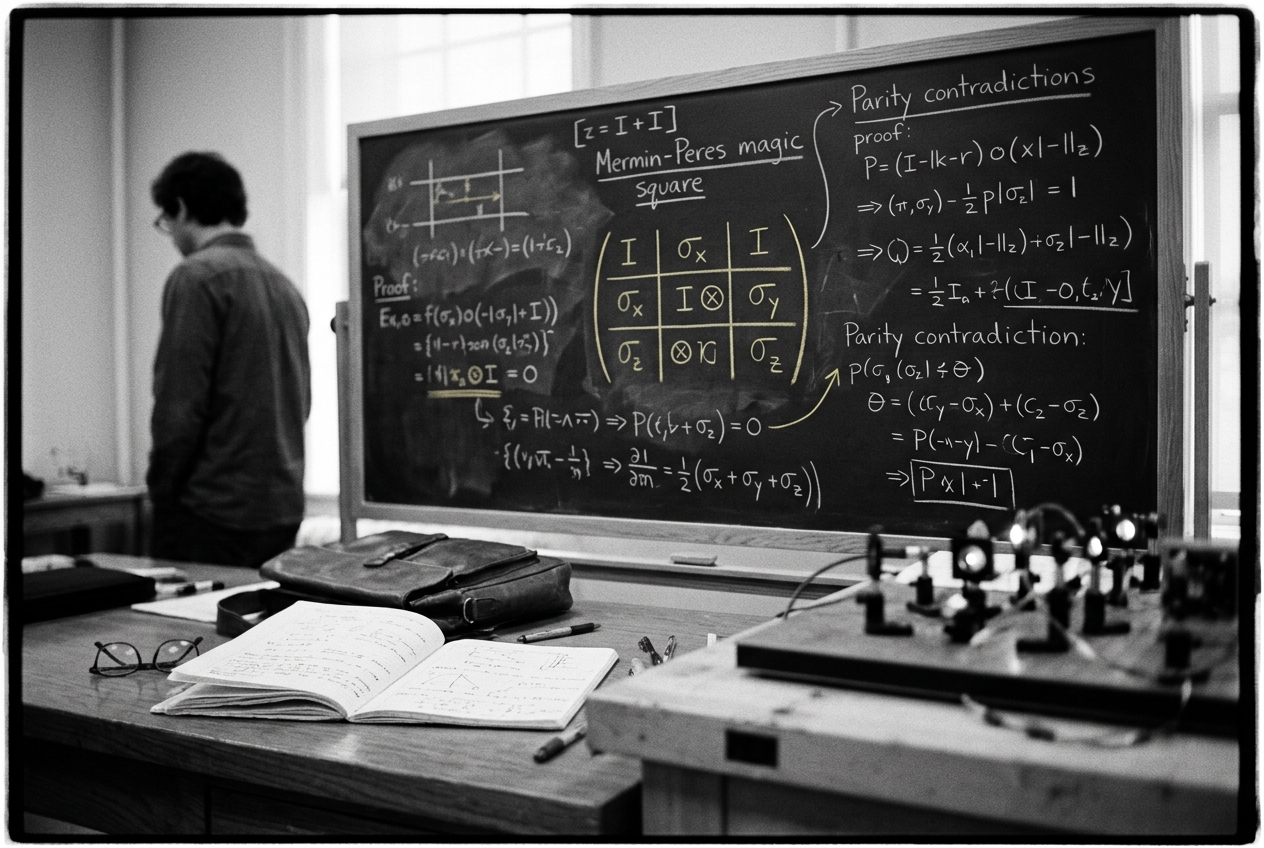
Mermin-Peres Magic Square: Demonstrating Quantum Contextuality and Flawless Pseudo-Telepathy Via Entangled Observables
QUANTUM COMPUTING

Mermin-Peres Magic Square: Demonstrating Quantum Contextuality and Flawless Pseudo-Telepathy Via Entangled Observables

The security architecture guarding international banking networks, national power grids, and encrypted diplomatic cables rests upon a silent, intuitive assumption: things in the physical world possess definite, unalterable properties whether or not anyone is observing them. In the classical mindset that has underpinned natural philosophy since Isaac Newton, an unread ledger in a locked vault contains specific numbers; a coin resting unviewed in a closed pocket is definitively either heads or tails. If nature behaves like this classical ledger, any secret can eventually be modeled, reverse-engineered, or intercepted by a sufficiently powerful adversary.

⚡ 6,538 Tokens • $0.00 Cost

Knill-Laflamme-Milburn Protocol: Achieving Scalable Optical Quantum Computation Via Linear Elements and Teleported Gates
QUANTUM COMPUTING

Knill-Laflamme-Milburn Protocol: Achieving Scalable Optical Quantum Computation Via Linear Elements and Teleported Gates

*For decades, building a quantum computer meant trapping delicate atoms inside multi-million-dollar cryogenic refrigerators cooled to temperatures colder than deep space. In 2001, the Knill-Laflamme-Milburn protocol proved that humanity could compute at the speed of light using glass, mirrors, and the counterintuitive power of quantum measurement.*

⚡ 6,764 Tokens • $0.00 Cost
Jaynes-Cummings Model: Resolving Atom-Cavity Quantum Dynamics, Dressed States, and Vacuum Rabi Oscillations
QUANTUM COMPUTING

Jaynes-Cummings Model: Resolving Atom-Cavity Quantum Dynamics, Dressed States, and Vacuum Rabi Oscillations

Every time you execute a secure digital transaction, your personal data is shielded by cryptographic protocols that would demand millennia of computation from the world's fastest supercomputers to dismantle. Yet, within research facilities across the globe, engineers and physicists are constructing processors capable of unravelling those very mathematical foundations in a matter of hours. The viability of these revolutionary machines does not rest upon elusive, science-fiction abstractions; it hinges on a profoundly physical dialogue: the controlled, exquisitely delicate exchange of energy between a single atom and a solitary particle of light.

⚡ 6,872 Tokens • $0.00 Cost
Electromagnetically Induced Transparency: Halting Light and Storing Coherent Quantum States in Atomic Ensembles
QUANTUM COMPUTING

Electromagnetically Induced Transparency: Halting Light and Storing Coherent Quantum States in Atomic Ensembles

Electromagnetically Induced Transparency (EIT) represents one of the foundational triumphs of modern quantum optics and coherent atomic physics. At its core, EIT is a quantum interference effect that renders an otherwise optically dense, resonant absorbing medium entirely transparent to a probe laser field through the simultaneous application of a strong, coherent control field. Beyond mere transparency, this quantum phenomenon radically modifies the dispersive properties of the atomic ensemble, producing an exceptionally steep normal dispersion that can decelerate the group velocity of light pulses by many orders of magnitude—from $3 \times 10^8\text{ m/s}$ down to human walking speeds, and ultimately bringing light to a complete, reversible standstill.

⚡ 9,023 Tokens • $0.00 Cost
Graph States: Unifying Multipartite Entanglement, Stabilizer Generators, and Cluster-State Architectures
QUANTUM COMPUTING

Graph States: Unifying Multipartite Entanglement, Stabilizer Generators, and Cluster-State Architectures

### The classical paradigm of computing relies on running electrical currents through physical logic gates step by step. Quantum information theory has unveiled a radically different architecture: pre-weaving an astronomical web of entangled particles and carving out calculations purely through the act of observation.

⚡ 6,308 Tokens • $0.00 Cost

Gleason's Theorem: Deriving the Born Rule and Quantum Measurement Probabilities From Hilbert Space Geometry
QUANTUM COMPUTING

Gleason's Theorem: Deriving the Born Rule and Quantum Measurement Probabilities From Hilbert Space Geometry

Every transaction that secures modern digital banking, every encrypted handshake passing across fiber-optic cables, and every protocol designed for next-generation post-quantum cryptography rests on a singular physical truth: quantum states cannot be observed without altering them, and the outcomes of those observations are fundamentally probabilistic. For nearly a century, physicists treated this probabilistic nature as an arbitrary decree—an ad-hoc postulate introduced by Max Born in 1926, which simply asserted that the probability of finding a particle in a given state equals the absolute square of its wave function amplitude. Generations of students were instructed to memorize this rule as an inexplicable axiom of nature. Yet, hidden within the abstract geometry of vector spaces lies one of the most profound mathematical achievements of the twentieth century: probability is not an arbitrary rule bolted onto quantum theory; it is mathematically forced into existence by the geometry of three-dimensional quantum space.

⚡ 8,445 Tokens • $0.00 Cost
Gaussian Quantum States: Characterizing Continuous-Variable Entanglement, Symplectic Transformations, and Covariance Matrices
QUANTUM COMPUTING

Gaussian Quantum States: Characterizing Continuous-Variable Entanglement, Symplectic Transformations, and Covariance Matrices

The foundational narrative of modern quantum technologies is predominantly told through the lens of finite-dimensional, discrete-variable systems. From the two-level spin systems of nuclear magnetic resonance to superconducting transmon qubits and trapped ions, quantum information is customarily digitized into orthogonal computational subspaces spanned by $|0\rangle$ and $|1\rangle$. Yet physical reality—from the electromagnetic field modes traversing optical fiber networks to the collective phononic excitations of mechanical oscillators—is fundamentally continuous. In these physical domains, observables do not register discrete binary eigenvalues; rather, they unfold across continuous spectra of position and momentum, or optical field quadratures. Continuous-variable (CV) quantum information theory provides the rigorous mathematical architecture required to exploit, control, and process quantum information across infinite-dimensional Hilbert spaces.

⚡ 12,755 Tokens • $0.00 Cost
← Previous Page Page 4 / 11 Next Page →