Gaussian Quantum States: Characterizing Continuous-Variable Entanglement, Symplectic Transformations, and Covariance Matrices
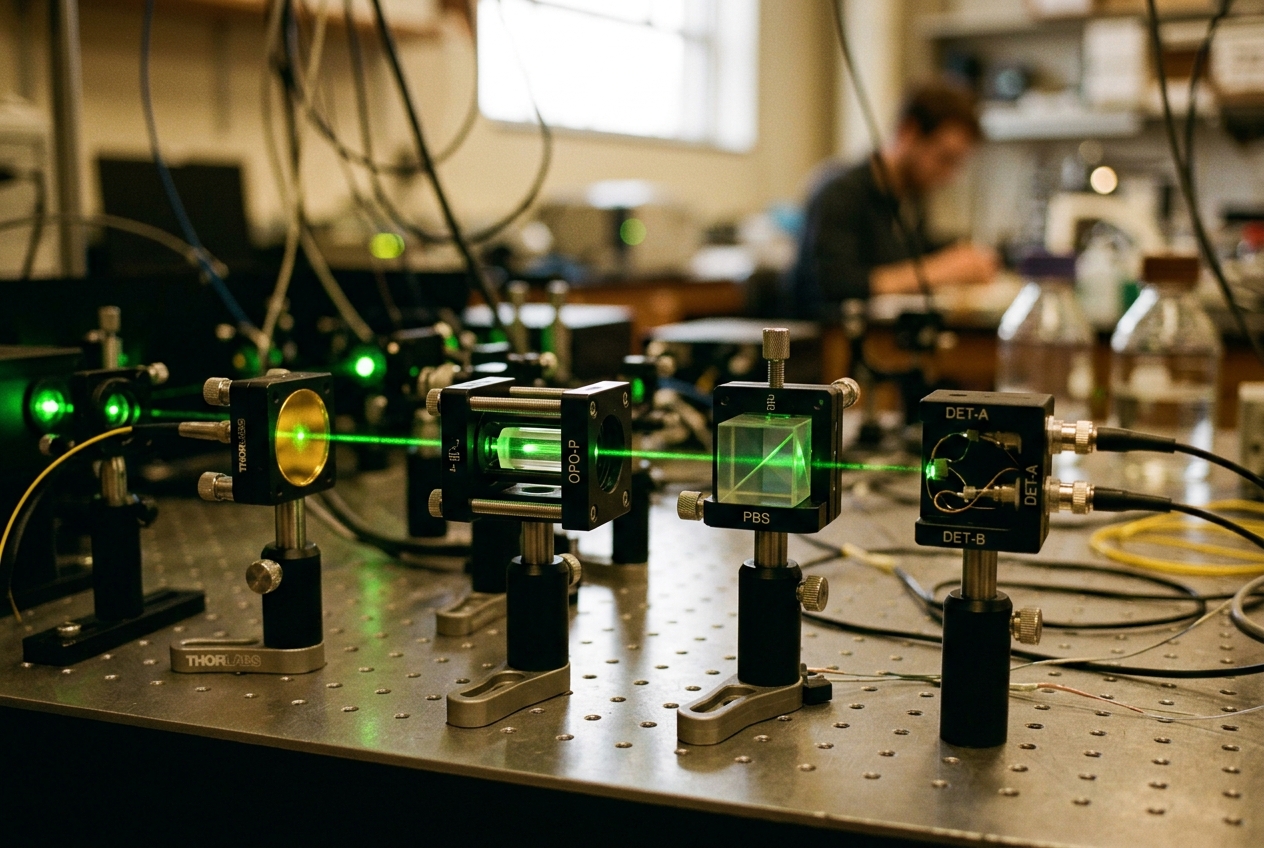
At the structural core of continuous-variable quantum mechanics lies the family of Gaussian quantum states. Characterized entirely by their first and second statistical moments, Gaussian states and their accompanying Gaussian operations constitute the continuous-variable analogue to stabilizer states and Clifford circuits in qubit systems. They represent the most experimentally accessible, analytically tractable, and ubiquitous quantum states in quantum optics, precision metrology, and continuous-variable quantum communication. However, this mathematical elegance carries profound foundational subtleties. The very property that renders Gaussian states analytically solvable—their representation as multivariate Gaussian probability densities in phase space—imposes strict algebraic constraints that forbid quantum computational advantage without the injection of non-Gaussian resources.
Understanding the continuous-variable paradigm demands a rigorous synthesis of infinite-dimensional functional analysis, symplectic group geometry, phase-space quasiprobability distributions, and entanglement theory. This treatise establishes the complete mathematical, physical, and operational framework of Gaussian quantum states, mapping the landscape from canonical commutation relations to the non-Gaussian frontiers necessary for universal fault-tolerant quantum computation.
1. Foundational Continuous-Variable Formalism
A continuous-variable quantum system consisting of $N$ interacting or non-interacting modes (canonical degrees of freedom, such as distinct spatial, temporal, or frequency modes of the electromagnetic field) is defined over the infinite-dimensional complex Hilbert space:
$$\mathcal{H} = \bigotimes_{k=1}^N \mathcal{H}_k \cong L^2(\mathbb{R}^N)$$
where $L^2(\mathbb{R}^N)$ denotes the Hilbert space of square-integrable complex-valued wavefunctions $\psi(x_1, \dots, x_N)$ with respect to the Lebesgue measure on $\mathbb{R}^N$.
Canonical Quadrature Operators and Commutation Relations
Each mode $k \in {1, \dots, N}$ is described by a pair of self-adjoint canonical quadrature operators: a generalized position-like quadrature $\hat{x}_k$ and a generalized momentum-like quadrature $\hat{p}_k$. In quantum optics, these operators correspond to the in-phase and out-of-phase electric field quadratures of a single electromagnetic field mode. Throughout this analysis, we adopt natural quantum units where $\hbar = 1$ (the alternative conventions $\hbar = 2$ or dimensionless scaling $\hat{x} = (\hat{a} + \hat{a}^\dagger)/\sqrt{2}$ and $\hat{p} = (\hat{a} - \hat{a}^\dagger)/(i\sqrt{2})$ are standard in the literature).
The canonical quadratures satisfy the Heisenberg-Weyl commutation relations:
$$[\hat{x}j, \hat{p}_k] = i \delta{jk} \hat{I}, \quad [\hat{x}_j, \hat{x}_k] = 0, \quad [\hat{p}_j, \hat{p}_k] = 0 \qquad \forall j, k \in {1, \dots, N}$$
To formulate multi-mode transformations compactly, we assemble the $2N$ quadrature operators into a single column vector operator $\hat{R}$:
$$\hat{R} = \begin{pmatrix} \hat{x}_1 \ \hat{p}_1 \ \hat{x}_2 \ \hat{p}_2 \ \vdots \ \hat{x}_N \ \hat{p}_N \end{pmatrix} \equiv (\hat{x}_1, \hat{p}_1, \dots, \hat{x}_N, \hat{p}_N)^T$$
The complete set of canonical commutation relations across all $N$ modes is captured by the matrix-valued commutator:
$$[\hat{R}j, \hat{R}_k] = i \Omega{jk} \hat{I}$$
where $\Omega$ is the $2N \times 2N$ standard real, skew-symmetric, non-singular symplectic form matrix:
$$\Omega = \bigoplus_{k=1}^N \omega, \quad \text{with} \quad \omega = \begin{pmatrix} 0 & 1 \ -1 & 0 \end{pmatrix}$$
The matrix $\Omega$ satisfies $\Omega^T = -\Omega$, $\Omega^2 = -I_{2N}$, and $\Omega^{-1} = -\Omega = \Omega^T$, endowing the real $2N$-dimensional phase space $\mathbb{R}^{2N}$ with a natural symplectic geometric structure.
The connection to standard bosonic annihilation and creation operators $\hat{a}k, \hat{a}_k^\dagger$ acting on the infinite-dimensional Fock space $\mathcal{F} = \text{span}{|n\rangle}{n=0}^\infty$ is established via the linear isometric map:
$$\hat{a}_k = \frac{\hat{x}_k + i\hat{p}_k}{\sqrt{2}}, \quad \hat{a}_k^\dagger = \frac{\hat{x}_k - i\hat{p}_k}{\sqrt{2}}$$
which preserves the canonical bosonic commutation relation $[\hat{a}j, \hat{a}_k^\dagger] = \delta{jk}\hat{I}$. Further technical explorations of these algebraic foundations can be found across the MIT OpenCourseWare Quantum Information Science curriculum.
2. Phase-Space Characterization of Quantum States
Infinite-dimensional density operators $\hat{\rho} \in \mathcal{S}(\mathcal{H})$ (satisfying $\hat{\rho} = \hat{\rho}^\dagger$, $\hat{\rho} \ge 0$, and $\mathrm{Tr}(\hat{\rho}) = 1$) can be challenging to analyze in the infinite Fock basis. An equivalent representation is achieved by mapping operators to smooth, continuous quasiprobability distributions over the classical phase space $\mathbb{R}^{2N}$.
The Weyl Displacement Operator and Characteristic Functions
For a classical phase-space point $\xi = (u_1, v_1, \dots, u_N, v_N)^T \in \mathbb{R}^{2N}$, the multi-mode unitary Weyl displacement operator $\hat{D}(\xi)$ is defined as:
$$\hat{D}(\xi) = \exp\left(i \hat{R}^T \Omega \xi\right) = \exp\left[i \sum_{k=1}^N (v_k \hat{x}_k - u_k \hat{p}_k)\right]$$
The displacement operators form a projective representation of the additive group $\mathbb{R}^{2N}$, obeying the composition law:
$$\hat{D}(\xi_1)\hat{D}(\xi_2) = \hat{D}(\xi_1 + \xi_2)\exp\left(-\frac{i}{2} \xi_1^T \Omega \xi_2\right)$$
The symmetrically ordered characteristic function $\chi_\rho(\xi)$ associated with an arbitrary state $\hat{\rho}$ is defined as the expectation value of the displacement operator:
$$\chi_\rho(\xi) = \mathrm{Tr}\left[\hat{\rho}\hat{D}(\xi)\right]$$
Because the set of all displacement operators ${\hat{D}(\xi) : \xi \in \mathbb{R}^{2N}}$ forms an orthogonal operator basis under the Hilbert-Schmidt inner product ($\mathrm{Tr}[\hat{D}(\xi)\hat{D}^\dagger(\xi')] = (2\pi)^N \delta^{(2N)}(\xi - \xi')$), the characteristic function $\chi_\rho(\xi)$ contains complete, invertible information about the quantum state $\hat{\rho}$.
The Wigner Quasiprobability Distribution
The Wigner distribution $W_\rho(r)$, where $r = (x_1, p_1, \dots, x_N, p_N)^T \in \mathbb{R}^{2N}$, is defined as the multidimensional symplectic Fourier transform of the characteristic function:
$$W_\rho(r) = \frac{1}{(2\pi)^{2N}} \int_{\mathbb{R}^{2N}} d^{2N}\xi \, \exp\left(-i r^T \Omega \xi\right) \chi_\rho(\xi)$$
In terms of the spatial coordinate matrix elements of $\hat{\rho}$, the single-mode Wigner distribution ($N=1$) takes the explicit phase-space integral form:
$$W_\rho(x, p) = \frac{1}{2\pi} \int_{-\infty}^{\infty} dy \, e^{-i p y} \left\langle x + \frac{y}{2} \right| \hat{\rho} \left| x - \frac{y}{2} \right\rangle$$
The Wigner distribution is real-valued ($W_\rho(r) \in \mathbb{R}$) and normalized to unity over phase space:
$$\int_{\mathbb{R}^{2N}} d^{2N}r \, W_\rho(r) = 1$$
Furthermore, integration over conjugate quadratures yields true marginal probability densities for arbitrary linear quadrature observables $\hat{x}_\theta = \hat{x}\cos\theta + \hat{p}\sin\theta$.
However, because non-commuting observables cannot possess a joint classical probability distribution, $W_\rho(r)$ can assume strictly negative values for certain quantum states (such as single-photon Fock states $|1\rangle$). For this reason, $W_\rho(r)$ is termed a quasiprobability distribution. The presence of negativity in the Wigner distribution is a direct signature of non-classicality and quantum interference in phase space, as detailed in Wikipedia's treatment of the Wigner quasiprobability distribution.
Definition of a Gaussian State
An $N$-mode quantum state $\hat{\rho}$ is defined as a Gaussian quantum state if and only if its characteristic function $\chi_\rho(\xi)$ and its Wigner quasiprobability distribution $W_\rho(r)$ are multivariate Gaussian functions over $\mathbb{R}^{2N}$.
Consequently, any Gaussian state is completely and uniquely characterized by only its first statistical moments (the mean vector) and its second statistical moments (the covariance matrix). All higher-order cumulants of the state vanish identically, reducing infinite-dimensional operator algebra to finite-dimensional linear algebra and symplectic geometry.
3. First and Second Moments and Matrix Uncertainty Relations
Because an $N$-mode Gaussian state is parameterized by a finite set of real variables, its analytical description relies on the displacement vector and the covariance matrix.
The First-Moment Mean Vector
The first moments of a quantum state $\hat{\rho}$ are defined by the phase-space displacement vector $\bar{r} \equiv d \in \mathbb{R}^{2N}$:
$$d_j \equiv \langle \hat{R}_j \rangle = \mathrm{Tr}\left(\hat{\rho} \hat{R}_j\right), \quad j \in {1, \dots, 2N}$$
The mean vector $d$ determines the center of the Gaussian distribution in phase space. Under unitary displacement operations $\hat{\rho} \mapsto \hat{D}(\alpha)\hat{\rho}\hat{D}^\dagger(\alpha)$, the mean vector shifts rigidly ($d \mapsto d + \sqrt{2}\,\mathrm{Re}(\alpha, \dots)$), while the quantum noise fluctuations, correlations, and entanglement remain completely invariant.
The Real Covariance Matrix
The quantum fluctuations and inter-modal correlations are encoded within the $2N \times 2N$ real, symmetric covariance matrix $\sigma$ (frequently denoted $\gamma$ or $V$). Its matrix elements are defined via the completely symmetrized covariance of the zero-mean quadrature operators $\Delta \hat{R}_j = \hat{R}_j - d_j \hat{I}$:
$$\sigma_{jk} = \frac{1}{2} \left\langle \Delta \hat{R}_j \Delta \hat{R}_k + \Delta \hat{R}_k \Delta \hat{R}_j \right\rangle = \frac{1}{2} \mathrm{Tr}\left[ \hat{\rho} \left( \Delta \hat{R}_j \Delta \hat{R}_k + \Delta \hat{R}_k \Delta \hat{R}_j \right) \right]$$
For a single mode ($N=1$), the covariance matrix is a $2 \times 2$ matrix:
$$\sigma = \begin{pmatrix} (\Delta x)^2 & \sigma_{xp} \ \sigma_{xp} & (\Delta p)^2 \end{pmatrix}$$
where $(\Delta x)^2 = \langle \hat{x}^2 \rangle - \langle \hat{x} \rangle^2$, $(\Delta p)^2 = \langle \hat{p}^2 \rangle - \langle \hat{p} \rangle^2$, and $\sigma_{xp} = \frac{1}{2}\langle \hat{x}\hat{p} + \hat{p}\hat{x} \rangle - \langle \hat{x} \rangle \langle \hat{p} \rangle$ represents the quadrature cross-correlation.
Explicit Phase-Space Gaussian Expressions
Given a displacement vector $d \in \mathbb{R}^{2N}$ and a valid covariance matrix $\sigma$, the characteristic function of an arbitrary $N$-mode Gaussian state is:
$$\chi_\rho(\xi) = \exp\left[ -\frac{1}{2} \xi^T \left( \Omega^T \sigma \Omega \right) \xi + i (\Omega d)^T \xi \right]$$
Evaluating the symplectic Fourier transform yields the explicit multivariate Gaussian Wigner distribution:
$$W_\rho(r) = \frac{1}{\pi^N \sqrt{\det \sigma}} \exp\left[ -(r - d)^T \sigma^{-1} (r - d) \right]$$
Because $\sigma$ is positive-definite for all physical states, $\det \sigma > 0$, ensuring that the Gaussian Wigner distribution is strictly strictly positive ($W_\rho(r) > 0$) for every point $r \in \mathbb{R}^{2N}$.
The Quantum Uncertainty Principle in Symplectic Matrix Form
A classical covariance matrix requires only real symmetry and positive semi-definiteness ($\sigma \ge 0$). In quantum mechanics, the non-commutativity of quadrature operators imposes a much stronger algebraic constraint.
The generalized Heisenberg-Robertson-Schrödinger uncertainty relation for all $2N$ canonical quadratures simultaneously is expressed as the complex matrix inequality:
$$\sigma + \frac{i}{2} \Omega \ge 0$$
The Quantum Uncertainty Relation (Symplectic Form)
A real, symmetric $2N \times 2N$ matrix $\sigma$ corresponds to the covariance matrix of a physical quantum state if and only if: $$\sigma + \frac{i}{2} \Omega \ge 0$$ (Under the scaling convention $[\hat{x}j, \hat{p}_k] = i\delta{jk}$ with vacuum variance $(\Delta x)_{\text{vac}}^2 = 1/2$, the uncertainty relation takes the form $\sigma + \frac{i}{2}\Omega \ge 0$. Under the convention $[\hat{x}, \hat{p}] = 2i$, it takes the form $\sigma + i\Omega \ge 0$.)
This matrix inequality encapsulates both the individual Heisenberg uncertainty relations for each mode ($(\Delta x_k)^2 (\Delta p_k)^2 - \sigma_{x_k p_k}^2 \ge 1/4$) and all inter-mode cross-correlations. Any mathematical matrix satisfying $\sigma \ge 0$ that violates $\sigma + \frac{i}{2}\Omega \ge 0$ describes an unphysical state that violates quantum mechanics.
4. Symplectic Algebra and Williamson's Theorem
Gaussian unitary operations are transformations that map Gaussian states to Gaussian states. In the Heisenberg picture, a unitary operator $\hat{U}S$ acting on $\mathcal{H}$ corresponds to a linear transformation of the quadrature vector $\hat{R} \mapsto S \hat{R} + d_0$ if and only if it preserves the canonical commutation relations $[\hat{R}_j, \hat{R}_k] = i\Omega{jk}\hat{I}$.
The Real Symplectic Group $\mathrm{Sp}(2N, \mathbb{R})$
Substituting $\hat{R}' = S \hat{R}$ into the commutation relations requires:
$$[\hat{R}'j, \hat{R}'_k] = [S{jm}\hat{R}m, S{kn}\hat{R}n] = S{jm} S_{kn} i \Omega_{mn} = i (S \Omega S^T){jk} \stackrel{!}{=} i \Omega{jk}$$
Therefore, the matrix $S$ must preserve the symplectic form:
$$S \Omega S^T = \Omega$$
The set of all real $2N \times 2N$ matrices satisfying this condition forms the real symplectic group $\mathrm{Sp}(2N, \mathbb{R})$. Under a symplectic transformation $S \in \mathrm{Sp}(2N, \mathbb{R})$ accompanied by a phase-space translation $d_0$, the statistical moments transform as:
$$d \mapsto S d + d_0, \qquad \sigma \mapsto S \sigma S^T$$
The group $\mathrm{Sp}(2N, \mathbb{R})$ is generated by Hamiltonians that are at most quadratic in the quadrature operators:
$$\hat{H} = \frac{1}{2} \hat{R}^T H \hat{R} + f^T \hat{R}$$
where $H$ is a $2N \times 2N$ real symmetric matrix. Quadratic Hamiltonians encompass phase shifters, beam splitters, single-mode squeezers, and two-mode parametric down-converters.
Williamson's Diagonalization Theorem
Williamson's Theorem (1936) is the continuous-variable counterpart to the spectral theorem for symmetric matrices under unitary transformations.
Williamson's Theorem
Let $\sigma$ be a $2N \times 2N$ real, strictly positive-definite symmetric matrix ($\sigma > 0$). There exists a symplectic matrix $S \in \mathrm{Sp}(2N, \mathbb{R})$ such that $\sigma$ is diagonalized into the canonical decoupled form:$$\sigma = S \left( \bigoplus_{k=1}^N \nu_k I_2 \right) S^T = S \begin{pmatrix} \nu_1 & 0 & \dots & 0 & 0 \ 0 & \nu_1 & \dots & 0 & 0 \ \vdots & \vdots & \ddots & \vdots & \vdots \ 0 & 0 & \dots & \nu_N & 0 \ 0 & 0 & \dots & 0 & \nu_N \end{pmatrix} S^T$$
where $I_2$ is the $2 \times 2$ identity matrix, and the positive quantities ${\nu_k}_{k=1}^N$ are called the symplectic eigenvalues of $\sigma$.
The symplectic eigenvalues are uniquely determined as the positive roots of the characteristic polynomial of the matrix product $i\Omega \sigma$. That is, the eigenvalues of the matrix $\Omega \sigma$ occur in conjugate imaginary pairs: $\pm i \nu_1, \pm i \nu_2, \dots, \pm i \nu_N$.
Physical Interpretation and State Purity
The symplectic eigenvalues directly quantify the mixedness and thermal excitation of the individual decoupled modes. In this diagonal basis, the Gaussian state is an uncorrelated product of $N$ thermal states:
$$\hat{\rho} = \bigotimes_{k=1}^N \hat{\rho}{\text{th}}(\nu_k), \quad \hat{\rho}{\text{th}}(\nu_k) = \sum_{n=0}^\infty \frac{\bar{n}_k^n}{(\bar{n}_k + 1)^{n+1}} |n\rangle\langle n|$$
where the mean thermal photon number in mode $k$ is related to its symplectic eigenvalue by:
$$\bar{n}_k = \nu_k - \frac{1}{2} \implies \nu_k = \bar{n}_k + \frac{1}{2}$$
The quantum uncertainty principle $\sigma + \frac{i}{2}\Omega \ge 0$ is equivalent to the condition on the symplectic spectrum:
$$\nu_k \ge \frac{1}{2} \qquad \forall k \in {1, \dots, N}$$
The quantum purity $\mu(\hat{\rho}) = \mathrm{Tr}(\hat{\rho}^2)$ of any Gaussian state is given by the determinant of its covariance matrix:
$$\mu(\hat{\rho}) = \frac{1}{2^N \sqrt{\det \sigma}} = \prod_{k=1}^N \frac{1}{2\nu_k} \le 1$$
A Gaussian state is pure ($\mu = 1$) if and only if $\nu_k = 1/2$ for all $k \in {1, \dots, N}$, which corresponds to $\det \sigma = (1/4)^N = 1/4^N$. For a pure Gaussian state, Williamson's theorem implies that the state can be transformed into the multi-mode vacuum state via a symplectic transformation $S \in \mathrm{Sp}(2N, \mathbb{R})$.
5. The Core Gaussian State Zoo
To ground these abstract symplectic constructs, we examine the primary single-mode and two-mode Gaussian states that populate quantum optics and continuous-variable information protocols.
The Vacuum State $|0\rangle$
The fundamental ground state of the continuous-variable Hilbert space is the vacuum state $|0\rangle$, defined by $\hat{a}|0\rangle = 0$. It possesses zero mean displacement and isotropic, minimum-uncertainty quantum fluctuations:
$$d_{\text{vac}} = \begin{pmatrix} 0 \ 0 \end{pmatrix}, \qquad \sigma_{\text{vac}} = \frac{1}{2} \begin{pmatrix} 1 & 0 \ 0 & 1 \end{pmatrix} = \frac{1}{2} I_2$$
Its Wigner distribution is a symmetric Gaussian centered at the origin:
$$W_{|0\rangle}(x, p) = \frac{1}{\pi} \exp\left[ -(x^2 + p^2) \right]$$
Coherent States $|\alpha\rangle$
Generated by applying the unitary displacement operator $\hat{D}(\alpha) = \exp(\alpha \hat{a}^\dagger - \alpha^* \hat{a})$ to the vacuum state, the coherent state $|\alpha\rangle$ represents the most classical pure state of an optical field mode. Writing $\alpha = (d_x + i d_p)/\sqrt{2}$, its parameters are:
$$d_\alpha = \begin{pmatrix} d_x \ d_p \end{pmatrix}, \qquad \sigma_\alpha = \frac{1}{2} I_2$$
The covariance matrix of a coherent state is identical to that of the vacuum. The Wigner distribution is simply the vacuum distribution shifted to the coordinates $(d_x, d_p)$:
$$W_{|\alpha\rangle}(x, p) = \frac{1}{\pi} \exp\left[ -(x - d_x)^2 - (p - d_p)^2 \right]$$
Single-Mode Squeezed Vacuum States $|r, \theta\rangle$
A squeezed state is generated by applying the unitary single-mode squeezing operator $\hat{S}(\xi) = \exp\left[ \frac{1}{2}(\xi^* \hat{a}^2 - \xi \hat{a}^{\dagger 2}) \right]$ to the vacuum. Setting $\xi = r e^{i\theta}$ with squeezing parameter $r \ge 0$ and angle $\theta = 0$ (squeezing along the $x$-quadrature):
$$d_{\text{sq}} = \begin{pmatrix} 0 \ 0 \end{pmatrix}, \qquad \sigma_{\text{sq}}(r) = \frac{1}{2} \begin{pmatrix} e^{-2r} & 0 \ 0 & e^{2r} \end{pmatrix}$$
The variance along the position quadrature is reduced below the vacuum shot-noise level: $(\Delta x)^2 = \frac{1}{2}e^{-2r} < 1/2$. To satisfy the Heisenberg uncertainty relation $(\Delta x)(\Delta p) = 1/2$, the conjugate momentum quadrature variance is amplified: $(\Delta p)^2 = \frac{1}{2}e^{2r} > 1/2$.
The phase-space contour of constant Wigner density deforms from a circle into an ellipse with major and minor axes proportional to $e^r$ and $e^{-r}$. This reduction in quadrature noise is the physical mechanism enabling sub-shot-noise metrology in advanced gravitational wave observatories.
Two-Mode Squeezed Vacuum States (EPR Entangled States)
The Two-Mode Squeezed Vacuum (TMSV) state is the continuous-variable realization of the Einstein-Podolsky-Rosen (EPR) state. Generated by the non-degenerate parametric Hamiltonian $\hat{H}_{\text{int}} \propto \hat{a}_1^\dagger \hat{a}_2^\dagger + \hat{a}_1 \hat{a}_2$ via the unitary operator $\hat{S}_2(r) = \exp\left[ r(\hat{a}_1\hat{a}_2 - \hat{a}_1^\dagger \hat{a}_2^\dagger) \right]$, the state is expressed in the two-mode Fock basis as:
$$|\text{TMSV}\rangle = \sqrt{1 - \tanh^2 r} \sum_{n=0}^\infty (\tanh r)^n |n\rangle_1 |n\rangle_2$$
The covariance matrix of the TMSV state, partitioned into $2 \times 2$ blocks corresponding to mode 1 ($A$), mode 2 ($B$), and their mutual correlations ($C$), is:
$$\sigma_{\text{TMSV}} = \frac{1}{2} \begin{pmatrix} \cosh(2r) I_2 & \sinh(2r) Z \ \sinh(2r) Z & \cosh(2r) I_2 \end{pmatrix}, \quad \text{where} \quad Z = \begin{pmatrix} 1 & 0 \ 0 & -1 \end{pmatrix}$$
Expanding the block structure yields:
$$\sigma_{\text{TMSV}} = \frac{1}{2} \begin{pmatrix} \cosh 2r & 0 & \sinh 2r & 0 \ 0 & \cosh 2r & 0 & -\sinh 2r \ \sinh 2r & 0 & \cosh 2r & 0 \ 0 & -\sinh 2r & 0 & \cosh 2r \end{pmatrix}$$
As the squeezing parameter $r \to \infty$, the correlations between the two modes become singular:
$$\Delta(\hat{x}_1 - \hat{x}_2)^2 = e^{-2r} \to 0, \qquad \Delta(\hat{p}_1 + \hat{p}_2)^2 = e^{-2r} \to 0$$
Simultaneously measuring the position of mode 1 allows prediction of the position of mode 2 with absolute certainty, while measuring the momentum of mode 1 allows prediction of the momentum of mode 2 with equal certainty. This state forms the core resource for continuous-variable quantum teleportation and quantum cryptography.
6. Entanglement Criteria in Phase Space
Entanglement verification in infinite-dimensional systems is complicated by the unbounded dimension of $\mathcal{H}$. However, for bipartite Gaussian states, entanglement can be determined directly from the algebraic properties of the covariance matrix.
The Peres-Horodecki (PPT) Criterion in Continuous Variables
In discrete quantum systems, the Positive Partial Transposition (PPT) criterion states that if a density operator $\hat{\rho}{AB}$ is separable, its partial transpose $\hat{\rho}{AB}^{T_B}$ remains a valid density operator ($\hat{\rho}_{AB}^{T_B} \ge 0$).
In phase space, transposition of an operator corresponds to time-reversal, which inverts the momentum operator while leaving the position operator invariant:
$$\hat{x} \mapsto \hat{x}, \qquad \hat{p} \mapsto -\hat{p}$$
For a two-mode Gaussian state with covariance matrix partitioned into $2 \times 2$ blocks:
$$\sigma = \begin{pmatrix} A & C \ C^T & B \end{pmatrix}$$
the partial transposition with respect to subsystem $B$ transforms $\sigma$ into the partially transposed covariance matrix $\tilde{\sigma} = \Theta_B \sigma \Theta_B$, where $\Theta_B = \operatorname{diag}(1, 1, 1, -1)$. Explicitly:
$$\tilde{\sigma} = \begin{pmatrix} A & C Z \ Z C^T & B \end{pmatrix}, \quad Z = \begin{pmatrix} 1 & 0 \ 0 & -1 \end{pmatrix}$$
Simon's Inseparability Criterion
Simon (2000) established that the PPT condition translates into a necessary and sufficient algebraic test for the separability of all $(1 \times 1)$-mode bipartite Gaussian states.
Simon's Criterion (PPT in Phase Space)
A two-mode Gaussian state with covariance matrix $\sigma$ is separable if and only if its partially transposed covariance matrix $\tilde{\sigma}$ satisfies the quantum uncertainty principle:$$\tilde{\sigma} + \frac{i}{2} \Omega \ge 0$$
If the lowest symplectic eigenvalue $\tilde{\nu}-$ of $\tilde{\sigma}$ is strictly less than $1/2$ ($\tilde{\nu}- < 1/2$), the state is inseparable (entangled).
In terms of the four local $Sp(2, \mathbb{R})$ symplectic invariants of the covariance matrix:
$$I_1 = \det A, \quad I_2 = \det B, \quad I_3 = \det C, \quad I_4 = \det \sigma$$
the condition for separability is:
$$I_1 I_2 + \left(\frac{1}{4} - |I_3|\right)^2 - \mathrm{Tr}(A J C J B J C^T J) \ge \frac{1}{4}(I_1 + I_2)$$
where $J = \begin{pmatrix} 0 & 1 \ -1 & 0 \end{pmatrix}$. Violation of this inequality is a necessary and sufficient signature of bipartite Gaussian entanglement, as discussed in Physical Review Letters.
Duan's Inseparability Criterion
Complementing Simon's symplectic formulation, Duan et al. (2000) developed an experimentally accessible operational test based on total variance inequalities of EPR-like non-local quadrature pairs.
For any pair of orthogonal quadratures and any separable state, the total variance of the combined operators $\hat{u} = |a|\hat{x}_1 + \frac{1}{a}\hat{x}_2$ and $\hat{v} = |a|\hat{p}_1 - \frac{1}{a}\hat{p}_2$ (with $a \neq 0$) is lower-bounded:
$$\langle (\Delta \hat{u})^2 \rangle + \langle (\Delta \hat{v})^2 \rangle \ge |a|^2 + \frac{1}{|a|^2}$$
For standard symmetric two-mode states ($a = 1$), this reduces to the canonical Duan inseparability condition:
$$\langle [\Delta(\hat{x}_1 - \hat{x}_2)]^2 \rangle + \langle [\Delta(\hat{p}_1 + \hat{p}_2)]^2 \rangle \ge 2$$
If an experimental state yields a measured sum of variances strictly below 2 (in units where $\hbar = 1$), the state is entangled. For the TMSV state, this sum evaluates to $2 e^{-2r} < 2$ for all $r > 0$, certifying entanglement for any non-zero squeezing parameter.
7. Hudson's Theorem and the Non-Gaussian Frontier
While Gaussian states possess elegant mathematical properties, they are subject to fundamental physical and computational limitations. The boundary between classical simulability and universal quantum computing is governed by phase-space topology and non-Gaussian transformations.
Hudson's Theorem
In 1974, R. L. Hudson proved a theorem connecting Gaussianity to the point-wise positivity of the Wigner distribution.
Hudson's Theorem
Let $|\psi\rangle \in L^2(\mathbb{R})$ be a pure continuous-variable quantum state. Its Wigner quasiprobability distribution is non-negative everywhere on phase space ($W_{|\psi\rangle}(x, p) \ge 0, \ \forall (x, p) \in \mathbb{R}^2$) if and only if $|\psi\rangle$ is a pure Gaussian state (i.e., a displaced squeezed vacuum state).
Any pure non-Gaussian state—including single-photon states $|1\rangle$, Schrödinger cat states $(|\alpha\rangle + |-\alpha\rangle)/\sqrt{2}$, and Gottesman-Kitaev-Preskill (GKP) states—must exhibit regions of negative quasiprobability ($W(x, p) < 0$).
The Lloyd-Braunstein Non-Gaussian Universality Theorem
In discrete-variable quantum computing, the Gottesman-Knill theorem dictates that quantum circuits composed exclusively of Clifford operations acting on stabilizer states can be efficiently simulated in polynomial time on a classical computer.
The continuous-variable analogue was formalized by Lloyd and Braunstein (1999):
- Classical Simulability: Any continuous-variable circuit initialized with Gaussian input states, processed by Gaussian operations (transformations generated by Hamiltonians at most quadratic in $\hat{x}_k, \hat{p}_k$), and measured via homodyne detection (Gaussian measurements) can be efficiently simulated on a classical Turing machine in $O(N^3)$ polynomial time.
- The Non-Gaussian Requirement: Universal quantum computation over continuous variables requires access to at least one non-Gaussian element. This can take the form of: - A non-Gaussian unitary evolution generated by a higher-order Hamiltonian (e.g., the cubic phase gate $\hat{V}3 = \exp(i \gamma \hat{x}^3)$ or the non-linear Kerr interaction $\hat{H}{\text{Kerr}} \propto (\hat{a}^\dagger \hat{a})^2$). - A non-Gaussian resource state (e.g., cubic phase states, Schrödinger cat states, or GKP grid states). - Non-Gaussian measurements (e.g., photon-number-resolving detectors implementing projective Fock measurements $\Pi_n = |n\rangle\langle n|$).
| Feature / Domain | Continuous-Variable Gaussian Sector | Non-Gaussian Augmented Sector |
|---|---|---|
| State Envelope | Smooth Gaussian exp $[-r^T \sigma^{-1} r]$ | Complex oscillatory interference |
| Wigner Distribution | Strictly non-negative ($W_\rho(r) \ge 0$) | Displays negative regions ($W_\rho(r) < 0$) |
| Algebraic Group | Real Symplectic Group $\mathrm{Sp}(2N, \mathbb{R})$ | Infinite-dimensional non-linear transformations |
| Simulability | Polynomial classical simulation via $\sigma, d$ | BQP-complete; classically intractable |
| Core Protocols | QKD, Gaussian Boson Sampling, Metrology | Universal fault-tolerant quantum computing |
Fault-Tolerant Architecture via GKP States
A prominent pathway toward fault-tolerant universal quantum computation is the Gottesman-Kitaev-Preskill (GKP) encoding. GKP states encode a discrete logical qubit into the infinite-dimensional Hilbert space of a single continuous-variable mode:
$$|0_{\text{GKP}}\rangle \propto \sum_{s=-\infty}^\infty |x = 2s\sqrt{\pi}\rangle, \qquad |1_{\text{GKP}}\rangle \propto \sum_{s=-\infty}^\infty |x = (2s+1)\sqrt{\pi}\rangle$$
Because ideal GKP states feature Dirac-comb grid distributions with periodic negative regions in their Wigner representation, their preparation requires non-Gaussian operations such as photon subtraction or non-linear coupling to two-level auxiliary systems. Once prepared, continuous-variable Gaussian operations (displacements, squeezing, and beam-splitters) are sufficient to implement the entire logical Clifford group fault-tolerantly, providing a bridge between continuous-variable hardware and discrete quantum error-correcting codes.
8. Real-World Applications and Contemporary Implementations
The theoretical machinery of continuous-variable Gaussian states drives practical implementations across quantum technology.
1. Photonic Quantum Computing and Gaussian Boson Sampling
- Institutions: Xanadu Quantum Technologies, National Institute of Standards and Technology (NIST).
- Physical Architecture: Integrated silicon-nitride photonic chips generating hundreds of phase-locked single-mode squeezed Gaussian states routed through dynamically programmable linear interferometer networks ($S \in \mathrm{Sp}(2N, \mathbb{R})$).
- Quantum Advantage Demonstration: In Gaussian Boson Sampling (GBS), non-Gaussianity is injected at the output through threshold photon-number detection. Calculating the output sampling probability distribution of a Gaussian state under photon-counting is governed by matrix Hafnians (a matrix function whose classical evaluation scales
#P-hard). Xanadu's Borealis system executed sampling tasks across 216 squeezed modes in fractions of a second, outperforming classical supercomputers by several orders of magnitude.
2. Sub-Shot-Noise Precision Metrology and Gravitational Wave Detection
- Institutions: LIGO Scientific Collaboration, Virgo Observatory, Max Planck Institute for Gravitational Physics (Albert Einstein Institute).
- Physical Architecture: Injection of single-mode frequency-dependent squeezed vacuum states into the dark ports of kilometer-scale Michelson laser interferometers.
- Operational Advantage: In classical interferometry, measurement sensitivity is limited by the shot-noise floor $(\Delta \phi){\text{shot}} = 1/\sqrt{N{\text{photons}}}$, generated by zero-point vacuum fluctuations entering open ports. Injecting squeezed vacuum oriented with its squeezed quadrature parallel to the signal field lowers measurement noise below the standard quantum limit, expanding the observable astrophysical detection volume.
3. Continuous-Variable Quantum Key Distribution (CV-QKD)
- Institutions: European Quantum Flagship, Toshiba Europe, Quantum Information Center Sorbonne.
- Physical Architecture: Information encoding on Gaussian-modulated coherent states $|\alpha\rangle$, with decoding via balanced heterodyne/homodyne detection over telecom fiber networks.
- Operational Advantage: Unlike discrete-variable QKD (which requires cryogenic single-photon detectors), CV-QKD uses room-temperature, high-bandwidth homodyne photodetectors compatible with dense wavelength division multiplexing (DWDM) in existing telecommunications infrastructure. Security against arbitrary collective eavesdropping attacks is certified directly through the symplectic invariants of the reconstructed covariance matrix.
9. Mathematical Summary and Foundational Theorems
To provide an analytical reference, the core mathematical structures of continuous-variable Gaussian quantum state theory are summarized in the following table:
| Physical / Algebraic Concept | Explicit Mathematical Formulation | Domain & Invariance |
|---|---|---|
| Quadrature Vector | $\hat{R} = (\hat{x}_1, \hat{p}_1, \dots, \hat{x}_N, \hat{p}_N)^T$ | $\hat{R}_j = \hat{R}_j^\dagger \in \mathcal{L}(L^2(\mathbb{R}^N))$ |
| Symplectic Form | $\Omega = \bigoplus_{k=1}^N \begin{pmatrix} 0 & 1 \ -1 & 0 \end{pmatrix}$ | $\Omega^T = -\Omega$, $\Omega^2 = -I_{2N}$ |
| Commutation Matrix | $[\hat{R}j, \hat{R}_k] = i\Omega{jk}\hat{I}$ | Preserved by $S \in \mathrm{Sp}(2N, \mathbb{R})$ |
| Displacement Operator | $\hat{D}(\xi) = \exp(i\hat{R}^T \Omega \xi)$ | Weyl-Heisenberg group |
| Covariance Matrix | $\sigma_{jk} = \frac{1}{2}\langle {\Delta\hat{R}_j, \Delta\hat{R}_k}\rangle$ | Real symmetric: $\sigma = \sigma^T \in \mathbb{R}^{2N \times 2N}$ |
| Quantum Uncertainty | $\sigma + \frac{i}{2}\Omega \ge 0$ | Symplectic Robertson-Schrödinger |
| Symplectic Group | $S \Omega S^T = \Omega$ | $\det S = +1$, $S \in \mathrm{Sp}(2N, \mathbb{R})$ |
| Williamson's Form | $\sigma = S \left(\bigoplus_{k=1}^N \nu_k I_2\right) S^T$ | Symplectic spectrum: $\nu_k \ge 1/2$ |
| State Purity | $\mu(\hat{\rho}) = \frac{1}{2^N \sqrt{\det \sigma}} = \prod_{k=1}^N \frac{1}{2\nu_k}$ | $\mu \le 1$; $\mu = 1 \iff \nu_k = 1/2$ |
| Simon PPT Criterion | $\tilde{\sigma} + \frac{i}{2}\Omega \ge 0 \iff$ Separable | Partial transposition: $\hat{p}_B \mapsto -\hat{p}_B$ |
| Hudson's Theorem | $W_{ | \psi\rangle}(r) \ge 0 \iff |
10. Conclusion and Pedagogical Takeaway
Gaussian quantum states form the foundation of continuous-variable quantum information science. Through the framework of symplectic geometry and phase-space quasiprobability distributions, the infinite-dimensional dynamics of continuous-variable systems become tractable via real matrix algebra. The $2N$-dimensional displacement vector $d$ and the $2N \times 2N$ symmetric covariance matrix $\sigma$, constrained by the matrix uncertainty relation $\sigma + \frac{i}{2}\Omega \ge 0$, completely capture the information content, quantum fluctuations, and entanglement structures of these states.
Williamson's theorem demonstrates that every mixed Gaussian state is symplectically equivalent to a decoupled ensemble of thermal modes, while Simon's and Duan's criteria provide rigorous methods for identifying bipartite entanglement in phase space. However, Hudson's theorem and the Lloyd-Braunstein theorem delineate a fundamental boundary: pure Gaussian states possess non-negative Wigner distributions, and Gaussian operations alone can be simulated efficiently on classical computers.
Achieving universal, fault-tolerant continuous-variable quantum computation requires crossing this boundary through non-Gaussian resources—such as cubic phase gates, photon subtraction, or Gottesman-Kitaev-Preskill grid states. Mastering the interplay between Gaussian symplectic structure and non-Gaussian phase-space interference is central to advancing continuous-variable quantum computing, secure communication networks, and sub-shot-noise metrology.
External References and Authoritative Resources
- MIT OpenCourseWare: Quantum Information Science — Complete curriculum on quantum states, operators, and continuous-variable formalisms.
- Nature Physics: Continuous-Variable Quantum Information — Research articles on photonic quantum computing, squeezing, and phase-space protocols.
- IBM Quantum Computing Platform — Educational modules and resources covering the boundary between discrete qubits and continuous field operations.
- Physical Review Letters: Symplectic Invariants and Continuous Entanglement — Foundational publications on Simon's criterion and phase-space separability.
- Wikipedia: Wigner Quasiprobability Distribution — Detailed mathematical formulation of Weyl-Wigner transformations and quasiprobability distributions.
- Reviews of Modern Physics: Gaussian Quantum Information — Comprehensive review literature on continuous-variable Gaussian states, operations, and quantum communication protocols.