Interaction-Free Measurement: Detecting Fragile Quantum Objects Without Photon Absorption Via Wave Interference
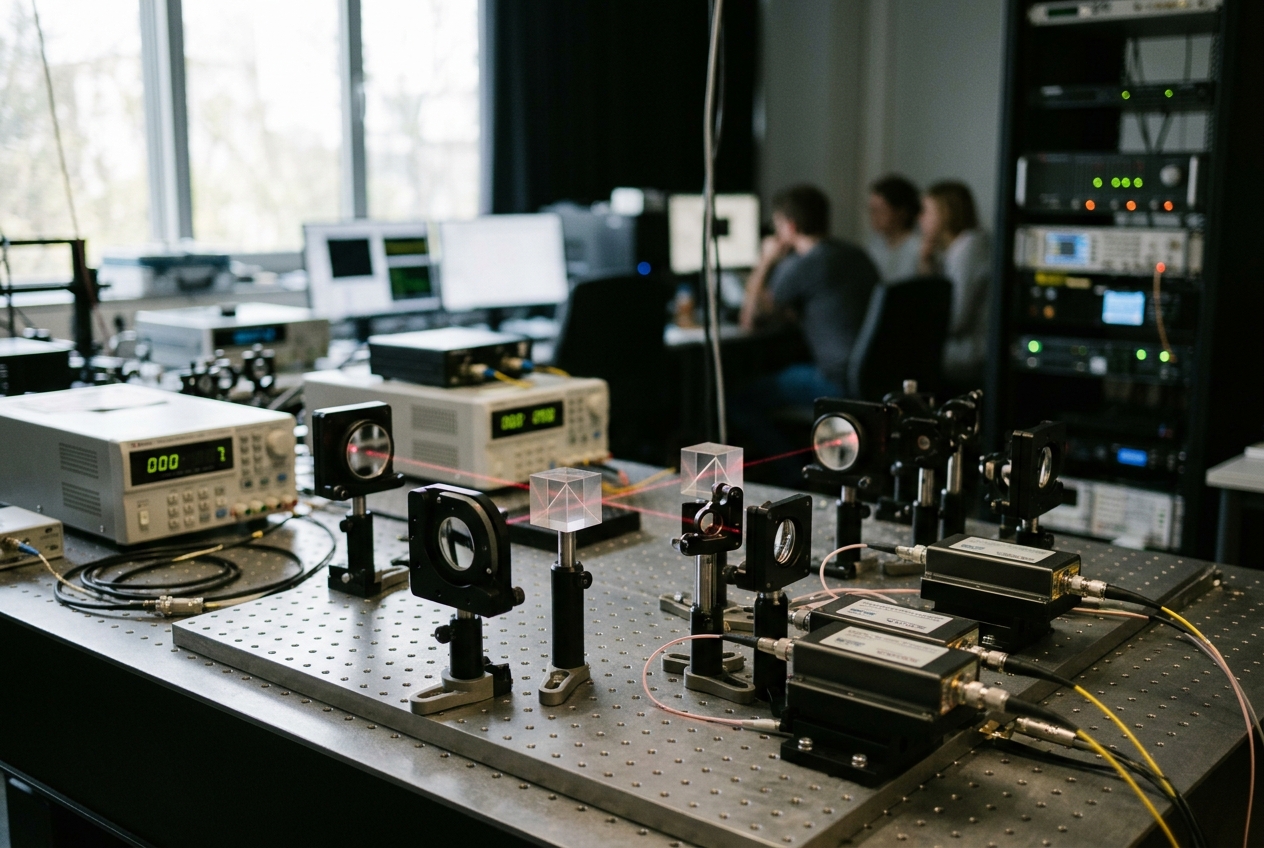
By harnessing the strange wave-particle duality of light and the Quantum Zeno effect, physicists can now detect fragile objects without hitting them with a single photon. Here is how interaction-free measurement is transforming medicine, computing, and our understanding of reality.
1. Opening Hook — Why You Should Care
Imagine attempting to photograph a living, delicate viral macromolecule or inspect a photographic film so sensitive that the arrival of a single particle of light instantly degrades or vaporises it. For centuries, the bedrock assumption of experimental science has been straightforward: to observe an object, you must touch it. You must shine light upon it, scatter electrons from its surface, or bounce acoustic waves off its boundaries. In the classical macroscopic world, every measurement extracts information by exchanging energy. No interaction means no signal, and no signal means total blindness.
Quantum mechanics fundamentally destroys this classical certainty.
In a world governed by quantum superposition, it is possible to determine with absolute mathematical certainty that an object is present in a specific location without a single quantum of energy—not one photon, electron, or neutron—ever being absorbed or scattered by that object. Known as interaction-free measurement (IFM), this phenomenon is not a theoretical sleight of hand or an optical illusion. It is an experimentally verified capability that is revolutionising how we approach the most fragile boundaries of materials science, structural biology, and cryptographic communication.
The implications are breathtaking. In pharmacology and medicine, interaction-free techniques promise to allow biophysicists to map the atomic architecture of living proteins and DNA complexes without the destructive radiation damage that currently limits cryo-electron microscopy. In digital security, it forms the foundation of "counterfactual communication," where cryptographic keys and sensitive data can be transmitted across networks without physical particles travelling through the transmission channel. To understand how we can see what we never illuminate, we must examine one of the most celebrated thought experiments in modern physics: the bomb that can only be found if it never goes off.
2. The Idea in Plain English
To build an intuition for how interaction-free measurement works, we do not need to plunge immediately into the abstract mathematics of Hilbert spaces. Instead, we can begin with a famous physical thought experiment proposed in 1993 by Israeli physicists Avshalom Elitzur and Lev Vaidman: the Elitzur–Vaidman bomb tester.
Consider a warehouse filled with hypothetical bombs equipped with ultra-sensitive optical triggers. The trigger is designed with such extreme sensitivity that if even a single photon of light strikes its sensor, the bomb absorbs the photon's energy and immediately explodes. Some of the bombs in the warehouse are defective duds—their sensors are jammed, allowing light to pass straight through them unimpeded. The rest are fully operational and live.
In classical physics, sorting the live bombs from the duds without detonating them is impossible. If you shine a light on a sensor to test if it absorbs photons, a live bomb will inevitably detonate, killing the tester. If you do not shine light on it, you learn nothing.
Quantum physics provides a miraculous third outcome. The core reason lies in the dual nature of light: a single photon is both an indivisible packet of energy (a particle) and a delocalised wave of probability.
When a single photon enters an optical device known as a Mach-Zehnder interferometer, it encounters a semi-transparent mirror called a beam splitter. Rather than choosing strictly the upper path or the lower path, the photon’s probability wave splits equally, traversing both paths simultaneously in a quantum superposition.
If the interferometer is completely empty—or if a dud bomb is placed in one arm—the waves travelling along both paths recombine at a second beam splitter. The geometry of the optical paths is tuned with precision so that the two waves interfere with each other: 1. Constructive Interference: Along the exit path leading to Detector 0 (the "Bright Port"), the wave peaks align, reinforcing each other so that the photon is detected 100% of the time. 2. Destructive Interference: Along the path leading to Detector 1 (the "Dark Port"), the wave peaks meet wave troughs, cancelling each other out completely. In an unobstructed setup, Detector 1 never clicks.
Now, what happens if we place a live bomb along the lower path?
The live bomb acts as a silent quantum interrogator. Because the bomb will instantly detonate if a photon hits it, it forces the quantum superposition to make a choice. The wave function collapses: * Half the time ($50\%$), the photon takes the lower path, hits the trigger, and the bomb explodes. * The other half of the time ($50\%$), the photon travels exclusively along the upper path.
Here is the crux: because the lower path was blocked by the bomb, there is no longer a second wave arriving at the second beam splitter to cancel out the light heading toward the "Dark Port." The destructive interference is destroyed!
When the surviving photon strikes the second beam splitter from the upper path alone, it has an equal $50/50$ chance of exiting toward the Bright Port or the Dark Port. If the Dark Port detector clicks, we learn something profound: the bomb in the lower path must be live, because only a live absorber could have broken the destructive interference. Yet the photon was registered at the Dark Port, meaning it traversed the upper path and never deposited a single quantum of energy into the bomb's trigger.
We have certified the existence of an active bomb without touching it.
3. How It Actually Works — The Mechanics
To fully appreciate the mathematical elegance of interaction-free measurement, we can formalise the physical system using quantum state vectors and matrix transformations, as taught in introductory quantum optics courses at institutions like MIT OpenCourseWare.
The Unobstructed Mach-Zehnder Interferometer
Let the two spatial paths inside the interferometer be represented by the orthonormal basis states $|0\rangle$ (Path A, upper arm) and $|1\rangle$ (Path B, lower arm). A standard symmetric 50:50 non-polarising beam splitter applies a unitary transformation, $U_{\text{BS}}$, to the incoming spatial modes:
$$U_{\text{BS}} = \frac{1}{\sqrt{2}}\begin{pmatrix} 1 & 1 \ 1 & -1 \end{pmatrix}$$
Suppose a single photon enters the first beam splitter ($BS_1$) through Path A, represented as the state vector:
$$|\psi_0\rangle = |0\rangle = \begin{pmatrix} 1 \ 0 \end{pmatrix}$$
Applying the first beam splitter transformation yields an equal superposition of spatial trajectories:
$$|\psi_1\rangle = U_{\text{BS}}|\psi_0\rangle = \frac{1}{\sqrt{2}}\begin{pmatrix} 1 & 1 \ 1 & -1 \end{pmatrix}\begin{pmatrix} 1 \ 0 \end{pmatrix} = \frac{1}{\sqrt{2}}|0\rangle + \frac{1}{\sqrt{2}}|1\rangle$$
The photon travels through the interferometer arms, reflects off ideal planar mirrors (introducing an identical phase shift to both paths), and reaches the second beam splitter ($BS_2$). We calculate the final state $|\psi_{\text{out}}\rangle$ by applying $U_{\text{BS}}$ a second time:
$$|\psi_{\text{out}}\rangle = U_{\text{BS}}|\psi_1\rangle = \frac{1}{\sqrt{2}}\begin{pmatrix} 1 & 1 \ 1 & -1 \end{pmatrix} \begin{pmatrix} \frac{1}{\sqrt{2}} \ \frac{1}{\sqrt{2}} \end{pmatrix} = \begin{pmatrix} \frac{1}{2} + \frac{1}{2} \ \frac{1}{2} - \frac{1}{2} \end{pmatrix} = \begin{pmatrix} 1 \ 0 \end{pmatrix} = |0\rangle$$
The probability of detecting the photon at Detector $D_0$ (the Bright Port) is $P(D_0) = |\langle 0 | \psi_{\text{out}} \rangle|^2 = 1.0$, while the probability of detection at Detector $D_1$ (the Dark Port) is $P(D_1) = |\langle 1 | \psi_{\text{out}} \rangle|^2 = 0.0$. Perfect destructive interference ensures that the dark port remains strictly silent.
The Elitzur-Vaidman Projective Measurement
Now, introduce a completely absorbing object (the live bomb) into Path B ($|1\rangle$). The presence of the absorber performs a projective measurement on the spatial wave function before the components can recombine at $BS_2$.
The measurement projection operator for absorption in Path B is $\hat{M}{\text{abs}} = |1\rangle\langle 1|$, and the projection operator for transmission through Path A is $\hat{M}{\text{trans}} = |0\rangle\langle 0|$.
-
Absorption / Detonation ($P = 0.50$): The probability that the photon interacts with the absorber is: $$P_{\text{detonate}} = \langle \psi_1 | \hat{M}_{\text{abs}} | \psi_1 \rangle = \left|\frac{1}{\sqrt{2}}\right|^2 = \frac{1}{2} = 50\%$$
-
Wave Function Reduction to Path A ($P = 0.50$): With $50\%$ probability, the photon is not absorbed. The wave function collapses onto Path A: $$|\psi_{\text{collapsed}}\rangle = \frac{\hat{M}{\text{trans}}|\psi_1\rangle}{\sqrt{\langle \psi_1 | \hat{M}{\text{trans}} | \psi_1 \rangle}} = |0\rangle$$
This surviving photon proceeds to $BS_2$. Since it enters $BS_2$ purely via Path A without any interfering component from Path B, the state after $BS_2$ is:
$$|\psi_{\text{final}}\rangle = U_{\text{BS}}|0\rangle = \frac{1}{\sqrt{2}}|0\rangle + \frac{1}{\sqrt{2}}|1\rangle$$
The resulting detection probabilities across all possible outcomes are: * Detonation: $P_{\text{detonate}} = 0.50$ ($50\%$) * Bright Port ($D_0$) Click: $P(D_0) = P_{\text{trans}} \times |\langle 0 | \psi_{\text{final}} \rangle|^2 = 0.50 \times \frac{1}{2} = 0.25$ ($25\%$) * Dark Port ($D_1$) Click: $P(D_1) = P_{\text{trans}} \times |\langle 1 | \psi_{\text{final}} \rangle|^2 = 0.50 \times \frac{1}{2} = 0.25$ ($25\%$)
If Detector $D_0$ clicks, the result is inconclusive; it could have been an unobstructed interferometer or a collapsed wave function. But if Detector $D_1$ clicks, we have conclusive proof of the object's presence without a single photon touching it.
The standard efficiency metric $\eta$, defined as the ratio of successful interaction-free detections to total decisive events, is:
$$\eta = \frac{P(D_1)}{P(D_1) + P_{\text{detonate}}} = \frac{0.25}{0.25 + 0.50} = \frac{1}{3} \approx 33.3\%$$
While a $33.3\%$ efficiency is an astounding triumph over classical mechanics, risking a $50\%$ detonation rate remains practically hazardous. Can we do better?
The Quantum Zeno Boost: Reaching 100% Efficiency
In 1995, a landmark paper in Physical Review Letters by Paul Kwiat, Harald Weinfurter, Thomas Herzog, Anton Zeilinger, and Mark Kasevich demonstrated how to drive the efficiency of interaction-free measurement arbitrarily close to $100\%$.
Their technique combines interaction-free interrogation with the Quantum Zeno Effect—the principle that continuous or frequent projective observation freezes the dynamical evolution of a quantum system (colloquially: "a watched pot never boils").
Instead of splitting the photon’s amplitude $50/50$ in a single pass, the Kwiat setup circulates a horizontally polarised single photon $|H\rangle$ through an optical cavity across $N$ successive cycles. In each cycle: 1. An optical element (such as a birefringent waveplate or Faraday rotator) rotates the polarisation by a tiny angle: $$\theta = \frac{\pi}{2N}$$ 2. The photon passes through a Polarising Beam Splitter (PBS) that transmits horizontally polarised light $|H\rangle$ along an unobstructed path and reflects vertically polarised light $|V\rangle$ toward the object under test.
In the absence of an object, the small rotations accumulate coherently over $N$ passes:
$$\theta_{\text{total}} = N \times \theta = N \left(\frac{\pi}{2N}\right) = \frac{\pi}{2}$$
After $N$ complete cycles, the polarisation is entirely converted from horizontal $|H\rangle$ to vertical $|V\rangle$. A final polarisation analyser detects the photon in state $|V\rangle$ with $100\%$ probability.
In the presence of an absorbing object, the object performs a projective measurement at every single pass. During cycle $k$, the state immediately after the tiny rotation is:
$$|\psi_k\rangle = \cos\left(\frac{\pi}{2N}\right)|H\rangle + \sin\left(\frac{\pi}{2N}\right)|V\rangle$$
The probability that the photon is absorbed by the object in any single pass is:
$$P_{\text{absorb, single}} = \sin^2\left(\frac{\pi}{2N}\right) \approx \left(\frac{\pi}{2N}\right)^2 = \frac{\pi^2}{4N^2}$$
If the photon is not absorbed, its state collapses back to pure horizontal polarisation $|H\rangle$. The total probability that the photon survives all $N$ successive cycles without being absorbed is given by the product of the survival probabilities:
$$P_{\text{survive}} = \left[\cos^2\left(\frac{\pi}{2N}\right)\right]^N \approx \left[1 - \frac{\pi^2}{4N^2}\right]^N \approx 1 - \frac{\pi^2}{4N}$$
As the number of interrogation cycles $N$ approaches infinity, the total absorption probability vanishes toward zero:
$$P_{\text{detonate}} = 1 - P_{\text{survive}} \approx \frac{\pi^2}{4N} \xrightarrow{N \to \infty} 0$$
$$P_{\text{IFM}} = P_{\text{survive}} \xrightarrow{N \to \infty} 1.0$$
======================================================================
  Cycles (N)   Detonation Prob (P_det)   IFM Success Prob (P_IFM)   Efficiency (η)
======================================================================
      1                50.00%                    25.00%                 33.3%
      5                22.18%                    77.82%                 77.8%
     20                 6.02%                    93.98%                 94.0%
    100                 1.22%                    98.78%                 98.8%
   1000                 0.12%                    99.88%                 99.9%
======================================================================
By dividing the observation into small, frequent interrogations, the quantum state is continuously pinned to $|H\rangle$. If the final state remains $|H\rangle$ after $N$ cycles, we know an absorbing object is present in the $|V\rangle$ channel, yet the probability of having transferred any energy to it drops to negligible levels.
4. Real-World Applications Today
Far from being confined to philosophical debates about the foundations of quantum mechanics, interaction-free measurement and its theoretical derivatives are actively driving high-impact research in advanced laboratories worldwide.
1. Radiation-Damage-Free Cryo-Electron Microscopy
- Institutions: Max Planck Institute for Multidisciplinary Sciences and Stanford University
- The Challenge: Cryo-electron microscopy (Cryo-EM) has revolutionised structural biology by imaging frozen macromolecules. However, high-energy electron beams ionise biological tissue, breaking covalent bonds and destroying delicate protein structures before high-resolution diffraction data can be gathered.
- The Quantum Advantage: By adapting the multi-pass Zeno interaction-free scheme from photons to free electrons in an electron-optical resonator, researchers can detect the presence and phase shift of biomolecules with electron wavefunctions that collapse away from the specimen. This promises sub-nanometre resolution imaging of living cellular machinery at electron dosages far below the classical radiation-damage threshold.
2. Counterfactual Quantum Key Distribution & Direct Communication
- Institutions: University of Science and Technology of China (USTC) and Toshiba Quantum Information Group
- The Challenge: Quantum Key Distribution (QKD) protocols like BB84 transmit cryptographic keys via polarised photons. However, physical photon loss in optical fibres and free-space channels limits transmission distance and exposes the channel to side-channel eavesdropping.
- The Quantum Advantage: In counterfactual communication protocols, Alice and Bob exchange secret cryptographic keys—and even transmit direct classical bits—over a channel where the logical "0" and "1" states are determined by whether an interaction-free path was blocked or unblocked. Because the photons that carry information never travel through the public transmission line connecting the two parties, the protocol exhibits unprecedented resilience against interception and eavesdropping attacks.
3. Non-Destructive Semiconductor Metrology & Defect Inspection
- Institutions: ASML, Applied Materials, and IMEC
- The Challenge: Modern extreme ultraviolet (EUV) photolithography etches semiconductor features smaller than 2 nanometres. Inspecting EUV photoresists for molecular defects is notoriously difficult because standard EUV inspection beams expose and ruin the photoresist material during the measurement process.
- The Quantum Advantage: Interaction-free inspection arrays utilise nested multi-pass optical cavities to scan EUV masks and unexposed photoresists. The system identifies nanometre-scale particulate contaminations and structural line breaks without triggering the photochemical reactions that cure the resist.
4. Matter-Wave and Neutron Interferometric Sensing
- Institutions: Vienna University of Technology (TU Wien, Atominstitut) and the National Institute of Standards and Technology (NIST)
- The Challenge: Probing opaque, dense nuclear materials or observing delicate magnetic vortex structures in Bose-Einstein condensates (BECs) typically causes heating, state decoherence, or immediate destruction of the fragile degenerate quantum state.
- The Quantum Advantage: Utilising single-neutron interferometers and matter-wave beams, physicists perform interaction-free interrogation of ultracold atomic clouds. The technique records the topological and magnetic characteristics of the quantum gas without collapsing the collective condensate wave function or injecting destructive kinetic energy.
5. What This Means for You
For anyone outside a physics laboratory, interaction-free measurement may sound like an esoteric curiosity. Yet its philosophical and technological ramifications touch the core of how society will handle data privacy, medicine, and computing over the next two decades.
Consider the impact on healthcare. Most life-saving pharmaceuticals work by binding to complex, flexible pocket sites on viral or bacterial proteins. Today, pharmaceutical designers must spend months inferring these structures from computer simulations or x-ray crystallography of dead, crystallised molecules. When interaction-free electron microscopes reach clinical maturity, pharmacologists will be able to watch individual drug compounds dock into live, moving cellular receptors in real time without destroying the biological specimen. This could compress drug development timelines from years to days.
Consider your personal data security. Modern banking, communications, and national infrastructure rely on cryptographic algorithms that are vulnerable to eavesdropping and quantum decryption. Counterfactual quantum networks provide a layer of security that does not depend on shielding physical cables from wiretaps; if an eavesdropper attempts to measure the communication channel, they alter the counterfactual probability paths, instantly alerting the network without obtaining a single photon of transmitted data.
Most fundamentally, interaction-free measurement challenges our classical understanding of reality. It proves that nature does not keep accounts purely in terms of physical collisions and tangible interactions. In the quantum realm, the paths a particle might have taken leave an indelible imprint on the paths it actually takes. Reality is shaped just as powerfully by unrealised possibilities as it is by physical impacts.
6. Today's Takeaway
Interaction-free measurement demonstrates that quantum information is not governed by physical force or energetic impact, but by the geometry of probability. By manipulating destructive interference and harnessing the Quantum Zeno effect, we can interrogate the physical universe and extract decisive facts about our environment using particles that never touched the things they reveal—proving that in quantum mechanics, the mere possibility of an event is enough to change the world.
References and Further Reading
- Nature: Experimental Interaction-Free Measurement — Pioneering experimental confirmations of counterfactual imaging.
- Physical Review Letters: Kwiat et al. (1995) — High-efficiency interaction-free measurement via the Quantum Zeno effect.
- MIT OpenCourseWare: Quantum Physics I — Detailed lectures on Mach-Zehnder interferometry and wave function evolution.
- IBM Quantum Learning — Foundations of quantum measurement, superpositions, and circuit models.
- Stanford Encyclopedia of Philosophy: Quantum Measurement Problem — Analysis of wave function reduction and counterfactual definiteness.
- Wikipedia: Elitzur–Vaidman Bomb Tester — Comprehensive background on the foundational 1993 thought experiment.