Mermin-Peres Magic Square: Demonstrating Quantum Contextuality and Flawless Pseudo-Telepathy Via Entangled Observables
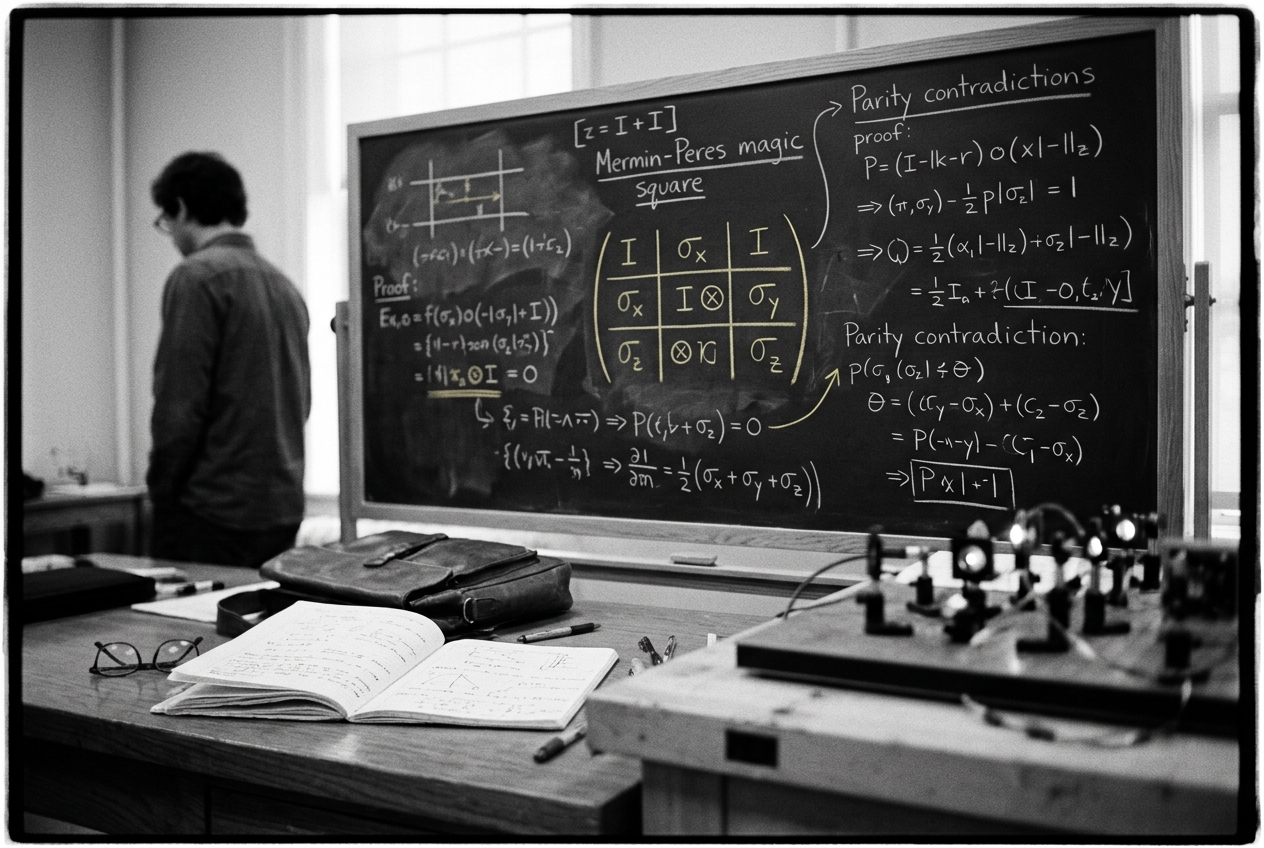
Yet beneath the surface of classical intuition lies a structural feature of quantum mechanics that destroys this foundational premise. In 1990 and 1993, physicists N. David Mermin and Asher Peres unveiled an algebraic construction known as the Mermin-Peres magic square. Unlike previous milestones in quantum foundations that relied on statistical averages, detector efficiencies, and probabilistic inequalities, the magic square establishes an "all-versus-nothing" proof of quantum contextuality. Through a simple 3-by-3 arrangement of quantum measurements, it forces a direct, irreconcilable confrontation between classical realism and quantum mathematics: the algebraic equation $+1 = -1$.
Understanding how nine quantum measurements shatter classical realism is not merely an exercise in philosophical gymnastics. The magic square provides the mathematical blueprint for modern device-independent cryptography, fault-tolerant quantum error correction, and self-testing protocols that allow computer scientists to certify the authenticity of quantum supercomputers without trusting the vendor who manufactured them.
1. The Idea in Plain English: Reality as an Unwritten Script
To understand what makes the quantum realm so deeply alien, we must distinguish between three foundational concepts that are often conflated: realism, locality, and contextuality.
Classical realism posits that physical systems possess predetermined measurement outcomes prior to observation. When a meteorologist measures atmospheric pressure, the barometer merely registers a value that existed microseconds before the measurement. In the 1960s, John Stewart Bell challenged this intuition through Bell's theorem, demonstrating that no physical theory based on local, predetermined hidden variables could reproduce the statistical predictions of quantum mechanics across spacelike separations. Bell’s refutation required measuring probability distributions over thousands of experimental runs, computing statistical correlations, and showing that quantum systems violate an upper numerical threshold (such as the Clauser-Horne-Shimony-Holt inequality).
Before Bell, mathematicians Simon Kochen and Ernst Specker formulated the Kochen-Specker theorem in 1967. They proved that realism itself—specifically non-contextual realism—is mathematically incompatible with quantum mechanics in any Hilbert space of dimension three or greater, entirely independent of spatial separation.
Contextuality is the principle that the outcome of a physical measurement depends inherently upon the context in which it is performed—that is, which other compatible (mutually commute and non-disturbing) measurements are carried out alongside it. In a non-contextual world, if you ask a system question $A$, the answer is fixed, whether you ask question $B$ or question $C$ at the same time. In a contextual world, nature does not possess a static catalog of predetermined answers. The answer to $A$ is forged dynamically by the experimental context in which $A$ is asked.
While Kochen and Specker’s original geometric proof was immensely complex—requiring an intricate web of 117 three-dimensional vectors—Mermin and Peres distilled this profound insight into an elegant, two-qubit 3-by-3 grid. Furthermore, they eliminated the need for statistical inequalities. In the Mermin-Peres formulation, quantum mechanics does not merely violate a probabilistic average; it reveals that the assumption of pre-existing classical values leads to an immediate arithmetic paradox.
2. How It Actually Works: The Mechanics of the Magic Square
The Mermin-Peres magic square operates within a four-dimensional Hilbert space ($\mathbb{C}^2 \otimes \mathbb{C}^2$), corresponding to a physical system of two entangled qubits. The construction consists of nine observable operators arranged in a 3-by-3 matrix. Each observable is constructed as a tensor product of single-qubit Pauli operators ($\sigma_x, \sigma_y, \sigma_z$) and the two-dimensional identity operator ($I$).
The 3x3 Pauli Operator Grid
Consider the nine observables arranged as follows:
| Context | Observable 1 | Observable 2 | Observable 3 | Row Product ($R_i$) |
|---|---|---|---|---|
| Row 1 | $\sigma_x \otimes I$ | $I \otimes \sigma_x$ | $\sigma_x \otimes \sigma_x$ | $+I \otimes I$ |
| Row 2 | $I \otimes \sigma_y$ | $\sigma_y \otimes I$ | $\sigma_y \otimes \sigma_y$ | $+I \otimes I$ |
| Row 3 | $\sigma_x \otimes \sigma_y$ | $\sigma_y \otimes \sigma_x$ | $\sigma_z \otimes \sigma_z$ | $+I \otimes I$ |
| Column Product ($C_j$) | $+I \otimes I$ | $+I \otimes I$ | $-I \otimes I$ | Parity Contradiction |
Every single operator in this grid is Hermitian and involutory: its square equals the identity operator ($A_{ij}^2 = I \otimes I$). Consequently, when any of these operators is measured on a two-qubit state, the only possible measurement outcome is one of its eigenvalues: $+1$ or $-1$.
Algebraic Proof of Mutual Commutativity
For a set of quantum observables to be measurable simultaneously without mutual disturbance (forming a valid measurement context), they must mutually commute. Let us verify the commutativity relations across the rows and columns:
-
Row Commutativity: - In Row 1, $\sigma_x \otimes I$ and $I \otimes \sigma_x$ act on distinct qubit subsystems, trivially commuting. Their product is $\sigma_x \otimes \sigma_x$, which commutes with both factors. - In Row 2, $I \otimes \sigma_y$ and $\sigma_y \otimes I$ similarly commute and yield $\sigma_y \otimes \sigma_y$. - In Row 3, we evaluate the commutator of $A_{31} = \sigma_x \otimes \sigma_y$ and $A_{32} = \sigma_y \otimes \sigma_x$: $$(\sigma_x \otimes \sigma_y)(\sigma_y \otimes \sigma_x) = (\sigma_x \sigma_y) \otimes (\sigma_y \sigma_x) = (i\sigma_z) \otimes (-i\sigma_z) = \sigma_z \otimes \sigma_z$$ Reversing the order: $$(\sigma_y \otimes \sigma_x)(\sigma_x \otimes \sigma_y) = (\sigma_y \sigma_x) \otimes (\sigma_x \sigma_y) = (-i\sigma_z) \otimes (i\sigma_z) = \sigma_z \otimes \sigma_z$$ Because the two operators commute, they possess a complete basis of simultaneous eigenstates.
-
Column Commutativity: - In Column 1, $(\sigma_x \otimes I)(I \otimes \sigma_y) = \sigma_x \otimes \sigma_y = (I \otimes \sigma_y)(\sigma_x \otimes I)$. - In Column 2, $(I \otimes \sigma_x)(\sigma_y \otimes I) = \sigma_y \otimes \sigma_x = (\sigma_y \otimes I)(I \otimes \sigma_x)$. - In Column 3, we examine $A_{13} = \sigma_x \otimes \sigma_x$ and $A_{23} = \sigma_y \otimes \sigma_y$: $$(\sigma_x \otimes \sigma_x)(\sigma_y \otimes \sigma_y) = (\sigma_x \sigma_y) \otimes (\sigma_x \sigma_y) = (i\sigma_z) \otimes (i\sigma_z) = -\sigma_z \otimes \sigma_z$$ Reversing the order yields identical results, confirming that all three operators in Column 3 mutually commute.
Deriving the Parity Contradiction
When we calculate the algebraic product of the operators along each row and column, an astonishing asymmetry emerges:
-
Row Products: $$\prod_{j=1}^3 A_{1j} = (\sigma_x \otimes I)(I \otimes \sigma_x)(\sigma_x \otimes \sigma_x) = +I \otimes I$$ $$\prod_{j=1}^3 A_{2j} = (I \otimes \sigma_y)(\sigma_y \otimes I)(\sigma_y \otimes \sigma_y) = +I \otimes I$$ $$\prod_{j=1}^3 A_{3j} = (\sigma_x \otimes \sigma_y)(\sigma_y \otimes \sigma_x)(\sigma_z \otimes \sigma_z) = (\sigma_z \otimes \sigma_z)(\sigma_z \otimes \sigma_z) = +I \otimes I$$
-
Column Products: $$\prod_{i=1}^3 A_{i1} = (\sigma_x \otimes I)(I \otimes \sigma_y)(\sigma_x \otimes \sigma_y) = (\sigma_x^2) \otimes (\sigma_y^2) = +I \otimes I$$ $$\prod_{i=1}^3 A_{i2} = (I \otimes \sigma_x)(\sigma_y \otimes I)(\sigma_y \otimes \sigma_x) = (\sigma_y^2) \otimes (\sigma_x^2) = +I \otimes I$$ $$\prod_{i=1}^3 A_{i3} = (\sigma_x \otimes \sigma_x)(\sigma_y \otimes \sigma_y)(\sigma_z \otimes \sigma_z) = (-\sigma_z \otimes \sigma_z)(\sigma_z \otimes \sigma_z) = -I \otimes I$$
Notice the third column: the algebraic product of its operators evaluates to negative identity ($-I \otimes I$).
Now, let us examine what classical non-contextual realism requires. If each of the nine operators possesses a predetermined classical value $v(A_{ij}) \in {+1, -1}$ prior to measurement, these pre-existing values must respect the identity algebraic relations of the commuting observables:
- For each row $i$, the product of the classical values must equal $+1$: $$\prod_{j=1}^3 v(A_{ij}) = +1 \quad \forall \, i \in {1, 2, 3} \implies \prod_{i=1}^3 \prod_{j=1}^3 v(A_{ij}) = (+1)(+1)(+1) = +1$$
- For the columns, the first two must multiply to $+1$ and the third must multiply to $-1$: $$\prod_{i=1}^3 v(A_{i1}) = +1, \quad \prod_{i=1}^3 v(A_{i2}) = +1, \quad \prod_{i=1}^3 v(A_{i3}) = -1 \implies \prod_{j=1}^3 \prod_{i=1}^3 v(A_{ij}) = (+1)(+1)(-1) = -1$$
Because multiplication over real numbers is commutative, the total product of all nine numbers evaluated by rows must equal the total product evaluated by columns: $$\prod_{i=1}^3 \prod_{j=1}^3 v(A_{ij}) \equiv \prod_{j=1}^3 \prod_{i=1}^3 v(A_{ij}) \implies +1 = -1$$
This is a formal mathematical contradiction. It proves that it is mathematically impossible to assign predefined, context-independent values $\pm 1$ to these nine observables.
Crucially, this proof is state-independent: it does not depend on preparing a specific quantum state $|\psi\rangle$. The contradiction resides entirely within the algebraic structure of the observables themselves. This elevates the Mermin-Peres magic square beyond traditional Bell tests, which require precise entangled state preparations and statistical hypothesis testing.
3. The Non-Local Pseudo-Telepathy Game
The algebraic impossibility of non-contextuality can be translated into a cooperative game that vividly demonstrates the superiority of quantum information processing over classical physics. This construction is known as a quantum pseudo-telepathy game.
                   +-----------------------+
                   |       REFEREE         |
                   +-----------------------+
                          /         \
              Row r in   /           \  Column c in
             {1, 2, 3}  /             \ {1, 2, 3}
                       v               v
                +-------------+  +------------+
                |    ALICE    |  |    BOB     |
                +-------------+  +------------+
                | Measures    |  | Measures   |
                | Row r       |  | Column c   |
                +-------------+  +------------+
                       \               /
             Outputs    \             / Outputs
          (a1, a2, a3)   \           /  (b1, b2, b3)
          with Prod=+1    v         v   with Prod=-1
                   +-----------------------+
                   | Winning Condition:    |
                   |   a_c == b_r          |
                   | (Agreement at (r, c)) |
                   +-----------------------+
Game Rules and Setup
Two players, Alice and Bob, are physically separated and forbidden from communicating once the game begins. 1. A referee sends Alice a random row index $r \in {1, 2, 3}$. 2. The referee sends Bob a random column index $c \in {1, 2, 3}$. 3. Alice must output three numbers $(a_1, a_2, a_3) \in {-1, +1}^3$ such that their product is strictly even: $a_1 a_2 a_3 = +1$. 4. Bob must output three numbers $(b_1, b_2, b_3) \in {-1, +1}^3$ such that their product is strictly odd: $b_1 b_2 b_3 = -1$. 5. Winning Condition: Alice and Bob win the round if and only if their outputs agree on the intersection of their respective row and column—that is, Alice’s $c$-th assignment must match Bob’s $r$-th assignment: $$a_c = b_r$$
The Classical Ceiling: Why Classical Teams Fail
In a classical universe, any deterministic shared strategy corresponds to pre-populating the nine cells of the 3-by-3 grid with fixed numbers $v_{ij} \in {-1, +1}$.
As established by our parity derivation, no classical 3-by-3 grid can satisfy all six parity constraints simultaneously (three rows multiplying to $+1$, two columns multiplying to $+1$, and one column multiplying to $-1$). At most, a classical grid can satisfy 5 out of the 6 parity conditions.
Because there are $3 \times 3 = 9$ equally likely question pairs $(r, c)$ chosen uniformly at random by the referee: - If a strategy satisfies 5 of the 6 constraints, there is at least one row or column that fails its parity check. - To guarantee that Alice always outputs a valid row product ($+1$) and Bob always outputs a valid column product ($-1$), their classical assignments must differ on at least one cell in the grid. - Consequently, Alice and Bob can agree on at most 8 out of the 9 possible intersection queries.
The classical win rate is strictly bounded: $$\mathbb{P}_{\text{classical}}(\text{Win}) \le \frac{8}{9} \approx 88.89\%$$
No amount of shared classical randomness can surpass this ceiling, because a randomized strategy is simply a probability distribution over deterministic strategies.
The Quantum Winning Strategy: Perfect Pseudo-Telepathy
In the quantum version of the game, Alice and Bob share two pairs of maximally entangled qubits (two Bell states): $$|\Psi\rangle = |\Phi^+\rangle \otimes |\Phi^+\rangle = \frac{1}{2} (|00\rangle + |11\rangle) \otimes (|00\rangle + |11\rangle)$$
When the referee sends Alice row index $r$, she performs a projective measurement on her two qubits in the joint eigenbasis of the three commuting operators belonging to Row $r$ of the Mermin-Peres magic square. Because the operator product for any row is $+I \otimes I$, the product of her three observed eigenvalues $(a_1, a_2, a_3)$ is guaranteed with certainty to equal $+1$.
When the referee sends Bob column index $c$, he performs a projective measurement on his two qubits in the joint eigenbasis of the three commuting operators belonging to Column $c$. Because the operator product for Column 3 is $-I \otimes I$ (and $+I \otimes I$ for Columns 1 and 2), the product of his observed eigenvalues $(b_1, b_2, b_3)$ is guaranteed with certainty to equal $-1$ for Column 3, and $+1$ for Columns 1 and 2.
Due to the exact correlations of the shared Bell states, whenever Alice and Bob measure the observable corresponding to the intersection cell $A_{rc}$, quantum mechanics guarantees that their outcomes are identical: $$\mathbb{P}_{\text{quantum}}(a_c = b_r) = 1.0 \quad (100\%)$$
Alice and Bob win the game on every single round without exchanging a single bit of information. To an outside observer who assumes classical physics, the players appear to possess telepathic communication—hence the moniker quantum pseudo-telepathy.
4. Real-World Applications Today
The Mermin-Peres magic square is not an abstract curiosity; it serves as a core primitive across multiple subfields of contemporary quantum information science.
+-----------------------------------------------------------------------------------+
|               MODERN APPLICATIONS OF THE MERMIN-PERES PARADIGM                    |
+------------------------------------+----------------------------------------------+
| Field                              | Core Mechanism / Advantage                   |
+------------------------------------+----------------------------------------------+
| 1. Device-Independent Self-Testing | Certifies quantum hardware & entanglement    |
|    (IBM, Rigetti, Oxford)          | without trusting internal components.        |
|                                    |                                              |
| 2. Fault-Tolerant Stabilizers      | Maps commutation relations in CSS & surface  |
|    (Nature, QuTech, Google Quantum)| codes; identifies contextuality as fuel.     |
|                                    |                                              |
| 3. Certified Quantum Randomness    | Generates untamperable entropy verified by   |
|    (NIST, European Quantum Flag.)  | contextuality contradictions.                |
|                                    |                                              |
| 4. Distributed Quantum Games       | Replaces classical communication rounds in   |
|    (MIT, Inria, Caltech)           | multi-agent distributed consensus algorithms.|
+------------------------------------+----------------------------------------------+
1. Device-Independent Self-Testing and Verification
In commercial cloud-hosted quantum computing, users must submit jobs to remote, black-box hardware. How can a user verify that a quantum processor—such as those accessible via IBM Quantum Platform or programmatic frameworks like IBM Qiskit Documentation—is executing true quantum operations rather than spoofing results using a classical simulator?
Because the quantum magic square game has a classical ceiling of $8/9$ and a quantum ceiling of $1$, it acts as a self-testing protocol. By playing the pseudo-telepathy game with a quantum device, a user can mathematically certify that the device contains genuine two-qubit entanglement and executes exact Pauli measurements, up to local unitary transformations, without inspecting the physical hardware internals.
2. Stabilizer Error Correction and Magic State Distillation
Fault-tolerant quantum computing relies on stabilizer codes, such as surface codes, to protect delicate quantum information from environmental decoherence. The algebraic properties of the Mermin-Peres square directly mirror the Pauli stabilizer group structure.
In a landmark research paper published in Nature, researchers proved that quantum contextuality is the foundational resource powering quantum computational speedup in fault-tolerant architectures. Specifically, contextuality is the indispensable property present in "magic states"—non-stabilizer states distilled to enable universal quantum computation. Without contextuality, quantum circuits can be efficiently simulated on classical computers, as codified by the Gottesman-Knill theorem.
3. Certified True Randomness Generation
Classical pseudorandom number generators rely on mathematical algorithms that are fundamentally deterministic and vulnerable to cryptanalysis. By leveraging the state-independent contextuality of the Mermin-Peres magic square, national metrology institutes (such as the National Institute of Standards and Technology) and European quantum consortia can produce certified private randomness. Because the measurement outcomes in a contextual square are generated dynamically upon observation and cannot be pre-programmed, the resulting bitstrings provide provably unpredictable entropy.
4. Distributed Multi-Agent Coordination
In distributed computing, coordinating autonomous agents without excessive network communication latency represents a classic bottleneck. Quantum pseudo-telepathy games prove that shared quantum entanglement can eliminate communication rounds in distributed consensus protocols. Researchers exploring foundational quantum information theory at institutions like MIT OpenCourseWare Quantum Physics and Stanford Encyclopedia of Philosophy: Entanglement and Information study these game-theoretic frameworks to design decentralized consensus protocols that bypass classical communication bandwidth limits.
5. What This Means for You
For the non-physicist, the implications of the Mermin-Peres magic square extend far beyond the laboratory.
First, it redefines the nature of digital trust. As quantum computers mature, society will transition toward zero-trust security architectures. Device-independent protocols derived from the magic square ensure that cryptographic systems can be verified without placing blind faith in hardware supply chains. You will not need to trust that a quantum chip manufacturer omitted a backdoor; the mathematical rigidity of the parity contradiction allows the hardware to prove its integrity continuously.
Second, it permanently alters our comprehension of reality. The Mermin-Peres magic square proves that the physical world does not consist of static objects with fixed properties waiting to be photographed. Instead, nature is fundamentally participatory: properties are created in the crucible of the interaction between the observer and the observed.
6. Today's Takeaway
The Mermin-Peres magic square provides the ultimate, unequivocal demonstration that our universe is non-contextual at its core: by arranging nine simple two-qubit measurements into a 3-by-3 grid, it reduces the profound mystery of quantum reality to a stark arithmetic contradiction ($+1 = -1$), proving that nature never decides what an answer will be until the full context of the question is asked.