Quantum Illumination: Surpassing Classical Detection Bounds and Enhancing Target Discrimination in High-Noise Regimes
Imagine attempting to spot a dark, matte-black drone flying through a blazing sandstorm in the middle of a searing desert afternoon. If you shine a conventional searchlight or radar beam into the sky, virtually none of your light bounces off the drone and returns to your detector. Instead, the sensor is completely overwhelmed by the blazing ambient glare of the sun and the thermal radiation bouncing off trillions of hot sand grains. To classical physics, the drone is effectively invisible—swallowed whole by random environmental noise.
Turning up the power of your radar might sound like an obvious fix, but in many delicate situations, cranking up the energy is catastrophic. A high-powered microwave pulse exposes the radar station's location to adversaries, while an intense laser blast can burn delicate biological tissues, destroy live retinal cells in medical imaging, or melt photosensitive quantum materials under study.
For nearly a century, engineers have faced this rigid, classical trade-off: to spot faint objects buried in noise, you must blast them with more energy.
Quantum illumination completely rewrites this rulebook. By exploiting subtle quantum correlations between pairs of light particles, it enables a detector to pick out a reflective target hidden inside an ocean of blinding thermal noise using a beam so faint it emits less than a single photon per pulse. Most astonishingly, it achieves this feat even when the delicate quantum entanglement that powers the system is completely destroyed by the environment before the light ever makes it back to the sensor.
Here is how quantum mechanics allows us to extract pristine information from what appears to be total, irreversible chaos.
1. The Idea in Plain English
To understand why quantum illumination seems impossible at first glance, consider how we typically think about quantum technology. In quantum computing and secure communication, quantum entanglement—what Albert Einstein famously dubbed "spooky action at a distance"—is notoriously fragile. The moment an entangled particle collides with a stray thermal atom or bounces off a dusty surface, its delicate quantum state collapses. Physicists call this decoherence. In everyday environments filled with heat and light, decoherence acts like an unforgiving sledgehammer.
Because of this fragility, conventional wisdom long held that quantum sensing could only work in pristine, cryogenically cooled laboratories or deep, noiseless space. Sending an entangled photon through the turbulent, warm atmosphere to bounce off an airplane seemed like a fool's errand: the photon would scatter, the entanglement would vanish, and the quantum advantage would evaporate.
Quantum illumination bypasses this obstacle through an ingenious conceptual trick: two-mode squeezing.
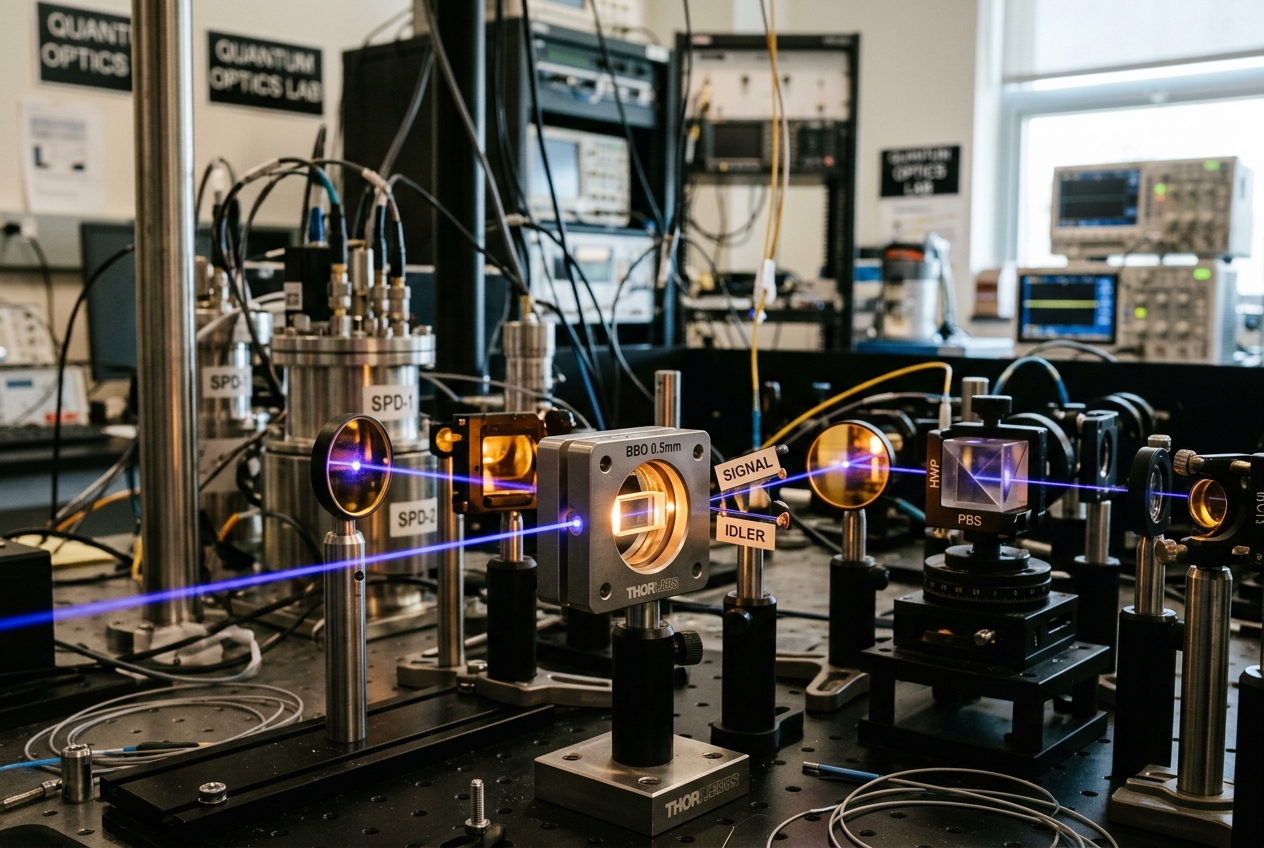
Instead of sending an entangled photon out on its own, a quantum illumination radar creates twins: a "signal" photon and an "idler" photon. The signal photon is dispatched into the hostile, noisy environment to search for the target, while the idler photon is carefully preserved in a local quantum memory loop inside the radar receiver.
Think of it like tearing a unique, intricately patterned banknote down the middle. You keep one half locked securely in your safe at home (the idler) and give the other half to a courier heading out into a raging blizzard (the signal). If the courier returns, they hand you a torn piece of paper covered in mud, soot, and random debris (ambient noise).
A conventional observer looking only at the returned scrap would see nothing but useless trash. But because you hold the matching half in your safe, you can place the two torn edges together under a microscope. Even if 99.9% of the returned paper has been obliterated, the microscopic tear pattern along the surviving fibers matches your locked half in a way that random debris never could.
In the quantum domain, this matching pattern represents quantum discord and phase-sensitive cross-correlations. Even though the thermal background noise is millions of times brighter than the returning signal, and even though the original quantum entanglement is 100% destroyed during the round trip, the lingering mathematical "fingerprint" between the stored idler and the returned signal survives. That microscopic correlation is all the receiver needs to separate the real target from the blinding noise.
2. How It Actually Works — The Mechanics
To formalize this phenomenon, physicists treat target detection as a binary quantum hypothesis testing problem. The receiver must decide between two competing hypotheses:
- Hypothesis $H_0$ (Target Absent): The transmitted signal was lost into empty space. The light entering the receiver consists entirely of random, uncorrelated ambient thermal noise.
- Hypothesis $H_1$ (Target Present): A faint fraction $\eta$ of the transmitted signal reflected off the target and reached the receiver, embedded within the same intense bath of thermal background noise.
The Hostile Operating Regime
Quantum illumination is purpose-built for the most challenging operating regime in physics: 1. Extremely Low Target Reflectivity ($\eta \ll 1$): Only a tiny sliver of the transmitted energy bounces back (often less than 1% or even 0.01%). 2. Ultra-Low Signal Brightness ($N_S \ll 1$): The transmitter emits an average of far less than one photon per electromagnetic mode, rendering the probe virtually undetectable to hostile interceptors and non-damaging to delicate specimens. 3. Overwhelming Thermal Glare ($N_B \gg 1$): The background noise contributes thousands or millions of random thermal photons per mode, completely swamping the returning probe.
Under these conditions, a classical radar transmitting standard coherent laser pulses (the gold standard of classical electromagnetic sensing) struggles severely. The error probability for a classical radar decays exponentially with the number of pulses $M$ sent, governed by an error exponent determined by the classical signal-to-noise ratio:
$$\text{Error Exponent}_{\text{Classical}} \approx \frac{\eta N_S}{4 N_B}$$
This formula describes how rapidly detection mistakes decline as you collect more data. It reveals a punishing reality: when background noise $N_B$ is enormous and reflectivity $\eta$ is tiny, the classical exponent shrinks to near zero. To get a reliable detection, you must average millions of pulses over a long duration.
The Quantum Transmitter: Two-Mode Squeezed Vacuum
Quantum illumination replaces the classical coherent pulse with a continuous-variable Two-Mode Squeezed Vacuum (TMSV) state. Generated via non-linear optical processes such as spontaneous parametric down-conversion (SPDC) or microwave Josephson parametric amplifiers, the TMSV state exhibits zero mean field but possesses quantum-entangled fluctuations.
The transmitter is mathematically characterized by a covariance matrix over its quadrature operators $(\hat{q}_S, \hat{p}_S, \hat{q}_I, \hat{p}_I)$. While the individual signal and idler modes look like featureless, random thermal noise when measured in isolation, their cross-quadrature covariance reveals strong phase-sensitive correlations:
$$\langle \hat{a}_S \hat{a}_I \rangle = \sqrt{N_S(N_S + 1)}$$
This cross-correlation term represents the joint variance of the twin beams. Because $N_S \ll 1$, the correlation term $\sqrt{N_S(N_S + 1)} \approx \sqrt{N_S}$ is vastly larger than the energy of the transmitted signal $N_S$ itself. This square-root scaling is the fundamental quantum lever that powers the entire system.
The Survival of Non-Classical Signatures
When the signal mode propagates through the channel, it undergoes massive loss $\eta$ and mixes with thermal noise $N_B$ at a beam splitter. By the time the returning mode reaches the detector, the entanglement between the signal and idler has been broken.
Yet, as proven in foundational research published in Physical Review Letters, the quantum mutual information and phase-sensitive cross-correlation between the returned mode $\hat{a}_R$ and the retained idler $\hat{a}_I$ do not vanish. Under Hypothesis $H_1$, the cross-correlation remains non-zero:
$$\langle \hat{a}R \hat{a}_I \rangle{H_1} = \sqrt{\eta N_S(N_S + 1)}$$
Under Hypothesis $H_0$, because no signal returns, this cross-correlation is identically zero: $\langle \hat{a}R \hat{a}_I \rangle{H_0} = 0$.
The 6 dB Quantum Chernoff Advantage
By evaluating the Helstrom Bound (the fundamental quantum mechanical limit on state discrimination) and the Quantum Chernoff Bound for large pulse ensembles $M$, quantum illumination achieves a stunning theoretical result:
$$\text{Error Exponent}_{\text{Quantum}} \approx \frac{\eta N_S}{N_B}$$
Comparing the quantum error exponent to the classical coherent state exponent reveals an exact factor-of-four advantage:
$$\frac{\text{Error Exponent}{\text{Quantum}}}{\text{Error Exponent}{\text{Classical}}} = 4 \quad (6\text{ dB})$$
Unlocking the Advantage: Non-Linear Joint Receivers
Discovering that the quantum state holds a 6 dB advantage was only half the battle. For years, physicists faced a vexing problem: how do you actually measure it?
If a laboratory uses standard detection techniques—such as measuring the signal with a homodyne detector and comparing it digitally to the idler—the 6 dB advantage vanishes, collapsing to at most a 3 dB gain. Classical local measurements destroy the subtle phase-sensitive correlations before they can be harvested.
To unlock the full 6 dB bound, the returning signal photon and the stored idler photon must be injected together into a non-linear joint receiver: 1. Optical Parametric Amplifier (OPA) Receiver: The returned light and stored idler are combined in a non-linear crystal pumped by a strong laser. The crystal acts as a phase-sensitive amplifier that physically interferes the two optical modes, converting their phase-sensitive correlation into a measurable mean photon number difference. 2. Feed-Forward Sum-Frequency Generation (FF-SFG): Proposed as an optimal receiver, FF-SFG repeatedly up-converts the joint signal-idler modes into higher-frequency single photons in a multi-stage cavity with adaptive measurement feedback, asymptotically saturating the full 6 dB Quantum Chernoff Bound.
3. Real-World Applications Today
While the theory of quantum illumination was pioneered in the late 2000s by Seth Lloyd and formalized by researchers at MIT, the technology has transitioned into active experimental development across multiple commercial, academic, and defense laboratories worldwide between 2024 and 2026.
1. Microwave Quantum Radar and Aerospace Defense
- Institutions: Raytheon BBN Technologies, the Institute for Quantum Computing at the University of Waterloo, and Chalmers University of Technology.
- Objective: Developing microwave-domain quantum radar prototypes capable of identifying stealth targets cloaked in atmospheric noise and electronic jamming.
- The Quantum Advantage: Stealth aircraft are designed with radar-absorbent coatings and faceted geometries that scatter standard high-power radio waves away from detectors. Quantum illumination operates at the single-photon level within the microwave spectrum using superconducting Josephson Parametric Converters (JPCs). Because the probe power is miniscule, the target's electronic countermeasures fail to detect that it is being tracked, while the radar slices through background jamming noise with fourfold faster statistical convergence.
2. Ultra-Low-Damage Biomedical Imaging
- Institutions: The European Q-MIC Consortium, the Max Planck Institute for the Science of Light, and the University of Oxford.
- Objective: Imaging ultra-sensitive living biological specimens, including developing embryos, living neurons, and light-sensitive photoreceptor cells in the retina.
- The Quantum Advantage: In high-resolution optical microscopy, illuminating living cells with bright laser light causes severe phototoxicity and photobleaching, killing the very biological processes scientists wish to observe. Quantum illumination allows researchers to operate with sub-photon probe intensities ($N_S \ll 1$) across visible and near-infrared wavelengths, resolving cellular structures submerged in ambient thermal fluorescence without inducing physiological damage.
3. Covert Satellite Lidar and Earth Observation
- Institutions: NASA Jet Propulsion Laboratory (JPL), the European Space Agency (ESA), and MIT Lincoln Laboratory.
- Objective: Earth-to-orbit tracking, satellite rendezvous navigation, and planetary observation under direct, blinding solar illumination.
- The Quantum Advantage: Optical sensors pointed near the sun are typically blinded by solar background radiation ($N_B \gg 1$). By generating entangled optical twin pairs and retaining the idler in a low-loss fiber loop or solid-state optical memory, satellite-borne quantum lidar can track nearby orbital debris or navigate docking maneuvers through direct sunlight while transmitting minimal optical power.
4. Non-Destructive Quantum Materials Characterization
- Institutions: National Institute of Standards and Technology (NIST) and leading international solid-state physics laboratories.
- Objective: Probing delicate phase transitions in topological insulators, superconducting films, and strongly correlated 2D materials.
- The Quantum Advantage: Exotic quantum states of matter frequently collapse when heated by external measurement lasers. Quantum illumination probes these materials using quantum-correlated photon modes that extract structural and spectroscopic properties while transferring negligible thermal energy to the sample.
4. The Engineering Hurdles: What Stands in the Way?
Despite its extraordinary theoretical promises, scaling quantum illumination into widespread operational hardware requires solving several formidable physical and engineering bottlenecks:
- Idler Storage Losses in Quantum Memory: The entire protocol hinges on storing the idler mode cleanly while the signal traverses the target path. If the idler photon is lost or suffers attenuation in its storage medium, the cross-correlation collapses. For long-range radar operating across hundreds of kilometers, the idler must be stored for milliseconds—an eternity for optical delay lines and microwave cavities.
- Electro-Optic Microwave Transduction: While generating optical entanglement is straightforward using non-linear crystals, radar requires microwave frequencies that easily penetrate rain, fog, and clouds. Generating entangled microwave-optical pairs or converting microwave idlers to robust optical states requires electro-optomechanical transducers with near-unity conversion efficiency, a technology still in its infancy.
- Cryogenic Constraints: High-fidelity microwave parametric devices such as Josephson junctions must be cooled to millikelvin temperatures inside liquid-helium dilution refrigerators. Miniaturizing these systems into field-deployable payloads for aircraft or drones remains a major defense engineering challenge.
5. What This Means for You
Why should someone outside an advanced optics laboratory care about a factor-of-four improvement in noisy photon detection?
The implications touch the future of human health, security, and scientific discovery.
In medicine, quantum illumination paves the way toward zero-damage cancer biopsies and non-invasive eye exams. Today, high-resolution diagnostic imaging of living tissue is strictly limited by how much light radiation a cell can tolerate before burning or mutating. By breaking the classical noise barrier, quantum-enhanced sensors will allow doctors to look deeper into live, functioning organs at molecular resolutions without harming a single cell.
In everyday aviation and environmental monitoring, quantum-illuminated lidar and radar could allow commercial airliners and autonomous vehicles to see clearly through blinding blizzards, dense sea fog, and sudden dust storms without blinding the camera sensors of nearby vehicles.
Furthermore, quantum illumination provides a profound philosophical revelation about our universe: fragility is not always fatal. For decades, scientists believed that once quantum entanglement was lost to environmental noise, every shred of quantum advantage vanished with it. Quantum illumination proves that quantum information leaves an indelible signature—a ghost in the noise that can be recovered to see what was previously thought to be permanently invisible.
6. Today's Takeaway
The Core Insight: Quantum illumination is the art of detecting faint objects hidden within overwhelming glare by dispatching one photon of an entangled pair while locking its twin safely in memory. Even though atmospheric noise completely obliterates the delicate entanglement during flight, the surviving mathematical correlations allow a joint receiver to cut through noise four times faster than any classical beam of equal power. It proves that quantum technologies can thrive not just in pristine vacuum chambers, but out in the messy, hot, and noisy real world.
Further Reading and Authoritative Resources
- Explore fundamental research on continuous-variable states in Nature Physics.
- Read the original theoretical foundations in Physical Review Letters.
- Learn more about quantum hypothesis testing via MIT OpenCourseWare Quantum Optical Communication.
- Review technical overviews on the Wikipedia Quantum Illumination Portal.
- Discover experimental quantum microwave engineering with the IBM Quantum Documentation.