Knill-Laflamme-Milburn Protocol: Achieving Scalable Optical Quantum Computation Via Linear Elements and Teleported Gates
1. Opening Hook — Why You Should Care
The encryption protecting your bank account, your medical records, and the global financial infrastructure relies on mathematical problems that would take today's fastest classical supercomputers thousands of years to unravel. A full-scale, fault-tolerant quantum computer could dissolve those protections in a matter of hours. Yet, if you walk into the world's leading quantum laboratories today, you will encounter a startling bottleneck: towering, multi-million-dollar dilution refrigerators, humming continuously to maintain a frigid 15 millikelvin—colder than the void of interstellar space. These fragile cryogenic machines isolate superconducting circuits and trapped ions from the slightest thermal whisper of the everyday world.
This reliance on extreme refrigeration raises an urgent question: how can quantum technology ever scale to millions of interconnected units if every processor requires its own cathedral of cryogenic plumbing?
There is an alternative medium that bypasses this limitation entirely: light. Particles of light—photons—do not experience thermal jitter at room temperature. They can travel through standard fiber-optic cables across entire continents without losing their delicate quantum information. However, this extraordinary resilience hides a fundamental physical barrier: photons are entirely indifferent to one another. Two crossed flashlight beams pass straight through each other without altering their paths by a single degree. Because conventional computing logic requires information to interact—where the state of one bit flips the state of another—physicists long believed that computing with light alone was physically impossible without exotic, non-existent materials.
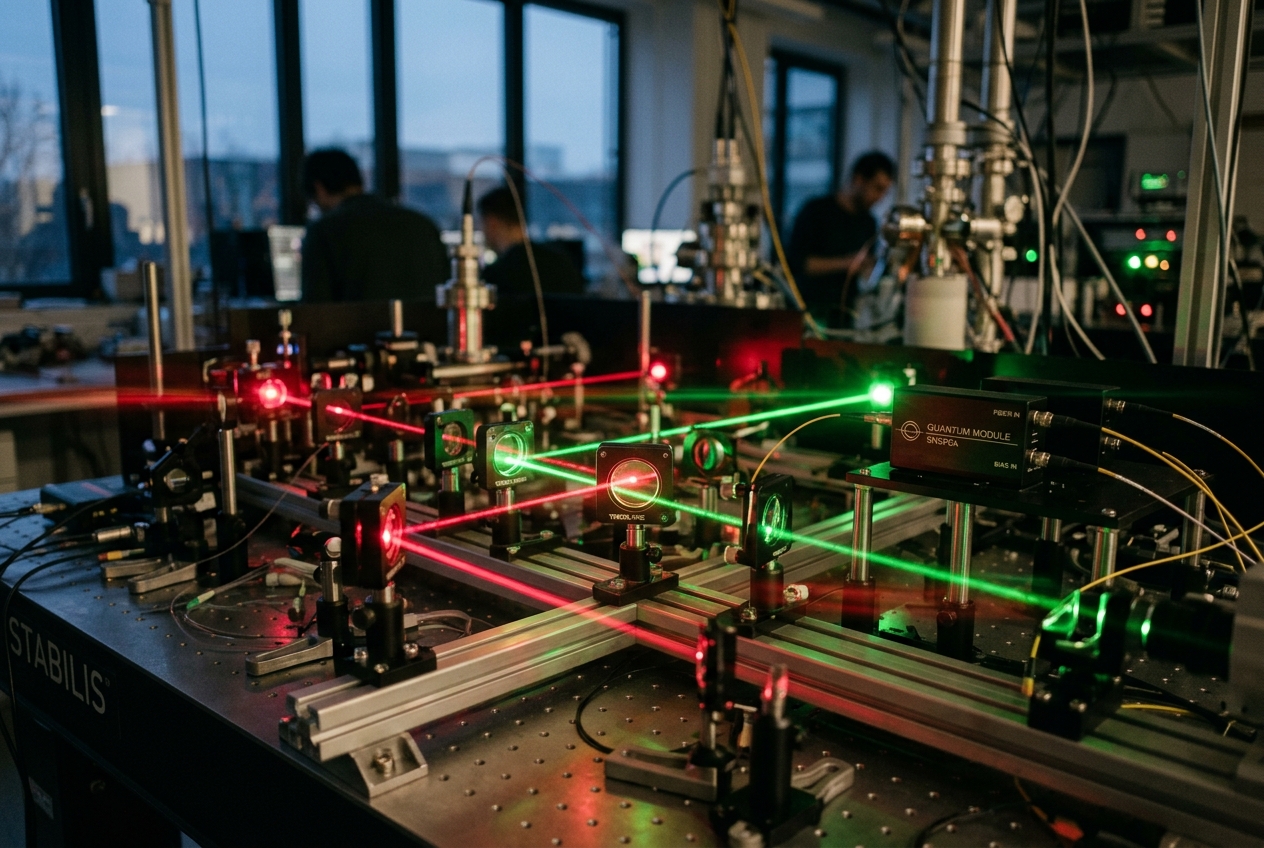
In 2001, a landmark theoretical breakthrough shattered that assumption. Known as the Knill-Laflamme-Milburn (KLM) protocol, it proved that simple optical hardware—half-silvered mirrors, glass phase shifters, and light detectors—could force photons to interact and perform universal quantum computation. By turning the act of measurement itself into a computational engine, the KLM protocol laid the foundation for a new generation of room-temperature, chip-scale quantum computers.
2. The Idea in Plain English
To understand why computing with light is so challenging—and how the KLM protocol resolved it—it helps to visualize quantum information through an everyday physical analogy.
The Railway Switch of Quantum Light
In a classical computer, a bit is like a mechanical light switch: it is either decisively OFF ($0$) or ON ($1$). A quantum bit, or qubit, behaves like a coin spinning in mid-air. Until it lands on a table and is observed, it exists in a simultaneous combination, or superposition, of both heads and tails.
In optical quantum computing, physicists typically encode this coin toss using what is called dual-rail encoding. Imagine a miniature railway system with two parallel tracks: an Upper Rail (representing state $0$) and a Lower Rail (representing state $1$). A single photon enters the junction. Instead of choosing one track exclusively, the photon travels along both tracks at once in a quantum superposition.
- Dual-Rail Encoding: A method of representing quantum information where the logical state ($0$ or $1$) corresponds to which of two spatial paths contains the photon.
- Beam Splitter: A semi-transparent mirror that splits an incoming light beam, acting as an optical railway switch that places a photon into a superposition of transmitted and reflected paths.
- Phase Shifter: A transparent piece of glass with a tailored thickness that delays the optical wave along one path, rotating the quantum state of the photon.
Single-qubit operations are straightforward in this framework. If you want to change the relative phase of the coin, you pass one of the optical paths through a slice of glass. If you want to randomize the paths, you bounce the photon off a beam splitter.
The Missing Interaction
The crisis emerges when you attempt a two-qubit logic gate, such as a Controlled-NOT (CNOT) gate. In computing, a two-qubit gate is the essential building block of all complex algorithms: it means "Look at Track A; if a train is present on Track A, switch the track on Train B."
Because photons do not carry electrical charge or magnetic poles, they do not repel or attract one another. Two photons traveling through the same optical glass glide past each other like ghosts in the night. For decades, the orthodox view in physics was that optical quantum computation required intense non-linear optical materials—special crystals with high Kerr non-linearities that would force one photon to alter the refractive index experienced by another. Unfortunately, in natural media, these single-photon interactions are infinitesimal, rendering direct optical logic gates practically impossible.
Knill, Raymond Laflamme, and Gerard J. Milburn realized that one could introduce sacrificial "helper" particles—known as ancilla photons—and mix them with the data photons across an optical network. When photodetectors record the arrival of these helper photons, the quantum wave function collapses. If the detectors click in a specific combination, the operation has succeeded, and the unmeasured data photons have executed an effective, non-linear quantum logic gate.
3. How It Actually Works — The Mechanics
The technical brilliance of the KLM protocol lies in how it constructs universal quantum logic from exclusively linear elements: beam splitters, phase shifters, single-photon sources, and photon-number-resolving photodetectors.
The Non-Linear Sign Shift (NS) Gate
The foundational building block of the entire KLM architecture is the Non-linear Sign (NS) gate. In quantum optics, a single spatial path can hold zero photons (vacuum, $|0\rangle$), one photon ($|1\rangle$), or two photons ($|2\rangle$). Linear optical components can shift the overall phase of light, but they apply a phase shift that scales linearly with the number of photons: one photon picks up a phase $\theta$, and two photons pick up $2\theta$.
A universal quantum computer requires a non-linear phase response. The NS gate achieves this by leaving the zero- and single-photon states unaltered while multiplying the two-photon state by a negative sign (a $\pi$ phase shift):
$$\text{NS}: \quad \alpha|0\rangle + \beta|1\rangle + \gamma|2\rangle \;\longrightarrow\; \alpha|0\rangle + \beta|1\rangle - \gamma|2\rangle$$
This sign flip on the two-photon component is the quantum-mechanical catalyst required to construct two-qubit entangling gates, such as the Controlled Phase or CNOT gate.
Constructing the Probabilistic Optical Network
To generate this non-linear shift without a physical non-linear medium, KLM designed a three-mode interferometer. The input data state occupies Mode 1, while Modes 2 and 3 are loaded with two ancilla modes initialized to exactly one photon and zero photons (vacuum), respectively: $|\psi_{\text{in}}\rangle = |\psi_{\text{data}}\rangle_1 \otimes |1\rangle_2 \otimes |0\rangle_3$.
These three paths are routed through a sequence of beam splitters and phase shifters governed by a $3 \times 3$ unitary scattering matrix, denoted as $U$:
$$U = \begin{pmatrix} 1-\sqrt{2} & \sqrt{2\sqrt{2}-2} & \sqrt{\sqrt{2}-1} \ \sqrt{2\sqrt{2}-2} & \sqrt{2}-1 & -\sqrt{\sqrt{2}-1} \ \sqrt{\sqrt{2}-1} & -\sqrt{\sqrt{2}-1} & \frac{1}{\sqrt{2}} \end{pmatrix}$$
When the output of Mode 2 and Mode 3 are measured using high-efficiency photodetectors, the circuit exhibits a conditional measurement outcome: 1. If detector 2 registers exactly 1 photon and detector 3 registers exactly 0 photons (the herald pattern $|1, 0\rangle_{2,3}$), the input state in Mode 1 is guaranteed to have undergone the exact transformation of the NS gate. 2. If any other combination of photons is detected (such as 0 or 2 photons in mode 2), the gate has failed, destroying the quantum superposition in Mode 1.
The probability of obtaining this specific herald pattern is mathematically fixed:
$$P_{\text{success}} = \frac{1}{4} = 25\%$$
At first glance, a gate that fails 75% of the time seems useless for high-precision computation. If you chained together a modest algorithm requiring 1,000 gates, the total success probability would be $(1/4)^{1000}$—an infinitesimally small number that would doom the computer to perpetual failure.
Teleportation and Asymptotic Scaling to Determinism
The true genius of the original 2001 paper published in Nature by Knill, Laflamme, and Milburn was demonstrating that these probabilistic gates can be boosted asymptotically toward a 100% success rate with only polynomial resource overhead.
To circumvent the exponential failure cliff, KLM adopted a strategy known as Quantum Gate Teleportation, originally conceptualized by Daniel Gottesman and Isaac Chuang:
- Off-line State Preparation: Instead of applying the risky 25%-success NS gate directly onto live data qubits, the gates are applied off-line to disposable, entangled ancilla states (such as multi-photon Bell or GHZ states). If the gate fails, the ancillae are discarded and re-prepared without corrupting the active calculation.
- Teleportation into the Circuit: Once an entangled resource state is successfully verified, it is linked to the computational data qubits via a linear optical Bell-state measurement.
- Polynomial Error Correction: By scaling the size of the entangled resource states to $n$ photons and employing optical parity codes, the effective success probability of the gate scales as: $$P(n) = \frac{n}{n+1}$$ As $n$ increases, the probability of failure drops toward zero ($1/(n+1)$), requiring an increase in hardware components that grows polynomially, not exponentially.
This theoretical proof established that Linear Optical Quantum Computing (LOQC) falls squarely within the computational complexity class BQP (Bounded-Error Quantum Polynomial Time)—proving that light-based quantum computers are fundamentally universal and scalable.
4. Real-World Applications Today (2024–2026)
While the original 2001 KLM proposal required too many physical optical elements to be immediately practical in bulk optics, its foundational concepts have fueled a modern industrial renaissance in integrated nanophotonics. Today, leading quantum enterprises and research institutes are actively deploying second- and third-generation variations of the KLM framework.
1. Fault-Tolerant Silicon Photonics: PsiQuantum
- Institution/Company: PsiQuantum (in partnership with GlobalFoundries).
- Objective: Building a utility-scale, fault-tolerant quantum computer containing one million physical qubits.
- The Quantum Advantage: Rather than using bulk mirrors and lenses aligned on optical tables, PsiQuantum manufactures optical circuits directly on standard 300-millimeter silicon wafers using commercial semiconductor foundry lines. They employ a modernized evolution of KLM known as Fusion-Based Quantum Computing (FBQC). In this paradigm, small networks of entangled photons are continuously "fused" via linear optical measurements to construct vast, three-dimensional error-corrected cluster states. This sidesteps the need for cryogenic qubit storage, leveraging standard telecom wavelengths ($1550\text{ nm}$) to build utility-scale processors capable of designing new battery chemistries and catalytic materials.
2. Gaussian Boson Sampling and Room-Temperature Simulation: Xanadu
- Institution/Company: Xanadu (Canada).
- Objective: Scaling integrated photonic processors (Borealis) and software ecosystems for quantum chemistry and graph optimization.
- The Quantum Advantage: Xanadu blends discrete single photons with continuous-variable "squeezed light" states generated on monolithic silicon nitride ($\text{Si}_3\text{N}_4$) chips. By exploiting multi-photon quantum interference—the foundational physics illuminated by the KLM protocol—their processors solve complex graph-similarity and molecular docking problems orders of magnitude faster than classical supercomputing clusters.
3. High-Efficiency Quantum Dot Engines: Quandela
- Institution/Company: Quandela (France).
- Objective: Developing cloud-accessible photonic quantum processors (Ascella, MosaiQ) powered by deterministic single-photon sources.
- The Quantum Advantage: One of the primary practical hurdles of the original KLM proposal was the probabilistic nature of early single-photon sources. Quandela solves this by embedding artificial semiconductor atoms—optically stimulated quantum dots inside micropillar optical cavities. These devices emit pristine, indistinguishable single photons with near-unity efficiency. Quandela makes these linear optical processors accessible via the cloud for European aerospace and automotive clients optimizing structural materials and complex logistics.
4. Global Quantum Internet and Repeater Networks: Quantum Internet Alliance (QIA)
- Institution/Company: Quantum Internet Alliance (QIA) and Cisco Quantum Labs.
- Objective: Establishing continent-spanning quantum networks capable of distributing high-fidelity entanglement between distributed quantum servers.
- The Quantum Advantage: Unlike classical internet signals, quantum data cannot be amplified using conventional repeaters because the No-Cloning Theorem prohibits copying an unknown quantum state. By utilizing KLM-style linear optical Bell-state measurements, researchers can perform quantum entanglement swapping across long-distance fiber networks. This provides physics-guaranteed, mathematically unhackable communications for defense and cross-border financial transactions.
For deeper technical context on these foundational concepts, consult open academic resources such as the MIT OpenCourseWare Quantum Information Science Lecture Series and foundational overviews on Wikipedia's Knill-Laflamme-Milburn Protocol documentation.
5. What This Means for You
It is easy to perceive the debate between superconducting circuits, trapped ions, and photonic processors as an abstract engineering dispute confined to academic cleanrooms. In reality, the architecture that ultimately wins the quantum race will dictate how quantum computing touches your everyday life.
Because photonic quantum computing operates on particles of light, it holds a unique structural advantage: it is natively compatible with the telecommunication infrastructure that already powers our digital world.
Consider the personal implications across three immediate domains:
- Absolute Privacy in Cloud Computing: If you submit sensitive medical diagnostics or proprietary engineering designs to a remote quantum mainframe, a superconducting system requires your data to be decrypted and converted into microwave frequencies inside a single laboratory refrigerator. A photonic quantum processor can accept encrypted qubits sent directly through existing commercial fiber-optic cables from your local terminal. Through blind quantum computation, the remote photonic server processes your data without ever being able to read what calculation it is performing.
- Accelerated Discovery of Everyday Materials: The chemical simulations enabled by multi-photon linear optics target complex molecular interactions that are intractable today. These include discovering room-temperature catalysts that could dramatically reduce the energy consumed in industrial fertilizer production, or modeling stable solid-state electrolytes for electric vehicle batteries that charge in five minutes and never degrade.
- Decentralized, Accessible Quantum Hardware: Cryogenic dilution refrigerators cost hundreds of thousands of dollars just to power and maintain each year, restricting quantum hardware to massive data centers operated by multinational tech conglomerates. Integrated nanophotonic chips—etched in materials like Thin-Film Lithium Niobate (TFLN) and silicon nitride—operate at ambient room temperature. While early systems still use localized cryocoolers for specialized single-photon detectors, the processors themselves could eventually live in standard server racks, bringing high-performance quantum processing directly into enterprise data centers, hospitals, and regional research hubs.
For ongoing updates on how hardware platforms compare across the industry, explore industry benchmarks curated by IBM Quantum and peer-reviewed literature across the Nature Quantum Information archive.
6. Today's Takeaway
The Knill-Laflamme-Milburn protocol taught physics one of its most profound lessons: you do not need to force particles of light to physically interact to compute with them; you only need to master the art of observing them. By proving that simple mirrors, glass shifters, and the quantum collapse of photodetectors can orchestrate universal logic, KLM unlocked a roadmap toward room-temperature, chip-scale quantum computers that move information at the fundamental speed limit of the universe.
Further Reading & Authoritative References
- Knill, E., Laflamme, R., & Milburn, G. J. (2001). A scheme for efficient quantum computation with linear optics. Nature, 409(6816), 46–52.
- Knill, E., Laflamme, R., & Milburn, G. J. (2000). Efficient Linear Optical Quantum Computation Preprint. arXiv:quant-ph/0006088.
- Gottesman, D., & Chuang, I. L. (1999). Demonstrating the viability of quantum computation using teleportation. Nature, 402, 390–393.
- Detailed course syllabi and lecture notes on linear optics can be accessed via MIT OpenCourseWare.
- Architectural roadmaps and quantum hardware benchmarks are actively documented by IBM Quantum Systems and PsiQuantum Research.