Electromagnetically Induced Transparency: Halting Light and Storing Coherent Quantum States in Atomic Ensembles
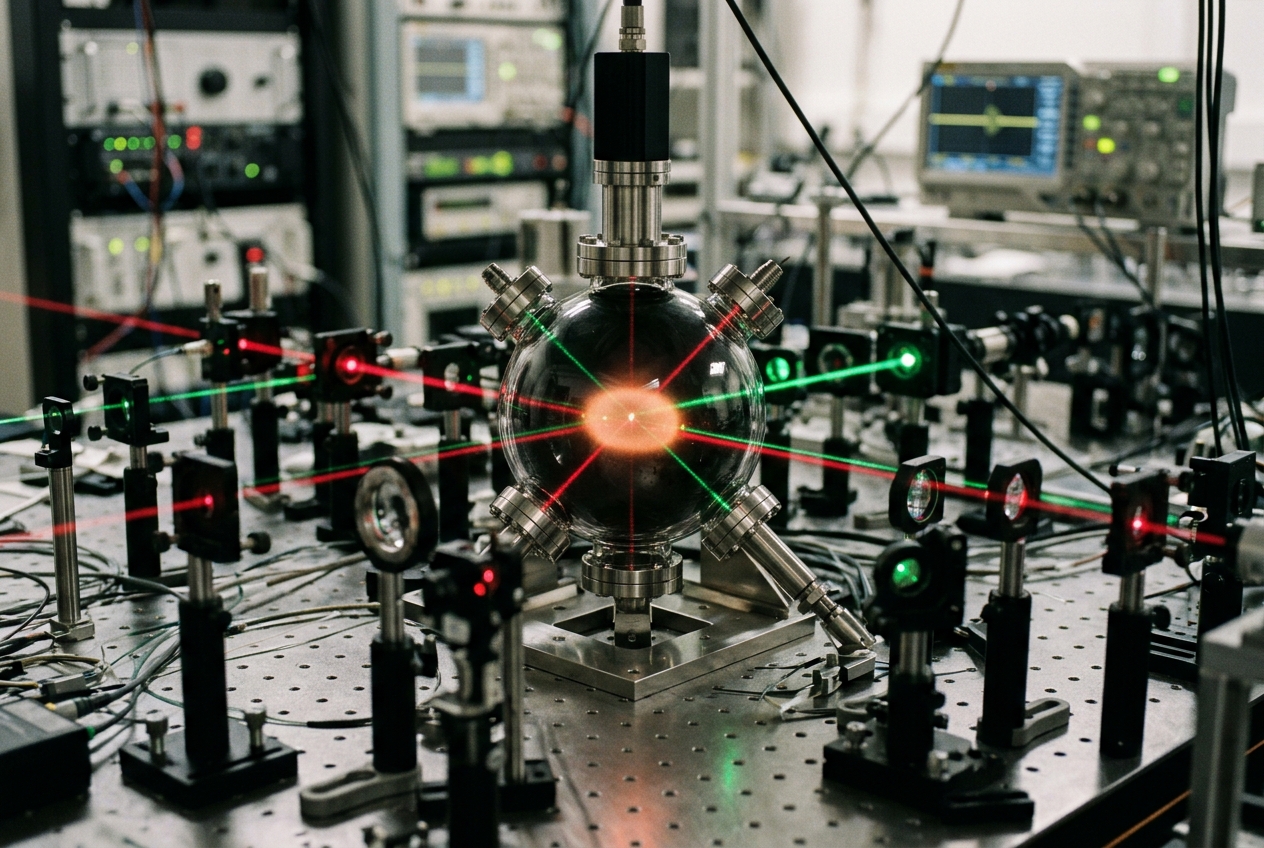
Today, EIT serves as a cornerstone technology for the emerging quantum internet. By mapping propagating photonic qubits onto long-lived collective atomic spin coherences—and subsequently retrieving them on demand with preserved quantum phase and amplitude—EIT provides the physical mechanism for high-fidelity optical quantum memory, quantum repeaters, non-destructive photon detection, and giant optical non-linearities at the single-photon level.
This didactic treatise develops the comprehensive theoretical foundation of EIT in three-level atomic systems, derives the Hamiltonian mechanics and the formation of uncoupled dark states, formulates the dynamics of dark-state polaritons, details pulse storage protocols, and evaluates modern experimental implementations in cold gases, warm vapors, and solid-state crystal matrices.
1. Theoretical Foundations & Three-Level Systems
To understand why a quantum medium can be rendered transparent without altering its physical density or chemical composition, one must examine the quantum state space of atomic systems driven by multiple coherent electromagnetic fields.
                  |3⟩ (Decaying Excited State, decay rate Γ₃)
                  / \
     Probe Field /   \ Control Field
        (Ω_p, ω_p)   (Ω_c, ω_c)
                /     \
               /       \
             |1⟩-------|2⟩ (Ground / Metastable States)
               Dipole-Forbidden
The $\Lambda$ (Lambda) Configuration
Classical absorption in a standard two-level atom occurs when an optical field is tuned to the transition frequency between a ground state $|1\rangle$ and an excited state $|3\rangle$. Photons are absorbed, promoting population from $|1\rangle$ to $|3\rangle$, followed by spontaneous radiative decay at a characteristic rate $\Gamma_3$, which destroys optical coherence and dissipates energy into the environment.
EIT overcomes this dissipative loss by introducing a three-level atomic system arranged in a $\Lambda$ (Lambda) configuration, comprising: 1. $|1\rangle$: The initial long-lived ground state. 2. $|2\rangle$: A second metastable ground or low-lying hyperfine/Zeeman state, which possesses no direct electric-dipole transition to $|1\rangle$ ($\langle 1 | \mathbf{d} | 2 \rangle = 0$). 3. $|3\rangle$: A common, short-lived electronic excited state that is dipole-coupled to both $|1\rangle$ and $|2\rangle$.
Coherent Driving Fields and Selection Rules
The system is driven by two distinct optical fields: - The Probe Field: Characterized by carrier frequency $\omega_p$, driving the $|1\rangle \leftrightarrow |3\rangle$ transition with a Rabi frequency $\Omega_p = \frac{\mu_{13} E_p}{\hbar}$, where $\mu_{13} = \langle 3 | \mathbf{d} \cdot \hat{\epsilon}p | 1 \rangle$ is the transition dipole matrix element and $E_p$ is the probe electric field envelope. In quantum memory protocols, the probe field is typically weak ($\Omega_p \ll \Omega_c$) and may even consist of single-photon wavepackets. - The Control (or Coupling) Field: Characterized by carrier frequency $\omega_c$, driving the $|2\rangle \leftrightarrow |3\rangle$ transition with a Rabi frequency $\Omega_c = \frac{\mu{23} E_c}{\hbar}$, where $\mu_{23} = \langle 3 | \mathbf{d} \cdot \hat{\epsilon}_c | 2 \rangle$. The control field is typically a strong classical laser beam.
We define the single-photon detunings as: $$\Delta_p = \omega_p - \omega_{31}$$ $$\Delta_c = \omega_c - \omega_{32}$$ where $\hbar \omega_{31} = E_3 - E_1$ and $\hbar \omega_{32} = E_3 - E_2$.
The crucial parameter governing EIT is the two-photon Raman detuning: $$\delta = \Delta_p - \Delta_c = (\omega_p - \omega_c) - \omega_{21}$$ When $\delta = 0$, the frequency difference between the probe and control fields matches the uncoupled hyperfine splitting $\omega_{21} = (E_2 - E_1)/\hbar$ with absolute precision. This condition is termed the two-photon resonance.
2. Hamiltonian Formalism & Dark States
The physical mechanism underlying EIT is quantum destructive interference between two alternative excitation pathways from the ground manifold to the decaying excited state $|3\rangle$. This is rigorously elucidated by deriving the interaction Hamiltonian and finding its instantaneous eigenstates.
Derivation of the Interaction Hamiltonian
The bare atomic Hamiltonian is given by: $$\hat{H}0 = \hbar \omega{31} |3\rangle\langle 3| + \hbar \omega_{21} |2\rangle\langle 2|$$ where we have set the ground-state energy $E_1 \equiv 0$. The semi-classical dipole interaction Hamiltonian is: $$\hat{V}(t) = -\mathbf{d} \cdot \left[ \mathbf{E}_p(t) + \mathbf{E}_c(t) \right]$$
Applying the Rotating Wave Approximation (RWA) to eliminate rapidly oscillating terms at optical frequencies ($\sim 10^{14}\text{--}10^{15}\text{ Hz}$), and transforming into a rotating frame via the unitary operator: $$\hat{U}(t) = \exp\left[ i \left( \omega_p |3\rangle\langle 3| + (\omega_p - \omega_c)|2\rangle\langle 2| \right) t \right]$$ the effective interaction Hamiltonian in the basis ${|1\rangle, |2\rangle, |3\rangle}$ becomes:
$$\hat{H}_{\text{int}} = -\hbar \begin{pmatrix} 0 & 0 & \frac{1}{2}\Omega_p^ \ 0 & \delta & \frac{1}{2}\Omega_c^ \ \frac{1}{2}\Omega_p & \frac{1}{2}\Omega_c & \Delta_p \end{pmatrix}$$
Exact Eigenstates and the Dark State
Let us consider the ideal resonant condition where both fields are on single-photon resonance ($\Delta_p = \Delta_c = 0$) and two-photon resonance ($\delta = 0$). Under these conditions, the Hamiltonian simplifies to:
$$\hat{H}_{\text{int}} = -\frac{\hbar}{2} \begin{pmatrix} 0 & 0 & \Omega_p^ \ 0 & 0 & \Omega_c^ \ \Omega_p & \Omega_c & 0 \end{pmatrix}$$
To obtain the instantaneous dressed eigenstates, we solve the characteristic eigenvalue equation $\det(\hat{H}_{\text{int}} - \lambda \mathbb{I}) = 0$:
$$\lambda \left( \lambda^2 - \frac{\hbar^2}{4}(|\Omega_p|^2 + |\Omega_c|^2) \right) = 0$$
This yields three distinct dressed eigenstates:
-
The Dark State ($|D\rangle$) corresponding to the eigenvalue $\lambda_0 = 0$: $$|D\rangle = \frac{\Omega_c |1\rangle - \Omega_p |2\rangle}{\sqrt{|\Omega_c|^2 + |\Omega_p|^2}}$$
-
The Bright States ($|B_\pm\rangle$) corresponding to non-zero eigenvalues $\lambda_\pm = \pm \frac{\hbar}{2}\Omega_{\text{eff}}$, where $\Omega_{\text{eff}} = \sqrt{|\Omega_p|^2 + |\Omega_c|^2}$: $$|B_\pm\rangle = \frac{1}{\sqrt{2}} \left( \frac{\Omega_p^ |1\rangle + \Omega_c^ |2\rangle}{\sqrt{|\Omega_c|^2 + |\Omega_p|^2}} \pm |3\rangle \right)$$
The Mechanism of Destructive Quantum Interference
The physical implications of the dark state $|D\rangle$ are profound: - Zero Excited-State Overlap: Notice that the dark state $|D\rangle$ is an exact linear superposition solely of the long-lived ground states $|1\rangle$ and $|2\rangle$. The projection of the dark state onto the decaying excited state is identically zero: $$\langle 3 | D \rangle = 0$$ - Suppression of Spontaneous Decay: Because the system has no population in $|3\rangle$ when prepared in $|D\rangle$, spontaneous radiative decay from the excited state is impossible ($\Gamma_{\text{eff}} = |\langle 3 | D \rangle|^2 \Gamma_3 = 0$). - Interference of Transition Amplitudes: When the probe field attempts to induce a transition $|1\rangle \to |3\rangle$, it produces a probability amplitude proportional to $\Omega_p$. Simultaneously, the control field drives the transition $|2\rangle \to |3\rangle$ with an amplitude proportional to $\Omega_c$. In the dark state configuration, the two paths $|1\rangle \to |3\rangle$ and $|1\rangle \to |2\rangle \to |3\rangle$ interfere destructively, completely canceling the net electric dipole excitation moment.
Consequently, at two-photon resonance ($\delta = 0$), the medium ceases to absorb probe photons, rendering an otherwise opaque gas transparent.
3. Dispersion, Slow Light & Dark-State Polaritons
To quantify how EIT alters the propagation of light through an atomic medium, we solve the open-system quantum dynamics using the density matrix master equation (the Optical Bloch Equations), incorporating decay channels via Lindblad superoperators:
$$\frac{\partial \hat{\rho}}{\partial t} = -\frac{i}{\hbar}[\hat{H}_{\text{int}}, \hat{\rho}] + \mathcal{L}(\hat{\rho})$$
Here, $\mathcal{L}(\hat{\rho})$ describes the spontaneous decay rate $\Gamma_3$ from state $|3\rangle$ and the non-radiative spin dephasing rate $\gamma_{12} = 1/T_2$ between states $|1\rangle$ and $|2\rangle$.
Linear Susceptibility $\chi(\omega_p)$
In the weak-probe limit ($\Omega_p \ll \Omega_c$), the vast majority of atomic population remains in ground state $|1\rangle$ ($\rho_{11} \approx 1, \rho_{22} \approx \rho_{33} \approx 0$). Solving for the steady-state off-diagonal coherence $\rho_{31}$ yields the complex linear susceptibility $\chi(\omega_p) = \chi'(\omega_p) + i\chi''(\omega_p)$:
$$\chi(\omega_p) = \frac{N |\mu_{13}|^2}{\epsilon_0 \hbar} \frac{i (\gamma_{12} - i\delta)}{(\Gamma_3/2 - i\Delta_p)(\gamma_{12} - i\delta) + \frac{|\Omega_c|^2}{4}}$$
where $N$ is the atomic number density and $\epsilon_0$ is the vacuum permittivity.
Decomposing $\chi(\omega_p)$ into its real and imaginary constituents: 1. Absorption Profile $\chi''(\omega_p)$: Near two-photon resonance ($\delta = 0$) and in the limit of negligible ground-state dephasing ($\gamma_{12} \to 0$), $\chi'' \to 0$. The absorption spectrum splits into an Autler-Townes doublet separated by $\Omega_c$, creating an EIT transparency window whose spectral width is: $$\Delta \omega_{\text{EIT}} \approx \frac{|\Omega_c|^2}{\Gamma_3 \sqrt{OD}}$$ where $OD = N \sigma_{13} L$ is the optical depth of the medium. 2. Dispersion Profile $\chi'(\omega_p)$: By virtue of the Kramers-Kronig relations, the sharp drop in absorption within the transparency window produces an ultra-steep, positive (normal) dispersive gradient $\frac{d\chi'}{d\omega_p} > 0$ centered precisely at $\delta = 0$: $$\left. \frac{dn}{d\omega_p} \right|{\delta=0} \approx \left. \frac{1}{2n_0} \frac{d\chi'}{d\omega_p} \right|{\delta=0} = \frac{N |\mu_{13}|^2}{\epsilon_0 \hbar} \frac{2}{|\Omega_c|^2}$$
Slow Light: Extreme Group Velocity Reduction
The velocity of an optical pulse envelope propagating through a dispersive medium is governed by the group velocity $v_g$:
$$v_g = \frac{c}{n_g} = \frac{c}{n(\omega_p) + \omega_p \frac{dn}{d\omega_p}}$$
Substituting the steep EIT dispersion relation into the group index $n_g$:
$$v_g \approx \frac{c}{1 + \frac{\omega_p}{2} \left(\frac{N |\mu_{13}|^2}{\epsilon_0 \hbar}\right) \frac{2}{|\Omega_c|^2}} = \frac{c}{1 + \frac{g^2 N}{|\Omega_c|^2}} \approx \frac{|\Omega_c|^2}{g^2 N} c \ll c$$
where $g = \mu_{13} \sqrt{\frac{\omega_p}{2 \epsilon_0 \hbar V}}$ is the single-photon coupling constant.
By tuning the control field power $\Omega_c$, experimentalists can continuously dial $v_g$ down from $300,000\text{ km/s}$ to dozens of meters per second. In pioneering experiments led by Lene Hau at Harvard University and Stephen Harris at Stanford University (detailed in classic reviews in Nature and Physical Review Letters), light was decelerated to $17\text{ m/s}$ in ultra-cold sodium condensates and warm rubidium vapors.
Dark-State Polariton Dynamics
What happens to the energy and quantum state of a photon when it is slowed down by a factor of tens of millions? The answer was formulated by Michael Fleischhauer and Mikhail Lukin in their seminal theory of Dark-State Polaritons (Phys. Rev. Lett. 84, 5094).
When an optical pulse enters an EIT medium, it forms a hybrid coupled quasi-particle known as a polariton—a quantum superposition of an electromagnetic field and a collective atomic spin coherence:
$$\hat{\Psi}(z,t) = \cos\theta(t) \hat{\mathcal{E}}(z,t) - \sin\theta(t) \sqrt{N} \hat{S}(z,t)$$
where: - $\hat{\mathcal{E}}(z,t)$ is the slowly varying quantum operator of the probe electric field. - $\hat{S}(z,t) = \frac{1}{N} \sum_{j=1}^N |1\rangle_j\langle 2| e^{-i(\mathbf{k}_p - \mathbf{k}_c)\cdot \mathbf{r}_j}$ is the collective atomic spin-wave operator describing the phase-coherent excitation of the ground-state manifold. - $\theta(t)$ is the polariton mixing angle, defined dynamically by: $$\tan\theta(t) = \frac{g \sqrt{N}}{\Omega_c(t)}, \quad \cos\theta(t) = \frac{\Omega_c(t)}{\sqrt{|\Omega_c(t)|^2 + g^2 N}}$$
The equation of motion governing polariton propagation under adiabatic conditions is a shape-preserving wave equation: $$\left( \frac{\partial}{\partial t} + v_g(t) \frac{\partial}{\partial z} \right) \hat{\Psi}(z,t) = 0$$
where $v_g(t) = c \cos^2\theta(t)$. As long as the temporal evolution of $\Omega_c(t)$ is sufficiently slow to prevent non-adiabatic transitions to the bright states $|B_\pm\rangle$, the polariton propagates through the atomic cloud completely free of absorption and distortion.
4. Quantum Memory & Coherent Pulse Storage Protocols
The dark-state polariton framework provides an intuitive and exact protocol for stopping, storing, and coherently retrieving quantum states of light.
Step-by-Step Storage and Retrieval Dynamics
- Spatial Compression: A light pulse of temporal duration $\tau$ in free space has a physical length $L_{\text{pulse}} = c \tau$. Upon entering the EIT medium, its front edge decelerates to $v_g \ll c$ while the rear edge is still moving in free space. The pulse is compressed spatially inside the atomic medium by the factor: $$L_{\text{medium}} = v_g \tau = L_{\text{pulse}} \left( \frac{v_g}{c} \right)$$ For $v_g / c \sim 10^{-7}$, a kilometer-long optical wavepacket compresses down to a fraction of a millimeter, fully fitting within a microscopic atomic cloud.
- Adiabatic Mapping to Spin Wave ($\Omega_c \to 0$): Once the compressed pulse is entirely enclosed within the medium, the control laser field $\Omega_c(t)$ is adiabatically ramped down to zero over a time interval $\Delta t \gg 1/\Delta \omega_{\text{EIT}}$. As $\Omega_c(t) \to 0$: $$\cos\theta(t) \to 0, \quad \sin\theta(t) \to 1 \implies \hat{\Psi}(z,t) \to -\sqrt{N}\hat{S}(z,t)$$ The photonic component of the polariton vanishes completely; all the electromagnetic field energy is transferred to the control laser field via stimulated emission, while the quantum information (quantum amplitude, superposition weights, and quantum phase) is mapped into a stationary spin coherence: $$\rho_{12}(z) = \sum_{j} c_j |1\rangle_j\langle 2| e^{i \Delta \mathbf{k} \cdot \mathbf{r}_j}$$ where $\Delta \mathbf{k} = \mathbf{k}_p - \mathbf{k}_c$ represents the spatial grating phase imprinted on the atomic ensemble.
- Stationary Storage Epoch: During the dark storage time $T_{\text{store}}$, the quantum state is shielded from optical decay since no atomic population resides in the excited state $|3\rangle$. The memory storage duration is fundamentally limited only by the ground-state spin coherence lifetime $T_2$.
- Coherent Readout: To retrieve the photon, the control field $\Omega_c(t)$ is re-engaged. The mixing angle rotates back ($\theta \to 0$), and the collective spin-wave coherently re-emits a propagating optical pulse in the phase-matched direction dictated by $\mathbf{k}_{\text{retrieved}} = \mathbf{k}_c + \Delta \mathbf{k} = \mathbf{k}_p$.
Quantum Memory Metrics
The performance of an EIT-based quantum memory is evaluated using four primary benchmarks:
| Metric | Mathematical Definition | Theoretical Limit | Dominant Degradation Factor |
|---|---|---|---|
| Storage Efficiency ($\eta$) | $\eta = \frac{N_{\text{photons, out}}}{N_{\text{photons, in}}}$ | $\eta \approx 1 - \frac{2.16}{\sqrt{OD}}$ | Residual absorption ($OD < \infty$), ground-state dephasing $\gamma_{12}$ |
| Quantum Fidelity ($\mathcal{F}$) | $\mathcal{F} = \langle \psi_{\text{in}} | \hat{\rho}_{\text{out}} | \psi_{\text{in}} \rangle$ |
| Coherence Time ($T_2$) | $\tau_{\text{mem}} \sim T_2 = 1/\gamma_{12}$ | Up to hours (with dynamical decoupling) | Magnetic field fluctuations, atomic collisions, spin-diffusion |
| Time-Bandwidth Product ($B \cdot T$) | $(B \cdot T) = \Delta \omega_{\text{EIT}} \times T_{\text{store}}$ | $\sim 10^3 \text{--} 10^6$ | Group velocity dispersion (GVD), spectral clipping |
5. Experimental Implementations, Decoherence & Quantum Networks
The practical realization of EIT quantum memories requires engineering atomic platforms that optimize optical depth while minimizing decoherence rates.
1. Ultra-Cold Neutral Atomic Gases (MOTs & BECs)
Magneto-Optical Traps (MOTs) cool alkali atoms (e.g., $^{87}\text{Rb}$, $^{133}\text{Cs}$, $^{23}\text{Na}$) to microkelvin temperatures. At these temperatures: - Doppler Broadening Elimination: Thermal velocity dispersion is reduced from hundreds of meters per second to centimeters per second, rendering Doppler shifts negligible relative to $\Delta \omega_{\text{EIT}}$. - Spatial Confinement: High optical depths ($OD > 100\text{--}1000$) can be achieved in cigar-shaped geometries, enabling storage efficiencies exceeding $90\%$.
2. Warm Atomic Vapors with Coherence Preservation Techniques
Room-temperature vapor cells offer compact, chip-scale architectures, but are susceptible to Doppler broadening ($\Delta \omega_D \sim 500\text{ MHz}$) and transit-time dephasing when atoms collide with cell boundaries. These issues are mitigated using: - Co-propagating Beam Geometries: Aligning probe and control wavevectors ($\mathbf{k}p \parallel \mathbf{k}_c$) ensures that the two-photon Doppler shift $\delta{\text{Doppler}} = (\mathbf{k}_p - \mathbf{k}_c) \cdot \mathbf{v} \approx 0$ cancels out to first order. - Paraffin / OTS Anti-Relaxation Wall Coatings: Thin polymer wall coatings allow alkali atoms to undergo over $10^4$ wall collisions without losing their ground-state spin polarization. - Noble Buffer Gases: Introducing inert buffer gases (e.g., $\text{Ne}$, $\text{Ar}$) induces diffusive, Brownian motion that localizes the atoms within the laser interaction volume.
3. Solid-State Rare-Earth-Ion-Doped Crystals
For scalable quantum network nodes, solid-state materials eliminate laser cooling hardware entirely. Rare-earth ions (e.g., $\text{Pr}^{3+}$, $\text{Eu}^{3+}$, $\text{Nd}^{3+}$) doped into host matrices like $\text{Y}2\text{SiO}_5$ exhibit narrow homogeneous linewidths at cryogenic temperatures ($T \sim 3\text{--}4\text{ K}$): - Zero First-Order Zeeman (ZEFOZ) Transitions: By applying a tailored, critical static magnetic field $\mathbf{B}_0$, the energy derivative $\partial \omega{21}/\partial B \to 0$ vanishes to first order. This decouples the nuclear spin transition from ambient magnetic noise fluctuations. - Record Storage Times: Utilizing ZEFOZ transitions combined with radio-frequency dynamical decoupling sequences (e.g., CPMG, KDD), researchers have demonstrated coherent optical pulse storage times exceeding one hour in $\text{Eu}^{3+}:\text{Y}_2\text{SiO}_5$ (Nature Physics).
6. Real-World Applications, Industry Landscape & Future Outlook
The capacity to decelerate, trap, and manipulate light has moved beyond laboratory demonstration into real-world quantum technology applications spanning industry and academia.
+----------------------------------------------------------------------------------------------------+
|                                    QUANTUM IMPACT CALLOUT BOX                                      |
+----------------------------------------------------------------------------------------------------+
|  Quantum Repeaters & The Global Quantum Internet                                                   |
|  Optical fiber attenuation (0.2 dB/km at 1550 nm) causes exponential photon loss, capping direct   |
|  fiber quantum communication at ~100-200 km. Classical optical amplifiers (EDFAs) clone photons   |
|  via stimulated emission, which fundamentally destroys quantum entanglement per the No-Cloning     |
|  Theorem. EIT quantum memories solve this bottleneck by storing entangled photon pairs at          |
|  intermediate nodes, enabling entanglement purification and swapping (the DLCZ Protocol) to build |
|  loss-resilient, transcontinental quantum networks.                                                |
+----------------------------------------------------------------------------------------------------+
1. Quantum Repeaters & Distributed Entanglement (2024–2026 Focus)
Direct quantum key distribution (QKD) and entanglement distribution through optical fibers are constrained by exponential transmission losses ($e^{-\alpha L}$). Because quantum states cannot be amplified using classical repeaters without violating the No-Cloning Theorem, quantum networks rely on the Duan-Lukin-Cirac-Zoller (DLCZ) architecture: - Institutions: The Harvard Quantum Initiative, Max Planck Institute of Quantum Optics (MPQ), QuTech (Delft), and the University of Science and Technology of China (USTC). - Function: EIT memory arrays store entangled photons at intermediate nodes spaced $50\text{--}100\text{ km}$ apart. Entanglement swapping via Bell-state measurements links adjacent segments into an unbroken, long-distance entangled channel.
2. Quantum Interconnects (Qubit Transduction)
- Organizations: IBM Quantum, AWS Center for Quantum Networking, and academic consortia.
- Objective: Superconducting quantum processors operate with microwave photons ($\sim 5\text{ GHz}$), which cannot propagate across room-temperature environments without thermal noise decoherence. EIT systems, especially in optomechanical or atomic ensembles, serve as hybrid quantum transducers, coherently converting microwave qubits into telecom optical photons ($1550\text{ nm}$) to interconnect modular quantum processors into distributed superclusters.
3. Single-Photon Nonlinear Optics & Photonic Quantum Logic
In conventional non-linear optics, generating significant phase shifts requires macroscopic laser intensities because the third-order non-linear susceptibility $\chi^{(3)}$ in standard media is small ($\sim 10^{-20}\text{ m}^2/\text{V}^2$). - The EIT Advantage: By combining vanishing absorption with steep normal dispersion, EIT enhances the Kerr non-linear coefficient by up to twelve orders of magnitude: $$\chi^{(3)}{\text{Kerr}} \propto \frac{N |\mu{13}|^2 |\mu_{23}|^2}{\hbar^3 \Gamma_3 |\Omega_c|^2}$$ - Application: Enabling deterministic photon-photon quantum logic gates (e.g., Controlled-NOT and Controlled-PHASE gates), where a single gate photon creates a conditional $\pi$-phase shift on a target photon without absorbing either one.
4. Quantum-Enhanced Precision Metrology
- Organizations: National Institute of Standards and Technology (NIST), PTB (Germany).
- Application: The steep dispersion of EIT makes the transmitted probe phase sensitive to minute perturbations in the ground-state Zeeman splitting $\omega_{21}$. This enables chip-scale atomic magnetometers (CSAMs) capable of detecting sub-femtotesla magnetic fields for non-invasive magnetoencephalography (MEG) brain imaging and geophysical surveying.
7. Mathematical & Conceptual Synthesis
To synthesize the theoretical derivation, let us summarize the key mathematical relationships of Electromagnetically Induced Transparency in a single reference framework:
$$\begin{aligned} \text{Dark State Eigenstate:} \quad & |D\rangle = \frac{\Omega_c |1\rangle - \Omega_p |2\rangle}{\sqrt{|\Omega_c|^2 + |\Omega_p|^2}} \quad \implies \quad \langle 3 | D \rangle = 0 \ \text{Complex Susceptibility:} \quad & \chi(\omega_p) = \frac{N |\mu_{13}|^2}{\epsilon_0 \hbar} \frac{i(\gamma_{12} - i\delta)}{(\Gamma_3/2 - i\Delta_p)(\gamma_{12} - i\delta) + \frac{|\Omega_c|^2}{4}} \ \text{Decelerated Group Velocity:} \quad & v_g = \frac{c}{n + \omega_p \frac{dn}{d\omega_p}} \approx \frac{|\Omega_c|^2}{g^2 N} c \ll c \ \text{Dark-State Polariton Field:} \quad & \hat{\Psi}(z,t) = \frac{\Omega_c(t)}{\sqrt{|\Omega_c(t)|^2 + g^2 N}}\hat{\mathcal{E}}(z,t) - \frac{g\sqrt{N}}{\sqrt{|\Omega_c(t)|^2 + g^2 N}}\hat{S}(z,t) \end{aligned}$$
8. Summary Takeaway
Electromagnetically Induced Transparency transforms destructive quantum interference into an engineering tool for controlling optical fields. By establishing an uncoupled, dark superposition of atomic ground states that eliminates resonant absorption, EIT establishes an ultra-steep dispersive window capable of slowing, compressing, and arresting propagating light pulses.
Through the continuous adiabatic hybridization of photons and atomic spin coherences in dark-state polaritons, EIT converts optical information into stationary, long-lived quantum matter states and retrieves them on demand. In doing so, EIT bridges the gap between flying photonic qubits and stationary atomic memories, providing a fundamental mechanism for quantum repeaters, non-linear single-photon gates, and the realization of a global quantum internet.
Authoritative Academic References & Further Reading
- Fleischhauer, M., Imamoglu, A., & Marangos, J. P. (2005). Electromagnetically induced transparency: Optics in coherent media. Reviews of Modern Physics, 77(2), 633.
- Lukin, M. D. (2003). Colloquium: Trapping and manipulating photons with atomic ensembles. Reviews of Modern Physics, 75(2), 457.
- Hau, L. V., Harris, S. E., Dutton, Z., & Behroozi, C. H. (1999). Light speed reduction to 17 metres per second in an ultracold atomic gas. Nature, 397(6720), 594-598.
- Fleischhauer, M., & Lukin, M. D. (2000). Dark-State Polaritons in Electromagnetically Induced Transparency. Physical Review Letters, 84(22), 5094.
- MIT OpenCourseWare: Atomic and Optical Physics II — Coherent Control and EIT. MIT OCW Physics Courseware.
- Wikipedia: Electromagnetically Induced Transparency Mechanics and Applications. Wikipedia Reference on EIT.