Quantum Homomorphic Encryption: Evaluating Encrypted Quantum Circuits in Untrusted Cloud Environments
Opening Hook — Why You Should Care
The digital security underpinning the modern global economy rests on a fragile mathematical asymmetry. Every time you transfer funds through an online banking portal, send an encrypted message, or access an electronic medical record, your data is shielded by classical cryptographic algorithms such as RSA and elliptic-curve cryptography. These systems are secure only because factoring enormous integers and computing discrete logarithms would require classical supercomputers thousands of years of continuous calculation.
A fault-tolerant quantum computer, executing Shor's algorithm, could dismantle these cryptographic foundations in a matter of hours.
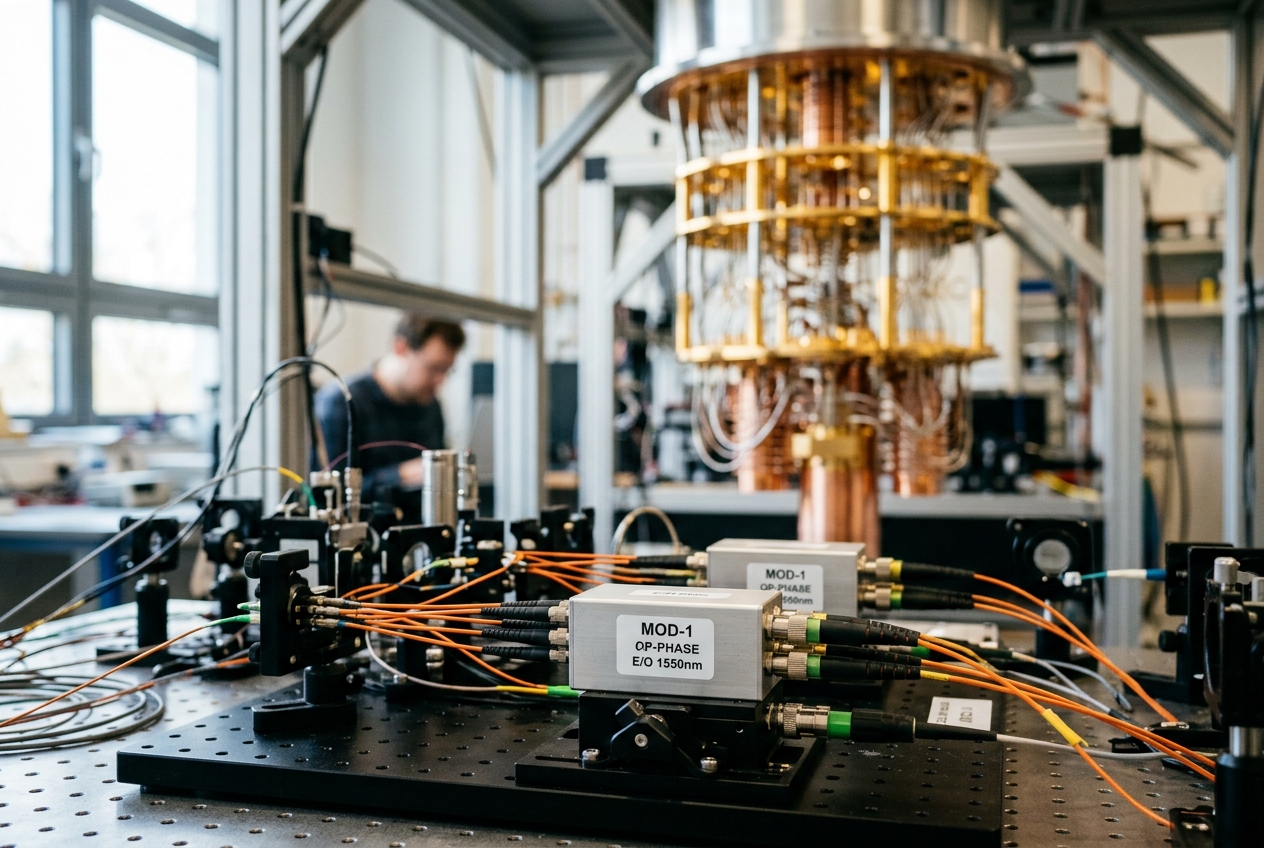
Yet this cryptographic vulnerability represents only half of the looming quantum disruption. As commercial quantum processors advance from laboratory curiosities toward commercial utility, a profound architectural challenge emerges. Quantum computers will not sit on our desks or fit inside our smartphones. They require millikelvin dilution refrigerators, ultra-high-vacuum chambers, and complex arrays of control lasers and microwave synthesizers. For the foreseeable future, nearly all quantum computation will be accessed through central cloud servers managed by a handful of technology giants.
+-------------------------------------------------------------------------+
|                        THE DELEGATION DILEMMA                           |
|                                                                         |
|   Client (Sensitive Data) -------------> Untrusted Cloud Server         |
|   [Unencrypted Qubits]                   [Full Visibility into State]   |
|                                                                         |
|   RESULT: Proprietary molecular designs, financial models, and genome   |
|   sequences are exposed to the server administrator.                    |
+-------------------------------------------------------------------------+
This dynamic introduces a severe delegation dilemma. If an energy company wishes to simulate a proprietary catalyst on a cloud-based quantum processor, or if a pharmaceutical firm seeks to model a patented molecular binding site, it must transmit the raw quantum state directly to the server. Under standard operating protocols, the cloud host possesses unrestricted visibility into the quantum memory registers. The host can observe every gate operation, read out intermediate states, and reverse-engineer the client's most valuable intellectual property.
To resolve this vulnerability, physicists and computer scientists have developed Quantum Homomorphic Encryption (QHE). QHE is a cryptographic framework that allows an untrusted server to execute arbitrary quantum circuits directly on fully encrypted qubits. The server manipulates the quantum data blindly, producing an encrypted output that only the client can decrypt, without ever discovering the input data, the underlying algorithm, or the final result.
The Idea in Plain English
To understand homomorphic processing, consider an analogy introduced by cryptographic pioneers: the locked glovebox.
Imagine you possess a quantity of raw gold and precious gemstones that you wish an artisan jeweler to craft into an intricate ring. You do not trust the jeweler not to pocket the precious stones or skim gold dust from the workbench. To protect your property, you place the raw materials inside a transparent, impenetrable strongbox, secure it with your private padlock, and hand the locked box to the artisan.
+-------------------------------------------------------------------------+
|                  THE HOMOMORPHIC GLOVEBOX ANALOGY                       |
|                                                                         |
|      +-----------------------------------------------------------+      |
|      |  [ Locked Strongbox ]                                     |      |
|      |                                                           |      |
|      |    Raw Materials --------(Jeweler via Gloves)------> Ring |      |
|      |    (Encrypted Input)     (Blind Gate Processing)     (Enc.|      |
|      |                                                      Res.)|      |
|      +-----------------------------------------------------------+      |
|             ^                                              |            |
|             |                                              v            |
|     Client Locks Box                              Client Unlocks Box    |
|     (Private Key Encrypt)                         (Private Key Decrypt) |
+-------------------------------------------------------------------------+
The strongbox is equipped with a pair of flexible, heavy-duty rubber gloves extending into its interior. Using these gloves, the jeweler can reach inside, operate tiny mechanical tools, melt the gold with an internal induction heater, and assemble the ring. Throughout the entire fabrication process, the materials remain sealed within the box. The jeweler cannot extract any gold, nor can they alter the contents with external contaminants. Once the work is complete, the jeweler returns the still-locked strongbox to you. You use your private key to open the padlock, retrieving your finished ring.
In the domain of computation, homomorphism describes this exact structural property. A mathematical map is homomorphic when performing an algebraic operation on encrypted data produces a result whose decryption matches the result of performing that same operation on the original unencrypted data.
In classical computing, fully homomorphic encryption was long regarded as an unattainable holy grail until Craig Gentry constructed the first viable lattice-based framework in 2009. In the quantum realm, the challenge is fundamentally magnified by the laws of quantum physics:
- Superposition: A classical bit is a simple switch, resting definitively at 0 or 1. A qubit (quantum bit) behaves like a coin spinning in mid-air, maintaining a continuous weighting of both heads and tails simultaneously until an observation forces it to land.
- The No-Cloning Theorem: In classical computing, an untrusted server can duplicate encrypted bits to facilitate complex error handling and signal recovery. In quantum mechanics, the No-Cloning Theorem establishes that an arbitrary, unknown quantum state cannot be copied. Encryption schemes cannot rely on backup copies or classical redundancy.
- Measurement Collapse: If the untrusted server attempts to inspect the encrypted qubit during processing, the act of quantum measurement irrecoverably collapses the superposition, destroying the computation and alerting the client to the intrusion.
Quantum Homomorphic Encryption achieves the equivalent of the locked glovebox for these fragile spinning quantum states, allowing servers to execute arbitrary quantum logic gates on scrambled states without triggering wavefunction collapse.
How It Actually Works — The Mechanics
To establish privacy-preserving computation, the client must first blind their quantum data before sending it to the cloud. This blinding relies on the Quantum One-Time Pad (QOTP), an information-theoretically secure quantum generalization of the classical one-time pad.
+-------------------------------------------------------------------------+
|                    THE QUANTUM ONE-TIME PAD (QOTP)                      |
|                                                                         |
|   Plaintext Qubit (|ψ⟩) ---> [ Apply X^a ] ---> [ Apply Z^b ]           |
|                                     |                |                  |
|                               Classical Key    Classical Key            |
|                                  Bit (a)          Bit (b)               |
|                                                                         |
|   Scrambled Ciphertext: Maximum Entropy State (Uniform Quantum Noise)   |
+-------------------------------------------------------------------------+
1. The Quantum One-Time Pad
A classical one-time pad encrypts a bit by combining it with a random key bit using an exclusive-OR (XOR) operation. To encrypt an arbitrary single-qubit state, the client must account for two distinct degrees of freedom: bit flips and phase shifts.
The client generates two uniformly random classical bits, denoted as $a$ and $b$. The bit $a$ controls the application of the Pauli-$X$ operator, which flips the amplitudes of the state (turning $|0\rangle$ into $|1\rangle$ and vice versa). The bit $b$ controls the application of the Pauli-$Z$ operator, which shifts the relative phase between $|0\rangle$ and $|1\rangle$ by 180 degrees ($\pi$ radians).
The encryption of an input quantum density state $\rho$ is governed by the following transformation:
$$\mathcal{E}_{a,b}(\rho) = X^a Z^b \rho Z^b X^a \quad \text{where } a, b \in {0,1}$$
Equation 1: The Quantum One-Time Pad encryption formula. It calculates the completely scrambled quantum state by applying bit-flip operator $X$ raised to key bit $a$, and phase-flip operator $Z$ raised to key bit $b$. To any observer lacking keys $a$ and $b$, the resulting density matrix is mathematically identical to maximally mixed, uniform quantum noise.
If the key bits $a$ and $b$ are chosen with true randomness and kept secret, the encrypted state reveals precisely zero information to the cloud server.
2. Clifford Gate Propagation and Key Updating
Once the server receives the encrypted qubits, it must manipulate them according to the client's requested algorithm. A universal quantum computer executes programs by decomposing them into a sequence of discrete quantum logic gates.
The primary building blocks of quantum circuits belong to the Clifford group, which includes three foundational operations: - The Hadamard Gate ($H$), which creates equal superpositions by rotating basis states into orthogonal superpositions. - The Phase Gate ($P$ or $S$), which introduces a 90-degree ($\pi/2$) phase rotation between $|0\rangle$ and $|1\rangle$. - The Controlled-NOT Gate ($\text{CNOT}$), an entangling operation that flips a target qubit if and only if a control qubit is in the state $|1\rangle$.
When the server applies a Clifford gate to a QOTP-encrypted qubit, the gate interacts with the Pauli encryption masks ($X^a Z^b$). Because Clifford operations map the Pauli group onto itself under conjugation, the gate moves through the encryption operators deterministically.
+-------------------------------------------------------------------------+
|                  CLIFFORD GATE COMMUTATION MECHANISM                    |
|                                                                         |
|   Server Operation:                                                     |
|   Encrypted State ---> [ Apply Gate H ] ---> Transformed Encrypted State|
|                                                                         |
|   Algebraic Consequence:                                                |
|   H · (X^a Z^b |ψ⟩)  =======>  (X^b Z^a) · (H |ψ⟩)                      |
|                                                                         |
|   Client Tracking:                                                      |
|   New Keys: a' = b,  b' = a   (Updated entirely on client laptop)       |
+-------------------------------------------------------------------------+
Consider the action of a Hadamard gate applied to an encrypted state. The algebraic commutation relation between the Hadamard gate and the Pauli operators is exact:
$$H (X^a Z^b) = (X^b Z^a) H$$
Equation 2: The Clifford commutation relation for the Hadamard gate. This equation shows that pushing a Hadamard gate past the Pauli encryption masks swaps the roles of the bit-flip key $a$ and the phase-flip key $b$. The gate acts directly on the underlying plaintext state, while the encryption wrapper is preserved in a modified, deterministic form.
The server applies the physical gate $H$ directly to the ciphertext without communicating with the client. Meanwhile, the client tracks the transformation classically. The client updates their private encryption keys according to simple deterministic rules: the new bit-flip key becomes $a' = b$, and the new phase-flip key becomes $b' = a$.
Similarly, for the two-qubit $\text{CNOT}$ gate acting on control qubit $1$ and target qubit $2$, the bit-flip mask on the control propagates to the target ($a_2' = a_2 \oplus a_1$), while the phase-flip mask on the target propagates backward to the control ($b_1' = b_1 \oplus b_2$).
At no point does the server learn the keys, nor does the client need to transmit corrections during the execution of Clifford circuits.
+-------------------------------------------------------------------------+
|                    CLIFFORD KEY PROPAGATION SUMMARY                     |
|                                                                         |
|   Gate Applied by Server   | Old Keys (a, b)     | New Keys (a', b')   |
|   -------------------------+---------------------+---------------------|
|   Hadamard (H)             | (a, b)              | (b, a)              |
|   Phase (P)                | (a, b)              | (a, b ⊕ a)          |
|   CNOT (Control 1, Target 2)| (a1, b1), (a2, b2)  | a1' = a1,           |
|                            |                     | b1' = b1 ⊕ b2,      |
|                            |                     | a2' = a2 ⊕ a1,      |
|                            |                     | b2' = b2            |
+-------------------------------------------------------------------------+
3. The Non-Clifford Bottleneck: The T-Gate Crisis
Clifford gates alone cannot support universal quantum computation; by the Gottesman-Knill theorem, circuits consisting solely of Clifford operations can be simulated efficiently on a classical computer. To unlock quantum advantage, the circuit must include at least one non-Clifford gate, typically the $T$-gate (a $\pi/4$ axial phase rotation: $T = \text{diag}(1, e^{i\pi/4})$).
When the server attempts to apply a $T$-gate to a QOTP-encrypted qubit, the algebraic harmony breaks down. Pushing a $T$-gate past a Pauli-$Z$ operator causes no disruption because both matrices are diagonal in the computational basis ($T Z^b = Z^b T$). However, pushing a $T$-gate past a Pauli-$X$ operator alters the rotation angle:
$$T (X^a Z^b) = (X^a Z^{a \oplus b} P^a) T$$
Equation 3: The non-Clifford phase shift generated by the T-gate. This formula shows that when a T-gate is pushed through a bit-flip mask $X^a$, it generates an unwanted phase correction gate $P$ raised to the power of the secret key bit $a$.
+-------------------------------------------------------------------------+
|                        THE T-GATE PHASE DILEMMA                         |
|                                                                         |
|   If secret key a = 0  ===>  T · (X^0 Z^b |ψ⟩) = Z^b · (T |ψ⟩)          |
|                              No phase error generated!                  |
|                                                                         |
|   If secret key a = 1  ===>  T · (X^1 Z^b |ψ⟩) = (X Z^(1⊕b) P) · (T |ψ⟩)|
|                              Unwanted P-gate error injected!            |
|                                                                         |
|   THE PROBLEM: The server cannot apply P^(-1) to fix the state          |
|   without knowing whether a = 1, which would break data privacy.        |
+-------------------------------------------------------------------------+
If $a = 0$, the $T$-gate passes through cleanly. But if $a = 1$, an unwanted phase gate ($P$) is injected directly into the active computation. The server cannot remove this phase error on its own because doing so requires knowing whether $a$ equals $0$ or $1$. If the client reveals $a$ to the server, the encryption is compromised. If the error remains uncorrected, all subsequent quantum interference patterns are corrupted.
4. Resolving the Bottleneck: Evaluation Gadgets and Dual-Layer LWE
To resolve this phase dilemma, modern QHE protocols use two primary architectural frameworks:
+-------------------------------------------------------------------------+
|                  RESOLVING THE NON-CLIFFORD BOTTLENECK                  |
|                                                                         |
|   Approach A: Broadbent-Jeffery (BJ15) / Auxiliary Gadgets              |
|   - Client prepares encrypted auxiliary "magic states" before run.      |
|   - Server consumes one gadget per T-gate to absorb phase error.        |
|   - Limitation: Circuit depth bounded by number of pre-loaded gadgets.  |
|                                                                         |
|   Approach B: Dulek-Schaffner-Speelman (DSS16) / Classical LWE Hybrid   |
|   - Client encrypts classical QOTP keys under Learning with Errors (LWE)|
|   - Server evaluates key updates homomorphically via classical circuits.|
|   - Result: Fully Homomorphic Quantum Encryption for arbitrary circuits.|
+-------------------------------------------------------------------------+
- Auxiliary Evaluation Gadgets (Broadbent-Jeffery, BJ15): In the protocol formulated by Anne Broadbent and Stacey Jeffery, the client generates specialized auxiliary quantum states (encrypted ancilla qubits or "evaluation gadgets") during the initialization phase. When the server encounters a $T$-gate, it entangles the data qubit with an auxiliary gadget and executes a designated measurement. This operation teleports the phase error into the gadget, neutralizing the corruption without revealing the underlying key bit $a$.
- Classical Learning with Errors Integration (Dulek-Schaffner-Speelman, DSS16): In the landmark DSS16 scheme, quantum encryption is integrated with classical lattice-based cryptography, specifically the Learning with Errors (LWE) problem. The client encrypts the classical QOTP keys ($a$ and $b$) using a classical fully homomorphic encryption scheme before delegating the job. When a $T$-gate injects a conditional $P^a$ error, the server uses the classical homomorphic engine to compute the required quantum gate corrections blindly, achieving fully homomorphic quantum computation for arbitrary circuit depths.
5. Compact QHE vs. Blind Quantum Computing
It is important to distinguish Quantum Homomorphic Encryption from interactive Blind Quantum Computing (BQC), such as the Broadbent-Fitzsimons-Kashefi (BFK) protocol based on Measurement-Based Quantum Computing.
+-------------------------------------------------------------------------+
|             COMPACT QHE  vs.  BLIND QUANTUM COMPUTING (BQC)             |
|                                                                         |
|   Metric                  | Blind Quantum Computing | Compact QHE       |
|   ------------------------+-------------------------+-------------------|
|   Interactivity           | High (Round-by-round)   | Zero (Non-inter.) |
|   Network Latency Impact  | Catastrophic over dist. | Negligible        |
|   Client Quantum Hardware | Requires single-photon  | Completely        |
|   Requirements            | source / emitter        | classical after tx|
|   Server Execution Mode   | Locked to client clock  | Fully autonomous  |
+-------------------------------------------------------------------------+
In interactive BQC, the client must remain continuously online, exchanging classical measurement angles and feedback instructions with the server for every single layer of the quantum circuit. Over long-distance fiber networks, the physical speed of light introduces latency bottlenecks that can exceed the coherence times of the server's qubits, causing the quantum memory to decohere while waiting for the next classical instruction.
Compact QHE is non-interactive. The client uploads the encrypted dataset and circuit description in a single transmission. The server executes the entire algorithm autonomously and returns the encrypted result. The client decrypts the payload locally using their classical key register.
Real-World Applications Today
Between 2024 and 2026, the transition from theoretical QHE protocols to experimental implementations accelerated across several high-consequence industries.
+-------------------------------------------------------------------------+
|                   FRONTIERS OF QHE DEPLOYMENT (2024-2026)               |
|                                                                         |
|   1. PHARMACEUTICALS: Proprietary oncology drug binding simulations.    |
|   2. FINANCE: Arbitrage optimization across encrypted trade ledgers.    |
|   3. DEFENSE: Autonomous satellite routing and radar cross-sections.    |
|   4. GENOMICS: Privacy-preserving quantum machine learning on DNA.      |
+-------------------------------------------------------------------------+
1. Biopharmaceutical Molecular Modeling & Drug Discovery
- Institutions: Collaborations involving research groups at Nature, European pharmaceutical consortia, and cloud access providers such as IBM Quantum.
- Objective: Simulating the electronic ground states and binding affinities of complex macrocyclic compounds for targeted oncology therapies.
- Quantum Advantage in Plain Language: Modeling the electron correlation in transition-metal enzyme complexes is intractable for classical supercomputers due to the exponential growth of quantum state spaces. By executing Variational Quantum Eigensolver (VQE) algorithms over QHE-encrypted cloud instances, pharmaceutical enterprises can compute precise molecular ground states on remote multi-qubit systems without exposing proprietary chemical structures or patented active pharmaceutical ingredients to the cloud vendor.
2. Quantitative Finance and Arbitrage Optimization
- Institutions: Leading financial institutions partnering with quantum software developers and research initiatives indexed on arXiv Quantum Physics.
- Objective: Solving large-scale quadratic unconstrained binary optimization (QUBO) problems for real-time global asset pricing, dynamic portfolio risk hedging, and settlement clearing.
- Quantum Advantage in Plain Language: Quantum approximate optimization algorithms (QAOA) process combinatorial possibilities across thousands of financial assets concurrently. Financial institutions are legally barred from uploading unencrypted transaction logs, institutional balances, or proprietary trading signals to third-party cloud environments. QHE allows financial firms to offload intense risk-matrix optimizations to cloud quantum processors while ensuring client accounts and proprietary trading strategies remain mathematically obscured.
3. Aerospace Defense and Classified Logistics
- Institutions: Defense research agencies in conjunction with academic laboratories publishing in Physical Review Letters.
- Objective: Optimizing real-time satellite constellation routing, synthetic aperture radar (SAR) phase-matching, and secure multi-party supply-chain scheduling under adversarial conditions.
- Quantum Advantage in Plain Language: Aerospace logistics optimization involves massive graph-partitioning problems that can be accelerated using quantum annealing and fault-tolerant Grover-based search routines. Using QHE, defense personnel can submit classified operational flight paths and mission parameters to commercial quantum server farms. Even if the server infrastructure is physically compromised or monitored by foreign adversaries, the underlying mission data remains unreadable.
4. Genomic Privacy and Quantum Machine Learning (QML)
- Institutions: Medical genomics institutes and enterprise quantum AI research teams.
- Objective: Training quantum neural networks and quantum support vector machines on multi-patient whole-genome sequencing datasets to detect rare polygenic disease markers.
- Quantum Advantage in Plain Language: Quantum kernels can map high-dimensional genomic features into quantum state spaces that reveal non-linear genetic correlations invisible to classical classifiers. Strict healthcare privacy mandates (such as HIPAA and GDPR) prohibit the unencrypted processing of identifiable patient genomes on remote servers. QHE allows hospitals to pool encrypted patient genomes into a unified cloud quantum training pipeline, unlocking diagnostic breakthroughs while mathematically guaranteeing absolute patient anonymity.
What This Means for You
For the non-physicist, the emergence of Quantum Homomorphic Encryption represents a pivotal development in the governance of digital sovereignty and personal privacy.
We are living through an era in which the centralization of computing power has systematically eroded personal data control. To use modern digital services—from search engines and social networks to automated medical diagnostic tools—we routinely surrender our raw, unencrypted data to remote corporate server architectures. We trust corporate privacy policies and regulatory fines to keep that data safe, but technical access to raw data remains open to system administrators, insider threats, and foreign intelligence compromises.
+-------------------------------------------------------------------------+
|                       THE PRIVACY PARADIGM SHIFT                        |
|                                                                         |
|   OLD PARADIGM (Classical Cloud Computing):                             |
|   "We promise not to look at your data while we compute on it."         |
|   (Enforced by legal contracts, compliance audits, and corporate trust) |
|                                                                         |
|   NEW PARADIGM (Quantum Homomorphic Encryption):                        |
|   "We cannot look at your data even if we try; the laws of physics      |
|   and mathematics prevent us from reading the memory registers."        |
|   (Enforced by the Quantum One-Time Pad and algebraic group theory)     |
+-------------------------------------------------------------------------+
The arrival of the quantum era could easily have accelerated this loss of control, concentrating unprecedented computational power inside proprietary server farms that demand full visibility into your secrets.
Quantum Homomorphic Encryption inverts this paradigm. It establishes a computational model where privacy is enforced not by human compliance or legal contracts, but by the fundamental laws of quantum mechanics and algebraic group theory.
When your future healthcare provider uses a cloud-based quantum supercomputer to screen your entire genome for personalized cancer immunotherapies, QHE is the mathematical guarantee that your intimate biological blueprint is never exposed to the cloud operator. The server processes your biological data, identifies the therapeutic compound, and returns the encrypted result. The host infrastructure learns nothing about your health, your identity, or your genetic sequence.
Today's Takeaway
===========================================================================
                            THE CORE PRINCIPLE
===========================================================================
Quantum Homomorphic Encryption bridges the gap between massive cloud-based
computing power and absolute privacy. By shielding quantum states within a
Quantum One-Time Pad and propagating algebraic logic gates blindly through
Clifford commutation and lattice-based evaluation gadgets, QHE enables
untrusted supercomputers to process your most sensitive data without ever
observing what they are calculating.
===========================================================================
Authoritative References & Further Reading
For researchers, students, and engineers seeking deeper technical formulations, refer to the following resources:
- MIT OpenCourseWare: Quantum Optical Systems and Information Theory — Foundational lectures on density matrices, operator algebra, and the Quantum One-Time Pad.
- IBM Quantum Documentation: Qiskit Developer Framework and Gate Identities — Tutorials on Clifford group decomposition, Pauli commutation, and quantum circuit synthesis.
- Nature: Peer-reviewed research articles on quantum information processing and blind delegation — Landmark publications covering experimental demonstrations of delegated quantum computing.
- Wikipedia: Quantum Homomorphic Encryption — Comprehensive overview of the historical evolution from BJ15 to DSS16 protocols.
- arXiv Quantum Physics Repository: Quant-Ph Preprints on Homomorphic Delegation — Technical preprints covering fault-tolerant gadget optimization and non-Clifford key update schemes.
- Physical Review Letters: Fundamental studies on quantum measurement and cryptographic bounds — Foundational research on the physical limits of non-interactive quantum cryptography.