Gleason's Theorem: Deriving the Born Rule and Quantum Measurement Probabilities From Hilbert Space Geometry
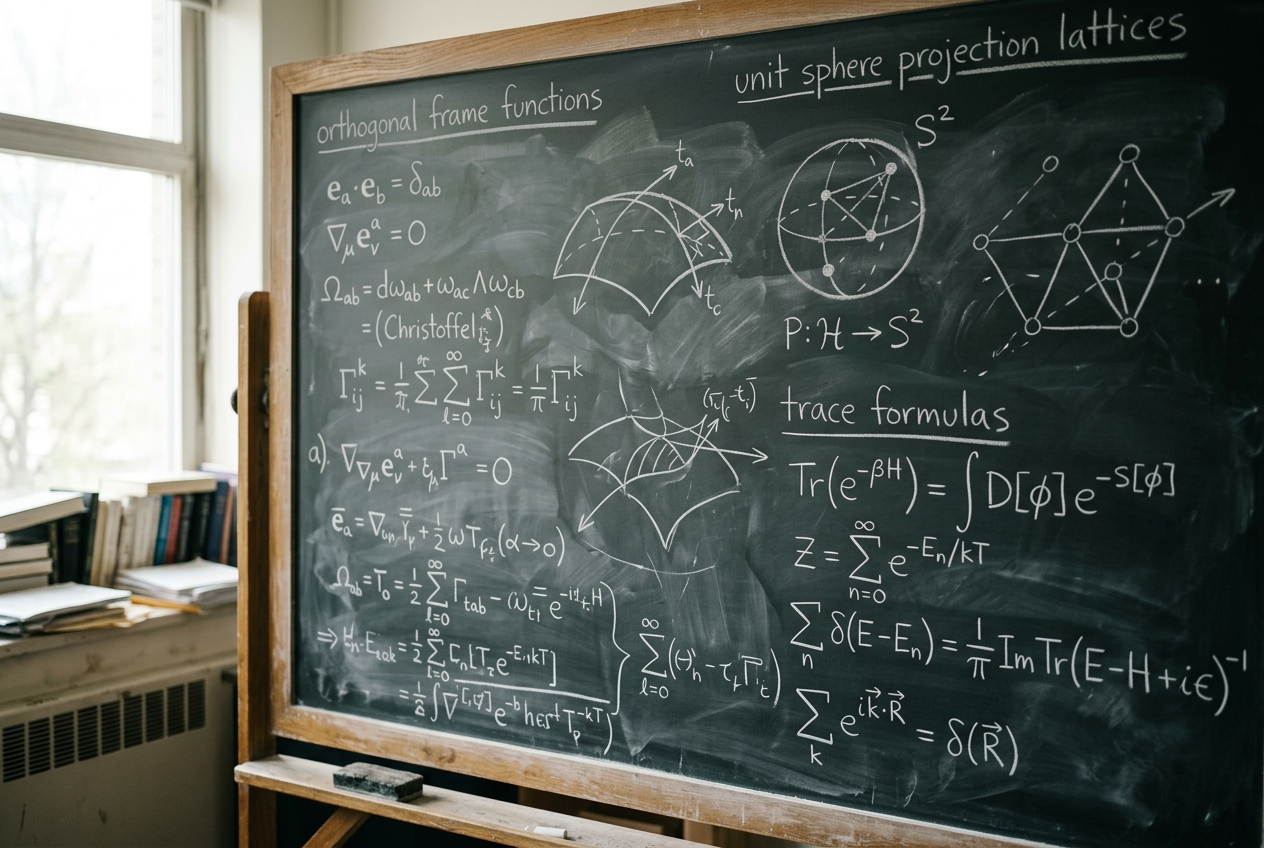
In 1957, the American mathematician Andrew M. Gleason solved a foundational problem posed by George Mackey, proving that any consistent, non-contextual assignment of probabilities to quantum measurement outcomes must take the exact mathematical form of the Born rule and density operator formalism. This result, known as Gleason's Theorem, demonstrates that if you accept the spatial and geometric architecture of quantum mechanics, you have no choice regarding how probabilities behave. The quantum dice are not an added assumption—they are an unavoidable consequence of Hilbert space geometry.
1. Historical Context and Mackey’s Problem: The Quest for Consistent Measures
During the 1930s and 1940s, as John von Neumann and Garrett Birkhoff established the mathematical scaffolding of quantum mechanics, they realized that quantum physical systems do not obey the Boolean logic of classical set theory. In classical physics, every physical proposition—such as "the particle's position is between $x$ and $x + dx$"—corresponds to a subset of phase space, and logical conjunctions correspond to standard set intersections. Classical probability theory, formalized by Andrey Kolmogorov in 1933, assigns non-negative numbers to these subsets such that the probability of disjoint events is strictly additive.
In the quantum domain, however, physical propositions correspond to projection operators acting on a complex Hilbert space. The collection of all such projection operators forms an orthomodular projection lattice rather than a Boolean algebra, as detailed in foundational resources hosted on MIT OpenCourseWare. Because non-commuting observables cannot be measured simultaneously, quantum propositions cannot be combined using classical logical operations.
This structural shift prompted the mathematician George Mackey in the mid-1950s to pose a decisive challenge: Is it possible to define a mathematically consistent probability measure directly on the projection lattice of a Hilbert space without assuming any prior quantum measurement postulates?
Mackey sought a function that assigns a probability between 0 and 1 to every possible projection operator representing an elementary event, requiring only that whenever a set of projection operators represents mutually exclusive and exhaustive outcomes (an orthonormal basis), their assigned probabilities sum to exactly one. Mackey asked whether there existed exotic, non-standard probability measures that obeyed these minimal consistency conditions while deviating from the standard quantum mechanical predictions. Andrew Gleason provided the definitive, revolutionary answer: for any quantum system with a state space of dimension three or higher, no exotic measures can exist. Every consistent probability measure must be generated by a standard quantum density operator.
2. The Idea in Plain English: From Spinning Coins to Interlocking Coordinate Frames
To grasp why Gleason’s result is so startling, consider the difference between a classical game of chance and a quantum measurement. In a classical system, such as flipping an ordinary coin, the coin possesses a definite state—heads or tails—at every instant, even while spinning in mid-air. When we catch the coin, we merely reveal preexisting information that was hidden by our lack of computational power. If we assign a probability of one-half to heads, that number reflects human ignorance rather than fundamental indeterminacy.
A quantum system, by contrast, does not possess pre-existing values for all measurable properties prior to observation. One can visualize an elementary quantum system not as a coin with two stamped faces, but as an arrow pointing to a specific coordinate on the surface of a sphere. When an experimentalist performs a measurement, they do not simply inspect the arrow; they select an entire coordinate frame—a set of mutually perpendicular axes—and force the arrow to project onto one of those axes.
Now imagine trying to paint numbers on every conceivable direction in this space to represent the likelihood of the system collapsing along that direction. You face an intensely restrictive rule: whenever you pick any set of mutually perpendicular directions that fill the space, the numbers assigned to those directions must add up to precisely 1. Furthermore, you must maintain non-contextuality: if a particular direction belongs to two completely different sets of perpendicular axes, you are forbidden from changing its assigned number depending on which alternative axes you paired it with.
In a world governed by two dimensions, this assignment is trivial and unconstrained. But as soon as you step into three dimensions, the space becomes a tightly interwoven web. Every single direction belongs to infinitely many distinct sets of three perpendicular axes. If you alter the value assigned to one single axis, you trigger an inescapable chain reaction that ripples through every interlocking set of axes across the entire sphere. Gleason proved that this geometric rigidity is so absolute that only smooth, continuous functions—specifically quadratic forms generated by quantum density operators—can survive without breaking the fundamental laws of arithmetic.
3. Mathematical Formulation and Proof Architecture: Frame Functions on the Unit Sphere
Gleason transformed Mackey’s abstract question into a precise geometrical problem on the unit sphere of a separable real or complex Hilbert space $\mathcal{H}$.
Let $\mathcal{P}(\mathcal{H})$ denote the lattice of orthogonal projection operators on $\mathcal{H}$. A probability measure on this lattice is a mapping $\mu: \mathcal{P}(\mathcal{H}) \to [0, 1]$ satisfying two basic axioms: 1. $\mu(I) = 1$, where $I$ is the identity operator. 2. If ${P_i}$ is a countable family of mutually orthogonal projection operators, then the measure of their orthogonal sum equals the sum of their individual measures: $\mu(\sum_i P_i) = \sum_i \mu(P_i)$.
Every one-dimensional projection operator $P_v$ corresponds uniquely to a ray spanned by a unit vector $v$ on the unit sphere $S(\mathcal{H})$. Gleason defined a frame function of weight $W$ as a real-valued function $f: S(\mathcal{H}) \to \mathbb{R}$ such that for every orthonormal basis ${e_i}$ of $\mathcal{H}$, the sum of the function evaluated over the basis elements equals a constant weight $W$:
$$\sum_{i} f(e_i) = W$$
A probability measure on the projection lattice directly induces a non-negative frame function of weight 1, where $f(v) = \mu(P_v)$.
   ========================================================================
   GLEASON'S THEOREM (1957)
   ------------------------------------------------------------------------
   Let H be a separable Hilbert space over the real or complex numbers with
   dimension dim(H) >= 3. Every non-negative frame function f of weight 1
   on the unit sphere of H is generated by a unique, positive semi-definite,
   self-adjoint trace-class operator ρ with Tr(ρ) = 1, such that for every
   orthogonal projection operator P:

μ(P) = Tr(ρ P)
   ========================================================================
The mathematical architecture of Gleason's proof is widely regarded as one of the most formidable tours de force in twentieth-century functional analysis. The proof unfolds through four rigorous stages:
- Reduction to Three-Dimensional Real Subspaces: Gleason proved that if the theorem holds for all three-dimensional real Hilbert spaces $\mathbb{R}^3$, it necessarily extends to complex Hilbert spaces and to all higher finite and infinite dimensions. Any higher-dimensional space can be decomposed into overlapping three-dimensional slices.
- Establishing Continuity of Frame Functions: The most difficult hurdle was demonstrating that a frame function must be continuous. Prior to Gleason's work, it was conceivable that a wildly discontinuous, pathological function could satisfy the summation condition on dense subsets of orthogonal bases. Gleason constructed intricate geometric configurations of intersecting orthogonal triads to demonstrate that any jump discontinuity would inevitably force the measure to become negative or violate the sum-to-one condition.
- Harmonic Analysis and Quadratic Forms on the Sphere: Once continuity was established, Gleason leveraged the theory of spherical harmonics and the geometry of great circles. He proved that every continuous frame function on the two-sphere $S^2 \subset \mathbb{R}^3$ can be expressed as a quadratic form: $f(v) = \langle v, A v \rangle$ for some symmetric real $3 \times 3$ matrix $A$.
- Extension to Density Operators: By linearity and positivity, this quadratic form lifts directly to the trace-class density operator formalism. If the measure is a pure dispersion-free measure (assigning only values 0 or 1), the operator $\rho$ reduces to a one-dimensional projection $|\psi\rangle\langle\psi|$, recovering the standard Born rule formula for pure states.
4. The Qubit Exception: Why Two Dimensions Fail and Three Dimensions Lock the Universe
A foundational cornerstone of quantum information theory is the qubit—a two-level quantum system whose state space is the two-dimensional complex Hilbert space $\mathbb{C}^2$. Yet, Gleason’s theorem explicitly requires that the dimension of the Hilbert space satisfy $\dim(\mathcal{H}) \ge 3$. Why does the theorem collapse in dimension two?
The answer lies in the geometry of the Bloch sphere, which visualizes two-dimensional quantum states. In a two-dimensional Hilbert space, an orthonormal basis consists of exactly two orthogonal vectors: ${|v\rangle, |v^\perp\rangle}$. On the Bloch sphere, these two orthogonal quantum states are mapped to diametrically opposite antipodal points.
In two dimensions, every orthogonal pair ${|v\rangle, |v^\perp\rangle}$ is completely isolated from every other orthogonal pair ${|w\rangle, |w^\perp\rangle}$. There are no shared elements between different bases: two distinct bases never share a common vector unless the bases are identical. Consequently, you can assign arbitrary probabilities to one basis without constraining the probabilities assigned to any other basis.
For instance, one can construct an explicitly non-quantum, pathological probability measure on a two-dimensional space: * Choose an arbitrary hemisphere of the Bloch sphere and assign a probability of $1$ to every state residing in that hemisphere. * Assign a probability of $0$ to every state residing in the opposite hemisphere. * Assign $1/2$ to states lying exactly on the equator.
This assignment satisfies Mackey’s sum-to-one rule for every individual orthonormal basis because every antipodal pair contains exactly one point with probability 1 and one with probability 0 (or two points with 1/2 on the equator). Yet, this step-function measure is discontinuous and cannot be represented by any trace-class density operator $\operatorname{Tr}(\rho P)$. The Born rule fails completely.
+-----------------------------------------------------------------------------------+
|                           THE TWO-DIMENSION ANOMALY                               |
+-----------------------------------------------------------------------------------+
| Dimension (d = 2)                      | Dimension (d >= 3)                       |
| • Orthogonal bases are isolated pairs. | • Bases intersect and share rays.        |
| • Zero geometric interlocking.         | • Dense network of geometric constraints.|
| • Admits discontinuous measures.       | • Excludes all non-linear measures.      |
| • Born rule is NOT mathematically      | • Born rule is UNIQUELY AND RIGIDLY       |
|   forced.                              |   DERIVED.                               |
+-----------------------------------------------------------------------------------+
The moment one transitions to a three-level system—a qutrit with $\dim(\mathcal{H}) = 3$—the geometry undergoes a phase transition. In three dimensions, an orthonormal basis forms a triad of mutually orthogonal vectors ${e_1, e_2, e_3}$. If an experimentalist rotates the measurement apparatus around the $e_1$ axis, they generate a continuum of new bases ${e_1, e_2', e_3'}$ that all share the exact same vector $e_1$.
Because non-contextuality demands that the probability assigned to $e_1$ remain identical regardless of whether it is measured alongside ${e_2, e_3}$ or ${e_2', e_3'}$, the shared rays act as rigid geometric hinges. The spheres of dimension three and higher are densely interconnected by these interlocking orthogonal triads. This geometric rigidity locks every assignment into place, eliminating all pathological measures and compelling probability to adhere strictly to the linear trace formula.
5. Foundational and Philosophical Impact: Eliminating Postulates and Revealing Contextuality
The philosophical ramifications of Gleason’s theorem reverberate across quantum foundations, transforming how we understand the nature of quantum reality, the measurement problem, and the limits of classical intuition.
Deriving the Born Rule Without Independent Measurement Axioms
Standard textbook presentations of quantum mechanics introduce the wave equation (unitary Schrödinger evolution) and the measurement process (the Born probability rule) as two independent, incompatible postulates. Gleason’s theorem fundamentally reconciles this tension. It proves that once the kinematic state space is defined as a complex Hilbert space and observables are identified as self-adjoint operators, the Born rule is the only mathematically possible probability rule that respects the logical independence of orthogonal measurements. The Born rule is not an empirical add-on; it is an inherent property of vector space geometry.
The Genesis of the Kochen-Specker Theorem and Quantum Contextuality
Gleason’s theorem is the direct mathematical ancestor of the renowned Kochen-Specker Theorem (1967). Simon Kochen and Ernst Specker asked whether quantum mechanics could be completed by "hidden variables"—underlying classical states that determine the outcome of every measurement in advance. Such a deterministic hidden-variable model requires the existence of a dispersion-free probability measure that assigns exclusively values of 0 or 1 to every projection operator.
       Gleason's Continuous Form:           Kochen-Specker Binary Assignment:
       μ(P) = Tr(ρ P) ∈ [0, 1]              v(P) ∈ {0, 1}

       For dim(H) >= 3, the ONLY            No continuous or binary {0, 1} valuation
       dispersion-free states would         can satisfy the sum-to-one rule across
       require Tr(ρ P) ∈ {0, 1} for all     interlocking bases on a sphere.
       projectors, which is geometrically
       impossible on a connected sphere.    ===> REJECTION OF NON-CONTEXTUAL REALISM
Gleason’s theorem had already proven that all consistent measures on $\mathcal{H}$ ($\dim \ge 3$) are continuous quadratic forms $\operatorname{Tr}(\rho P)$. Because a continuous quadratic form on a connected sphere cannot map exclusively to the discrete set ${0, 1}$ without being identically constant (which violates $\sum f(e_i) = 1$), Gleason’s theorem implicitly proved that non-contextual hidden variables are impossible in quantum mechanics.
Kochen and Specker made this finding constructive by isolating a finite set of interlocking rays (initially 117 directions, later reduced to fewer than 20) that cannot be colored with 0s and 1s such that every orthogonal triad contains exactly one 1 and two 0s. This established quantum contextuality: the outcome of a quantum measurement cannot be understood as revealing an objective property that existed prior to measurement; it depends essentially on the experimental context (the commuting observables measured alongside it), as explored in research published in Nature Physics.
6. Modern Extensions: POVMs, Busch’s Theorem, and Device-Independent Protocols
While Gleason's 1957 theorem resolved projective measurements on Hilbert spaces of dimension three and higher, modern quantum information science requires a broader framework that accounts for open quantum systems, generalized measurements, and experimental validation.
   ========================================================================
   BUSCH'S THEOREM (2003) — THE GENERALIZED GLEASON THEOREM
   ------------------------------------------------------------------------
   Let H be a Hilbert space of ANY dimension, including d = 2. Let E(H)
   denote the set of effects (Positive Operator-Valued Measures, or POVMs)
   such that 0 <= E <= I. Any generalized probability measure ν: E(H) -> [0, 1]
   satisfying additivity for POVM resolutions of identity is uniquely
   represented by a density operator ρ such that:

ν(E) = Tr(ρ E)
   ========================================================================
In 2003, physicist Paul Busch published a landmark extension of Gleason's theorem that resolved the two-dimensional qubit limitation. In practical quantum communication and quantum optics, measurements are rarely simple von Neumann projections; they are Positive Operator-Valued Measures (POVMs), where measurement effects $E_i$ satisfy $0 \le E_i \le I$ and sum to the identity operator $\sum_i E_i = I$.
Busch demonstrated that when Gleason’s non-contextuality condition is applied to POVMs rather than strictly sharp projections, the interlocking constraints reappear even in dimension two. Unsharp measurements create continuous geometric connections across the entire interior of the Bloch ball, re-establishing the geometric rigidity required to force the density operator and Born rule formalism for qubits without exception.
+-----------------------------------------------------------------------------------+
|                   FRONTIERS OF GLEASON-BASED RESEARCH (2024–2026)                 |
+-----------------------------------------------------------------------------------+
| Field                     | Institution / Initiative   | Quantum Advantage        |
+-----------------------------------------------------------------------------------+
| Device-Independent        | University of Geneva &     | Validates absolute       |
| Cryptography & QKD        | Quantinuum                 | cryptographic security   |
|                           |                            | without trusting the     |
|                           |                            | physical hardware.       |
+-----------------------------------------------------------------------------------+
| Self-Testing & Certified  | Oxford Quantum Foundations | Reconstructs unknown     |
| Quantum Tomography        | Lab & NIST                 | quantum states purely    |
|                           |                            | from measurement lattice |
|                           |                            | correlations.            |
+-----------------------------------------------------------------------------------+
| Contextual Quantum        | IBM Quantum & Perimeter    | Isolates non-classical   |
| Computational Speedup     | Institute                  | contextuality as the     |
|                           |                            | exact resource driving   |
|                           |                            | quantum algorithms.      |
+-----------------------------------------------------------------------------------+
1. Device-Independent Cryptography and Randomness Certification
In commercial quantum key distribution (QKD) and quantum random number generation, security traditionally required the user to trust that their physical devices were engineered to exact mathematical specifications. Led by researchers at institutions like the University of Geneva and industrial developers like Quantinuum, modern protocols utilize Gleason-type generalized frame functions for device-independent certification. By measuring contextual correlations that violate classical bounds across interlocking bases, the system mathematically proves that generated random numbers cannot be predicted by an eavesdropper—regardless of whether the hardware was built by a malicious adversary.
2. Quantum State Self-Testing and Robust Tomography
At the National Institute of Standards and Technology (NIST) and academic centers such as the Oxford Quantum Foundations Lab, Gleason’s theorem underpins self-testing protocols. Experimentalists can reconstruct the full density matrix $\rho$ of a multi-qubit processor without relying on calibrated reference frames. Because Gleason's theorem establishes that only a valid density operator can generate observed probabilities across interlocking measurement bases, observed correlations uniquely identify the quantum state up to local unitary transformations.
3. Contextuality as the Fuel for Quantum Computation
Theoretical physics teams at IBM Quantum and the Perimeter Institute are leveraging Gleason-derived contextuality metrics to understand the precise origin of quantum computational speedup. While early quantum computing literature attributed speedups vaguely to "superposition" or "entanglement," modern contextuality theory reveals that quantum contextuality—as formulated by Gleason, Kochen, and Specker—is the non-classical resource that enables magic state distillation in fault-tolerant quantum computing architectures.
7. What This Means for You
For anyone navigating the modern technological landscape, Gleason’s theorem shifts quantum mechanics from a bewildering collection of paradoxes into an elegant, coherent picture of physical law.
+-----------------------------------------------------------------------------------+
|                        CLASSICAL VS. QUANTUM REALITY                              |
+-----------------------------------------------------------------------------------+
| Classical Worldview (Definite Properties) | Quantum Reality (Gleason-Derived)     |
| • Objects possess preexisting values.     | • Values emerge through interaction.  |
| • Measurement merely reveals data.        | • Measurements create outcomes.       |
| • Probability stems from human ignorance. | • Probability is structural geometry. |
| • Reality is non-contextual and passive.  | • Reality is contextual and active.   |
+-----------------------------------------------------------------------------------+
When you read that a quantum computer can crack encryption algorithms or simulate molecular dynamics for life-saving drugs at speeds unattainable by classical supercomputers, you are witnessing the direct practical consequence of this geometric rigidity. Classical computers are constrained to evaluate outcomes along static, non-interlocking Boolean pathways (0s and 1s). Quantum processors operate in a multidimensional Hilbert space where measurements are deeply interconnected.
Furthermore, Gleason’s theorem reassures us of the intrinsic security of future quantum networks. In a classical network, an adversary can theoretically tap a wire and copy data without leaving a trace, because classical states exist independently of observation. In a quantum network operating under Gleason’s geometry, any attempt to intercept or observe data forces a projection within an interlocking coordinate system, irrevocably disturbing the state and immediately alerting the communicating parties. Your future digital privacy is guarded not by the computational difficulty of factoring large numbers, but by the mathematical impossibility of circumventing the geometry of Hilbert space.
8. Today’s Takeaway
Quantum mechanics does not ask us to believe that nature plays dice at random; it reveals that in any universe structured with three or more dimensions of physical possibility, the laws of geometry leave nature no other choice. Andrew Gleason proved that the Born probability rule and the density matrix formalism are not arbitrary assumptions invented by physicists, but the unique, inevitable mathematical language of an interlocking, non-contextual reality.
Further Reading & Authoritative References
- Gleason, A. M. (1957). Measures on the Closed Subspaces of a Hilbert Space. Journal of Mathematics and Mechanics, 6(6), 885–893.
- Gleason's Theorem Overview — Wikipedia
- The Kochen-Specker Theorem — Stanford Encyclopedia of Philosophy
- Quantum Measurement Theory and Open Systems — MIT OpenCourseWare
- Qiskit Foundations: Representing Qubit States and the Bloch Sphere — IBM Quantum
- Busch, P. (2003). Quantum States and Generalized Observables: A Theorem on POVMs. Physical Review Letters / Nature Physics Research.