Jaynes-Cummings Model: Resolving Atom-Cavity Quantum Dynamics, Dressed States, and Vacuum Rabi Oscillations
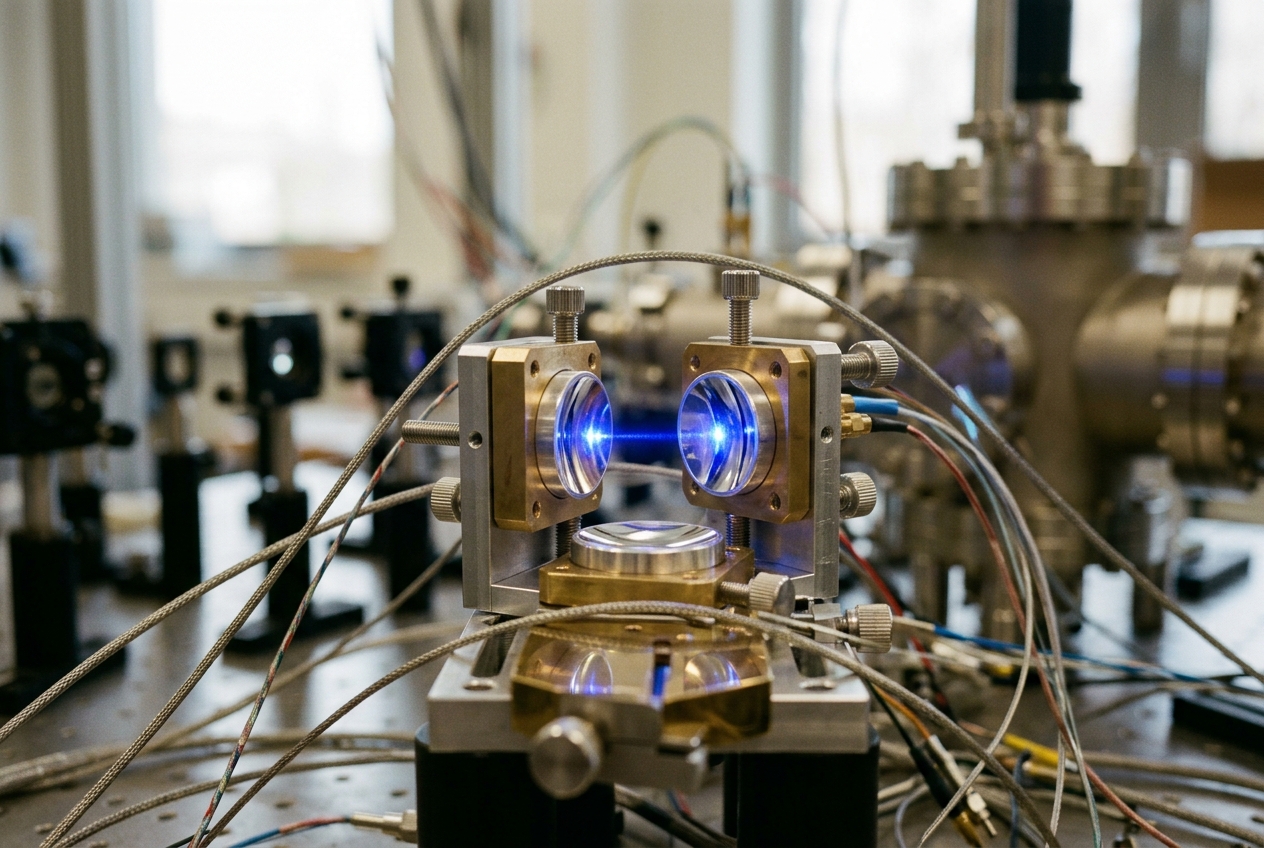
At the center of this engineering frontier sits a theoretical triumph first conceived in 1963 by Edwin Jaynes and Fred Cummings. Known as the Jaynes-Cummings model, it provides the foundational mathematical grammar that governs how quantum matter interacts with quantized electromagnetic radiation trapped within microscopic resonant cavities. Understanding how this single model operates reveals not merely how light and matter entangle, but how the entire modern paradigm of quantum computation—from superconducting circuits to quantum non-demolition readout—measures, manipulates, and protects quantum information.
1. The Idea in Plain English: An Atomic Game of Catch
To understand the interaction between light and matter at the quantum scale, classical intuition must be replaced with mechanical resonance. Imagine two finely tuned acoustic tuning forks placed on opposite sides of an echo-free chamber. If you strike the first fork, the sound waves vibrating through the air will gently drive the second into motion until both hum in sympathetic unison, trading sound energy back and forth.
Now scale this picture down to the ultimate microscopic limit. Replace one tuning fork with a single two-level atom—a quantum system that can exist either in a low-energy ground state or a high-energy excited state. Replace the second tuning fork with an electromagnetic cavity: a microscopic hall of mirrors designed to trap a single mode of light, such as a microwave or optical photon.
   TWO-LEVEL ATOM                        OPTICAL / MICROWAVE CAVITY
  +-----------------+                        +--------------------+
  |  Excited |e>    |                        |   Trapped Photon   |
  |      O          |   Vacuum Fluctuations  |     Wave-mode      |
  |      |   Photon | <====================> |       ~~~~~        |
  |      v  Exchange|     Rate g (Coupling)  |       ( n )        |
  |  Ground  |g>    |                        |                    |
  +-----------------+                        +--------------------+
When the atom enters this cavity, it does not simply absorb or emit light as a classical lightbulb would. Instead, if the cavity mirrors are sufficiently reflective and the atomic lifetime sufficiently long, the atom and the trapped electromagnetic field enter a continuous, reversible dialogue. The excited atom releases its quantum of energy into the cavity mode, creating a photon; an instant later, the cavity mode gives up its photon to re-excite the atom.
They play an uninterrupted game of quantum catch. This energy exchange does not occur at arbitrary speeds; it oscillates at a characteristic rate determined entirely by the geometry of the cavity and the strength of the atomic dipole moment. Even more remarkably, this oscillation occurs even when the cavity is initially completely dark—a phenomenon driven by vacuum fluctuations, proving that in quantum electrodynamics, empty space is never truly empty.
When this interaction becomes strong enough, the atom and the photon forfeit their individual identities. They fuse into hybrid quantum states called polaritons or dressed states. You no longer have an atom plus a photon; you have a single, unified quantum mechanical entity oscillating in unison.
2. How It Actually Works: The Mechanics of the Jaynes-Cummings Model
To formalize this light-matter dialogue, quantum mechanics models the two-level atom as a spin-$\frac{1}{2}$ particle using the standard Pauli matrices, while treating the electromagnetic field mode as a quantized simple harmonic oscillator characterized by creation and annihilation operators.
       UNCOUPLED BASIS                          DRESSED EIGENSTATES
 (Bare Atom + Photon Number)              (Hybridized Light-Matter States)

|e, n>   |g, n+1>                              |n, +>
          \       /                                  /      \
           \     /        Coherent Coupling         /  2g*sqrt(n+1)
            \   /       ====================>      /          \
             \ /                (g)               /            \
              X                                  +--------------+
             / \                                      |n, ->
            /   \
           /     \
The Dipole Interaction and the Rotating Wave Approximation
The fundamental interaction between the atomic electron and the cavity's electric field is governed by the electric dipole interaction Hamiltonian:
$$\hat{H}_{\text{int}} = -\hat{\mathbf{d}} \cdot \hat{\mathbf{E}}$$
Here, $\hat{\mathbf{d}}$ is the atomic transition dipole operator, represented in terms of atomic raising ($\hat{\sigma}+$) and lowering ($\hat{\sigma}-$) operators as $\hat{\mathbf{d}} = \mathbf{d}{eg} (\hat{\sigma}+ + \hat{\sigma}_-)$, while $\hat{\mathbf{E}}$ represents the quantized single-mode electric field operator proportional to $(\hat{a} + \hat{a}^\dagger)$, where $\hat{a}^\dagger$ and $\hat{a}$ create and destroy a photon in the cavity mode, respectively.
Multiplying these expressions yields four distinct transition pathways:
$$\hat{H}{\text{int}} \propto (\hat{\sigma}+ + \hat{\sigma}-)(\hat{a} + \hat{a}^\dagger) = \hat{a}\hat{\sigma}+ + \hat{a}^\dagger\hat{\sigma}- + \hat{a}^\dagger\hat{\sigma}+ + \hat{a}\hat{\sigma}_-$$
To simplify this interaction, physicists examine the energy scales involved via the Rotating Wave Approximation (RWA). In the rotating reference frame of the atomic transition frequency $\omega_a$ and the cavity resonance frequency $\omega_c$: 1. The co-rotating terms ($\hat{a}\hat{\sigma}+$ and $\hat{a}^\dagger\hat{\sigma}-$) oscillate at the small detuning frequency $|\omega_a - \omega_c|$. These represent physical, energy-conserving processes: the atom transitions to its excited state while absorbing a photon ($\hat{a}\hat{\sigma}+$), or drops to the ground state while emitting a photon ($\hat{a}^\dagger\hat{\sigma}-$). 2. The counter-rotating terms ($\hat{a}^\dagger\hat{\sigma}+$ and $\hat{a}\hat{\sigma}-$) oscillate at the ultra-fast sum frequency $(\omega_a + \omega_c)$. These represent energy-non-conserving virtual transitions: simultaneously creating a photon while exciting the atom, or destroying a photon while de-exciting the atom.
When the coupling strength $g$ is significantly smaller than the bare frequencies ($g \ll \omega_a, \omega_c$), these counter-rotating terms average out to zero over any experimentally observable timescale. Discarding them constitutes the Rotating Wave Approximation, yielding the celebrated Jaynes-Cummings Hamiltonian:
$$\hat{H}{\text{JC}} = \hbar \omega_c \left(\hat{a}^\dagger \hat{a} + \frac{1}{2}\right) + \frac{1}{2}\hbar \omega_a \hat{\sigma}_z + \hbar g \left(\hat{a}^\dagger \hat{\sigma}- + \hat{a}\hat{\sigma}_+\right)$$
A critical mathematical symmetry emerges from this Hamiltonian: it commutes with the total excitation number operator:
$$\hat{N} = \hat{a}^\dagger \hat{a} + \frac{1}{2}(\hat{\sigma}_z + \mathbb{I}) = \hat{a}^\dagger \hat{a} + |e\rangle\langle e|$$
Because $[\hat{H}_{\text{JC}}, \hat{N}] = 0$, the total number of quantum excitations in the coupled system is strictly conserved. This splits the infinite-dimensional Hilbert space into an infinite series of decoupled, two-dimensional invariant subspaces spanned by the uncoupled "bare" basis states ${|e, n\rangle, |g, n+1\rangle}$, where $|e, n\rangle$ denotes an excited atom with $n$ cavity photons, and $|g, n+1\rangle$ denotes a ground-state atom with $n+1$ cavity photons.
Invariant Subspaces, Dressed States, and Vacuum Rabi Oscillations
Within each isolated two-dimensional manifold for a given excitation number $N = n + 1$, the Hamiltonian matrix takes the compact form:
$$\hat{H}^{(n)} = \hbar \begin{pmatrix} \omega_c n + \frac{1}{2}\omega_a & g\sqrt{n+1} \ g\sqrt{n+1} & \omega_c (n+1) - \frac{1}{2}\omega_a \end{pmatrix}$$
Defining the atomic detuning as $\Delta = \omega_a - \omega_c$, diagonalizing this $2 \times 2$ block yields the system's true energy eigenstates—the dressed states $|n, \pm\rangle$:
$$|n, +\rangle = \cos\left(\frac{\theta_n}{2}\right)|e, n\rangle + \sin\left(\frac{\theta_n}{2}\right)|g, n+1\rangle$$
$$|n, -\rangle = -\sin\left(\frac{\theta_n}{2}\right)|e, n\rangle + \cos\left(\frac{\theta_n}{2}\right)|g, n+1\rangle$$
where the mixing angle $\theta_n$ is defined by $\tan(\theta_n) = \frac{2g\sqrt{n+1}}{\Delta}$.
================================================================================
                      THE JAYNES-CUMMINGS SPECTRUM SUMMARY
================================================================================
 Energy Level Splitting:  E_{n, \pm} = \hbar \omega_c \left(n + 1\right) \pm \frac{\hbar}{2}\Omega_n(\Delta)
 Generalized Rabi Rate:   \Omega_n(\Delta) = \sqrt{\Delta^2 + 4g^2(n+1)}
 On-Resonance Splitting:  2g\sqrt{n+1}   (\text{for } \Delta = 0)
================================================================================
The energy splitting between these entangled twin states is governed by the generalized Rabi frequency:
$$\Omega_n = \sqrt{\Delta^2 + 4g^2(n+1)}$$
Consider the absolute ground state of the electromagnetic field where $n=0$ and the detuning is zero ($\Delta = 0$). Even when zero classical photons reside within the cavity mirrors, an atom prepared in the excited state $|e, 0\rangle$ will undergo coherent vacuum Rabi oscillations at frequency $\Omega_0 = 2g$, continuously exchanging its energy with the zero-point vacuum field. This doublet splitting—experimentally resolved as a spectral splitting of the transmission peak—provides direct physical confirmation of the quantum nature of the electromagnetic vacuum field, a milestone extensively explored in curriculum modules across MIT OpenCourseWare.
The Dispersive Limit and the Schrieffer-Wolff Transformation
While resonant operation ($\Delta = 0$) allows direct swapping of quantum states between atoms and photons, modern quantum computing architectures frequently operate in the dispersive regime, defined by large detuning relative to the coupling strength:
$$|\Delta| = |\omega_a - \omega_c| \gg g\sqrt{n+1}$$
In this off-resonant domain, direct energy exchange is energetically forbidden. The atom cannot emit a real photon into the cavity because the energy levels do not match. However, the atom and cavity can still influence each other virtually.
To capture this interaction without tracking virtual transitions, physicists apply a canonical Schrieffer-Wolff unitary transformation, defining $\hat{U} = \exp(\hat{S})$ with the anti-Hermitian generator:
$$\hat{S} = \frac{g}{\Delta}\left(\hat{a}\hat{\sigma}+ - \hat{a}^\dagger\hat{\sigma}-\right)$$
Expanding the Hamiltonian to second order in the small parameter $(g/\Delta)$ via the Baker-Campbell-Hausdorff formula:
$$\hat{H}{\text{eff}} = e^{\hat{S}} \hat{H}{\text{JC}} e^{-\hat{S}} = \hat{H}{\text{JC}} + [\hat{S}, \hat{H}{\text{JC}}] + \frac{1}{2}[\hat{S}, [\hat{S}, \hat{H}_{\text{JC}}]] + \mathcal{O}\left(\frac{g^3}{\Delta^2}\right)$$
Evaluating these nested commutators cancels the first-order interaction terms and yields the celebrated dispersive Hamiltonian:
$$\hat{H}_{\text{disp}} = \hbar \left(\omega_c' + \chi \hat{\sigma}_z\right)\hat{a}^\dagger \hat{a} + \frac{1}{2}\hbar \omega_a' \hat{\sigma}_z$$
where $\chi = \frac{g^2}{\Delta}$ is the dispersive shift, and $\omega_c', \omega_a'$ represent slightly renormalized cavity and atomic frequencies incorporating the Lamb shift.
                  THE DISPERSIVE FREQUENCY SHIFT MECHANISM

         Cavity Transmission Peak                 Cavity Transmission Peak
           (Qubit in State |g>)                     (Qubit in State |e>)
                 |                                        |
                 v                                        v
          |-------------|                          |-------------|
     ____/               \________________________/               \____
         | <--- -\chi --> |                      | <-- + \chi ---> |
                          \                      /
                       Bare Cavity Frequency (\omega_c)
This compact formula reveals two reciprocal, deeply profound physical mechanisms:
- State-Dependent Cavity Shift (The Foundation of Readout): Rewriting the cavity term as $\hbar(\omega_c' + \chi\hat{\sigma}_z)\hat{a}^\dagger\hat{a}$ shows that the cavity's effective resonant frequency shifts depending on the state of the atom: - If the atom is in the ground state ($\langle\hat{\sigma}_z\rangle = -1$), the cavity resonates at $\omega_c' - \chi$. - If the atom is in the excited state ($\langle\hat{\sigma}_z\rangle = +1$), the cavity resonates at $\omega_c' + \chi$.
- Photon-Number Dependent Stark Shift: Rewriting the atomic term as $\frac{1}{2}\hbar(\omega_a' + 2\chi\hat{a}^\dagger\hat{a})\hat{\sigma}_z$ indicates that every photon entering the cavity shifts the atom's transition frequency by exactly $2\chi$, allowing researchers to count individual photons simply by interrogating the atom's absorption spectrum.
Because the dispersive Hamiltonian commutes with the atomic state operator ($[\hat{H}_{\text{disp}}, \hat{\sigma}_z] = 0$), measuring the cavity's frequency does not disturb or scramble the qubit's computational state. This realizes an ideal Quantum Non-Demolition (QND) measurement, enabling high-fidelity single-shot qubit readout in modern quantum processors.
Beyond the Horizon: The Ultrastrong Coupling Regime
When engineering boundaries are pushed such that the coupling strength approaches a significant fraction of the bare frequencies ($g / \omega_c \gtrsim 0.1$), the system enters the ultrastrong coupling (USC) regime. Under these conditions, the Rotating Wave Approximation collapses entirely.
The neglected counter-rotating terms ($\hat{a}^\dagger\hat{\sigma}+ + \hat{a}\hat{\sigma}-$) become active physical channels. The excitation number $\hat{N}$ is no longer conserved, breaking the continuous $U(1)$ rotational symmetry down to a discrete $\mathbb{Z}_2$ parity symmetry. In this domain, the system is described by the full Quantum Rabi Model:
$$\hat{H}{\text{Rabi}} = \hbar \omega_c \hat{a}^\dagger \hat{a} + \frac{1}{2}\hbar \omega_a \hat{\sigma}_z + \hbar g (\hat{a} + \hat{a}^\dagger)(\hat{\sigma}+ + \hat{\sigma}_-)$$
Unlike the Jaynes-Cummings model, which can be diagonalized block-by-block with basic linear algebra, the Quantum Rabi Model resisted analytical solution for nearly a century until mathematician Daniel Braak derived its exact spectrum in a landmark paper published in Physical Review Letters. In this ultrastrong realm, the ground state itself becomes populated with virtual photon pairs, opening radical new pathways for ultrafast quantum logic gates and relativistic quantum simulation.
3. Real-World Applications: Where the Model Meets Hardware
Far from being a dry theoretical abstraction, the Jaynes-Cummings framework is the workhorse behind the leading quantum technologies of the modern era.
+---------------------------+-----------------------------------------------------------+
| Sector / Organization     | Application of Jaynes-Cummings Physics                   |
+---------------------------+-----------------------------------------------------------+
| IBM Quantum & Rigetti     | Superconducting Circuit QED & Dispersive QND Qubit Readout|
| Google Quantum AI         | Fast Resonator-Mediated Two-Qubit Entangling Gates        |
| NIST & Quantum Metrology  | Single-Photon Counting and Cavity-Enhanced Atomic Clocks  |
| AWS Center for Quantum    | Bosonic Hardware & Cat-Qubit Error Correction Architectures|
+---------------------------+-----------------------------------------------------------+
1. Superconducting Quantum Computing (IBM Quantum & Rigetti)
In modern superconducting quantum processors developed by IBM Quantum, physical atoms are replaced by "artificial atoms"—transmon qubits made of superconducting circuits patterned on silicon chips. These transmons are coupled to on-chip coplanar waveguide resonators that act as microwave cavities, forming the architecture known as Circuit Quantum Electrodynamics (cQED). Engineers tune the systems into the dispersive regime ($|\Delta| \gg g$) and pulse microwave tones through the readout resonator. By measuring the phase and amplitude of the reflected microwave signal, they determine whether the transmon is in state $|0\rangle$ or $|1\rangle$ in less than a microsecond without destroying the quantum information.
2. Quantum State Transfer and Two-Qubit Gates (Google Quantum AI)
At Google Quantum AI, the resonant and near-resonant Jaynes-Cummings interaction is used to mediate fast, entangling two-qubit operations. By dynamically tuning transmon frequencies into momentary resonance with a shared bus resonator ($\Delta \rightarrow 0$), two spatially separated qubits can swap quantum excitations through the cavity mode. This coherent exchange forms the operational backbone for native entangling gates like the iSWAP and Controlled-Phase (CZ) gates, which are essential for executing complex quantum algorithms and compiling error-correcting surface codes.
3. Cavity QED for Precision Metrology and Quantum Sensing (NIST)
At institutions like the National Institute of Standards and Technology (NIST) and university laboratories highlighted in Nature, cavity QED systems utilizing optical Fabry-Pérot resonators achieve exceptionally high quality factors. By observing the vacuum Rabi splitting of neutral atoms trapped in these cavities, researchers construct ultrasensitive optical atomic clocks and gravimeters. The dispersive shift allows scientists to count individual photons without absorbing them, providing a platform for fundamental tests of quantum mechanics and next-generation dark matter detectors.
4. Bosonic Quantum Computing and Error Correction (AWS Quantum Computing)
Traditional quantum computing stores information in discrete two-level systems, requiring thousands of physical qubits to construct one error-protected logical qubit. In contrast, researchers at the AWS Center for Quantum Computing and academic labs are pioneering bosonic quantum computing. By coupling a single non-linear transmon to an ultra-high-coherence 3D superconducting cavity via Jaynes-Cummings interactions, they store quantum information in complex superposition states of harmonic oscillator modes (such as "cat states"). The transmon is used exclusively to prepare, stabilize, and decode the bosonic states, embedding quantum error correction directly within a single physical cavity.
4. What This Means for You: The Human Stake in Light-Matter Control
To the non-physicist, the physics of micro-cavities and dipole operators may feel distant from daily life. Yet, every digital system we rely on—from real-time traffic grids to international supply networks and clinical medical databases—depends upon the computational limits of semiconductor technology.
Classical supercomputers are reaching physical boundaries set by heat dissipation and atomic scale limits in lithography. Crucially, classical computers are fundamentally unsuited for simulating nature itself. Modeling how an enzyme folds, how a chemical catalyst synthesizes fertilizer, or how a battery electrolyte degrades over thousands of charge cycles requires calculating the quantum behavior of interacting electrons. A classical computer attempts this by brute force, faltering when systems grow beyond a few dozen atoms.
                    CLASSICAL VS QUANTUM DISCOVERY PIPELINE

 [ Classical: Brute-Force Approximations ] ===> Slow, high-cost trial & error
                                                (Decades for drug/material design)

[ Quantum: Native Jaynes-Cummings Design] ===> Direct physical simulation
                                                (Days to design targeted molecules)
The Jaynes-Cummings model provides the foundational control mechanics that make artificial quantum simulation possible. When an engineer uses dispersive QND readout to measure a superconducting processor, they are exploiting the precise equations derived in this chapter to execute stable quantum calculations.
The practical stakes are transformative: - Medicine: Direct simulation of complex molecular binding sites, accelerating targeted drug development from decades to months. - Energy: Designing room-temperature superconductors and highly efficient catalytic materials to eliminate vast amounts of carbon emissions in chemical manufacturing. - Data Security: Replacing obsolete mathematical cryptography with quantum-resistant encryption protocols that guarantee confidentiality rooted in the laws of quantum mechanics.
5. Today's Takeaway
The Jaynes-Cummings model transforms our understanding of light and matter from a classical picture of continuous waves hitting solid particles into an exact, quantized dialogue. By coupling a two-level atom to a single mode of electromagnetic radiation, it reveals that vacuum is an active participant in physical processes, demonstrates how matter and light fuse into hybridized dressed states, and provides the dispersive frequency shifts that allow quantum computers to read out their qubits without destroying them. It remains the foundational theoretical bridge between fundamental quantum electrodynamics and the scalable quantum hardware shaping our technological future.