Kitaev's Honeycomb Model: Resolving Exact Topological Spin Liquids, Fractionalized Majorana Fermions, and Non-Abelian Anyons
1. Opening Hook — Why You Should Care
The greatest engineering bottleneck of the twenty-first century is not processing speed, memory density, or energy storage; it is quantum decoherence. The encryption algorithms that secure global financial networks, medical databases, and sovereign communication channels rely on mathematical problems that would take conventional supercomputers millennia to crack. A fault-tolerant quantum computer could neutralize these protocols within hours and simulate molecular chemistry with atomic precision. Yet the very property that gives quantum processors their power—quantum superposition—is also their most fragile vulnerability. A stray thermal fluctuation, an imperceptible magnetic field, or a microscopic vibration from a cooling pump can scramble a quantum bit, causing its stored information to collapse into useless static.
To overcome this existential fragility, physicists have spent two decades pursuing a radical concept: topological quantum computation. Rather than storing sensitive information inside an isolated physical particle, what if a quantum state could be braided across the collective fabric of thousands of interacting electrons, rendering it immune to local noise?
In 2006, theoretical physicist Alexei Kitaev published a monumental paper in the journal Annals of Physics that provided the exact mathematical blueprint for this vision. Known as the Kitaev Honeycomb Model, it solved a longstanding problem in quantum mechanics by demonstrating how ordinary electron spins arranged on a two-dimensional hexagonal lattice can split apart into emergent particles called Majorana fermions and static gauge fluxes. Today, this theoretical tour de force stands at the center of global materials science, guiding the search for quantum spin liquids in real-world crystals and providing the theoretical foundation for error-immune quantum computers.
2. The Idea in Plain English
To understand the genius of Kitaev’s model, consider the difference between balancing a pencil on its sharp tip and tying a knot in a piece of rope.
If you balance a pencil on a table, any microscopic disturbance—a gentle breeze or a slight tremor—causes it to fall. This is how conventional quantum bits (qubits) operate today: their state is stored locally in an individual trapped ion or superconducting circuit, where any stray environmental interaction destroys the delicate superposition.
Now consider a knot tied into a piece of rope. You can shake the rope, pull on it, drop it on the floor, or expose it to heat, but the knot remains intact. The only way to undo the knot is to cut the rope or deliberately thread the ends back through the loops. The information represented by the knot does not reside at any single millimeter of the cord; rather, it is a global, geometric property of the entire rope. This is the essence of topological protection: storing information globally across a system so that no local noise can corrupt it.
       LOCAL STORAGE (Fragile)                  TOPOLOGICAL STORAGE (Protected)

          | (Pencil on tip)                           ~~~@~~~ (Knot in rope)
          |
     [Stray Breeze]                              [Stray Breeze]
          v                                              v
          \                                           ~~~@~~~
           \___ (Collapses instantly)                 (Knot remains unchanged)
In solid-state physics, materials typically freeze their atomic magnetic moments—known as electron spins—into orderly patterns at low temperatures. In a ferromagnet, all spins point in the same direction; in an antiferromagnet, adjacent spins alternate up and down. Kitaev imagined a completely different scenario: a state of matter called a quantum spin liquid.
On a two-dimensional honeycomb lattice (the familiar hexagonal pattern of chicken wire or graphene), Kitaev designed a system where every electron spin is pulled in three mutually incompatible directions by its nearest neighbors. This directional conflict creates profound frustration: the spins can never settle into a uniform magnetic alignment, even at absolute zero temperature.
Instead of freezing, the electron spins undergo a quantum process known as fractionalization. When spins are subjected to this extreme geometric tension, the electron's magnetic identity fractures into two distinct emergent entities: 1. Itinerant Majorana fermions: exotic quantum particles that act as their own antiparticles and hop freely across the lattice sites. 2. Stationary flux vortices: local geometric twists in the quantum fabric that remain frozen in the hexagonal plaquettes, behaving as an emergent $\mathbb{Z}_2$ gauge field.
By splitting a local spin into non-local fractional components, Kitaev showed that quantum information can be stored across pairs of separated vortices. A stray environmental disturbance interacting with a single atom cannot destroy the information, because neither half of the fractionalized particle carries the complete quantum state on its own.
3. How It Actually Works — The Mechanics
The brilliance of Kitaev’s honeycomb model lies in its exact mathematical solvability. In quantum many-body physics, interacting two-dimensional systems are notoriously intractable, often requiring uncontrolled approximations or brute-force numerical simulations. Kitaev formulated a Hamiltonian whose underlying symmetries permit an exact, non-perturbative analytical solution across its entire parameter space.
The Anisotropic Honeycomb Hamiltonian
Consider a planar honeycomb lattice where every vertex represents a localized spin-$1/2$ magnetic ion, and every site is connected to exactly three nearest neighbors via three distinct types of crystallographic bonds labeled $x$, $y$, and $z$.
                  (z-bond)
                     |
                     |
                   ( A )
                  /     \
       (x-bond)  /       \  (y-bond)
                /         \
             ( B )       ( B )
                \         /
       (y-bond)  \       /  (x-bond)
                  \     /
                   ( A )
                     |
                     |
                  (z-bond)
Unlike conventional magnetic models where isotropic exchange interactions (such as the Heisenberg interaction) couple all spin components equally along every bond, Kitaev introduced extreme bond-directional anisotropy: along $x$-bonds, only the $x$-components of the spins interact; along $y$-bonds, only the $y$-components interact; and along $z$-bonds, only the $z$-components interact.
The Hamiltonian governing the system is defined by:
$$H = - J_x \sum_{x\text{-links}} \sigma_j^x \sigma_k^x - J_y \sum_{y\text{-links}} \sigma_j^y \sigma_k^y - J_z \sum_{z\text{-links}} \sigma_j^z \sigma_k^z$$
Here, $\sigma_j^\alpha$ (for $\alpha \in {x, y, z}$) denotes the standard Pauli spin operators acting on site $j$, and $J_x, J_y, J_z$ represent the real-valued exchange coupling energies along the respective directional links.
Majorana Representation and the Gauge Subspace
To solve this interacting spin model, Kitaev mapped each localized spin-$1/2$ degree of freedom (which inhabits a two-dimensional Hilbert space) onto four distinct species of real, self-adjoint Majorana fermions: one itinerant mode $c_j$, and three directional gauge modes $b_j^x, b_j^y, b_j^z$. These Majorana operators satisfy the standard Clifford anticommutation relations:
$${c_j, c_k} = 2\delta_{jk}, \quad {b_j^\alpha, b_k^\beta} = 2\delta_{jk}\delta^{\alpha\beta}, \quad {c_j, b_k^\alpha} = 0$$
Under this transformation, the three physical Pauli spin operators at site $j$ are expressed as bilinears of the Majorana operators:
$$\sigma_j^x = i b_j^x c_j, \quad \sigma_j^y = i b_j^y c_j, \quad \sigma_j^z = i b_j^z c_j$$
Because a system of four Majorana fermions spans a four-dimensional Hilbert space ($2^{4/2} = 4$), this mapping doubles the degrees of freedom of the physical two-dimensional spin space. To project out the unphysical states, one must enforce a local gauge constraint on every site $j$ using the projection operator $D_j = -i b_j^x b_j^y b_j^z c_j$. Physical quantum states $|\Psi_{\text{phys}}\rangle$ are defined strictly within the gauge-invariant subspace satisfying $D_j |\Psi_{\text{phys}}\rangle = +|\Psi_{\text{phys}}\rangle$ for all lattice sites $j$.
Emergence of the Static $\mathbb{Z}_2$ Gauge Field and Free Quadratic Fermions
When these Majorana representations are substituted into the original Hamiltonian, an astonishing simplification occurs. Consider an isolated $\alpha$-directed bond connecting site $j$ on sublattice $A$ to site $k$ on sublattice $B$. The interaction term transforms as:
$$\sigma_j^\alpha \sigma_k^\alpha = (i b_j^\alpha c_j)(i b_k^\alpha c_k) = -i (i b_j^\alpha b_k^\alpha) c_j c_k = -i \hat{u}_{jk} c_j c_k$$
where we have defined the bond operator $\hat{u}_{jk} = i b_j^\alpha b_k^\alpha$.
Remarkably, these bond operators $\hat{u}{jk}$ commute with the Hamiltonian $[H, \hat{u}{jk}] = 0$ and with each other $[\hat{u}{jk}, \hat{u}{lm}] = 0$. Since $\hat{u}{jk}^2 = 1$, their eigenvalues are strictly static classical numbers $u{jk} = \pm 1$.
Consequently, the interacting spin problem decouples completely into a static background $\mathbb{Z}2$ gauge field ${u{jk}}$ and a system of non-interacting, free itinerant Majorana fermions hopping through that gauge background:
$$H_{{u}} = \frac{i}{2} \sum_{\langle j, k \rangle_\alpha} J_\alpha u_{jk} c_j c_k$$
For every elementary hexagonal plaquette $p$ surrounded by six vertices labeled $1$ through $6$, one can construct a gauge-invariant Wilson loop operator:
$$W_p = \sigma_1^x \sigma_2^y \sigma_3^z \sigma_4^x \sigma_5^y \sigma_6^z = \prod_{\langle j, k \rangle \in \partial p} u_{jk} = \pm 1$$
Each plaquette operator commutes with the Hamiltonian and has eigenvalues $W_p = +1$ (representing a vortex-free hexagon) or $W_p = -1$ (representing a localized flux vortex or "visometron"). According to Lieb's Theorem for reflection-symmetric hopping problems, the global ground state of the system resides squarely in the zero-flux sector, where $W_p = +1$ for every plaquette on the lattice.
The Phase Diagram: Abelian Gapped Phases vs. the Gapless B Phase
By tuning the coupling constants $J_x, J_y, J_z$, the system traverses a rich phase diagram characterized by a central triangular parameter space:
                                  J_z
                                   /\
                                  /  \
                                 / A_z\
                                /      \
                               /--------\
                              / \      / \
                             /   \ B  /   \
                            / A_x \  / A_y \
                           /_______\/_______\
                         J_x                 J_y
- Gapped $A$ Phases ($A_x, A_y, A_z$): When one interaction dominates over the sum of the other two (for instance, $J_z > J_x + J_y$ in the $A_z$ regime), the itinerant Majorana fermions acquire a finite energy gap. In this regime, fourth-order perturbation theory reveals that the low-energy effective Hamiltonian maps directly onto the Toric Code—Kitaev's foundational model of Abelian topological order on a square lattice. The emergent excitations are gapped Abelian anyons (electric charges $e$ and magnetic fluxes $m$) that display mutual semionic braiding statistics.
- Gapless $B$ Phase: When the couplings satisfy the triangle inequalities ($|J_x| \le |J_y| + |J_z|$, $|J_y| \le |J_z| + |J_x|$, and $|J_z| \le |J_x| + |J_y|$), the itinerant Majorana fermions form a gapless relativistic spectrum featuring isolated Dirac cones at the corners of the hexagonal Brillouin zone, perfectly analogous to the electronic band structure of graphene.
Breaking Time-Reversal Symmetry: Chern Numbers and Chiral Edge Modes
The gapless $B$ phase is a semimetal of Majorana fermions. However, when an external magnetic field $\mathbf{h} = (h_x, h_y, h_z)$ is applied to the lattice, it explicitly breaks time-reversal symmetry ($\mathcal{T}$).
Because physical time-reversal symmetry reverses the sign of the spin operators ($\boldsymbol{\sigma} \to -\boldsymbol{\sigma}$), the third-order perturbative correction generates an effective three-spin interaction $\sim \frac{h_x h_y h_z}{\Delta^2} \sigma_i^x \sigma_j^y \sigma_k^z$. In the Majorana language, this term introduces next-nearest-neighbor complex hopping terms with an intrinsic phase factor of $\pm i$.
This complex hopping gaps out the bulk Dirac cones, converting the system into a topological superconductor classified by an odd integer Chern number:
$$\nu = \operatorname{sgn}(h_x h_y h_z) = \pm 1$$
According to the bulk-boundary correspondence, this bulk topological invariant guarantees the existence of a gapless, one-dimensional chiral Majorana edge mode circulating unidirectionally along the physical boundaries of the sample. This edge mode possesses a fractional chiral central charge of $c = 1/2$, carrying heat along the boundary with half the quantized thermal conductance of a standard chiral electron channel.
Non-Abelian Anyons and Braiding Algebra
The most profound consequence of the time-reversal-broken gapped $B$ phase is the nature of its localized flux excitations ($W_p = -1$). When a vortex is introduced into a $\nu = \pm 1$ topological Majorana superconductor, it binds a single zero-energy Majorana bound state $\gamma_0$.
The system's excitation spectrum fractures into three fundamental superselection sectors: - $1$ (The Vacuum Sector): The unexcited, topologically trivial ground state. - $\psi$ (The Fermion Sector): The bulk itinerant Majorana fermion excitation ($c_j$). - $\sigma$ (The Non-Abelian Vortex Sector): The localized $\mathbb{Z}_2$ flux plaquette binding a zero-energy Majorana mode.
These emergent quasi-particles satisfy the celebrated Ising Anyon Fusion Algebra:
$$\sigma \times \sigma = 1 + \psi, \quad \sigma \times \psi = \sigma, \quad \psi \times \psi = 1$$
The first fusion rule ($\sigma \times \sigma = 1 + \psi$) is the defining hallmark of non-Abelian statistics. It states that when two $\sigma$ vortices are brought together, their combined state does not yield a single deterministic outcome; rather, it possesses a two-dimensional topological subspace that can fuse into either the vacuum ($1$) or a fermion ($\psi$).
           BRAIDING TWO NON-ABELIAN ANYONS IN SPACETIME

           Worldline of sigma_1         Worldline of sigma_2
                 \                           /
                  \                         /
                   \                       /
                    \                     /
                     \                   /
                      \                 /
                       \   [SWAP]      /
                        \             /
                         \           /
                          \         /
                           \       /
                            /     \
                           /       \
                          /         \
                         /           \
                 (Final Topological State Vector Rotated)
When multiple $\sigma$ anyons are present at fixed positions, the system possesses a macroscopic ground-state degeneracy that grows as $2^{N/2-1}$ for $N$ well-separated vortices.
Adiabatically moving one vortex around another in two-dimensional spacetime does not simply multiply the wavefunction by a scalar phase factor $e^{i\theta}$; instead, it applies a non-commuting unitary matrix operator to the degenerate ground-state manifold. This mathematical operation is a topological quantum gate. Because the result of the braid depends solely on the topological winding number of the worldlines and not on the precise trajectory, velocity, or local shape of the path, the resulting quantum logic gate is inherently protected against environmental errors.
4. Real-World Applications Today
The transition of the Kitaev Honeycomb Model from an abstract blackboard construction to applied experimental physics represents one of the most vibrant frontiers in modern condensed matter research. Between 2024 and 2026, major academic institutions and industrial laboratories have achieved significant milestones toward realizing and manipulating Kitaev physics:
+---------------------------------------------------------------------------------------------------+
| CANDIDATE MATERIALS & MECHANISMS                                                                  |
+------------------------------------+--------------------------------------------------------------+
| Material Candidate                 | Key Physical Mechanism & Signatures                          |
+------------------------------------+--------------------------------------------------------------+
| Alpha-Ruthenium Trichloride        | Ru3+ 4d5 ions, strong spin-orbit coupling (j_eff = 1/2),      |
| (alpha-RuCl3)                      | half-integer quantized thermal Hall plateaus (kappa_xy / T)  |
+------------------------------------+--------------------------------------------------------------+
| Sodium / Lithium Iridates          | Ir4+ 5d5 ions in edge-sharing oxygen octahedra; competing    |
| (Na2IrO3, alpha-Li2IrO3)           | Heisenberg-Kitaev exchange interactions                      |
+------------------------------------+--------------------------------------------------------------+
+---------------------------------------------------------------------------------------------------+
| INDUSTRIAL & ACADEMIC INITIATIVES (2024-2026)                                                     |
+------------------------------------+--------------------------------------------------------------+
| Organization / Consortium          | Core Mission & Strategic Advantage                           |
+------------------------------------+--------------------------------------------------------------+
| Microsoft Quantum                  | Developing topological qubit architectures using Majorana   |
| (Station Q / Quantum Lab)          | zero modes to build hardware-level fault-tolerant processors |
+------------------------------------+--------------------------------------------------------------+
| Oak Ridge National Lab (ORNL) &    | High-resolution inelastic neutron scattering on alpha-RuCl3  |
| Max Planck Institute (MPI-CPfS)    | demonstrating fractionalized spin continua over magnons      |
+------------------------------------+--------------------------------------------------------------+
| IBM Quantum & Google Quantum AI    | Digital and analog quantum simulation of Kitaev plaquettes   |
| Research Teams                     | and non-Abelian anyon braiding on superconducting processors |
+------------------------------------+--------------------------------------------------------------+
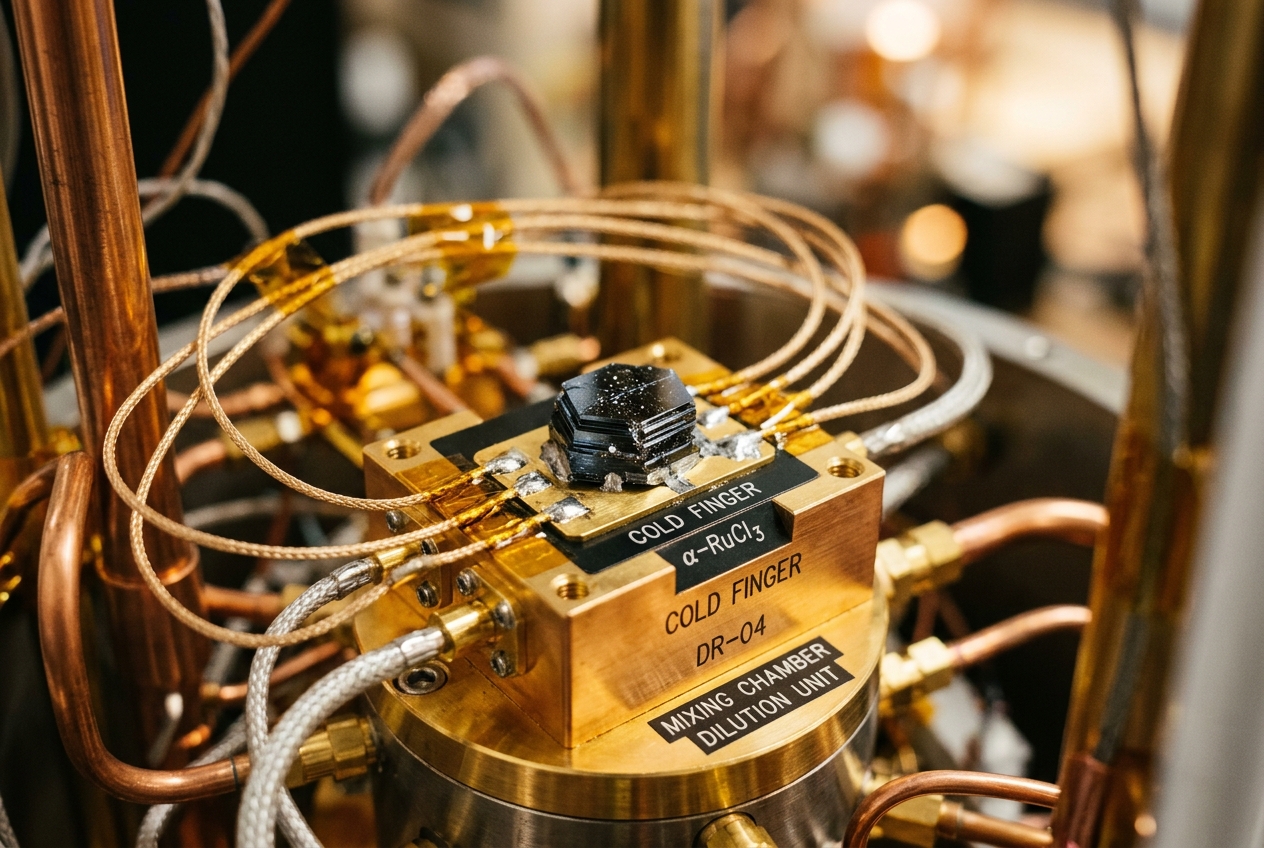
1. Realization in Mott Insulators: $\alpha\text{-RuCl}_3$ and Honeycomb Iridates
In 2009, physicists George Jackeli and Giniyat Khaliullin uncovered a realistic solid-state mechanism to synthesize Kitaev interactions in real materials. In transition metal compounds with strong spin-orbit coupling and $d^5$ electron configurations inside edge-sharing octahedral cages—such as ruthenium trichloride ($\alpha\text{-RuCl}_3$) and iridates ($\text{Na}_2\text{IrO}_3$)—the conventional isotropic Heisenberg interaction is suppressed by destructive quantum interference across the $90^\circ$ metal-oxygen-metal bonds. This leaves bond-directional Kitaev exchange as the dominant magnetic coupling.
At facilities such as the Oak Ridge National Laboratory Spallation Neutron Source and the Max Planck Institute for Chemical Physics of Solids, researchers use inelastic neutron scattering to probe single crystals of $\alpha\text{-RuCl}_3$. When conventional magnets are probed with neutrons, they produce sharp, well-defined resonance peaks corresponding to single spin waves (magnons). In $\alpha\text{-RuCl}_3$, experiments reveal a broad, diffuse continuum of scattering intensity across a wide energy window—the direct fingerprint of a single neutron decaying into two fractionalized Majorana fermions.
2. Half-Integer Quantized Thermal Hall Transport
Because Majorana fermions are electrically neutral, they do not conduct electrical currents and cannot be measured using standard electrical resistivity techniques. However, they carry entropy and heat.
Experiments published in Nature have measured the transverse thermal Hall conductivity ($\kappa_{xy}$) of $\alpha\text{-RuCl}3$ under tilted magnetic fields. When the field suppresses parasitic zigzag magnetic order, $\kappa{xy}/T$ reaches a plateau quantized precisely at:
$$\frac{\kappa_{xy}}{T} = \frac{1}{2} \left( \frac{\pi^2 k_B^2}{3h} \right)$$
This half-integer value corresponds to a chiral central charge $c = 1/2$, providing direct experimental evidence of a bulk topological phase hosting a single chiral Majorana edge channel.
3. Topological Qubit Architecture at Microsoft Quantum
Microsoft Quantum is actively engineering topological qubits based on Majorana zero modes. While their hardware platform primarily employs semiconductor-superconductor heterostructures (such as indium arsenide nanowires coated with aluminum), the underlying mathematics governing topological error suppression, non-Abelian braiding, and parity readout directly derives from the principles established in the Kitaev Honeycomb Model on arXiv. The goal is to produce topological qubits with intrinsic hardware error rates below $10^{-6}$, dramatically reducing the physical qubit overhead required for error correction.
4. Digital Quantum Simulation on Superconducting Processors
In parallel with material synthesis, research teams at IBM Quantum and Google Quantum AI have used programmable superconducting processors to simulate Kitaev spin liquids digitally. By mapping the Kitaev Hamiltonian onto planar arrays of transmon qubits, researchers can synthetically engineer $\mathbb{Z}_2$ flux pairs, adiabatically steer non-Abelian anyon braids across the grid, and directly verify the non-commutative nature of the Ising fusion algebra $\sigma \times \sigma = 1 + \psi$ via quantum state tomography.
5. What This Means for You
For anyone outside a specialized condensed matter laboratory, the physics of Majorana fermions on a hexagonal grid might appear intensely abstract. Yet the downstream technological consequences of this physics will shape everyday life across the coming decades.
The End of the "Error Correction Tax"
Current prototype quantum computers are categorized as Noisy Intermediate-Scale Quantum (NISQ) devices. To run a complex calculation on a standard machine today, engineers must link hundreds or even thousands of physical qubits together just to protect a single "logical" qubit of data from environmental noise—a massive resource penalty known as the error-correction tax.
If materials exhibiting Kitaev topological order can be perfected and integrated into microelectronics, the hardware itself will protect the information. This dramatic efficiency gain would compress the timeline for scalable quantum computing from several decades down to a few years.
       CONVENTIONAL ERROR CORRECTION                TOPOLOGICAL HARDWARE IMMUNITY

    [1,000+ Physical Qubits]                    [Single Topological Element]
    [Massive Laser/Wiring Overhead]             [Intrinsic Physical Protection]
                 |                                             |
                 v                                             v
        { 1 Logical Qubit }                           { 1 Logical Qubit }
Real-World Transformations
- Medicine and Molecular Design: Fault-tolerant quantum processors will simulate complex enzyme reactions, such as the nitrogenase enzyme that produces fertilizer at ambient temperatures. This single breakthrough could decarbonize global chemical agriculture.
- Next-Generation Energy: Simulating transition-metal oxide chemistry at the quantum level will accelerate the discovery of room-temperature superconductors and ultra-dense solid-state battery electrolytes.
- Cybersecurity Transition: Understanding topological spin liquids guides the development of both post-quantum cryptographic standards and unhackable quantum repeaters for a global quantum internet, as detailed in advanced curricula at MIT OpenCourseWare.
6. Today's Takeaway
Kitaev’s Honeycomb Model is one of the crowning achievements of modern theoretical physics: an exactly solvable model showing how ordinary electron spins on a hexagonal lattice spontaneously dissolve into emergent Majorana fermions and a static $\mathbb{Z}_2$ gauge field. When time-reversal symmetry is broken, this lattice gives birth to non-Abelian Ising anyons whose worldlines weave fault-tolerant quantum logic gates into the very topology of spacetime—turning the dream of noise-immune quantum computation into a concrete physical reality.
Additional Authoritative References & Recommended Reading
- Kitaev's Original 2006 Landmark Paper on the Honeycomb Model (arXiv:cond-mat/0506438)
- Kitaev Model Overview and Mathematical Framework (Wikipedia)
- Quantized Majorana Thermal Hall Effect in $\alpha\text{-RuCl}_3$ (Nature)
- IBM Quantum & Qiskit Topological Quantum Computing Curriculum
- MIT OpenCourseWare: Advanced Quantum Theory and Topology in Condensed Matter
- Physical Review Letters: Jackeli-Khaliullin Mechanism for Kitaev Interactions