Powernews Section Archive

TCM Meridians & Acupressure Archive

Page 9 of 10
Yuan-Source Points: Accessing Primordial Qi Reservoirs, Zang-Fu Diagnostics, and Bilateral Acupressure Protocols
TCM MERIDIANS & ACUPRESSURE

Yuan-Source Points: Accessing Primordial Qi Reservoirs, Zang-Fu Diagnostics, and Bilateral Acupressure Protocols

If you have ever experienced an unyielding afternoon fatigue that coffee fails to touch, a persistent knot of muscular tension between your shoulder blades after hours at a desk, or an elusive sense of somatic burnout where your body feels simultaneously depleted and hyper-reactive, you are encountering a state that classical medicine identifies as a breakdown in constitutional energy distribution. In modern parlance, we might describe this as chronic autonomic nervous system dysregulation or low-grade allostatic overload. In the diagnostic framework of Traditional Chinese Medicine (TCM), however, this state points directly to an imbalance within the deep bio-energetic reservoirs governed by the **Yuan-Source points** (*原穴, Yuan Xue*).

⚡ 8,595 Tokens • $0.00 Cost
Sinew Meridians: Navigating Myofascial Kinetic Chains, Musculoskeletal Articulation, and Ah-Shi Acupressure Protocols
TCM MERIDIANS & ACUPRESSURE

Sinew Meridians: Navigating Myofascial Kinetic Chains, Musculoskeletal Articulation, and Ah-Shi Acupressure Protocols

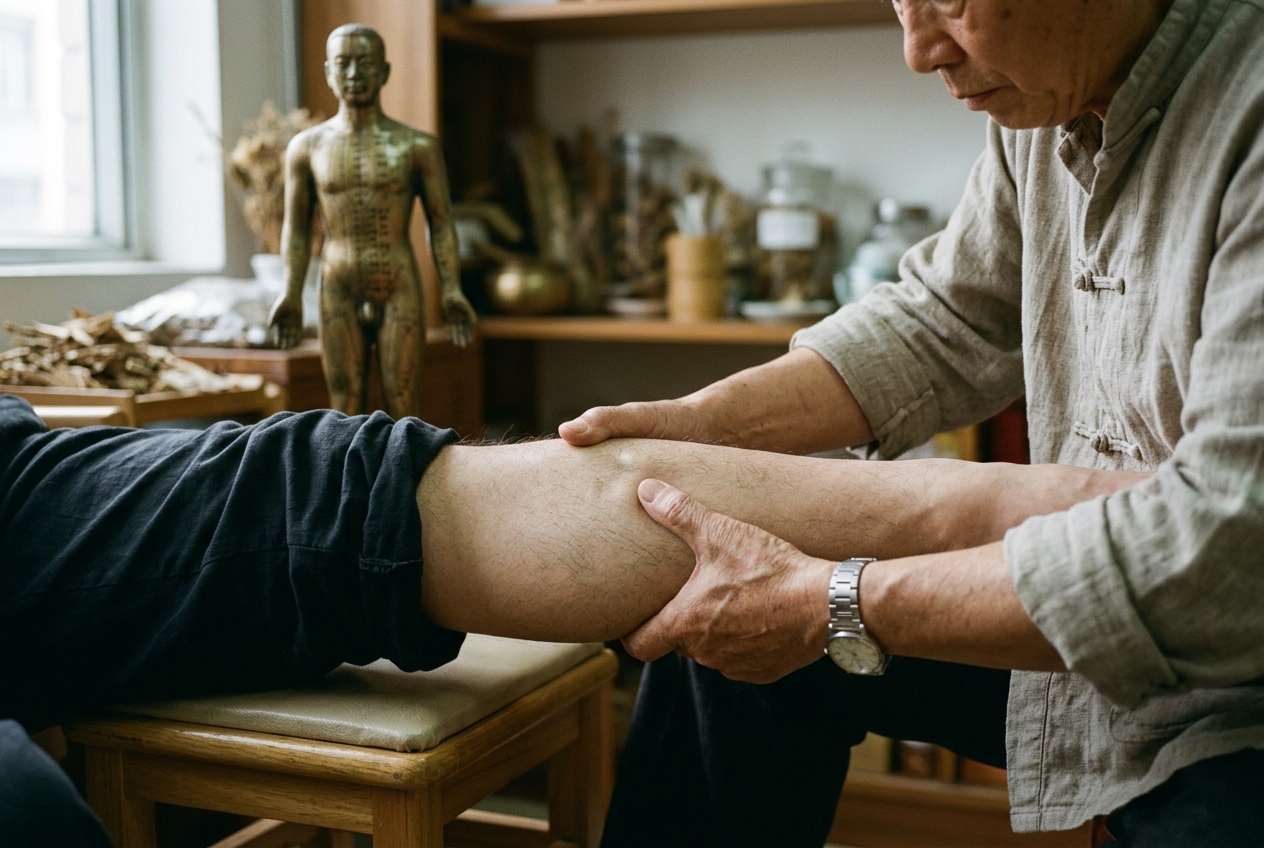
If you have ever spent eight uninterrupted hours anchored to an ergonomic task chair, only to stand up and discover that your neck feels concretized, your lower back resists extension, and an inexplicable ache radiates along the outer ridge of your shoulder down to your wrist, you have experienced a functional failure of your body’s kinetic network. Modern clinical ergonomics typically categorizes these complaints as isolated muscular micro-traumas: tension headaches, levator scapulae spasm, upper crossed syndrome, or repetitive strain injury. Yet, conventional isolationist rehabilitation frequently falters because musculoskeletal tissue does not operate in mechanical isolation. When the body locks into compensation patterns, it does so along continuous, continuous, multi-articular tracks of tension.

⚡ 10,338 Tokens • $0.00 Cost
Eight Influential Points: Navigating Systemic Tissue Resonance, Zang-Fu Dynamics, and Hui-Meeting Acupressure Protocols
TCM MERIDIANS & ACUPRESSURE

Eight Influential Points: Navigating Systemic Tissue Resonance, Zang-Fu Dynamics, and Hui-Meeting Acupressure Protocols

If you have ever spent an afternoon trapped beneath the fluorescent hum of an office, nursing a diffuse, stubborn fatigue that seems to occupy neither muscle nor organ exclusively, you have encountered the limits of fragmented medicine. You stretch your neck, yet the tension immediately migrates toward your lower back. You drink water to soothe an irritable digestive tract, only to feel an inexplicable tightness constricting your mid-chest. You rest, yet the exhaustion lingers in your very bones. This pervasive sense of multi-tissue dissonance—where connective fascial sheets, visceral rhythms, vascular tone, and neuromuscular coordination fall out of harmonic synchronization—is one of the hallmark afflictions of modern sedentary existence.

⚡ 8,315 Tokens • $0.00 Cost
Front-Mu Points: Navigating Ventral Alarm Networks, Visceral Diagnostic Palpation, and Abdominal Acupressure Protocols
TCM MERIDIANS & ACUPRESSURE

Front-Mu Points: Navigating Ventral Alarm Networks, Visceral Diagnostic Palpation, and Abdominal Acupressure Protocols

If you have ever experienced a sudden knot in your stomach during a moment of acute anxiety, felt an unexplained tenderness between your ribs after a week of chaotic meals, or noticed an uncomfortable tightening across your breastbone when deadlines mount, you have already experienced the somatic language of your internal organs. Long before modern diagnostic imaging existed, clinicians observed that internal physiological stress does not remain locked within the viscera. Instead, it projects outward onto the surface of the body, mapping itself across specific zones of the chest and abdomen.

⚡ 10,110 Tokens • $0.00 Cost
Back-Shu Points: Navigating Dorsal Reflex Zones, Autonomic Visceral Regulation, and Paravertebral Acupressure Protocols
TCM MERIDIANS & ACUPRESSURE

Back-Shu Points: Navigating Dorsal Reflex Zones, Autonomic Visceral Regulation, and Paravertebral Acupressure Protocols

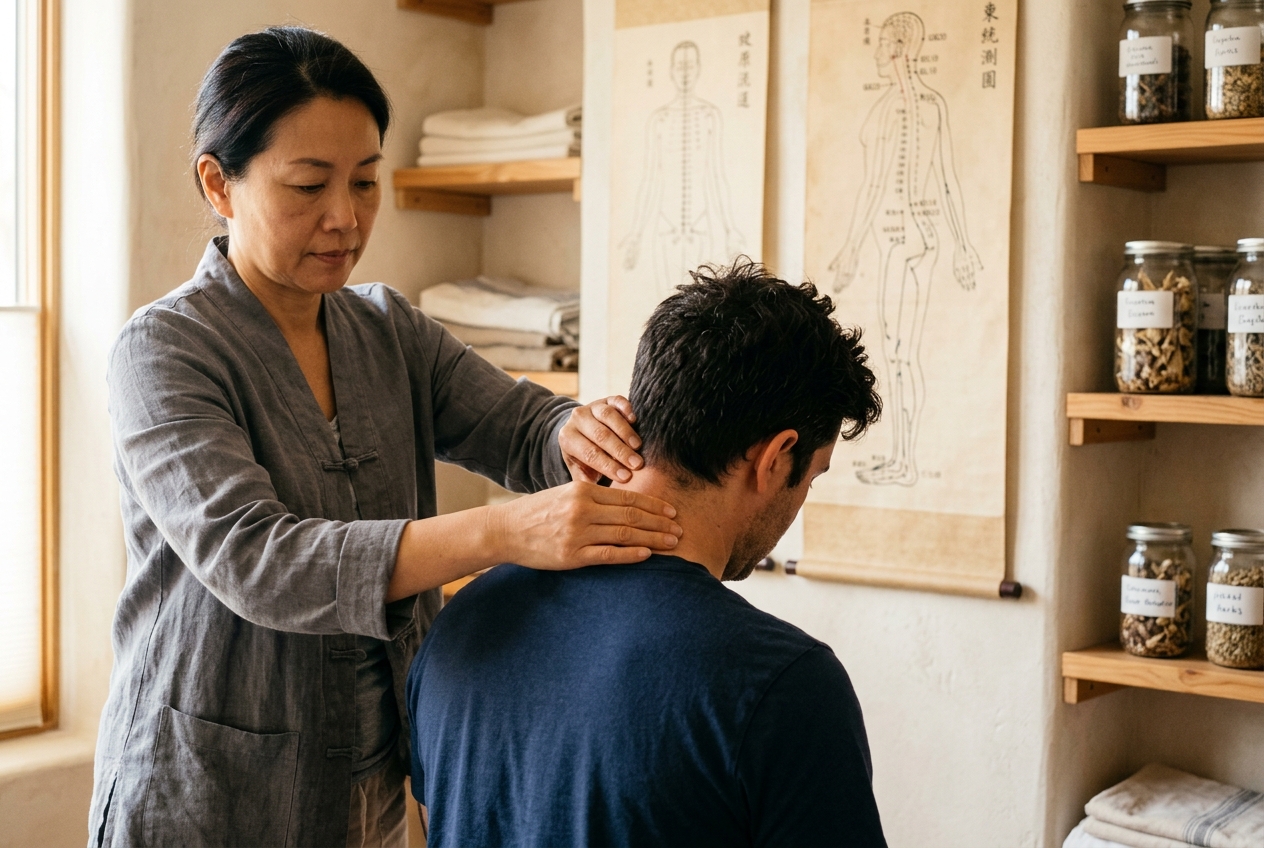
If you sit at a desk for eight hours a day, you are almost certainly familiar with the dull, pervasive ache that settles between your shoulder blades by mid-afternoon. You may notice that this muscular tightness rarely stays confined to the back: it arrives alongside a shallow, constricted breathing pattern, a subtle afternoon brain fog, an irritable digestive sluggishness, or a persistent low-grade anxiety that refuses to dissolve even after you step away from the screen. Conventional ergonomics treats this as a purely mechanical failure of posture—a matter of strained rhomboids and overstretched erector muscles. Traditional East Asian medicine, however, offers a profoundly different and significantly more sophisticated diagnostic framework: your dorsal spine is a living switchboard wired directly into the physiological vitality of your internal organs.

⚡ 7,001 Tokens • $0.00 Cost
Triple Burner Meridian Architecture: Hand Shaoyang Pathways, Interstitial Fluid Dynamics, and SJ5 Acupressure Protocols
TCM MERIDIANS & ACUPRESSURE

Triple Burner Meridian Architecture: Hand Shaoyang Pathways, Interstitial Fluid Dynamics, and SJ5 Acupressure Protocols

For more than two millennia, traditional East Asian medicine has posited that somatic vitality depends upon the harmonious orchestration of systemic fluids and bioenergetic currents across a network of discrete connective conduits. Among the twelve principal channels, none has elicited greater physiological intrigue than the *San Jiao* (三焦), traditionally designated in the West as the [Triple Burner Meridian](https://en.wikipedia.org/wiki/San_Jiao) or *Hand Shaoyang* channel. Historically conceptualized as an organ system having "a name but no physical form" (*you ming er wu xing*), the San Jiao has frequently defied simplistic anatomical reductionism.

⚡ 10,551 Tokens • $0.00 Cost
← Previous Page Page 9 / 10 Next Page →