Thirteen Ghost Points: Navigating Sun Simiao's Neuropsychiatric Topography, Shen Spirit Dysregulation, and Psycho-Emotional Acupressure Protocols
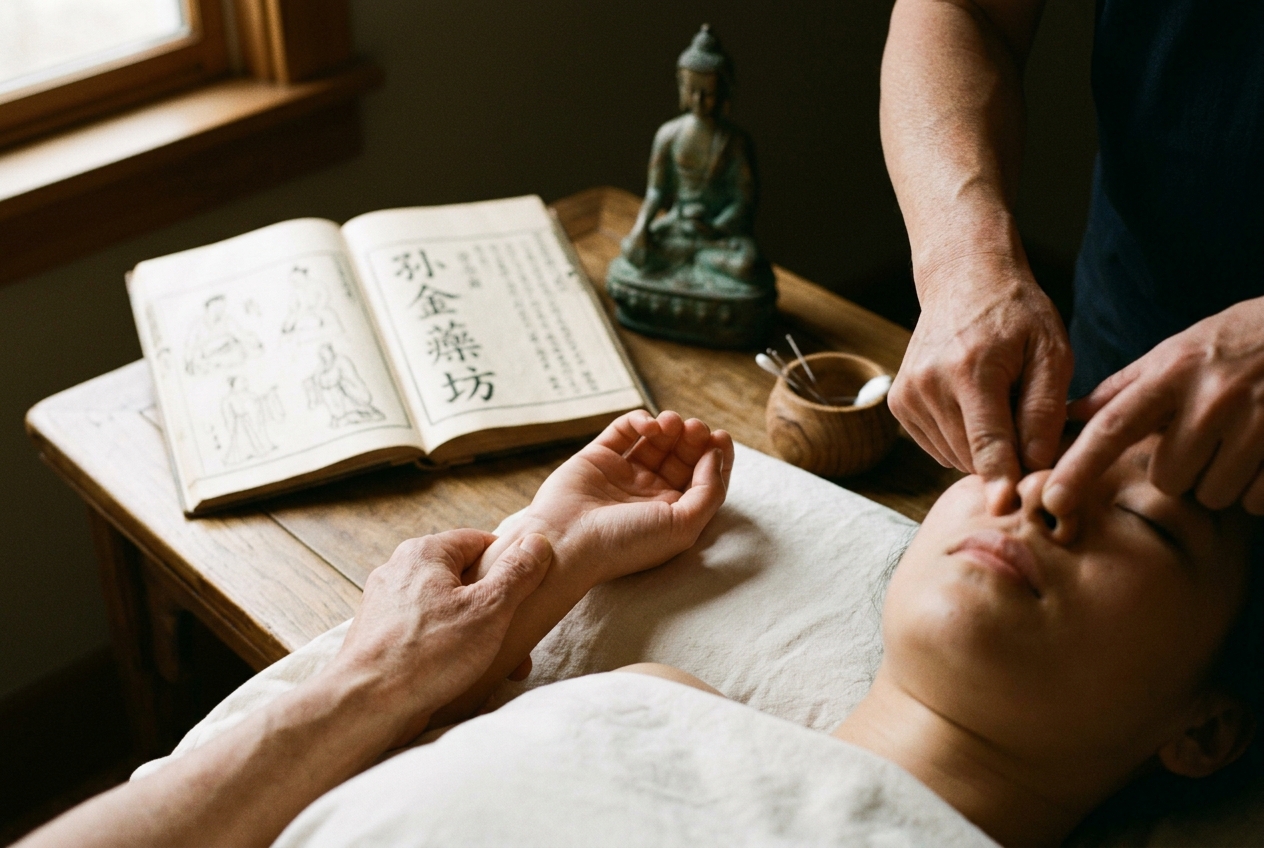
1. Opening — A Problem This Solves Today
There is a distinct, visceral threshold where psychological distress ceases to be merely cognitive and collapses into a complete somatic rebellion. You might recognise it as the sudden, dizzying onset of sensory derealization during a panic attack, where the surrounding room appears distant, drained of colour, and two-dimensional. You might experience it as the suffocating paralysis of acute situational dread—the throat tightening, the heart hammering erratically against the sternum, the mind racing through catastrophic loops while the limbs feel simultaneously leaden and disconnected from the trunk. In other instances, it manifests as the chronic, agitated insomnia of burnout: lying awake at three in the morning with a buzzing central nervous system, utterly exhausted yet vibrating with an inexplicable, hyper-vigilant vigilance.
When emotional overwhelm reaches this pitch, conventional cognitive reframing often fails. The prefrontal cortex—the seat of narrative reason and rational deliberation—has been functionally hijacked by subcortical alarm cascades. One cannot simply "think" one's way out of a physiological state that has decoupled the conscious mind from somatic reality.
Long before modern neuroimaging mapped the circuits of panic and dissociative trauma, seventh-century Chinese clinical medicine developed an emergency protocol designed specifically for severe psycho-emotional derailment. Formulated by the polymath physician Sun Simiao during the Tang Dynasty, the Thirteen Ghost Points (Gui Xue, 鬼穴) represent classical medicine's most profound intervention for stabilizing a shattered psyche. Rather than addressing mild muscular tension or minor digestive sluggishness, this specialized topographical network was engineered to shock, anchor, and recalibrate an organism overwhelmed by internal chaos. By understanding both the classical architecture and the modern neurobiology of these points, we gain access to a remarkably precise, non-invasive somatic toolkit for reclaiming autonomic equilibrium when the mind feels hopelessly unmoored.
2. Theoretical & Historical Foundations: From Tang Dynasty Demonology to Classical Neuropsychiatry
To comprehend the Thirteen Ghost Points, one must first dismantle the modern Western misunderstanding of the word Gui (鬼). Translated literally in early Orientalist literature as "ghost," "demon," or "evil spirit," the character Gui in classical East Asian medical epistemology did not signify a literal theatrical phantom. Instead, within the scholarly lineage of Sun Simiao (孙思邈, 581–682 CE)—frequently canonized in medical history as China's Yao Wang (King of Medicine)—Gui functioned as a sophisticated diagnostic category for exogenous trauma, irrational compulsion, personality fragmentation, and sudden, severe psychiatric illness.
In his monumental clinical compendium Beiji Qianjin Yaofang (备急千金要方, Essential Prescriptions Worth a Thousand Gold Pieces, c. 652 CE), Sun Simiao codified these thirteen specific acupuncture points as a systematic, graduated protocol for treating conditions that had stripped an individual of self-sovereignty. Within classical Chinese psychiatric taxonomy, these states were catalogued under the diagnostic spectrum of Dian Kuang (癫狂)—a polarity closely mirroring modern manic-depressive illness, acute schizophrenia, traumatic shock, and dissociative stupor.
According to classical internal medicine: 1. Dian (癫) denotes depressive withdrawal, catatonic mutism, sudden disorientation, and emotional numbness, typically attributed to Phlegm (pathological metabolic stagnation) silently occluding the subtle apertures of the Heart (Xin Qiao), thereby suffocating the clarity of consciousness. 2. Kuang (狂) denotes manic agitation, uncontrolled shouting, hyper-reactive insomnia, racing thoughts, and uninhibited rage, driven by internal Phlegm-Fire violently flaring upwards into the brain and destabilizing the Shen.
The Shen (神), commonly translated as "Spirit," encompasses the totality of human cognitive function, emotional awareness, sensory integration, and self-consciousness. The Shen resides within the vascular and energetic matrix of the Heart, but relies upon the unobstructed circulation of Qi and Blood through the Extraordinary Vessels—primarily the Du Mai (Governing Vessel) and Ren Mai (Conception Vessel)—to maintain its coherent relationship with the external environment. When an individual undergoes acute physical shock, profound psychological betrayal, or overwhelming emotional terror, the Qi dynamic reverses (Qi Ni), the apertures of perception become congested, and the Shen is ejected from its physiological anchor.
Sun Simiao recognized that rational verbal counselling was utterly impotent during the height of such neuro-emotional crises. His Thirteen Ghost Points were arranged not as isolated symptom relievers, but as a descending and ascending somatic ladder: an aggressive sequence of sensory inputs targeting the cranial nerves, the distal extremities, and the midline neurovascular junctions to "expel the pathogen"—which, in clinical terms, translated to restoring sensory orientation, breaking catatonic loops, draining cerebral hyper-arousal, and grounding the individual back into their somatic vessel.
3. Systematic Topographical Mapping of the 13 Points
Sun Simiao’s thirteenth-point canon constitutes a rigorous anatomical survey of primary junction points where the peripheral nervous system interfaces with the central axis. Below is the systematic mapping of the thirteen points, incorporating their classical poetic names, standardized alphanumeric designations, anatomical landmarks according to the World Health Organization (WHO) Standard Acupuncture Point Locations, and functional clinical specificities.
Complete Topographical Index of the Thirteen Ghost Points
| # | Classical Name | Pinyin | Standard Code | Anatomical Location (Surface Landmark) | Classical Indication & Functional Specificity |
|---|---|---|---|---|---|
| 1 | Ghost Palace (鬼宫) | Gui Gong | DU26 (Shuigou) | In the philtrum, at the junction of the upper third and lower two-thirds of the midline groove below the nose. | Emergency revival from shock, acute loss of consciousness, resetting the autonomic axis, acute hysterical lockjaw. |
| 2 | Ghost Faith (鬼信) | Gui Xin | LU11 (Shaoshang) | On the radial side of the thumb, approximately 0.1 cun proximal to the corner of the nail bed. | Clears extreme heat from the Upper Jiao, restores consciousness, alleviates mania, cools acute respiratory/cerebral agitation. |
| 3 | Ghost Eye (鬼垒/鬼眼) | Gui Yan | SP1 (Yinbai) | On the medial side of the great toe, approximately 0.1 cun proximal to the corner of the nail bed. | Anchors the Yi (intellect/ruminative thought), halts emotional bleeding, treats nightmare-ridden sleep and dream-disturbed stupor. |
| 4 | Ghost Heart (鬼心) | Gui Xin | PC7 (Daling) | At the midpoint of the anterior wrist crease, between the tendons of palmaris longus and flexor carpi radialis. | Calms the Shen, drains Fire from the Heart and Pericardium, alleviates palpitations, acute panic, and suffocating chest constriction. |
| 5 | Ghost Path (鬼路) | Gui Lu | BL62 (Shenmai) | Directly inferior to the lateral malleolus, in the depression between the lower border of the ankle bone and the calcaneus. | Confluent point of the Yang Qiao Mai (Yang Motility Vessel). Clears cranial Wind, grounds excess ascending energy, treats severe insomnia and nocturnal fright. |
| 6 | Ghost Pillow (鬼枕) | Gui Zhen | DU16 (Fengfu) | Along the posterior midline of the neck, directly below the external occipital protuberance, in the depression between the trapezius muscles. | Entry point of internal/external Wind into the brainstem; treats dizziness, manic delirium, sudden aphasia, and cranial tension headaches. |
| 7 | Ghost Bed (鬼床) | Gui Chuang | ST6 (Jiache) | One finger-breadth anterior and superior to the lower angle of the mandible, at the prominence of the masseter muscle when teeth are clenched. | Releases profound somatic holding of unconscious rage and panic; relieves jaw clenching (bruxism), facial paralysis, and trigeminal tension. |
| 8 | Ghost Market (鬼市) | Gui Shi | CV24 (Chengjiang) | In the depression on the anterior midline of the face, midway between the lower lip and the mentolabial groove of the chin. | Point of crossing between Ren Mai and Large Intestine/Stomach channels; harmonizes neurological signals of the lower face, calms emotional tremors. |
| 9 | Ghost Cave (鬼窟) | Gui Ku | PC8 (Laogong) | In the center of the palm, between the 2nd and 3rd metacarpal bones, directly beneath the tip of the middle finger when making a loose fist. | Ying-Spring Fire point of Pericardium; directly drains pathogenic heat from the core, treats hyper-manic agitation, hot flushes of panic, and delirium. |
| 10 | Ghost Hall (鬼堂) | Gui Tang | DU23 (Shangxing) | On the midline of the head, 1.0 cun posterior to the anterior hairline, in the sagittal suture line. | Clears the sensory orifices of the head, disperses mental fog, relieves persistent frontal pressure, stabilizes psychiatric mania. |
| 11 | Ghost Hideout (鬼藏) | Gui Zang | CV1 (Huiyin) | In the center of the perineum, midway between the anus and the posterior labial commissure (females) or root of the scrotum (males). | Meeting point of Ren, Du, and Chong vessels; deep somatic anchor for dissociative split, radical grounding, emergency resuscitation from drowning/shock. |
| 12 | Ghost Minister (鬼臣) | Gui Chen | EX-HN11 (Haiquan) | In the oral cavity, on the sublingual frenulum, midway between the orifices of the submandibular ducts (Jinjin and Yuye). | Stimulates profound salivation, clears cerebral heat, treats sudden neurological mutism, tongue rigidity, and unquenchable emotional thirst. |
| 13 | Ghost Net (鬼封) | Gui Feng | DU24 / Extra (Yinjiao/Shenting) | Variable classical assignment: Frequently identified as the inner aspect of the upper lip frenulum (Yinjiao), or DU24 (Shenting, 0.5 cun posterior to hairline). | Locks the therapeutic intervention; seals the connection between the central governing axis and the sensory periphery, preventing energetic relapse. |
4. The Meridian Path — A Journey Through the Body
To understand how these points function as a dynamic clinical system, we must leave behind rigid abstractions and trace the pathways directly along the living contours of the body. Rather than isolated dots, the Thirteen Ghost Points map a continuous somatic highway linking our deep central axis to our most sensitive expressive peripheries: the face, the fingertips, the palms, the feet, and the pelvic floor.
The circuit begins at the cranial midline, along the crest of the skull where the Governing Vessel (Du Mai) ascends. The Du Mai is the "Sea of Yang Channels," running directly from the pelvic base, straight up the spine, over the dome of the brain, and terminating inside the upper mouth. Point 10 (Ghost Hall / DU23) sits right at the crest of the forehead, just beyond the natural hairline. From here, the pathway cascades backward down the curve of the skull into the soft, hollow notch at the very base of your neck—right where the skull rests upon the first cervical vertebra. This is Point 6 (Ghost Pillow / DU16), an anatomical harbor where muscular holding and mental exhaustion routinely bottleneck.
From the occiput, the pathway routes forward into the orofacial landscape, the primary anatomical interface for human emotional expression and social engagement. Point 1 (Ghost Palace / DU26) is nestled in the upper third of the vertical trough between the base of your nose and your upper lip—the philtrum. Direct your awareness down across the lips to the soft depression directly beneath your lower lip, right in the crease above the chin: this is Point 8 (Ghost Market / CV24), the terminus of the Conception Vessel (Ren Mai), the "Sea of Yin Channels." Move your fingers slightly outward and upward to the prominent muscular ridge at the angle of your lower jaw—the thick muscle that bunches up firmly when you clench your back teeth. This is Point 7 (Ghost Bed / ST6), the gateway of the Stomach Meridian, where unconscious tension, suppressed anger, and stress-induced jaw clenching reside.
Next, the circuit leaps outward to the distal peripheries of the limbs, targeting points rich in sensory receptors: - The Upper Extremity: Travel down the inner aspect of the arm along the Pericardium Channel—the vascular and emotional bodyguard of the Heart. Arrive at Point 4 (Ghost Heart / PC7), located right at the center of the main horizontal crease of your inner wrist, nestled securely between the two prominent cords (tendons) that stand out when you flex your hand. Press forward into the hollow center of your palm, directly where your middle finger curls down to touch your skin when making a soft fist: this is Point 9 (Ghost Cave / PC8). Finally, move out to the radial corner of your thumb, just next to the base of the thumbnail: Point 2 (Ghost Faith / LU11), the energetic terminus of the Lung Meridian. - The Lower Extremity & Pelvic Floor: Descend to the foot. At the inner edge of your big toe, right at the corner of the nail bed, sits Point 3 (Ghost Eye / SP1), anchoring the earthy, grounding energy of the Spleen Meridian. Move outward to the lateral edge of the ankle: nestled in the soft hollow directly below the outer ankle bone sits Point 5 (Ghost Path / BL62), the master regulator of the Bladder Meridian and the Yang Qiao Mai (Stepping Vessel), governing somatic stance and vertical stability.
Finally, the entire network anchors deep in the pelvic floor at Point 11 (Ghost Hideout / CV1), resting at the central perineal hub where all midline energy originates.
5. Modern Neurobiological Correlates: The Trigeminal-Vagal and Limbic Regulatory Complex
When stripped of seventh-century symbolic vernacular, Sun Simiao’s Ghost Point formula emerges as a remarkably prescient framework for somatic neuromodulation. Modern neuroscience demonstrates that stimulating these specific topographical coordinates triggers a profound shift across three primary physiological systems: the trigeminal-vagal sensory complex, the limbic-paralimbic neural network, and the hypothalamic-pituitary-adrenal (HPA) neuroendocrine axis.
1. The Trigeminal-Vagal Axis & Brainstem Arousal
The prominent clustering of Ghost Points across the midline of the face (DU26, CV24, ST6) is neuroanatomically extraordinary. The facial and orofacial tissues receive the densest somatosensory innervation in the entire human body via the Trigeminal Nerve (Cranial Nerve V). - Mechanical stimulation of DU26 (Shuigou) engages the infraorbital branch of the maxillary nerve ($V_2$) and the facial nerve ($CN\ VII$). Research indexed by the National Center for Biotechnology Information (NCBI) on Trigeminal Stimulation and Vagal Tone reveals that intense tactile stimulation of DU26 activates afferent projections directly into the nucleus tractus solitarii (NTS) within the brainstem. - The NTS serves as the central switching station for the autonomic nervous system. By activating the NTS, trigeminal input directly stimulates the dorsal motor nucleus of the Vagus Nerve (Cranial Nerve X), triggering immediate parasympathetic output: slowing runaway tachycardia, lowering systemic vascular resistance, and terminating the acute panic cascade. This mirrors the physiological "mammalian diving reflex," rapidly terminating sympathetic overdrive.
2. Limbic Attenuation and Prefrontal Cortical Down-Regulation
During acute emotional trauma or panic, fMRI neuroimaging reveals marked hyper-activation within the amygdalar-hippocampal complex, coupled with functional deactivation of the ventromedial prefrontal cortex (vmPFC). The patient loses top-down cognitive governance over subcortical survival drives.
Scientific investigations into Acupuncture and Limbic-Paralimbic-Neocortical Network Modulation demonstrate that mechanical stimulation of points along the Pericardium channel—notably PC7 (Daling) and PC8 (Laogong)—transmits mechanoreceptive signals along the Median Nerve. These sensory afferents travel through the spinothalamic tracts to the thalamus, prompting an immediate deactivation of the limbic system (specifically the amygdala and anterior cingulate cortex) while reducing default mode network (DMN) hyperactivity.
3. Hypothalamic-Pituitary-Adrenal (HPA) Axis Dampening
Prolonged psycho-emotional stress locks the hypothalamic-pituitary-adrenal axis in an excitotoxic state of persistent corticotropin-releasing hormone (CRH) secretion, elevating systemic cortisol and systemic inflammation. Studies on the Neurobiological Mechanisms of Acupoint PC7 and Pericardium Stimulation reveal that regular sustained pressure at PC7 down-regulates central sympathetic tone, normalizes hypothalamic gene expression of stress-induced neuropeptides, and enhances cardiac vagal index (CVI).
6. Key Non-Invasive Points You Can Press Right Now
While Sun Simiao’s classical needle protocol required clinical mastery, a powerful subset of accessible exterior Ghost Points can be stimulated safely through non-invasive, manual acupressure. These points serve as immediate somatic anchors for everyday stress, nervous tension, cognitive exhaustion, and situational anxiety.
Point 1: Ghost Heart — PC7 (Daling / 大陵, "Great Mound")
- Body Landmark Location: Turn your left hand palm up. Look at the primary crease running across the base of your wrist. Bend your wrist slightly forward to make the two prominent cord-like tendons in the middle of your wrist stand out. Ghost Heart (PC7) lies precisely in the middle of this wrist crease, in the soft dip between those two tendons.
- Somatic Feedback (Deqi): When you apply direct, perpendicular pressure with your opposite thumb, you should feel a distinct, satisfying dull ache, a mild spreading warmth, or a pleasant tingling sensation radiating down into the center of your palm or traveling slightly up the forearm along the median nerve pathway.
- Application Method: Apply steady, firm, graduated pressure using the tip or pad of your right thumb. Maintain firm contact without sliding across the skin. Hold for 90 to 180 seconds per wrist while engaging in deep, slow, diaphragmatic breathing.
- Everyday Clinical Utility:
- Rapid termination of situational anxiety and racing heart rate (palpitations).
- Relief from suffocating tightness across the center of the chest.
- Calming the Shen before sleep to overcome racing thoughts and agitated insomnia.
Point 2: Ghost Palace — DU26 (Shuigou / 水沟, "Water Trough")
- Body Landmark Location: Place your index finger in the vertical groove directly between the base of your nose and the margin of your upper lip (the philtrum). Divide this groove visually into three equal horizontal bands. Ghost Palace (DU26) is located at the exact dividing line between the upper third and the lower two-thirds, right in the midline.
- Somatic Feedback (Deqi): Because this region is richly supplied by trigeminal nerve endings, pressure here produces an immediate, crisp, highly alert sensation. It may cause a slight watery sensation in the eyes or a spontaneous urge to take a deep, reflexive inhalation.
- Application Method: Use the edge of your thumbnail or the tip of your index finger. Press firmly inward and slightly upward toward the center of your head with sustained, graduated pressure for 60 to 90 seconds.
- Everyday Clinical Utility:
- Emergency grounding during sudden episodes of derealization, dissociation, or lightheadedness.
- Breaking through debilitating mental lethargy, "brain fog," and mid-afternoon cognitive collapse.
- Acute emotional shock recovery (e.g., immediately after receiving distressing news).
Point 3: Ghost Bed — ST6 (Jiache / 颊车, "Jaw Bone")
- Body Landmark Location: Place your fingertips at the lower, back corner of your jawbone (the angle of the mandible). Move your fingers approximately one finger-width forward and slightly upward onto the cheek. Now, bite your back teeth together firmly: you will feel a thick muscle swell up beneath your fingers (the masseter). Relax your jaw; Ghost Bed (ST6) sits right in the center of that muscular mound, in a small, natural indentation.
- Somatic Feedback (Deqi): This point is almost universally tender in modern individuals due to chronic stress-induced bruxism. When pressed, you will experience a deep, heavy, localized ache that may refer upward into the temples or along the lower teeth.
- Application Method: Use both thumbs simultaneously on both sides of the jaw. Apply firm, inward circular friction, pressing into the muscle belly for 2 minutes, consciously letting your lower jaw drop slack and allowing your teeth to separate slightly.
- Everyday Clinical Utility:
- Releasing chronic temporomandibular joint (TMJ) tension, nocturnal jaw clenching, and tooth grinding.
- Alleviating tension headaches radiating across the temples and forehead.
- Discharging stored somatic anger, frustration, and muscular hyper-reactivity.
Point 4: Ghost Path — BL62 (Shenmai / 申脉, "Extending Vessel")
- Body Landmark Location: Sit comfortably and place your finger on the prominent bony knob on the outside of your ankle (the lateral malleolus). Slide your finger directly downward toward the sole of your foot. Approximately one-half to three-quarters of an inch below the lower edge of the ankle bone, you will feel a distinct, soft, cup-shaped depression between the bone and the heel tendon. This is Ghost Path (BL62).
- Somatic Feedback (Deqi): A subtle, grounding, heavy sensation that spreads along the outer border of the foot and up the lateral aspect of the lower leg.
- Application Method: Grasp the ankle with your fingers wrapping around the heel, placing your thumb pad firmly into the hollow of BL62. Apply steady, moderate-to-firm circular pressure for 2 to 3 minutes on both legs.
- Everyday Clinical Utility:
- Anchoring ungrounded, "floating" mental energy back down into the lower body.
- Relieving restless legs and motor agitation prior to sleep.
- Calming daytime hypersensitivity and sensory overload.
7. Step-by-Step Somatic Reset Protocol: Acute Panic Overwhelm and Shen Deregulation
When experiencing severe acute stress, cognitive panic, or emotional shock, executing an uncoordinated sequence of random points is inefficient. The following evidence-informed, four-stage protocol leverages the neurobiological synergy of the Ghost Points to systematically down-regulate sympathetic arousal and re-establish somatic grounding.
Stage 1: Shock Termination & Sensory Re-Orientation (0:00 – 1:30)
- Target: Ghost Palace (DU26 / Shuigou).
- Position: Seated upright with feet firmly planted flat on the floor.
- Technique: Place the tip or edge of your dominant thumb into the upper third of your philtrum. Press firmly inward and upward toward the nasal septum. Maintain this pressure for 90 seconds.
- Respiration: Take sharp, deliberate inhalations through the nose, followed by slow, unhurried exhalations through pursed lips.
- Objective: Engage trigeminal sensory afferents to stimulate the brainstem NTS, terminating acute dissociative flight and forcing cognitive presence.
Stage 2: Limbic Calming & Cardiac Deceleration (1:30 – 3:30)
- Target: Ghost Heart (PC7 / Daling).
- Position: Rest your left forearm comfortably on your lap, palm facing upward.
- Technique: Position your right thumb pad squarely in the center of the left palmar wrist crease, between the flexor tendons. Apply graduated, deep perpendicular pressure until a firm, warm ache radiates into the palm. Hold steadily for 60 seconds, then switch to the right wrist for another 60 seconds.
- Respiration: Implement the 4-7-8 Vagal Breathing Pattern (Inhale through the nose for 4 seconds, hold gently for 7 seconds, exhale smoothly through the mouth for 8 seconds).
- Objective: Transmit mechanoreceptive signals via the median nerve to attenuate amygdalar firing, elevate heart rate variability, and halt runaway tachycardia.
Stage 3: Somatosensory Motor Discharge (3:30 – 5:30)
- Target: Ghost Bed (ST6 / Jiache).
- Position: Head upright, shoulders relaxed and dropped away from the ears.
- Technique: Place both thumbs onto the prominence of your masseter muscles on either side of your jaw. Clench briefly to confirm the location, then relax the jaw completely. Apply firm, circular, kneading pressure in a backward-and-upward motion for 2 continuous minutes. Allow your mouth to fall slightly open and let your tongue rest on the floor of the mouth.
- Respiration: Deep, rhythmic diaphragmatic breaths, vocalizing a soft sigh on each exhalation to release vocal cord and laryngeal tension.
- Objective: Discharge involuntary neuromuscular guarding, release trigeminal motor stress loops, and alleviate cranial vascular constriction.
Stage 4: Earth Basal Anchoring (5:30 – 7:30)
- Target: Ghost Path (BL62 / Shenmai).
- Position: Cross your left ankle over your right knee, or lean forward while seated.
- Technique: Locate the soft depression immediately beneath the external ankle bone of your left foot. Press your thumb pad deeply into the hollow, sustaining firm, continuous pressure for 60 seconds. Switch legs and repeat on the right foot for 60 seconds.
- Respiration: Natural, deep, effortless belly breathing, visualizing the accumulated heat and mental turbulence descending from the head, passing down the spine, and discharging deep into the floor.
- Objective: Activate the Yang Qiao Mai to anchor ascending cerebral energy, re-establishing a grounded baseline of stability and physical orientation.
8. Clinical Safety, Contraindications, and Professional Boundaries
While non-invasive acupressure carries an exceptional safety profile, rigorous clinical discipline requires strict adherence to anatomical contraindications, pressure guidelines, and psychiatric boundaries.
According to the WHO Guidelines on Basic Training and Safety in Acupuncture, clinical acupoint stimulation must always respect anatomical integrity and physiological boundaries:
- Pregnancy Considerations: While non-invasive surface acupressure on PC7, DU26, and ST6 is generally safe, intense, painful stimulation of distal points such as SP1 (Yinbai), LU11 (Shaoshang), or BL62 (Shenmai) should be avoided during pregnancy due to their strong descending energetic vector and potential to stimulate autonomic uterine reflexes. Point 11 (CV1 / Huiyin) is strictly contraindicated for self-treatment in pregnancy.
- Proper Pressure Mechanics: Acupressure is an act of somatic communication, not mechanical conquest. Pressure should follow a graduated curve: starting lightly, deepening over 15 to 30 seconds as the tissues soften, and holding at a steady intensity that yields a clear, satisfying dull ache (Deqi) rated between 3 and 6 on a 10-point discomfort scale. If you feel sharp, lancinating, or electrical nerve pain, or if the skin turns pale or bruises, your pressure is excessively forceful and must be moderated.
- Emergency Care Boundaries: Ghost Point acupressure is an adjunct self-regulation modality for situational emotional distress, anxiety, somatic tension, and stress-induced insomnia. It is not a replacement for emergency psychiatric intervention or acute neurological care. If an individual presents with active suicidal ideation, unremitting bipolar mania, acute psychosis, suspected stroke (manifesting as unilateral weakness or slurred speech), or severe crushing chest pain, immediate emergency medical services must be contacted without delay.
9. Today's Takeaway: The 2-Minute Wrist-to-Philtrum Somatic Anchor
If you find yourself right now struggling with racing thoughts, workplace overwhelm, or the creeping fog of mental exhaustion, you do not need an hour of meditation or an acupuncture table to reclaim your equilibrium. You can execute this foundational two-point somatic reset in precisely 120 seconds before closing this page.
- Minute 1: Awaken & Orient (DU26): Place the edge of your right thumb pad into the upper third of your philtrum, directly below your nose. Apply firm, upward pressure toward your skull. Close your eyes and take three sharp, clear breaths through your nose. Feel the immediate, crisp neurological wakefulness clearing the mental fog behind your forehead.
- Minute 2: Ground & Anchor (PC7): Release your face and drop your left arm into your lap, palm facing upward. Place your right thumb directly in the center of your left wrist crease, right between the two prominent tendons. Press down firmly until you locate that sweet, heavy, radiating ache. Hold it with steady, unyielding gentleness for sixty seconds while letting your breath slow to a relaxed, six-second exhale.
Notice the immediate physical reality: your shoulders dropping an inch away from your ears, your heart settling into a steady, unhurried rhythm, and your consciousness firmly returning to the safe harbor of your living body. This is the enduring genius of Sun Simiao’s Thirteen Ghost Points: an ancient, elegant map proving that no matter how far the mind wanders into the wilderness of overwhelm, the body always holds the keys to bring it home.