Window of the Sky Points: Navigating Craniocervical Qi Inversion, Sensory Orifice Regulation, and Neck Acupressure Protocols
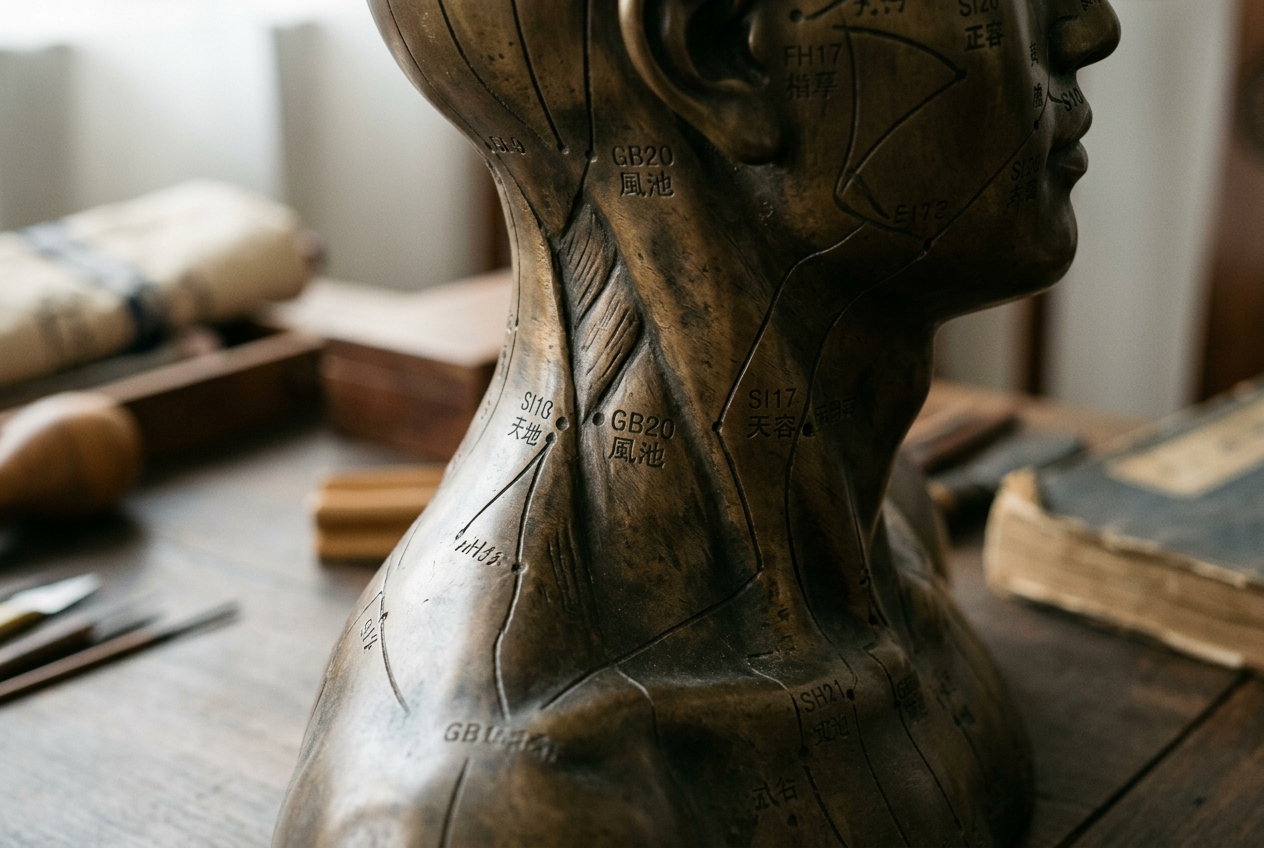
If you have ever spent eight hours anchored to a glowing workstation, only to feel an oppressive surge of heat, cranial fullness, and throbbing pressure tightening around the base of your skull like a steel band, you have experienced a failure of your body’s primary hydraulic release valve. In our modern sedentary reality, cognitive exertion is divorced from physical movement. As deadlines mount and notifications cascade, blood pressure spikes, the breath migrates upward into the clavicles, and an enormous volume of neurological and vascular activity becomes trapped within the cranium. The eyes burn, a high-pitched ring whispers in the ears, the jaw clenches involuntarily, and the voice tightens into a strained, shallow rasp.
In the conceptual framework of Traditional Chinese Medicine (TCM), this state is neither an arbitrary consequence of fatigue nor a simple muscular cramp. It is a textbook manifestation of Ni Qi—the rapid, rebellious counterflow of energetic and physiological pressure surging upward from the somatic reservoir of the torso into the fragile sensory chambers of the head.
Classical acupuncture mapped this exact psychosomatic bottleneck millennia ago. Encrypted within the classical texts are a specialized collective of twelve acupuncture apertures known collectively as the Window of the Sky points (Tian You Xue or Window of Heaven points). These points act as precise regulatory dampers, physiological gateways, and neurovascular drainage conduits located almost exclusively around the narrow isthmus of the neck and craniocervical junction. Where modern neurology identifies the convergence of the carotid sinus baroreceptors, the vagus nerve (nervus vagus), the cervical sympathetic ganglia, and the suboccipital myodural bridges, classical physicians recognized a ring of energetic "windows" designed to ventilate celestial madness, down-regulate cerebral hyperperfusion, and restore equilibrium between the corporeal body and the cognitive mind.
Understanding and gently manipulating these points offers a direct, non-invasive method for releasing the accumulated pressure of the digital age. By learning the anatomical geography and safe palpation protocols of these classical apertures, anyone can access an internal release mechanism that dissipates mental fog, clears sensory stagnation, and calms an overstimulated central nervous system.
2. The Meridian Path — A Journey Through the Body: Classical Textual Heritage & Craniocervical Neurovascular Topography
Classical Textual Foundations: Ling Shu Chapters 21 and 49
The authoritative foundations of the Window of the Sky points are recorded in the foundational Han Dynasty canon, the Huangdi Neijing Ling Shu (The Spiritual Pivot). Unlike standard meridian classifications that group points strictly along linear energetic trajectories from extremity to organ, the Window of the Sky designation represents a functional, topographical grouping.
In Chapter 21 of the Ling Shu (Han Re Bing / "Illnesses of Cold and Heat"), the text introduces the core ten points, framing them as emergency conduits for severe discordances where pathogenic factors cause violent energetic reversals between the head and trunk:
"When Qi rebellious surges upward, producing sudden deafness, loss of vision, inability to speak, or acute madness, search along the neck where the conduits enter the cranium."
The text identifies ten primary loci: 1. Renying (ST9) 2. Futu (LI18) 3. Tianchuang (SI16) 4. Tianrong (SI17) 5. Tianyou (SJ16) 6. Tianzhu (BL10) 7. Tianfu (LU3) 8. Tianchi (PC1) 9. Fengfu (GV16) 10. Tiantu (CV22)
Later clinical treatises, including the Zhen Jiu Jia Yi Jing (The Systematic Classic of Acupuncture and Moxibustion), incorporated two supplementary points due to their direct energetic affinity: Yamen (GV15) and Taiyang (Extra Point) or Wangu (GB12), solidifying the canon of craniocervical regulatory points.
In Chapter 49 of the Ling Shu (Wei Qi / "Defensive Qi"), the paradigm expands through the theory of Gen Jie (Roots and Terminations). This doctrine establishes that the primary Yang meridians possess their dynamic roots (Gen) in the distal extremities (the toes and fingers) and their structural junctions or terminations (Jie) at the neck, cranium, and sensory orifices. The Window of the Sky points represent these precise Jie nodal hubs. When stress, postural collapse, or emotional shock constricts the muscular and fascial sheaths of the neck, the conduits strangle the flow of Wei Qi (defensive, circulating vitality) and blood, causing profound sensory disarray above and somatic stagnation below.
========================================================================================
                      CLASSICAL CANON OF WINDOW OF THE SKY POINTS
========================================================================================
Point Code   Pinyin Name   English Translation      Classical Text    Key Modern Correlation
----------------------------------------------------------------------------------------
ST9          Renying       Man's Welcome            Ling Shu Ch. 21   Carotid Sinus / Vagal
LI18         Futu          Beside the Prominence    Ling Shu Ch. 21   Brachial / SCM Plexus
SI16         Tianchuang    Celestial Window         Ling Shu Ch. 21   Post. Border SCM / C3
SI17         Tianrong      Celestial Countenance    Ling Shu Ch. 21   Glossopharyngeal / Vagus
SJ16         Tianyou       Celestial Window         Ling Shu Ch. 21   Lesser Occipital Nerve
BL10         Tianzhu       Celestial Pillar         Ling Shu Ch. 21   Suboccipital Nerve / Dura
LU3          Tianfu        Celestial Residence      Ling Shu Ch. 21   Brachial Neurovascular
PC1          Tianchi       Celestial Pool           Ling Shu Ch. 21   Thoracic Outlet / T1
GV16         Fengfu        Wind Palace              Ling Shu Ch. 21   Foramen Magnum / C1
CV22         Tiantu        Celestial Chimney        Ling Shu Ch. 21   Suprasternal / Recurrent
========================================================================================
Craniocervical Neurovascular Topography and Fascial Mechanics
To understand why these points exert such profound clinical effects, one must examine the neck not as an isolated column of bone and muscle, but as a densely packed neurovascular bottleneck. The craniocervical junction contains every nerve, artery, vein, and lymphatic channel connecting the command center of the central nervous system to the metabolic viscera.
1. The Anterolateral Corridor: ST9, LI18, and CV22
- ST9 (Renying): Located directly over the bifurcation of the common carotid artery, at the anterior border of the sternocleidomastoid muscle (SCM). In modern physiology, this is the site of the carotid sinus and carotid body, housing high-pressure baroreceptors innervated by the glossopharyngeal nerve (CN IX) and vagus nerve (CN X). Mechanical modulation here directly influences systemic arterial pressure and heart rate variability via the baroreflex arc, as documented by NCBI PubMed research on autonomic regulation.
- LI18 (Futu): Situated on the lateral neck, precisely between the sternal and clavicular heads of the SCM, level with the tip of the thyroid cartilage (Adam's apple). It overlies the cervical plexus (C2–C4) and lies adjacent to the ascending sympathetic trunk, serving as a mechanical release for hypertonic cervical musculature that compresses venous return from the jugular system.
- CV22 (Tiantu): Positioned at the midline in the suprasternal fossa, directly above the manubrium of the sternum. Anatomically, it guards the entrance to the thoracic outlet, lying directly anterior to the trachea and near the recurrent laryngeal nerve. It acts as an escape chimney for trapped intrathoracic pressure and dyspnea.
2. The Lateral Retromandibular and Cervical Arc: SI16, SI17, and SJ16
- SI17 (Tianrong): Positioned posterior to the angle of the mandible, in the soft depression along the anterior margin of the SCM. This deep recess is adjacent to the internal jugular vein, carotid sheath, and glossopharyngeal nerve. It is the premier classical locus for resolving fullness in the throat, auditory distortion, and sudden emotional shock manifesting as an inability to swallow.
- SI16 (Tianchuang): Found on the posterior border of the SCM, level with the laryngeal prominence. It lies in close proximity to the cutaneous branches of the cervical plexus and the accessory nerve (CN XI), governing sensory flow to the ears and lateral cranium.
- SJ16 (Tianyou): Located at the posterior border of the SCM, directly below the mastoid process and level with the mandibular angle. This aperture sits atop the pathway of the lesser occipital nerve, making it clinically potent for clearing sudden unilateral temporal headaches, acute tinnitus, and visual vertigo resulting from vestibular-microvascular constriction.
3. The Occipital-Nuchal Gateway: BL10 and GV16
- BL10 (Tianzhu): Found in the muscular valley at the lateral border of the trapezius muscle, roughly half an inch below the occipital bone. This point penetrates directly into the suboccipital triangle (composed of the rectus capitis posterior and obliquus capitis muscles). Crucially, contemporary anatomical studies indexed on NCBI PubMed regarding cervicogenic headache pathogenesis confirm that connective tissue bridges (myodural bridges) physically link these suboccipital muscles directly to the pain-sensitive cranial dura mater. Hypertonicity here pulls on the dural sheath, triggering severe tension headaches and cognitive fatigue.
- GV16 (Fengfu): Situated on the posterior midline, in the deep hollow directly below the external occipital protuberance, between the bilateral trapezius muscles. It correlates with the cisterna magna and the external projection of the foramen magnum. Classical texts view it as the gateway through which "Internal and External Wind" invades the brain, destabilizing motor control, speech, and mental clarity (Shen).
4. The Somatic Peripheral Anchors: LU3 and PC1
- LU3 (Tianfu): Positioned on the anterolateral aspect of the upper arm, along the radial border of the biceps brachii muscle. As the sole Window point on the arm, it acts as a peripheral hydraulic damper, pulling ascending cerebral heat down through the Lung meridian.
- PC1 (Tianchi): Situated in the fourth intercostal space, one thumb-width lateral to the nipple. Positioned directly over the pectoralis major and intercostal neurovasculature, it relieves thoracic constriction, dysregulated cardiac rhythm, and emotional anxiety that shoots upward toward the throat.
3. Key Points You Can Palpate & Press Right Now
To make this ancient anatomical wisdom immediately accessible, we translate classical cun measurements into tactile landmarks on your living body. When engaging these points, apply steady, mindful pressure.
You will recognize the correct location by the emergence of Deqi—a distinct, non-sharp sensation characterized by a dull, spreading ache, a localized feeling of warmth, or a pleasant sensation of fascial release.
1. BL10 — Tianzhu ("Celestial Pillar")
+-----------------------------------------------------------------------------+
| POINT SUMMARY: BL10 (TIANZHU)                                               |
| - Target: Suboccipital myodural tension, screen fatigue, heavy head         |
| - Location: Ropey muscle band at skull base, 1 finger-width from spine      |
| - Sensation: Spreading warmth across the scalp, ocular decompression         |
| - Pressure: Firm, upward-angled hook using thumbs for 2–3 minutes           |
+-----------------------------------------------------------------------------+
- Everyday Landmark Location: Slide your fingers up the back of your neck along the spine until you hit the solid ledge of your skull bone. Drop your fingers slightly down into the soft muscular groove just outside the prominent, ropey central neck tendons (the trapezius). You are resting in a small, tender hollow at the very base of your skull, about one thumb-width out from your midline spine. For standard anatomical coordinates, refer to the World Health Organization (WHO) Standard Acupuncture Point Locations.
- What You Will Feel: When properly localized, firm pressure elicits a deep, satisfying ache that often radiates upward over the crown of the head or directly behind the eyeballs. It feels like pressing an internal switch that instantly relieves eye strain.
- Biomechanical Pressure Dynamics: Interlace your fingers around the back of your head and use both thumbs to hook upward and inward toward the center of your brain at a 45-degree angle. Maintain steady, firm pressure while taking slow, deep diaphragmatic breaths. Hold for 2 to 3 minutes.
- Clinical Utility: Exceptional for relieving tension headaches, mental burnout, ocular fatigue from prolonged screen immersion, and the feeling that your head is "too heavy" for your neck.
2. SI17 — Tianrong ("Celestial Countenance")
+-----------------------------------------------------------------------------+
| POINT SUMMARY: SI17 (TIANRONG)                                              |
| - Target: Jaw clenching, acute stress, throat tightness, vocal strain       |
| - Location: Valley between jaw angle and front edge of main neck muscle     |
| - Sensation: Deep, clearing ache draining ear and jaw tension               |
| - Pressure: Gentle, flat finger-pad compression for 60–90 seconds           |
+-----------------------------------------------------------------------------+
- Everyday Landmark Location: Locate the sharp, bony corner of your lower jawbone beneath your earlobe (the angle of the mandible). Slide your index finger just behind this bony corner into the soft, tender valley between the jawbone and the thick, diagonal neck muscle (the SCM).
- What You Will Feel: This area is physiologically sensitive. You will feel a distinct, tender, clearing ache that releases built-up tension in the jaw, ear, and side of the throat.
- Biomechanical Pressure Dynamics: Do not use sharp force or your fingernails. Use the flat, soft pad of your index or middle finger. Press gently inward and slightly forward toward the back of the jawbone. Apply mild-to-moderate pressure. Work one side at a time for 60 to 90 seconds while gently swallowing to encourage lymphatic and energetic drainage.
- Clinical Utility: Highly effective for dissolving the physical sensation of a "lump in the throat" (Mei He Qi), alleviating subconscious jaw-clenching (bruxism), soothing vocal fatigue, and settling acute nervous agitation.
3. CV22 — Tiantu ("Celestial Chimney")
+-----------------------------------------------------------------------------+
| POINT SUMMARY: CV22 (TIANTU)                                                |
| - Target: Shallow breathing, panic sensations, chest tightness, asthma      |
| - Location: Center of the hollow notch at the top of your collarbone        |
| - Sensation: Downward grounding sensation, expansion of breath depth        |
| - Pressure: Gentle downward-angled hook behind bone for 1–2 minutes         |
+-----------------------------------------------------------------------------+
- Everyday Landmark Location: Trace your collarbones inward toward the center of your throat until they meet. You will find a distinct, semi-circular dip right at the top of your breastbone (the suprasternal notch).
- What You Will Feel: A subtle, grounding sensation. Because this point sits directly in front of the windpipe, excessive force will cause a reflexive cough; proper, gentle touch produces an immediate, spontaneous impulse to inhale deeply and drop the shoulders.
- Biomechanical Pressure Dynamics: Place your index finger or thumb lightly into the center of the hollow notch. Direct your pressure slightly downward behind the top edge of the breastbone rather than pressing straight back against the trachea. Use light to medium pressure with rhythmic, slow circular motions for 1 to 2 minutes, synchronized with full abdominal exhalations.
- Clinical Utility: Instantly vents trapped heat and stagnant emotional stress from the chest, calms rapid or shallow breathing, eases coughing and throat tickles, and halts rising panic.
4. LU3 — Tianfu ("Celestial Residence")
+-----------------------------------------------------------------------------+
| POINT SUMMARY: LU3 (TIANFU)                                                 |
| - Target: Sensory overload, nosebleeds, emotional weeping, cloudy mind      |
| - Location: Outer arm muscle, where the tip of your nose touches your bicep |
| - Sensation: Localized radiating numbness/ache traveling toward the thumb   |
| - Pressure: Direct, perpendicular thumb pressure for 2 minutes              |
+-----------------------------------------------------------------------------+
- Everyday Landmark Location: Sit upright and extend your arm forward. Bend your head forward and touch the tip of your nose to the outer front of your upper arm bicep muscle. Where your nose touches the arm—roughly three thumb-widths down from the front armpit crease along the outer border of the bicep—is Tianfu.
- What You Will Feel: A pronounced, localized numbness or dull ache that may travel down the forearm along the thumb line.
- Biomechanical Pressure Dynamics: Grasp your upper arm with your opposite hand and press your thumb tip firmly into the outer muscle groove. Apply direct, perpendicular pressure, holding steadily for 2 minutes while rotating the wrist of the treated arm.
- Clinical Utility: Serves as a distant somatic anchor to pull rebellious blood and mental fire out of the head; useful for epistaxis (nosebleeds), emotional weeping, chronic brain fog, and sensory overwhelm.
4. A Point Combination for One Common Issue: The Craniocervical Reset Protocol
Clinical Target: Acute Cognitive Overload, Sensory Stagnation, and Cervicogenic Headaches
This step-by-step protocol is designed for the end of an intensive working day, or any moment when high mental stress manifests as throbbing temples, stiff neck musculature, ringing in the ears, and mental exhaustion.
Step-by-Step Clinical Sequence
========================================================================================
                      PRACTICAL CLINICAL PROTOCOL SUMMARY
========================================================================================
Phase    Target Point(s)       Hand Position & Technique               Duration
----------------------------------------------------------------------------------------
Phase 1  LU3 (Tianfu)          Perpendicular sustained thumb pressure   2 min / arm
Phase 2  SI17 & SJ16           Gentle pad circles along SCM groove      90 sec / side
Phase 3  BL10 & GV16           Bilateral thumb hook into suboccipital   2 min total
Phase 4  CV22 (Tiantu)         Downward-angled finger pad integration   1 min total
========================================================================================
-
Step 1: Ground the Ascent (Distal Somatic Drain) - Target: LU3 (Tianfu) bilaterally. - Action: Sit comfortably with your spine tall and feet flat on the floor. Palpate LU3 on your left arm. Apply firm, steady thumb pressure for 2 minutes while taking long, audible exhalations through the mouth. Switch and repeat on the right arm. - Mechanism: Initiates a distal energetic pull, drawing hyperperfusion away from the cerebral vascular beds and grounding motor activity down into the somatic limbs.
-
Step 2: Clear Lateral Cervical Drainage (Sensory Orifice Venting) - Target: SI17 (Tianrong) and SJ16 (Tianyou). - Action: Place the pads of your index and middle fingers into the soft groove behind the jaw angle and below the mastoid process on the left side of your neck. Apply gentle, fluid, downward-massaging circles for 90 seconds. Repeat on the right side. - Mechanism: Releases tension along the carotid sheath and cervical lymphatic chain, allowing congested venous blood to drain freely from the cranium while soothing the autonomic branches of the glossopharyngeal and vagus nerves.
-
Step 3: Decompress the Dural Sheath (Occipital Release) - Target: BL10 (Tianzhu) and GV16 (Fengfu). - Action: Bring both hands behind your head, interlacing your fingers. Place your thumbs directly into the bilateral hollows of BL10. Tilt your head back slightly into your thumbs, using the weight of your head to apply a steady upward hook into the skull base for 2 minutes. Conclude by shifting one thumb to the central midline hollow (GV16) for 30 seconds of gentle, sustained pressure. - Mechanism: Directly unloads the suboccipital myodural bridges, relaxing the mechanical pull on the cranial dura mater, reducing intracranial tension, and down-regulating sympathetic tone.
-
Step 4: Centering and Thoracic Integration (The Chimney Vent) - Target: CV22 (Tiantu). - Action: Place the soft pad of your right middle finger into your suprasternal notch, directing pressure gently downward behind the bone. Close your eyes, inhale deeply into your lower abdomen for a count of 4, and exhale slowly for a count of 8. Perform 6 breath cycles (approximately 1 minute). - Mechanism: Opens the superior thoracic aperture, lowering systemic blood pressure, dispelling residual tightness in the chest, and consolidating mental presence (Shen).
5. Safety & Clinical Sense: Biomechanical Precautions, Vagal Dynamics, and Absolute Contraindications
While non-invasive acupressure provides a remarkably safe approach to self-care, working around the neck demands anatomical respect and clinical prudence.
+-----------------------------------------------------------------------------+
|                        CRITICAL SAFETY CONTRAINDICATIONS                    |
|                                                                             |
|  [!] NEVER apply simultaneous bilateral pressure to the anterior neck.      |
|  [!] AVOID forceful pressure over ST9 / the carotid pulse.                  |
|  [!] STOP immediately if you experience dizziness, visual sparks, or nausea.|
|  [!] SEEK emergency medical care for sudden, severe "thunderclap" headaches. |
+-----------------------------------------------------------------------------+
1. The Carotid Sinus and Anterior Neck Precautions (ST9 / Renying)
The anterior triangle of the neck contains the carotid sinus, located at the bifurcation of the common carotid artery (the anatomical seat of ST9). - The Risk: External compression over the carotid sinus stimulates high-pressure baroreceptors, triggering the autonomic carotid sinus reflex. As detailed in the NCBI PubMed Clinical Review on Carotid Sinus Syncope, vigorous or prolonged compression here can cause acute reflex bradycardia (sudden drop in heart rate), peripheral vasodilation, and profound hypotension, leading to syncope (fainting). - Atherosclerotic Risk: In older individuals or those with cardiovascular disease, aggressive manipulation of the carotid triangle risks dislodging atheromatous plaques, potentially causing a transient ischemic attack (TIA) or stroke. - Mandate: Never apply simultaneous bilateral pressure to the anterior or lateral neck. Acupressure on points near the anterior vascular structures (such as ST9) should be avoided entirely in self-treatment routines; leave these points to licensed clinical acupuncturists. For home practice, focus on safe posterior and lateral landmarks (such as BL10, LU3, and gentle SI17/SJ16).
2. Force Dynamics: Defining "Too Much Pressure"
Acupressure works through neuromodulation and fascial signaling, not brute mechanical force. - The Threshold: Effective pressure should register between a 3 and 6 on a 10-point discomfort scale—a sensation traditionally termed Suan Zhang (a sweet, pleasant, dull ache). - Warning Signs: If you feel sharp, electric, stabbing, or pulsating pain, or if your fingertips trigger radiating numbness into your arms or face, you are compressing a superficial nerve branch or blood vessel. Back off immediately.
3. Special Populations & Pregnancy
- In pregnancy, strong downward-draining acupressure points (particularly systemic down-bearing points like GB21 on the shoulders or LI4 on the hands) are classically contraindicated as they stimulate downward motor force. While the posterior Window points like BL10 are generally safe with light touch, intense or aggressive stimulation along the neck and base of skull should be avoided during pregnancy.
4. Red Flag Symptoms Demanding Immediate Emergency Care
Acupressure is a restorative and regulatory modality, not an emergency intervention. Seek immediate medical evaluation if you or someone else experiences: - A sudden, excruciating headache unlike any experienced before ("thunderclap headache"). - Unilateral facial drooping, arm weakness, slurred speech, or sudden motor ataxia (classic stroke signs). - Acute chest pain radiating into the jaw or left arm, accompanied by cold sweats. - New-onset neurological deficits, visual loss, or progressive cognitive confusion following head trauma.
6. Today's Takeaway: The Two-Minute Suboccipital Reset
You do not need an entire hour of leisure to experience the therapeutic effects of the Window of the Sky system. You can perform this simple, effective 2-minute reset right now before closing this page:
+-----------------------------------------------------------------------------+
|                          THE 2-MINUTE DESK RESET                            |
|                                                                             |
|   1. LOCATE BL10: Thumbs in the hollows at the base of your skull.          |
|   2. HOOK & LEAN: Tilt head back slightly; hook thumbs upward at 45°.       |
|   3. BREATHE: Inhale for 4 seconds, exhale slowly for 6 seconds.            |
|   4. DURATION: 10 full breaths (approx. 2 minutes).                         |
|   5. RESULT: Immediate ocular clarity, cranial cooling, lowered tension.   |
+-----------------------------------------------------------------------------+
- Locate: Drop both thumbs into the tender muscular hollows at the base of your skull, about an inch apart on either side of your central neck tendon (BL10 / Tianzhu).
- Engage: Interlace your fingers over the top of your head to create a stable cradle. Let your head drop slightly backward into your thumbs, directing a firm, upward-angled pressure toward the center of your forehead.
- Breathe: Close your eyes. Inhale slowly through your nose for 4 counts, allowing your belly to expand. Exhale smoothly through your mouth for 6 counts, imagining the heat, tension, and mental pressure draining downward from your brain into your core.
- Integrate: Complete 10 full breath cycles (roughly two minutes). Gently release your hands, roll your shoulders backward three times, and open your eyes. Notice the immediate feeling of spaciousness at the base of your skull, the clearing of your vision, and the refreshed focus in your mind.