Eight Influential Points: Navigating Systemic Tissue Resonance, Zang-Fu Dynamics, and Hui-Meeting Acupressure Protocols
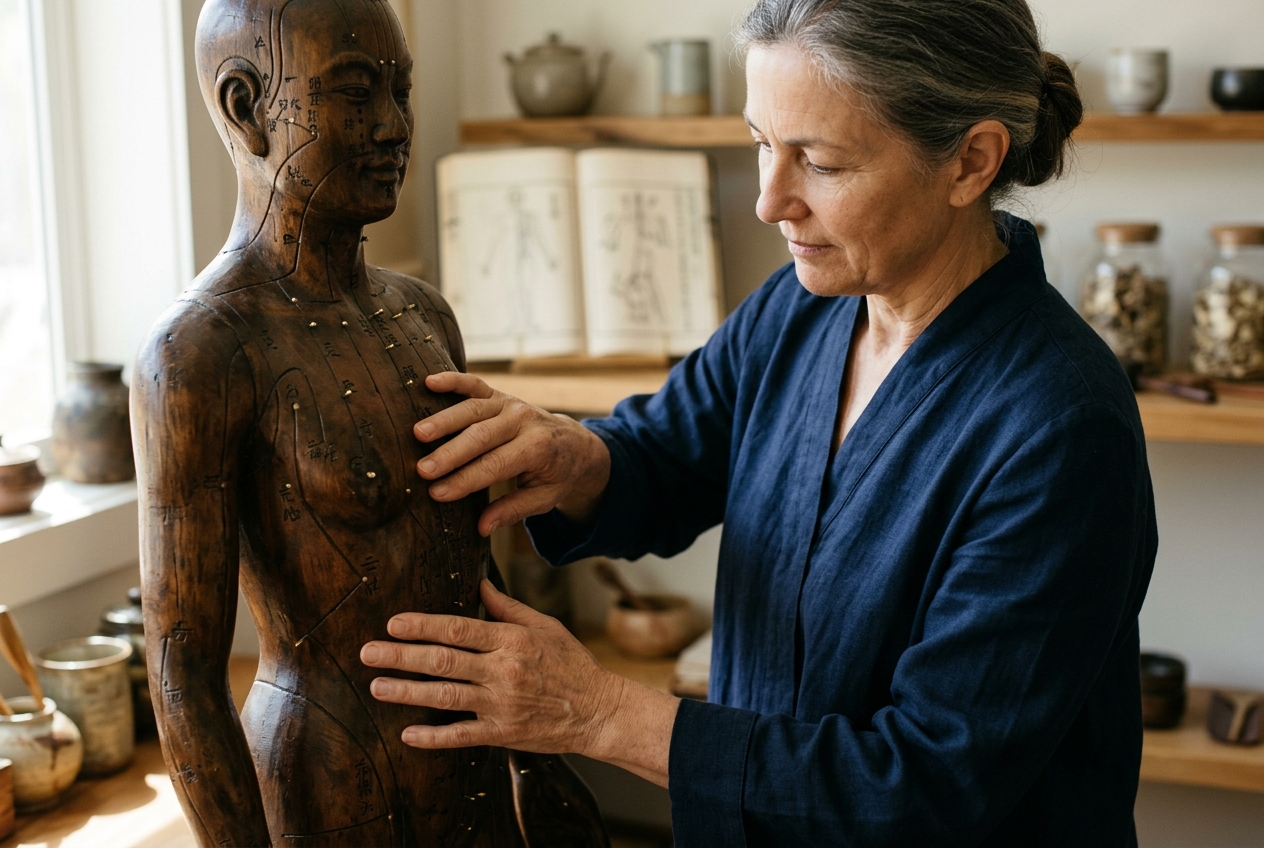
Classical East Asian medicine recognized this dilemma more than two millennia ago. Rather than viewing the human body as an assemblage of isolated, interchangeable parts, ancient physicians recognized that systemic homeostasis depends on overarching functional substrates: solid metabolic reservoirs, hollow processing conduits, energetic drivers, circulating fluids, tensile sinews, vascular pathways, structural bones, and the deep neural and hematological matrix known as marrow. To treat disorders that cut across entire tissue classes, classical practitioners did not merely needle local symptoms; they engaged specific physiological switchboards known as the Eight Influential Points (Ba Hui Xue, 八會穴), also historically designated as the "Hui-Meeting Points."
First codified in the foundational Han dynasty medical treatise, the Nan Jing (The Classic of Difficult Issues), these eight anatomical nodes represent master regulatory sites. Modern neurobiology, fascial anatomy, and microvascular research increasingly reveal why: these points sit at critical intersections of dense myofascial planes, major autonomic plexuses, and specialized mechanosensitive receptor zones. Understanding their functional architecture offers a clinically rigorous, practical roadmap for restoring somatic equilibrium.
1. Classical Origins and the Theoretical Matrix of Chapter 45
The earliest systematic formulation of the Eight Influential Points appears in the 45th Difficulty (Nan) of the Nan Jing:
“The solid organs (Zang) have their meeting point; the hollow organs (Fu) have their meeting point; the sinews (Jin) have their meeting point; the marrow (Sui) has their meeting point; the blood (Xue) has their meeting point; the bones (Gu) have their meeting point; the vessels (Mai) have their meeting point; the Qi has its meeting point. When illness resides in the interior, treat the corresponding meeting point.”
Classical East Asian physiology operates through an intricate taxonomy of tissue affinities (Ti He). The Nan Jing established that systemic diseases are not always confined to a single meridian pathway; instead, systemic pathology often attacks an entire functional category of tissue. For instance, generalized muscular flaccidity or joint stiffness is not merely a local pathology of the knee or shoulder, but a systemic disturbance of the Jin (sinews and fascia). Generalized arterial stiffness or circulatory irregularities reflect a global disturbance of the Mai (vessels).
The World Health Organization (WHO) Standard Acupuncture Point Nomenclature identifies these eight specific locations across six distinct meridian channels and two extraordinary vessels. When stimulated, each point elicits a somato-visceral or neuro-fascial cascade that reverberates through its corresponding tissue network.
2. Anatomical Foundations and Neurobiological Mechanisms of the Eight Nodes
To appreciate the clinical potency of the Ba Hui Xue, each point must be analyzed through both its traditional tissue correspondence and its contemporary neuroanatomical and biomechanical mechanisms.
                  THE EIGHT INFLUENTIAL POINTS

                       [ CV17: Qi / Breath ]
                         (Sternum Midline)
                                |
         [ CV12: Fu / Digestion ]    [ LR13: Zang / Metabolism ]
            (Upper Epigastrium)         (Free End of 11th Rib)
                                |
         [ BL11: Gu / Bone ]         [ BL17: Xue / Diaphragm ]
            (T1 Vertebra Level)         (T7 Vertebra Level)
                                |
         [ LU9: Mai / Vessels ]      [ GB34: Jin / Sinews ]
            (Radial Wrist Crease)       (Below Fibular Head)
                                |
                       [ GB39: Sui / Marrow ]
                         (Above Outer Ankle)
1. LR13 (Zhangmen / Chapter Gate) — The Influential Point of the Zang (Solid Organs)
- Traditional Role: Governs the five solid, parenchymal organs (Liver, Heart, Spleen, Lung, Kidney) responsible for manufacturing, transforming, and storing essential vital substances.
- Anatomical Topography: Located on the lateral aspect of the torso, directly below the free border of the eleventh floating rib.
- Neurofascial Substrate: Pierces the external and internal oblique muscles and the transversus abdominis. Innervated by the tenth and eleventh intercostal nerves.
- Biomechanical & Physiological Resonance: LR13 rests directly over the hypochondriac fascial ring, interfacing with the hepatophrenic ligament on the right and the splenorenal ligaments on the left. Studies in connective tissue mechanotransduction and acupoints demonstrate that mechanical torque applied at the costal margin induces interstitial fluid displacement across the subdiaphragmatic peritoneal fascia, regulating visceral perfusion and down-regulating sympathetic outflow to the adrenal glands and hepatic parenchyma.
2. CV12 / RN12 (Zhongwan / Middle Cavity) — The Influential Point of the Fu (Hollow Organs)
- Traditional Role: Master node for the six hollow, tubular organs (Stomach, Small Intestine, Large Intestine, Gallbladder, Urinary Bladder, San Jiao) responsible for ingestion, digestion, absorption, and excretion.
- Anatomical Topography: On the anterior median line of the upper abdomen, precisely halfway between the belly button and the base of the sternum (four proportional units above the umbilicus).
- Neurofascial Substrate: Situated along the linea alba, over the pre-peritoneal adipose cushion. Innervated anteriorly by the seventh and eighth thoracic intercostal nerves, with deep reflex arcs linking directly to the celiac plexus and the anterior vagal trunk.
- Biomechanical & Physiological Resonance: Sustained compression at CV12 activates the somato-autonomic reflex arcs, modulating gastric myoelectric activity. Mechanoreceptor stimulation along the linea alba triggers dorsal motor vagal efferents, promoting coordinated peristalsis, gastrin secretion, and pyloric sphincter relaxation.
3. CV17 / RN17 (Danzhong / Chest Center) — The Influential Point of Qi (Dynamic Breath & Vital Energy)
- Traditional Role: Gathers and distributes the Zong Qi (Pectoral / Ancestral Qi), regulating cardiac output, pulmonary ventilation, and emotional equilibrium across the diaphragm.
- Anatomical Topography: On the anterior midline of the sternum, directly level with the fourth intercostal space (traditionally in the hollow between the nipples in males).
- Neurofascial Substrate: Overlies the sternal body and the dense pre-sternal connective tissue fascia, innervated by anterior cutaneous branches of the fourth intercostal nerve.
- Biomechanical & Physiological Resonance: CV17 serves as the structural crossroads of the pectoralis major fascial envelopes and the internal thoracic vascular bundle. Afferent sensory signaling from sternal mechanoreceptors projects through the thoracic spinal cord to modulate baroreceptor sensitivity and cardiac vagal tone, making it the premier somatic switch for alleviating acute autonomic hyperarousal and hyperventilation.
4. BL17 (Geshu / Diaphragm Shu) — The Influential Point of Blood (Xue)
- Traditional Role: The central reservoir for regulating hemodynamics, blood rheology, erythropoiesis, and clearing vascular blood stasis throughout the organism.
- Anatomical Topography: In the upper-middle back, 1.5 proportional finger-widths lateral to the lower border of the spinous process of the seventh thoracic vertebra (T7), level with the inferior angle of the scapula.
- Neurofascial Substrate: Deep to the trapezius, latissimus dorsi, and rhomboid major muscles, situated over the longissimus thoracis. Innervated by posterior rami of the seventh and eighth thoracic spinal nerves.
- Biomechanical & Physiological Resonance: BL17 correlates anatomically with the somatic projection zone of the diaphragm and the entry of the splanchnic circulatory bed. Applying pressure here alters microvascular perfusion through sympathetic modulation of the thoracic ganglia, influencing splenic blood reserve filtration and stimulating systemic microcirculatory flow, as documented in extensive acupuncture neurobiology literature.
5. GB34 (Yanglingquan / Yang Mound Spring) — The Influential Point of Sinews (Jin)
- Traditional Role: Regulates the entire musculoskeletal myofascial tensegrity web—including tendons, ligaments, deep fascial sheaths, and joint capsules—alleviating contractures, stiffness, and motor impairment.
- Anatomical Topography: On the outer aspect of the lower leg, in the tender depression situated anterior and inferior to the prominence of the head of the fibula.
- Neurofascial Substrate: Situated at the origin of the peroneus (fibularis) longus muscle, immediately adjacent to the bifurcation of the common fibular (peroneal) nerve into its superficial and deep branches.
- Biomechanical & Physiological Resonance: GB34 is arguably the most potent biomechanical regulatory point in the peripheral nervous system. Stimulation triggers high-threshold mechanoreceptors within the tendon-bone insertion zones, modulating Golgi tendon organ feedback loops, terminating excessive muscle spindle reflex activity, and restoring elasticity to chronically contracted myofascial chains throughout the kinetic chain.
6. LU9 (Taiyuan / Great Abyss) — The Influential Point of the Vessels and Pulse (Mai)
- Traditional Role: Master node for arterial tone, vascular integrity, endothelial health, and the harmonic propagation of the arterial pulse wave.
- Anatomical Topography: At the radial end of the transverse crease of the wrist, in the anatomical depression directly between the radial artery and the tendon of the abductor pollicis longus.
- Neurofascial Substrate: Located directly over the radial artery and adjacent to the lateral antebrachial cutaneous nerve and radial nerve terminal branches.
- Biomechanical & Physiological Resonance: Gentle, rhythmic pulsatile compression at LU9 stimulates arterial baroreceptors and induces local shear-stress-mediated release of endothelial nitric oxide (eNO). This triggers local and systemic vasodilation, smooth muscle relaxation in peripheral arterioles, and normalization of blood pressure waveforms.
7. BL11 (Dazhu / Great Shuttle) — The Influential Point of Bone (Gu)
- Traditional Role: Governs the structural integrity, mineralization, cellular turnover, and joint interfaces of the skeletal system.
- Anatomical Topography: On the upper back, 1.5 proportional finger-widths lateral to the lower border of the spinous process of the first thoracic vertebra (T1).
- Neurofascial Substrate: Traverses the trapezius and rhomboideus minor to rest over the splenius cervicis and longissimus cervicis. Innervated by dorsal rami of the first and second thoracic nerves.
- Biomechanical & Physiological Resonance: Positioned at the cervicothoracic junction—the biomechanical pivot between the mobile cervical spine and the rigid thoracic cage—BL11 exhibits high concentrations of periosteal nerve endings. Stimulation here produces afferent neuro-reflexive inputs that downregulate inflammatory cytokines involved in osteoarticular degradation while relieving structural strain across the axial skeleton.
8. GB39 (Xuanzhong / Suspended Bell) — The Influential Point of Marrow (Sui)
- Traditional Role: Nourishes the spinal cord, cerebral matrix ("Sea of Marrow"), and the hematopoietic bone marrow responsible for stem cell genesis and structural bone density.
- Anatomical Topography: On the outer aspect of the lower leg, three proportional finger-widths directly above the tip of the external ankle bone (lateral malleolus), in the soft groove between the posterior border of the fibula and the peroneus longus/brevis tendons.
- Neurofascial Substrate: Overlies the fibular periosteum and the superficial fibular (peroneal) nerve.
- Biomechanical & Physiological Resonance: In classical Chinese medical theory, "Marrow" encompasses both the central nervous system (brain and spinal cord) and hematopoietic bone marrow. GB39's location on the distal fibula provides direct access to periosteal somatic afferents linked to ascending spinothalamic tracts, activating descending analgesic and neuroprotective pathways within the periaqueductal gray (PAG) matter of the brainstem.
3. Somatosensory Mapping: Point Navigation & Palpation
Finding these influential nodes does not require surgical instruments or complex measurement rods; your own hands, guided by anatomical contours, are the primary instruments of palpation. When traversing these landmarks, explore with slow, deliberate pressure.
When you arrive at the correct functional node, you will experience the distinct somatic sensation classical texts describe as De Qi (得氣)—a characteristic deep, dull ache, subtle tingling, mild thermal spreading, or pleasant heaviness.
4. Key Influential Points for Immediate Clinical Self-Regulation
While all eight points possess specialized tissue governance, three specific points serve as accessible, high-yield interventions for daily physiological strain:
Point 1: GB34 (Yanglingquan) — The Total-Body Fascial Unwind
- Where to Find It: Sit with your knees bent at 90 degrees. Slide your fingers down the outer side of your lower leg until you encounter the distinct, hard, marble-sized bony knob just below the outer corner of the knee (the head of the fibula). Slide your thumb forward and slightly downward into the soft muscular depression immediately below this knob.
- What You Will Feel: A distinct, sharp, satisfying ache that often radiates down the outer shin or into the foot. This confirms engagement with the common fibular nerve and the fascial junction.
- How to Stimulate: Apply firm, perpendicular pressure using the tip or pad of your thumb. Maintain sustained, steady compression for 90 to 120 seconds while slowly rotating the foot at the ankle in gentle circles to engage the tendon fibers beneath your thumb.
- Primary Indications:
- Alleviating tension headaches stemming from tight trapezius and neck lines.
- Relieving chronic tightness along the iliotibial (IT) band and lateral hip.
- Releasing post-exercise muscular stiffness and joint contractures.
Point 2: CV17 (Danzhong) — The Diaphragmatic & Autonomic Reset
- Where to Find It: Place your index and middle fingers directly in the center of your chest along the bone (the sternum). Trace vertically to find the horizontal level of your fourth intercostal space—roughly level with the armpits or the fourth rib junction. You will feel a small, natural dip or tender notch in the breastbone.
- What You Will Feel: Marked tenderness, a sense of localized pressure, or a sudden, reflexive impulse to take a spontaneous, deep inhalation.
- How to Stimulate: Avoid aggressive poking. Instead, use the flat pad of two fingers or your thumb to apply gentle, warm, circular dispersion over the sternal bone. Maintain this slow friction-rub for 2 full minutes while synchronizing with deep, diaphragmatic breathing (4-second inhale through the nose, 6-second exhale through pursed lips).
- Primary Indications:
- Halting acute stress-induced breathlessness and chest constriction.
- Alleviating postural tightness caused by hours of slouching over keyboards.
- Regulating nervous palpitations and high emotional irritability.
Point 3: LU9 (Taiyuan) — The Microvascular & Arterial Unburdening
- Where to Find It: Turn your palm upward. Look at the crease where your wrist meets your hand. Follow the crease outward toward the thumb side. Place your fingertip in the deep hollow directly between the pulsing radial artery and the prominent, taut tendon on the outer edge of your wrist.
- What You Will Feel: A rhythmic, pulsing sensation beneath your finger accompanied by a mild, spreading warmth across the base of your thumb and thenar eminence.
- How to Stimulate: Use your opposite thumb to apply gentle, sustained ischemic pressure directed slightly inward and upward toward the center of the wrist. Maintain a soft, pulsing rhythm for 60 to 90 seconds per side.
- Primary Indications:
- Soothing repetitive strain injury (RSI), carpal tunnel syndrome, and wrist fatigue.
- Enhancing peripheral circulation in chronically cold hands and fingers.
- Modulating elevated arterial pulse rates caused by mental overwork.
5. Clinical Protocol: The Neuro-Fascial Reset for Desk-Bound Strain and Autonomic Decompensation
Modern computer work induces a recognizable postural-autonomic syndrome: forward head posture, anterior chest collapse, diaphragmatic restriction, poor pelvic-abdominal circulation, and chronic myofascial contracture along the spine and legs.
The following four-step clinical sequence combines four Influential Points to re-establish postural balance, improve thoracic circulation, and reset autonomic tone:
The Step-by-Step Protocol:
-
Step 1: Release Peripheral Fascial Tension at GB34 (90 Seconds per Leg) * Position: Seated comfortably in a supportive chair with feet flat on the floor. * Action: Locate GB34 below the outer knee. Apply deep, firm thumb pressure into the depression below the fibular head. Hold for 90 seconds while gently flexing and extending your ankle. Repeat on the opposite leg. * Physiological Effect: Reduces spinal reflex hyperexcitability and releases the lateral kinetic chain.
-
Step 2: Expand the Anterior Thorax and Reset Autonomic Rhythm at CV17 (2 Minutes) * Position: Seated upright with the spine elongated and shoulders dropped. * Action: Place the pads of your middle and index fingers on the center of the sternum at CV17. Apply moderate pressure while performing slow, clockwise circular friction. Inhale deeply into the belly for 4 seconds, expand the ribs sideways, and exhale slowly for 6 seconds. * Physiological Effect: Opens the anterior fascial chain, frees diaphragmatic movement, and stimulates parasympathetic vagal outflow.
-
Step 3: Decompress the Mid-Thoracic Spine and Circulatory Pool at BL17 (90 Seconds) * Position: Reclined on a mat with two tennis balls or an acupressure sphere placed beneath the mid-back (level with the lower edge of the shoulder blades, flanking the spine). * Action: Allow your body weight to rest gently onto the tools at the T7 level (BL17). Keep the knees bent and breathe calmly for 90 seconds. * Physiological Effect: Relieves tension at the costovertebral joints, mobilizes the posterior diaphragm, and supports visceral microcirculation.
-
Step 4: Restore Systemic Vasomotor Tone at LU9 (60 Seconds per Wrist) * Position: Seated with arms resting comfortably in your lap. * Action: Grasp your left wrist with your right hand, positioning your right thumb over LU9 beside the radial pulse. Apply gentle, rhythmic pressure for 60 seconds while taking slow, natural breaths. Repeat on the right wrist. * Physiological Effect: Encourages peripheral vasodilation and balances the cardiovascular baroreflex.
6. Safety Parameters, Contraindications, and Clinical Boundaries
While non-invasive acupressure on the Eight Influential Points is safe for general self-regulation, certain physiological boundaries and medical contraindications must be respected:
[!WARNING]
Critical Clinical Precautions
- Pregnancy: Extreme caution is required with deep, strong abdominal stimulation (e.g., CV12 / Zhongwan) or forceful lower-extremity manipulation (such as aggressive downward stimulation on GB39 or GB34). Avoid vigorous downward pressure during all trimesters.
- Vascular Integrity: When palpating LU9 (Taiyuan), never use sharp fingernails or excessive force that occludes the radial artery. Pressure should be non-occlusive, gentle, and relaxing.
- Local Skin & Tissue Pathology: Never apply direct compression over broken skin, active infections, deep vein thrombosis (DVT) sites, unhealed surgical incisions, or acute bone fractures (especially near BL11 or LR13's floating ribs).
- Appropriate Force & Pressure Calibration: Acupressure should feel like a deep, therapeutic ache (the De Qi phenomenon), never sharp, electric, or agonizing. If you experience bruising, dizziness, or sharp stabbing pain, reduce your pressure immediately.
- When to Seek Medical Attention: Self-administered acupressure is designed for functional tension and somatic regulation. It is not a substitute for emergency medical care. Persistent chest pain, unexplained shortness of breath, sudden severe abdominal pain, acute neurological deficits, or rapid unexplained weight loss require immediate medical evaluation by a licensed physician.
7. Today's Takeaway: The Two-Minute Diaphragmatic Decompression
You do not need an hour of leisure to experience the systemic regulatory power of the Eight Influential Points. If you are experiencing mid-day mental strain or shallow breathing right now, perform this simple 2-minute reset:
- Locate CV17 (Danzhong): Place your index and middle fingertips at the center of your chest bone, level with your fourth intercostal space.
- Apply Gentle Circular Pressure: Press firmly enough to feel the tender dip beneath the bone, and begin slow, gentle, nickel-sized circular massage.
- Engage 4–7–8 Breathing: Inhale slowly through your nose for 4 seconds, hold your breath gently for 7 seconds, and exhale steadily through your mouth for 8 seconds. Complete four breath cycles (approximately two minutes).
Within 120 seconds, the mechanoreceptors in your sternal fascia will begin to modulate your autonomic nervous system, quieting sympathetic fight-or-flight activity, freeing your diaphragm, and restoring mental clarity.
Technical Appendix: Summary Table of the Eight Influential Points
| Point Code | Pinyin Name | English Translation | Resonant Substrate / Tissue | Primary Anatomical Landmark | Neurological / Fascial Affinity |
|---|---|---|---|---|---|
| LR13 | Zhangmen | Chapter Gate | Zang (Solid Organs) | Directly below the free tip of the 11th rib | 10th/11th Intercostal Nerves; Peritoneal Fascia |
| CV12 | Zhongwan | Middle Cavity | Fu (Hollow Organs) | 4 cun above umbilicus on midline | Celiac Plexus; Anterior Vagal Trunk via Linea Alba |
| CV17 | Danzhong | Chest Center | Qi (Breath & Energy) | Center of sternum, 4th intercostal space | Pectoral Fascia; 4th Intercostal Nerve; Baroreflex |
| BL17 | Geshu | Diaphragm Shu | Xue (Blood & Circulation) | 1.5 cun lateral to lower border of T7 spine | Splanchnic Bed Reflex; Posterior Thoracic Rami |
| GB34 | Yanglingquan | Yang Mound Spring | Jin (Sinews & Tendons) | Depression antero-inferior to fibular head | Common Fibular Nerve; Golgi Tendon Organs |
| LU9 | Taiyuan | Great Abyss | Mai (Vessels & Pulse) | Radial wrist crease, lateral to radial artery | Radial Artery Mechanoreceptors; Endothelial Nitric Oxide |
| BL11 | Dazhu | Great Shuttle | Gu (Bones & Joints) | 1.5 cun lateral to lower border of T1 spine | Cervicothoracic Periosteal Afferents; T1/T2 Dorsal Rami |
| GB39 | Xuanzhong | Suspended Bell | Sui (Marrow & Brain) | 3 cun superior to tip of lateral malleolus | Superficial Fibular Nerve; Fibular Periosteum |
References and Authoritative Resources
- World Health Organization: WHO Standard Acupuncture Point Locations in the Western Pacific Region — The definitive global anatomical reference establishing standardized point locations across all human meridian systems.
- Nan Jing (The Classic of Difficult Issues) on Wikipedia — Historical background, authorship, and classical textual lineages of the 81 Difficulties that codified early Chinese medical physiology.
- Langevin, H. M., et al. (2001). "Biomechanical response to acupuncture needling in humans." Journal of Applied Physiology via PubMed — Seminal research demonstrating that acupoint stimulation mechanically couples with collagenous connective tissue planes to initiate cellular signaling.
- National Center for Biotechnology Information (NCBI): Neurobiological Mechanisms of Acupuncture via PMC — Comprehensive peer-reviewed review detailing the somatosensory pathways, endorphin release mechanisms, and autonomic nervous system effects of acupuncture point activation.
- PubMed Central: Somato-autonomic Reflex Mechanisms of Acupoint Stimulation — Rigorous clinical and laboratory documentation of the spinal and vagal reflex pathways engaged when stimulating torso and extremity acupoints.
- World Health Organization Traditional Medicine Strategy — Global framework for integrating evidence-based traditional medicine practices into modern primary healthcare systems.