Powernews Section Archive

Quantum Computing Series Archive

Page 7 of 11
Quantum Process Tomography: Reconstructing Dynamical Superoperators and Process Matrices in Quantum Circuits
QUANTUM COMPUTING

Quantum Process Tomography: Reconstructing Dynamical Superoperators and Process Matrices in Quantum Circuits

The central challenge in quantum information processing is not merely creating delicate superpositions, but ensuring that quantum logic gates execute their target unitary operations with near-zero error. In classical computing, a logic gate operates deterministically on binary voltages; in a quantum system, environmental coupling, control pulse miscalibrations, and non-Markovian memory effects induce decoherence, transforming an intended unitary rotation $\mathcal{U}(\rho) = U \rho U^\dagger$ into a general open quantum dynamical channel $\mathcal{E}(\rho)$.

⚡ 9,925 Tokens • $0.00 Cost
Projected Entangled Pair States: Scaling 2D Tensor Networks and Simulating Strongly Correlated Quantum Systems
QUANTUM COMPUTING

Projected Entangled Pair States: Scaling 2D Tensor Networks and Simulating Strongly Correlated Quantum Systems

The quest to design room-temperature superconductors, optimize nitrogen-fixing catalysts for sustainable agriculture, and build unhackable quantum networks hinges on a single, notorious bottleneck: quantum systems are unimaginably difficult to simulate on classical supercomputers. If you attempt to track the quantum state of just a few hundred interacting electrons on a square grid using brute-force mathematics, the number of required memory variables exceeds the estimated count of atoms in the observable universe. For decades, this exponential wall rendered the simulation of two-dimensional quantum materials virtually impossible.

⚡ 6,807 Tokens • $0.00 Cost
Quantum Principal Component Analysis: Decomposing Density Matrix Eigenspaces and Accelerating Dimensionality Reduction Via Phase Estimation
QUANTUM COMPUTING

Quantum Principal Component Analysis: Decomposing Density Matrix Eigenspaces and Accelerating Dimensionality Reduction Via Phase Estimation

### By extracting the hidden geometric axes of massive datasets in logarithmic time, quantum principal component analysis offers an exponential leap over classical computing—turning intractable multidimensional mysteries into solvable quantum states.

⚡ 6,867 Tokens • $0.00 Cost
Quantum Non-Demolition Measurement: Evading Quantum Backaction to Read Qubit Observables Without State Destruction
QUANTUM COMPUTING

Quantum Non-Demolition Measurement: Evading Quantum Backaction to Read Qubit Observables Without State Destruction

Every measurement in our classical everyday world feels essentially free. Reading the speedometer of a car does not alter its velocity; glancing at a clock does not push its hands forward; taking a photograph of an apple does not transform it into an orange. In the subatomic realm, however, the simple act of looking is notoriously violent. Standard quantum mechanics dictates that when you measure a particle, you irrevocably alter it. To detect a photon, conventional detectors absorb and annihilate it. To locate an electron, you must bounce high-energy radiation off its surface, kicking it violently off its original trajectory.

⚡ 7,076 Tokens • $0.00 Cost
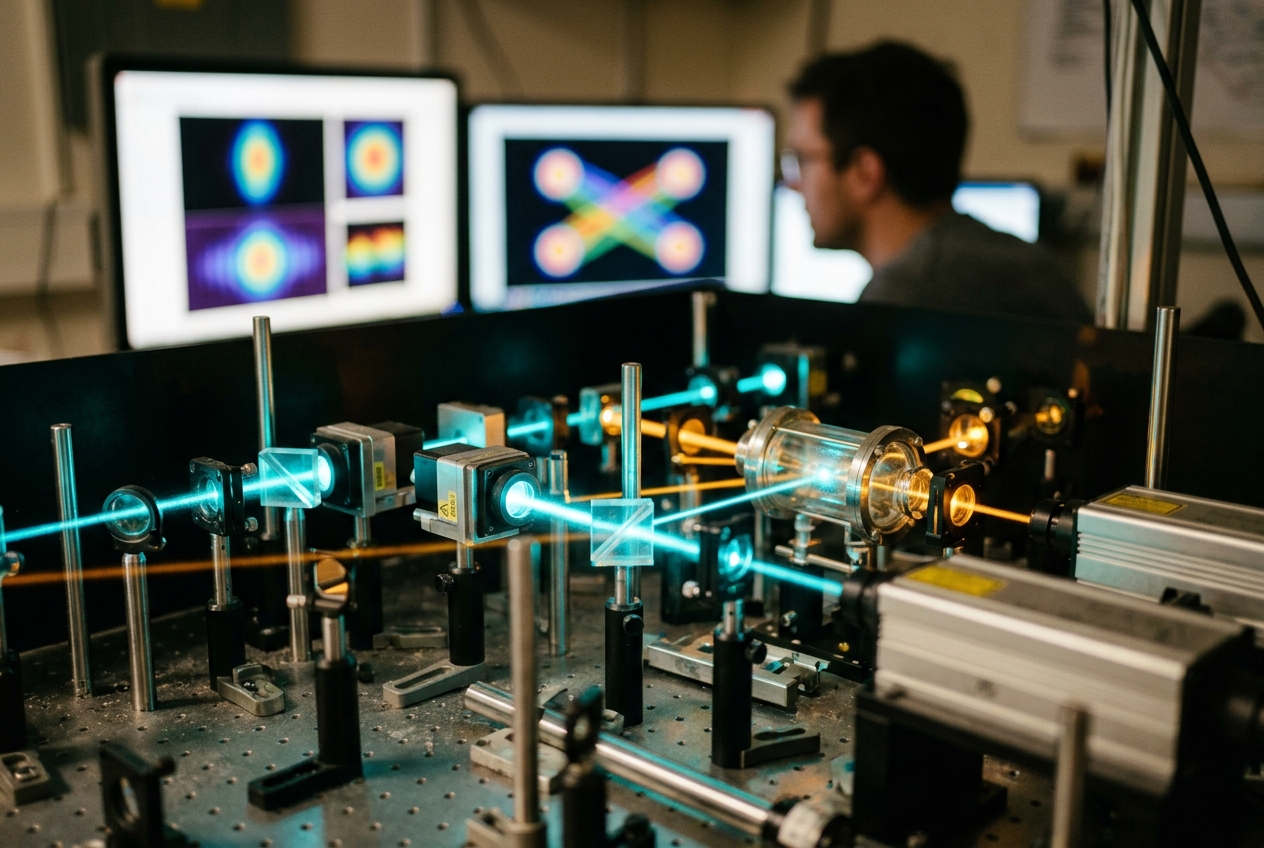
Neutral Atom Quantum Computing: Harnessing Rydberg Blockade and Optical Tweezer Arrays for Scalable Coherent Architectures
QUANTUM COMPUTING

Neutral Atom Quantum Computing: Harnessing Rydberg Blockade and Optical Tweezer Arrays for Scalable Coherent Architectures

The global cryptographic infrastructure that secures trillions of dollars in daily financial transactions, shields state secrets, and guarantees digital privacy rests on an asymmetric mathematical wager. Factoring a 2,048-bit number into its prime components would take the world’s most powerful classical supercomputer thousands of years of continuous calculation. A fully fault-tolerant quantum computer could unravel that same mathematical knot in under an afternoon.

⚡ 6,634 Tokens • $0.00 Cost
Majorana Zero Modes: Engineering Non-Abelian Anyons in Topological Nanowires for Hardware-Protected Qubits
QUANTUM COMPUTING

Majorana Zero Modes: Engineering Non-Abelian Anyons in Topological Nanowires for Hardware-Protected Qubits

Every digital transaction safeguarding the modern financial ecosystem, every encrypted diplomatic cable, and every secure cloud server rests upon a fragile mathematical asymmetry. Classical cryptography relies on mathematical problems—such as prime factorization and elliptic-curve discrete logarithms—that would require a classical supercomputer millennia of continuous computation to unravel. A full-scale, fault-tolerant quantum computer running Shor’s algorithm could dismantle these safeguards in a matter of hours. Yet, across the globe, the physical machines built to harness this power remain trapped in a state of delicate vulnerability.

⚡ 6,174 Tokens • $0.00 Cost
Lindblad Master Equation: Modeling Markovian Open Dynamics and Environmental Dissipation in Quantum Systems
QUANTUM COMPUTING

Lindblad Master Equation: Modeling Markovian Open Dynamics and Environmental Dissipation in Quantum Systems

The multi-billion-dollar race to build a functional quantum computer is often described as a quest to harness the bizarre magic of quantum mechanics—superposition, entanglement, and wave-particle duality. We are told that these machines will unravel the electronic structure of complex nitrogen-fixing enzymes, design solid-state electrolytes for next-generation batteries in hours, and break the public-key RSA cryptography underpinning global finance. Yet inside the gleaming dilution refrigerators of modern quantum laboratories, the primary challenge is not mastering pure quantum logic; it is waging an unrelenting war against the surrounding environment.

⚡ 9,625 Tokens • $0.00 Cost
← Previous Page Page 7 / 11 Next Page →