Majorana Zero Modes: Engineering Non-Abelian Anyons in Topological Nanowires for Hardware-Protected Qubits
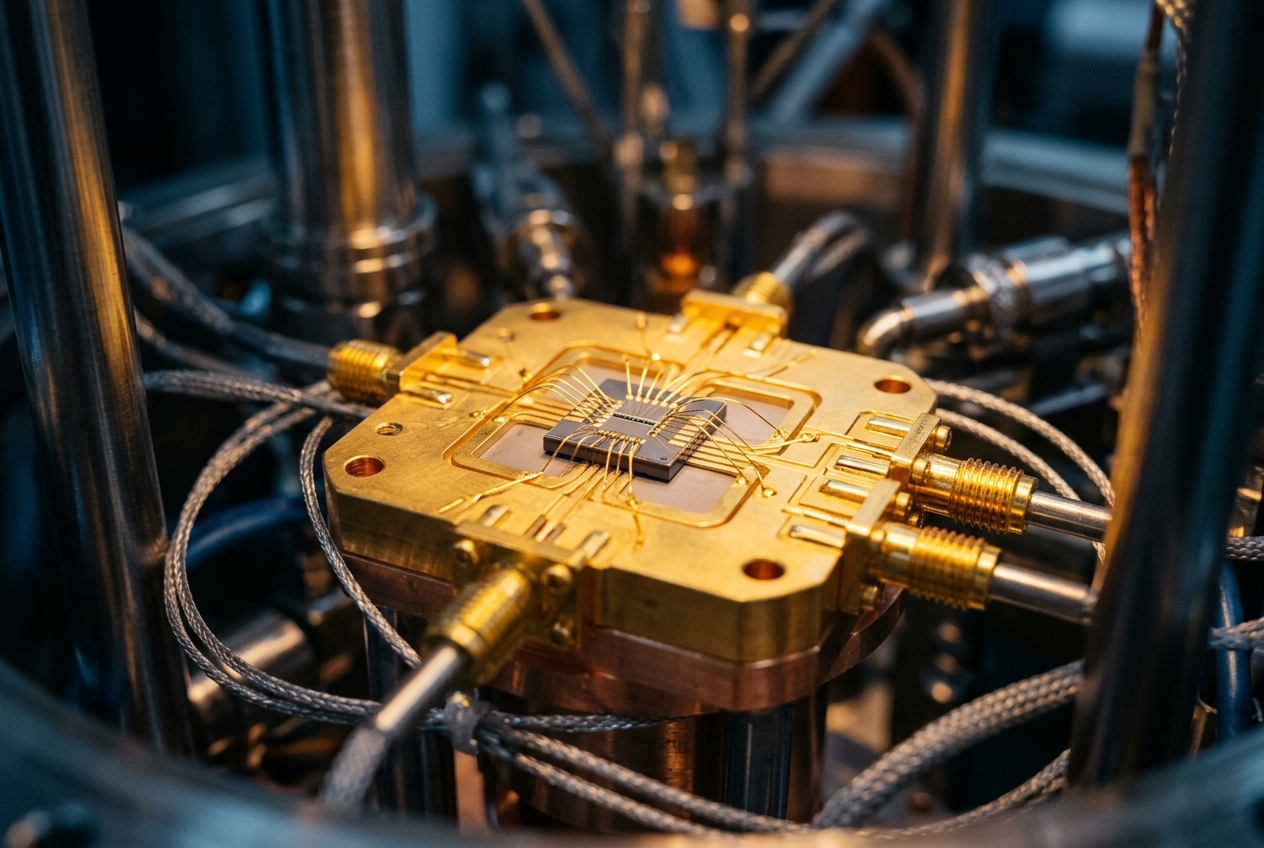
Current prototype quantum computers are noisy and hyper-sensitive. Whether constructed from superconducting circuits or trapped atomic ions, their fundamental units of information—qubits—are incessantly corrupted by stray thermal vibrations, fluctuating electromagnetic fields, and materials defects. To keep these systems coherent, engineers must construct elaborate, resource-intensive error-correction codes, bundling thousands of imperfect physical qubits together just to yield a single, stable "logical" qubit.
There is, however, an entirely different path. Deep within the mathematics of condensed matter physics lies the blueprint for a qubit that does not require continuous active correction because it cannot be perturbed by local noise. This is the realm of Majorana zero modes (MZMs): elusive, emergent quasiparticles that effectively split an electron into two spatially separated halves. By encoding quantum information non-locally across physical space, topological quantum computing promises hardware-level immunity to environmental noise. If physicists and materials engineers can master these topological boundary states, they will not merely iterate on existing computing paradigms—they will unlock the true, fault-tolerant era of quantum information science.
1. The Idea in Plain English: Splitting the Indivisible
In conventional computing, a bit is a macroscopic physical state: a switch that is definitively open (0) or closed (1). In quantum computing, as detailed across the foundational curricula of MIT OpenCourseWare, a qubit exists as a quantum superposition of states. A common intuitive analogy is a spinning coin: while rotating on a table, it is neither purely heads nor tails, but a dynamic combination of both possibilities until an observation forces it to land.
The fatal flaw of this spinning coin is its vulnerability. The slightest gust of wind, a microscopic vibration of the table, or a stray electromagnetic wave will knock the coin over prematurely, causing an irreversible loss of information known as quantum decoherence.
Conventional Qubit (Local Storage):
Local Noise [Lightning Bolt] ---> [ Qubit State ] ---> State Destroyed!

Topological Majorana Qubit (Non-Local Storage):
Local Noise [Lightning Bolt] ---> [ Majorana Mode γ₁ ] . . . . . [ Majorana Mode γ₂ ]
                                  (Half-Fermion)                 (Half-Fermion)
                                  \____________________________________________/
                                         Non-Local Quantum State Preserved!
Topological quantum computing solves this problem through spatial non-locality. Imagine tearing a page containing a secret message directly down the middle. If you place the left half in London and the right half in Tokyo, an adversary in London who steals or destroys the left half learns absolutely nothing about the message, nor can local noise in London alter the text that requires both halves to be read simultaneously.
Majorana zero modes are the physical realization of this torn page. In nature, an electron is an indivisible elementary particle carrying a negative fundamental charge and a half-integer spin. However, within specialized, low-dimensional solid-state environments, the collective behavior of billions of interacting particles can cause an electron’s quantum wave function to fractionate. The electron emerges as two distinct, zero-energy quasiparticles pinned to opposite ends of a semiconductor nanowire.
Because these two boundary modes together define only a single quantum state, no local perturbation—such as a stray magnetic field striking one end of the wire—can flip the stored information. To alter the state, an environmental disturbance would have to act coherently and simultaneously on both distant ends of the wire. This geometric immunity is known as topological protection.
2. How It Actually Works: The Mechanics of Topological Superconductivity
To understand how an electron can be split and manipulated, we must trace the physics from simple theoretical models down to atomic-scale semiconductor-superconductor interfaces.
The Kitaev 1D Toy Model
In 2001, physicist Alexei Kitaev proposed an idealized mathematical model that revealed how boundary Majoranas could emerge. Kitaev considered a one-dimensional lattice of $N$ sites occupied by spinless fermions. In standard quantum mechanics, each lattice site $j$ is governed by fermionic creation ($c_j^\dagger$) and annihilation ($c_j$) operators satisfying the canonical anticommutation relations:
$${c_j, c_k^\dagger} = \delta_{jk}, \quad {c_j, c_k} = {c_j^\dagger, c_k^\dagger} = 0$$
Kitaev’s key mathematical insight was to decompose each complex fermionic operator into two self-adjoint, real Majorana operators, denoted $\gamma_{2j-1}$ and $\gamma_{2j}$:
$$c_j = \frac{1}{2}(\gamma_{2j-1} + i\gamma_{2j}), \quad c_j^\dagger = \frac{1}{2}(\gamma_{2j-1} - i\gamma_{2j})$$
These Majorana operators are Hermitian ($\gamma_m = \gamma_m^\dagger$) and satisfy the Clifford algebra ${\gamma_m, \gamma_n} = 2\delta_{mn}$. This implies that $\gamma_m^2 = 1$; physically, a Majorana operator represents a particle that is its own antiparticle.
The tight-binding Hamiltonian for a 1D p-wave superconductor with nearest-neighbor hopping amplitude $t$, superconducting pairing gap $\Delta$, and chemical potential $\mu$ is given by:
$$H = -\sum_{j=1}^{N-1} \left( t c_j^\dagger c_{j+1} + \Delta c_j c_{j+1} + \text{h.c.} \right) - \mu \sum_{j=1}^N \left( c_j^\dagger c_j - \frac{1}{2} \right)$$
When Kitaev tuned this Hamiltonian to the special topological condition where hopping equals pairing ($t = \Delta > 0$) and the chemical potential vanishes ($\mu = 0$), the Hamiltonian rewrites in terms of Majorana operators as:
$$H_{\text{topo}} = i t \sum_{j=1}^{N-1} \gamma_{2j} \gamma_{2j+1}$$
Kitaev Chain Pairing at t = Δ, μ = 0:

Site 1            Site 2            Site 3            Site N
(γ₁ --- γ₂)       (γ₃ --- γ₄)       (γ₅ --- γ₆) ...   (γ₂N₋₁ --- γ₂N)
  |      \_________^     \_________^     \_________^          |
Unpaired                                                   Unpaired
MZM (γ₁)               Coupled Inter-Site Pairs            MZM (γ₂N)
Notice the pairing structure: the operator $\gamma_1$ at the very first site and the operator $\gamma_{2N}$ at the final site are completely absent from the Hamiltonian. They cost zero energy to excite. Together, these two spatially decoupled Majorana bound states form a single, non-local Dirac fermion:
$$d = \frac{1}{2}(\gamma_1 + i\gamma_{2N})$$
Because $d$ is non-local, the ground state of the wire is doubly degenerate (corresponding to $d^\dagger d = 0$ or $d^\dagger d = 1$). This degeneracy forms an inherently noise-protected qubit.
Physical Realization: The Oreg-Lutchyn Semiconductor Heterostructure
Spinless p-wave superconductors do not exist naturally in accessible crystalline solids. In 2010, Roman Lutchyn, Jay Sau, Sankar Das Sarma, and independently Yuval Oreg proposed a breakthrough: one could engineer an effective p-wave topological superconductor by assembling a hybrid heterostructure from standard, well-understood materials.
The physical recipe requires three precise ingredients: 1. Strong Rashba Spin-Orbit Coupling: A semiconductor nanowire made of Indium Arsenide (InAs) or Indium Antimonide (InSb). The spin-orbit interaction locks the electron’s momentum to its spin direction. 2. Proximity-Induced s-Wave Superconductivity: An epitaxial shell of a conventional s-wave superconductor, such as Aluminum (Al) or Niobium (Nb), grown directly on the nanowire facets to induce Cooper pair tunneling across the interface. 3. Zeeman Magnetic Field: An externally applied magnetic field $B$ aligned parallel to the wire axis, inducing a Zeeman splitting energy $V_Z = \frac{1}{2}g\mu_B B$.
The system is described by the Oreg-Lutchyn Hamiltonian integrated over the 1D wire coordinate $x$:
$$\mathcal{H} = \int dx \, \Psi^\dagger(x) \left[ \left(-\frac{\hbar^2}{2m^*} \partial_x^2 - \mu\right) \tau_z + \alpha_R (-i\partial_x) \sigma_y \tau_z + V_Z \sigma_x + \Delta \tau_x \right] \Psi(x)$$
where $\sigma_i$ and $\tau_i$ are Pauli matrices acting in spin and particle-hole space, respectively, $\alpha_R$ is the Rashba coupling strength, and $\Delta$ is the induced superconducting gap.
Topological Criterion for Majorana Emergence
As the external magnetic field is increased, the bulk superconducting energy gap closes and reopens, driving the system across a quantum phase transition into a topologically non-trivial state. This transition occurs when the Zeeman energy satisfies:
$$V_Z > \sqrt{\Delta^2 + \mu^2}$$
When this inequality is satisfied, the semiconductor nanowire behaves as an effective spinless p-wave topological superconductor hosting isolated, non-Abelian Majorana zero modes at its physical endpoints.
Non-Abelian Braiding and Topological Quantum Gates
Majorana zero modes are neither standard bosons nor fermions; in two spatial dimensions (or 1D networks), they behave as non-Abelian anyons, a class of quasiparticles explored extensively in modern physics research published in Nature Physics.
When two standard particles are exchanged in three dimensions, their collective quantum wave function acquires a trivial phase factor: $+1$ for bosons and $-1$ for fermions. Exchanging non-Abelian anyons, however, performs a unitary matrix rotation within the degenerate ground-state subspace.
Mathematically, the adiabatic exchange (braiding) of two adjacent Majorana modes $\gamma_i$ and $\gamma_j$ is represented by the non-Abelian braiding operator $\tau_{ij}$:
$$\tau_{ij} = \exp\left(\pm \frac{\pi}{4} \gamma_i \gamma_j\right) = \frac{1}{\sqrt{2}} \left( 1 \pm \gamma_i \gamma_j \right)$$
Because Majorana operators do not commute ($\gamma_i\gamma_j = -\gamma_j\gamma_i$), these braiding transformations are non-commutative:
$$\tau_{12} \tau_{23} \neq \tau_{23} \tau_{12}$$
This mathematical property is extraordinarily powerful. By physically dragging Majorana modes around one another in a network of intersecting nanowires (such as a T-junction or crossbar array), one executes quantum gate operations—specifically, the Clifford group operations such as the Hadamard and Phase gates. These logic gates depend solely on the topological winding number (how many times the strands crossed in spacetime) and are entirely independent of the precise speed, trajectory, or duration of the physical movement.
Experimental Signatures and the Andreev Bound State Challenge
Confirming the existence of Majorana zero modes in the laboratory requires differentiating their unique physical signatures from conventional, non-topological phenomena.
Physicists rely on two primary experimental signatures: 1. Zero-Bias Conductance Peaks (ZBCPs): In electron tunneling spectroscopy, when an electron tunnels from a normal metal lead into a topological superconductor hosting an MZM, resonant Andreev reflection induces a zero-bias differential conductance peak precisely quantized at $G = 2e^2/h$. 2. The $4\pi$-Periodic Fractional Josephson Effect: In a Josephson junction formed between two topological superconductors, the current-phase relation is governed by single-electron tunneling rather than Cooper pair transport. The resulting supercurrent exhibits a doubled periodicity of $I(\phi) \propto \sin(\phi/2)$, repeating every $4\pi$ radians of superconducting phase difference instead of the standard $2\pi$.
However, experimental verification has faced significant hurdles. Disordered nanowires, smooth electrostatic confinement potentials, and interface impurities can create trivial, low-energy Andreev Bound States (ABS). These "quasi-Majorana" states can mimic the zero-bias conductance peaks of true topological modes without offering any non-local topological protection. Disentangling true topological MZMs from trivial ABS requires multi-terminal transport measurements, closed-loop interferometry, and rigorous demonstrations of non-Abelian exchange statistics.
3. Real-World Applications Today (2024–2026)
While fully scaled topological quantum computers remain under active development, the principles of Majorana physics and non-Abelian anyons are driving cutting-edge research across several major institutions and industries:
1. Microsoft Azure Quantum: Topological Qubit Architecture
- The Objective: Microsoft Quantum is pursuing a hardware strategy focused entirely on topological protection. Through their "Majorana 1" hardware program, they are engineering top-gated, epitaxial InAs/Al nanowire devices capable of passing the strict "Topological Gap Protocol."
- The Quantum Advantage: Instead of needing up to 10,000 physical superconducting transmon qubits to create one error-corrected logical qubit, a Majorana-based topological system could reduce this physical-to-logical footprint overhead by several orders of magnitude, making a commercial 1,000,000-qubit processor physically feasible on a single wafer.
2. QuTech and the Niels Bohr Institute: Ultra-Clean Hetero-Interfaces
- The Objective: Academic consortia at QuTech (Delft University of Technology) and the Center for Quantum Devices at the Niels Bohr Institute (Copenhagen) are refining atomic-scale shadow-wall lithography. They grow semiconductor nanowires and superconducting layers in situ under ultra-high vacuum conditions without exposing interfaces to air or etching chemicals.
- The Quantum Advantage: Eliminating interfacial disorder directly prevents the formation of accidental Andreev bound states, creating clean, pristine topological superconducting gaps that permit deterministic non-Abelian braiding.
3. Quantinuum: Algorithmic Simulation of Non-Abelian Braiding
- The Objective: Quantinuum researchers have demonstrated the simulation and creation of non-Abelian topological orders on their H-series trapped-ion quantum processors, using programmatic braiding circuits like those explored in IBM Quantum Learning.
- The Quantum Advantage: By synthesizing non-Abelian anyon statistics algorithmically within trapped-ion registers, researchers can benchmark topological error-correcting codes long before monolithic solid-state topological hardware reaches commercial maturity.
4. Advanced Materials and Catalyst Design
- The Objective: Global research initiatives in computational chemistry are designing fault-tolerant quantum simulation algorithms tailored for future topological quantum processors.
- The Quantum Advantage: Complex biological and industrial enzymes—such as the nitrogenase enzyme used in room-temperature fertilizer synthesis—contain strongly correlated transition-metal clusters (e.g., FeMo-cofactor) that classical computers cannot accurately model. A fault-tolerant topological quantum computer could simulate these molecular orbitals precisely, accelerating the discovery of energy-efficient industrial catalysts.
4. What This Means for You
It is easy to view topological condensed matter physics as an abstract realm of high-level mathematics, absolute-zero cryogenics, and microscopic wires. Yet, the successful realization of Majorana-based computing has direct implications for daily life:
- Post-Quantum Cybersecurity: The advent of fault-tolerant quantum computing will instantly obsolete current public-key infrastructure (RSA and ECC). The development of stable, scalable topological qubits accelerates the urgent timeline for governments, banks, and enterprise networks to migrate to post-quantum cryptographic standards.
- Radical Materials and Clean Energy: From ambient-temperature superconductors to more efficient solar cells and next-generation battery chemistries, simulating complex electron correlations on a quantum level will convert materials science from an empirical trial-and-error discipline into a predictive engineering science.
- Miniaturization and Real Scalability: Unlike conventional quantum architectures that require rooms full of complex microwave cabling, dilution refrigerators, and massive cryogenic support for millions of physical channels, topological hardware could drastically reduce the physical footprint of supercomputers, enabling compact, high-density quantum computing centers.
5. Today's Takeaway
The defining bottleneck of modern quantum technology is noise, and the current strategy of mitigating it with massive, brute-force error correction carries immense engineering overhead. Majorana zero modes offer a radically elegant alternative: hardware-level immunity through spatial topology. By splitting an electron’s quantum state across the boundaries of a hybrid semiconductor-superconductor wire, information is preserved not in the fragile energy state of an isolated particle, but in the indestructible geometric braiding of spacetime worldlines. If we can master these ghostlike quasiparticles, the leap from noisy laboratory prototypes to scalable, fault-tolerant supercomputers will become an engineered reality.