Lattice Surgery: Executing Fault-Tolerant Logical Gates and Boundary Measurements on Planar Surface Codes
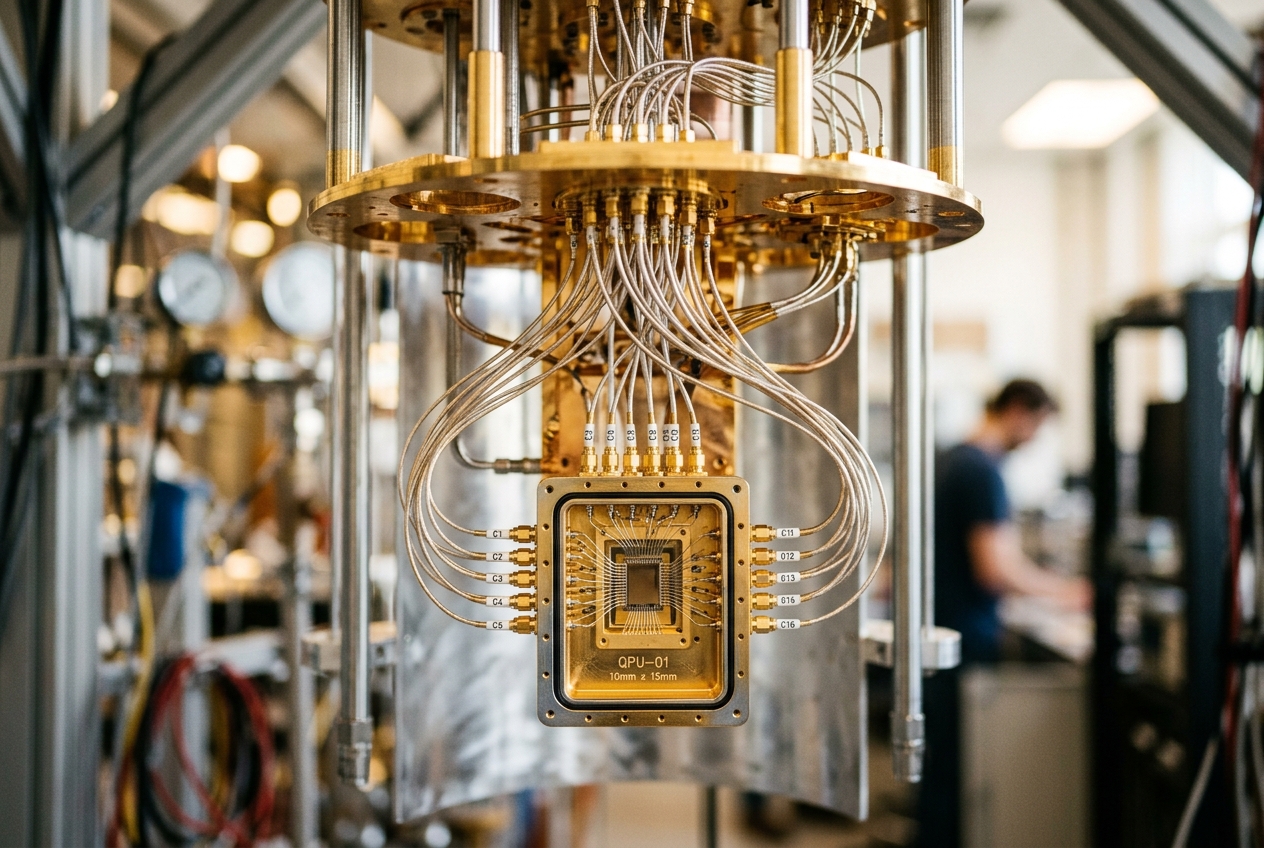
1. Opening Hook — Why You Should Care
Every transaction securing the global financial architecture—from SWIFT interbank transfers to the encrypted HTTPS session securing your personal bank login—depends on asymmetric cryptographic protocols such as RSA and elliptic-curve cryptography. These protocols remain secure solely because finding the prime factors of a 2048-bit integer would require classical supercomputers millions of core-years of relentless computation. A full-scale, fault-tolerant quantum computer running Shor's algorithm could dismantle that mathematical barrier in mere hours.
Yet, between today’s noisy quantum prototypes and that cryptographic horizon lies an engineering chasm of monumental proportions. Quantum information is astonishingly fragile. The microscopic thermal fluctuations of a dilution refrigerator, stray electromagnetic pulses, or even the trace decay of background cosmic rays can flip a fragile quantum bit—a qubit—destroying an entire computation in microseconds. In current physical devices, hardware components fail approximately once every thousand operations (an error rate around $p \approx 10^{-3}$). To execute algorithms capable of breaking public-key encryption or simulating complex molecular enzymes like nitrogenase, error rates must be driven below one part in a quadrillion ($10^{-15}$).
The only known path across this chasm is quantum error correction. By entangling dozens or hundreds of physical qubits into a single, highly coordinated collective known as a logical qubit, we can continuously detect and correct environmental noise without observing—and thus collapsing—the underlying quantum calculation.
For more than a decade, the dominant conceptual paradigm for manipulating these protected qubits required "braiding" topological defects around one another—a method that required complex, three-dimensional physical pathways that were extraordinarily difficult to implement on planar microchips. Today, an elegant geometric alternative has emerged: lattice surgery. By dynamically joining and cutting the spatial boundaries of two-dimensional qubit arrays, quantum engineers can perform universal logic deterministically, without physically moving a single particle. Understanding lattice surgery is understanding the precise mechanical blueprints upon which the industrial quantum era is currently being constructed.
2. The Idea in Plain English
To understand how lattice surgery revolutionizes quantum processing, one must first dismantle the prevailing metaphor of what a qubit is and how it behaves in an error-corrected system.
A classical bit is like a standard light switch: it is either decisively up (1) or down (0). A physical quantum bit—such as an artificial atom made from an aluminum superconducting transmon circuit or a neutral ytterbium atom suspended in an optical tweezer—is often likened to a sphere. The north pole represents 0, the south pole represents 1, and any point along the latitude or longitude represents a continuous quantum superposition. Because this state is continuous, any infinitesimal environmental disturbance nudges the state off-course, introducing an error.
       PHYSICAL CHIP SURFACE (2D)
  +-----------------------------------+
  |  [Data] --- [Ancilla] --- [Data]  |  <-- Physical qubits in a planar grid
  |    |             |          |     |
  | [Ancilla] --- [Data] --- [Ancilla]|  <-- Continuous local parity checks
  |    |             |          |     |
  |  [Data] --- [Ancilla] --- [Data]  |
  +-----------------------------------+
                   |
                   v  Topological Protection
  +-----------------------------------+
  |      LOGICAL QUBIT "PATCH"        |  <-- Single macroscopic quantum state
  |   (Defended by collective checks) |
  +-----------------------------------+
Topological surface codes overcome this vulnerability by distributing the delicate quantum state across a macroscopic chessboard of physical qubits. Instead of storing a value on a single atom, the system stores the information non-locally within the global entanglement patterns of the entire grid. Local noise might flip a single physical qubit, but as long as we inspect the parity of neighboring qubits continuously, we can pinpoint and isolate the damage before it spreads across the entire sheet.
Historically, manipulating these protected sheets of quantum fabric required creating artificial "holes" (defects) inside the lattice and physically braiding them around each other, much like braiding strands of hair. While theoretically robust, braiding in physical hardware is an architectural nightmare. Real-world quantum processors are strictly two-dimensional devices; qubits can only interact with their immediate physical neighbors. Dragging defects across a 2D surface code requires reserving vast, empty "highways" on the chip, dramatically inflating the qubit overhead and degrading the effective code distance.
Lattice surgery discards the braiding paradigm entirely. Instead of weaving defects through the interior of the code, it treats logical qubits as discrete planar square patches. When two logical qubits need to interact—such as when executing an entangling Controlled-NOT (CNOT) operation—we simply align their outer edges, activate an auxiliary line of boundary qubits to temporarily "sew" the two patches together into a single enlarged sheet, perform a joint parity measurement along the seam, and then "cut" the seam apart.
3. How It Actually Works — The Mechanics
To appreciate the engineering beauty of lattice surgery, we must examine the microscopic anatomy of a surface code patch, the physical distinction between its boundaries, and the cycle-by-cycle algebra of merging and splitting.
                  SMOOTH (X-TYPE) BOUNDARY (Top)
              D1 ------- D2 ------- D3 ------- D4
              |   (Z)   |   (X)   |   (Z)   |
              | Plaq 1  | Plaq 2  | Plaq 3  |
   ROUGH      D5 ------- D6 ------- D7 ------- D8      ROUGH
  (Z-TYPE)    |   (X)   |   (Z)   |   (X)   |     (Z-TYPE)
  BOUNDARY    | Plaq 4  | Plaq 5  | Plaq 6  |     BOUNDARY
   (Left)     D9 ------- D10 ------ D11 ------ D12     (Right)
              |   (Z)   |   (X)   |   (Z)   |
              | Plaq 7  | Plaq 8  | Plaq 9  |
              D13 ------ D14 ------ D15 ------ D16
                 SMOOTH (X-TYPE) BOUNDARY (Bottom)
The Anatomy of a Surface Code Patch
A standard planar surface code patch consists of a square array of physical data qubits ($D_i$) interleaved with measurement ancilla qubits. The state of the logical qubit is defined as the simultaneous $+1$ eigenstate of a set of commuting stabilizer generators: 1. $X$-type stabilizers (star/plaquette operators $A_s$): Measure the multi-qubit product of Pauli-$X$ operators around a vertex or face: $$A_s = \bigotimes_{i \in \text{vertex}(s)} X_i$$ 2. $Z$-type stabilizers (plaquette operators $B_p$): Measure the multi-qubit product of Pauli-$Z$ operators around a face: $$B_p = \bigotimes_{j \in \text{face}(p)} Z_j$$
Because all $A_s$ and $B_p$ operators commute with one another, measuring them yields a syndrome—a set of classical bits indicating whether and where physical bit-flip ($X$) or phase-flip ($Z$) errors have occurred—without revealing or disturbing the stored logical quantum superposition.
The physical boundary of any planar patch is terminated in one of two distinct topological configurations: * Rough Boundaries (Z-type): The outer edges where $Z$-type stabilizers are truncated into 3-qubit or 2-qubit checks. A chain of physical $Z$ operators can terminate harmlessly on a rough boundary without violating stabilizers. Consequently, the Logical $Z$ operator ($Z_L$) is formed by a continuous string of physical $Z$ operators extending from one rough boundary to the opposite rough boundary. * Smooth Boundaries (X-type): The outer edges where $X$-type stabilizers are truncated. Chains of physical $X$ operators can terminate here without syndrome detection. Thus, the Logical $X$ operator ($X_L$) is formed by a continuous string of physical $X$ operators extending from one smooth boundary to the opposite smooth boundary.
Because $X_L$ and $Z_L$ must cross each other on the 2D lattice, they intersect at an odd number of physical data qubits (typically one), ensuring they obey the fundamental anti-commutation relation of quantum logic: $$X_L Z_L = - Z_L X_L$$
The Mechanics of Patch Merging and Splitting
Lattice surgery performs non-destructive, fault-tolerant joint measurements of logical operators across adjacent patches. The two primary primitives are the Rough Merge (Z-merge) and the Smooth Merge (X-merge).
       PATCH A                         PATCH B
  +---------------+               +---------------+
  |               |  ANCILLA SEAM |               |
  |   Logical     | [M1] [M2] [M3]|   Logical     |
  |   Qubit A     |   |    |    | |   Qubit B     |
  | (Rough Edge)  |===+====+====+=| (Rough Edge)  |
  |               |               |               |
  +---------------+               +---------------+
          \_______________________________/
                          |
             Merged into Single Patch C
           (Joint Parity M_ZZ Measured)
1. The Rough (Z-Type) Merge
Consider two distinct surface code patches, Patch $A$ and Patch $B$, placed side-by-side such that their rough boundaries face each other across an intermediate line of ancilla qubits. * Initialization: To execute an $M_{ZZ} = Z_L^{(A)} \otimes Z_L^{(B)}$ measurement, the intermediate ancillas along the boundary are turned on. They begin measuring new joint $Z$-type boundary stabilizers of the form $Z_{A,k} \otimes Z_{B,k}$. * Topological Reconfiguration: Patches $A$ and $B$ instantly merge into a single, elongated patch $C$. The two individual logical degrees of freedom are compressed into one logical qubit, while the other degree of freedom is projected out via measurement. * Parity Extraction: The product of all newly measured boundary $Z$-stabilizers along the seam forms a continuous global string equivalent to $Z_L^{(A)} \otimes Z_L^{(B)}$. The eigenvalue ($\pm 1$) of this product gives the exact joint logical parity.
2. The Patch Split
After maintaining the merged state for sufficient verification cycles, the boundary stabilizers are deactivated. * The physical data qubits along the seam are measured in the $Z$-basis (for a $Z$-merge) or reset in the $X$-basis. * The system projects back into two independent surface code patches, $A$ and $B$. * Any random sign factor introduced during splitting is classically tracked and corrected via software-level Pauli frame updating, eliminating the need for physical corrective pulses.
Fault Tolerance Across Code Cycles: The $d$-Round Rule
A single round of syndrome measurement is never sufficient in a physical quantum processor. The syndrome extraction circuits themselves are built from physical two-qubit gates and readout resonators, both of which are prone to operational faults. If an ancilla qubit experiences a measurement readout error during a boundary merge, it produces a false syndrome bit, potentially tricking the classical decoder into applying a catastrophic erroneous correction.
  TIME (Cycles)
    ^
    |  Round d:  [Stabilizers Verified] -> Syndrome Graph Updated
    |     ...
    |  Round 2:  [Stabilizers Repeated] -> Space-Time Edge Formed
    |  Round 1:  [Boundary Initialized] -> Raw Parity Sampled
    +------------------------------------------------------------> SPACE (2D Grid)
        Fault-tolerant minimum distance requires d temporal rounds
To achieve true topological fault tolerance: 1. When merging or maintaining patches of code distance $d$ (where $d$ is the minimum number of physical qubit errors required to cause an undetected logical failure), the boundary stabilizer measurements must be repeated for $d$ consecutive measurement cycles. 2. This creates a 3D spacetime decoding volume (2D space + 1D time). 3. The decoding algorithm—such as Minimum-Weight Perfect Matching (MWPM) or Union-Find—identifies error chains across both space and time. A faulty measurement in round $t$ is identified as an isolated defect pair along the time axis, preventing measurement noise from corrupting the logical data.
Synthesizing Universal Logic: The Deterministic Logical CNOT
In classical computation, the NAND gate is universal. In quantum computation, universality requires single-qubit rotations, Hadamard ($H$) gates, Phase ($S$) gates, non-Clifford Magic States ($T = e^{i\pi/8}$), and a two-qubit entangling gate—conventionally the Controlled-NOT (CNOT) gate.
Applying a physical, transversal CNOT bit-by-bit between two surface code patches requires physical connectivity between every data qubit in Patch $A$ and its corresponding partner in Patch $B$. On a 2D planar chip, such 3D vertical connectivity is physically impossible without complex routing crossovers.
Lattice surgery resolves this elegantly by decomposing the logical CNOT into sequential multi-body parity measurements mediated by an auxiliary routing patch (ancilla patch $M$):
      STEP 1: Rough Merge (M_ZZ)           STEP 2: Smooth Merge (M_XX)
   [Control A] === (Z) === [Ancilla M]      [Ancilla M] === (X) === [Target B]
          |                         |              |                       |
   Parity M_ZZ extracted            |       Parity M_XX extracted          |
   Classical feedback tracked       |       Ancilla M reset for next op    |
- Step 1 — Joint $Z$-Parity ($M_{ZZ}$): Patch $A$ (Control) undergoes a rough merge with auxiliary Patch $M$, measuring $Z_L^{(A)} \otimes Z_L^{(M)}$.
- Step 2 — Joint $X$-Parity ($M_{XX}$): Auxiliary Patch $M$ undergoes a smooth merge with Patch $B$ (Target), measuring $X_L^{(M)} \otimes X_L^{(B)}$.
- Step 3 — Measurement and Frame Update: Patch $M$ is measured out in the $X$-basis. Depending on the parity outcomes of the $M_{ZZ}$ and $M_{XX}$ measurements, classical feedforward logic applies Pauli $Z$ or $X$ frame corrections to Patch $B$.
The net mathematical transformation on the logical basis states $|x\rangle_A |y\rangle_B$ is: $$\text{CNOT}_L |x\rangle_A |y\rangle_B = |x\rangle_A |x \oplus y\rangle_B$$ This operation is entirely planar, requires only local nearest-neighbor interactions, and maintains a strict fault-tolerant code distance $d$ throughout the entire execution lifecycle.
Circuit-Level Stabilizer Execution and Fault Propagation
To confirm that lattice surgery does not compromise fault tolerance, we must trace how individual physical faults propagate through the boundary ancilla circuits during a merge operation.
Circuit Diagram for Joint Boundary Stabilizer Measurement (Z1 (x) Z2):

Patch A Data Qubit 1 (D_A) : -----@----------------------- (Preserved)
                                    |
  Boundary Ancilla (Anc_Z)   : |0> -X-----@----- Measure Z   (Parity bit)
                                          |
  Patch B Data Qubit 2 (D_B) : -----------X----------------- (Preserved)
Consider the circuit above: * An ancilla qubit is initialized in the ground state $|0\rangle$. * It executes a Controlled-NOT gate targeting Data Qubit 1 ($D_A$), followed by a Controlled-NOT gate targeting Data Qubit 2 ($D_B$). * The ancilla is measured in the computational ($Z$) basis, yielding the product parity $Z_{D_A} Z_{D_B}$.
Fault Propagation Analysis:
- Single Ancilla $X$-fault: If a bit-flip occurs on the ancilla before the entangling gates, it propagates as an $X$ error to both $D_A$ and $D_B$. However, since $D_A$ and $D_B$ reside on rough boundaries, physical $X$ errors are orthogonal to the logical $Z_L$ string and form trivial boundary error chains that are caught by adjacent plaquette checks in the subsequent cycle.
- Single Ancilla $Z$-fault: A phase-flip on the ancilla causes an erroneous measurement outcome ($\pm 1$), but does not propagate phase errors to the data qubits. Because the operation is repeated for $d$ temporal rounds, the classical decoding graph interprets this single false measurement as a temporal defect edge, neutralizing it completely.
- Data Qubit Faults: Any single physical data error during the merge operation has weight 1, requiring at least $\lfloor (d-1)/2 \rfloor$ independent physical faults to align before a logical fault can occur.
| Component / Parameter | Physical Braiding Architecture | Planar Lattice Surgery Architecture |
|---|---|---|
| Physical Topology | Requires 2D punctures & non-local routing corridors | Compact, tileable 2D rectangular grid |
| Qubit Overhead | High ($\approx 2.5\times$ footprint for defect movement) | Minimal ($1\times$ data patches + compact routing lanes) |
| Gate Synthesis | Geometric braiding of punctures in spacetime | Dynamic boundary merges & splits via local ancillas |
| Effective Code Distance | Degraded by defect perimeter constraints | Uniform code distance $d$ across all operations |
| Hardware Compatibility | Challenging for fixed-frequency planar transmons | Ideal for nearest-neighbor 2D chips & neutral atom arrays |
4. Real-World Applications Today (2024–2026)
Lattice surgery has evolved from an elegant mathematical theory into the standard operating blueprint for industrial quantum computing programs worldwide. Leading quantum institutions are actively testing and scaling this architecture.
                2024-2026 INDUSTRIAL MILESTONES
  ==============================================================
   HARVARD / MIT / QuEra   --> Reconfigurable Neutral Atom Arrays
   [Nature 2024 Milestone]     (Dynamic logical zone routing)
  --------------------------------------------------------------
   GOOGLE QUANTUM AI       --> Superconducting "Willow" Architecture
   [Nature Milestones]         (Below-threshold distance scaling)
  --------------------------------------------------------------
   IBM QUANTUM             --> Heron / Starling Processors
   [Qiskit Runtime]            (Mid-circuit dynamic parity feeds)
  ==============================================================
1. Quantum Chemistry and Enzyme Catalysis (Microsoft Quantum & PNNL)
- The Mission: Simulating the active chemical core of the nitrogenase enzyme—specifically the iron-molybdenum cofactor (FeMoco)—to develop synthetic ambient-temperature fertilizers and reduce the massive carbon footprint of the industrial Haber-Bosch process.
- The Quantum Advantage: Classical Hartree-Fock and density functional approximations break down when modeling the strong electron correlation of transition metal clusters. Fault-tolerant quantum phase estimation using lattice-surgery-mediated $T$-factories enables exact Hamiltonian simulation, condensing calculations that would take millennia on classical clusters into a few hours of runtime.
2. Post-Quantum Cryptographic Assurance (IBM Quantum & NIST)
- The Mission: Rigorously evaluating the security margins of lattice-based post-quantum cryptographic standards (such as ML-KEM and ML-DSA) by compiling optimized logical quantum circuits for Shor's and Grover's algorithms.
- The Quantum Advantage: Using dynamic circuit execution on their latest Heron and Starling superconducting processors, IBM Quantum utilizes lattice surgery compiler passes within Qiskit to minimize the total space-time volume (qubits $\times$ cycles) required to calculate discrete logarithms, providing precise empirical estimates for when current RSA encryption will become obsolete.
+-------------------------------------------------------------------------+
|                  CALLOUT: 2024 HARDWARE BREAKTHROUGHS                  |
|                                                                         |
| In landmark papers published in Nature, research teams demonstrated:    |
| 1. Logical error suppression: Increasing code distance d reliably       |
|    decreased logical error rates exponentially (Google Quantum AI).     |
| 2. Reconfigurable zoning: Neutral atoms shuttled via optical tweezers   |
|    executed universal fault-tolerant gates with zero cross-talk         |
|    (Harvard, QuEra, MIT, Nature 2024).                                  |
+-------------------------------------------------------------------------+
3. Materials Discovery for High-Density Energy Storage (Google Quantum AI & BASF)
- The Mission: Designing solid-state lithium-metal battery electrolytes with superior ion conductivity and zero dendrite formation.
- The Quantum Advantage: Modeling the complex interface reactions between liquid/solid electrolytes requires solving multi-orbital quantum many-body systems. Google Quantum AI utilizes surface code patches on its latest superconducting processors to demonstrate below-threshold error suppression, paving the way for fault-tolerant quantum chemistry simulations.
4. Reconfigurable Neutral-Atom Quantum Processors (Harvard, QuEra, & MIT)
- The Mission: Building scalable quantum processors with thousands of neutral atoms trapped in two-dimensional optical tweezer arrays.
- The Quantum Advantage: In groundbreaking experiments published in Nature, researchers demonstrated the execution of complex algorithms across dozens of encoded logical qubits. By mechanically shuttling atomic ensembles across the processor surface, neutral-atom platforms can reconfigure the boundaries of logical patches dynamically, executing lattice surgery merges across arbitrary distances with minimal physical interconnects.
5. What This Means for You
For anyone outside the cleanrooms of quantum physics, the transition to lattice surgery might sound like an esoteric debate over microscopic geometries. In reality, it represents the exact dividing line between quantum computing as an expensive scientific curiosity and quantum computing as an industrial reality.
Consider the history of classical computing. In the 1940s, computers were room-sized assemblages of bespoke vacuum tubes and hand-soldered wires. They were unreliable, prone to thermal burnout, and impossibly difficult to scale. The breakthrough that put a supercomputer in your pocket was the invention of the planar silicon integrated circuit—a standard, flat geometry where transistors could be printed and interconnected systematically.
Lattice surgery is the planar integrated circuit moment for quantum computation: * Digital Privacy: It brings the timeline for breaking classical public-key cryptography into sharp engineering focus. Organizations, banks, and governments can no longer treat quantum threats as theoretical; migration to post-quantum cryptography is an immediate, operational necessity. * Medical Breakthroughs: Pharmaceuticals designed today take over a decade and billions of dollars in trial-and-error laboratory synthesis. Lattice-surgery-driven fault-tolerant quantum computers will simulate molecular drug-target interactions at atomic precision, discovering targeted therapies for auto-immune diseases and cancers before a single physical compound is synthesized in a wet lab. * Clean Energy: From room-temperature superconductors to more efficient solar cells and catalysts that capture industrial carbon emissions, simulating quantum mechanics with quantum mechanics will unlock materials that are mathematically impossible to design on classical hardware.
6. Today's Takeaway
Further Reading & Authoritative References
- Detailed open-access lecture notes on fault-tolerant quantum error correction are available via MIT OpenCourseWare.
- The foundational mathematics of lattice surgery are detailed in the literature at Physical Review A and the open-access archive arXiv.org.
- Explore real-time implementations of dynamic quantum circuits on the official IBM Quantum Platform.
- Read the latest experimental validation of fault-tolerant logical qubit operations in Nature.