Photonic Quantum Computing: Generating Scalable Cluster States and Measurement-Induced Entanglement with Squeezed Light
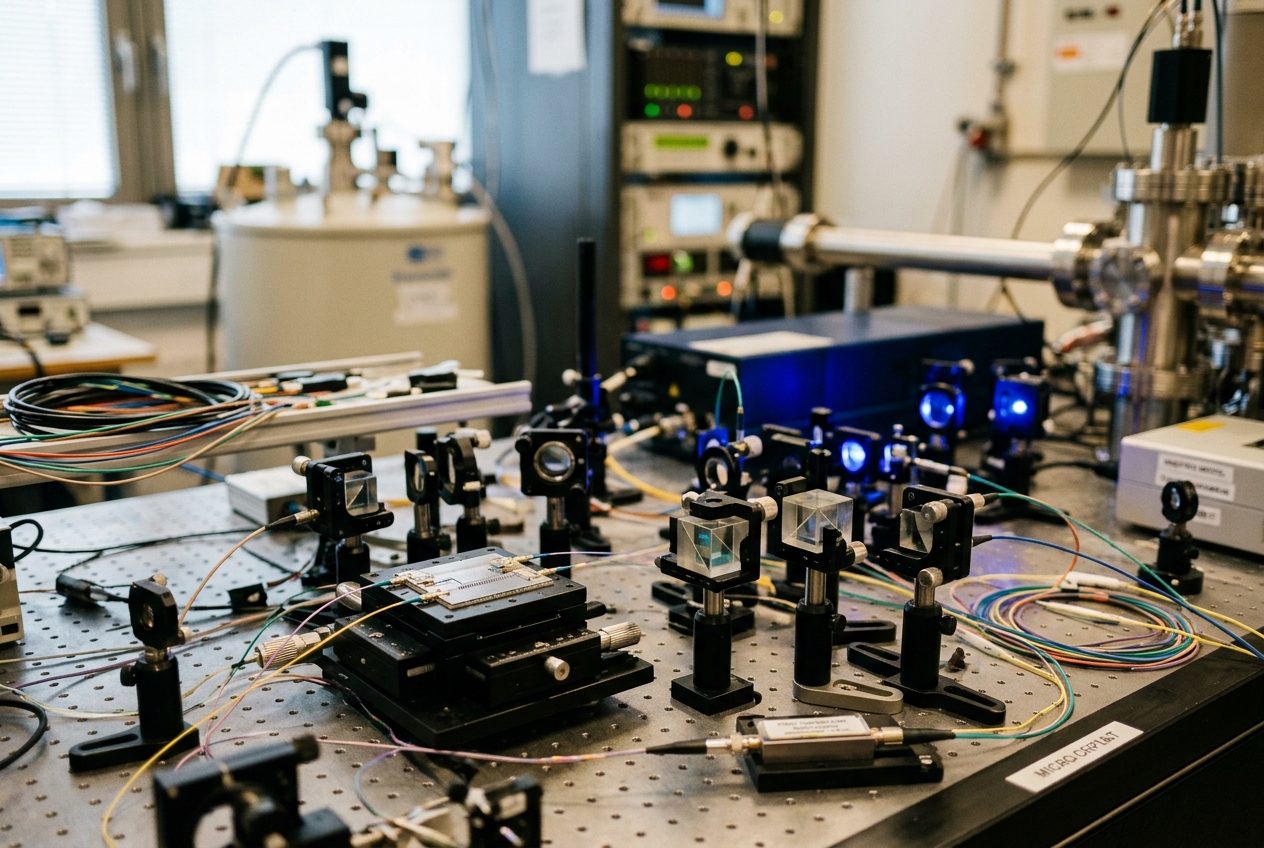
The global race to construct a commercially viable quantum computer is currently stalled behind a colossal engineering wall: the cryogenic bottleneck. Today’s leading quantum processors—built from superconducting circuits or trapped atomic ions—rely on massive, multi-million-dollar dilution refrigerators that cool microscopic chips to fifteen millikelvin, temperatures colder than the vacuum of deep space. If every future quantum supercomputer requires liquid-helium cooling infrastructure the size of an industrial boiler just to stabilize a few hundred fragile physical qubits, large-scale deployment across global telecommunications networks and commercial data centers will remain an insurmountable fantasy.
Photonic quantum computing offers an audacious and mathematically elegant alternative: abandon stationary matter entirely and encode quantum information into particles of light. Traveling at 300,000 kilometres per second through ambient-temperature optical waveguides and existing telecommunications fiber, photons do not suffer from thermal decoherence, do not require room-sized cryostats for their computational circuits, and are inherently compatible with global fiber-optic networks. The computational prize is immense. A fault-tolerant photonic quantum processor operating at terahertz clock speeds could simulate room-temperature superconductors, break standard public-key cryptography in minutes, and optimize complex logistics networks across the globe—all while running on silicon microchips manufactured in standard commercial semiconductor foundries.
2. The Idea in Plain English
To understand how light can perform computation, consider a simple physical analogy. In a classical electronic computer, information is moved by forcing billions of electrons down microscopic copper wires, using mechanical or semiconductor switches to guide them into distinct bins representing binary 0 and binary 1. Matter-based quantum computers attempt to hold those electrons or atomic ions suspended in delicate physical positions midway between states. However, because electrons carry electric charge, they constantly interact with stray electromagnetic fields and thermal vibrations, causing their delicate quantum states to collapse.
Photons, by contrast, carry no electric charge and pass through one another without scattering. In a photonic quantum computer, the simplest way to represent a quantum bit (a qubit) is through a concept known as dual-rail encoding. Imagine a miniature railway track that splits into two parallel optical paths: Track $A$ and Track $B$. We fire a single photon into the junction. Rather than choosing one track or the other, the laws of quantum mechanics allow the single photon to travel down both tracks at the same time. If the photon is found on Track $A$, we read out a 0; if it is on Track $B$, we read out a 1. Because the photon exists across both channels simultaneously, it forms a coherent quantum superposition:
$$\lvert \psi \rangle = \alpha \lvert 1, 0 \rangle + \beta \lvert 0, 1 \rangle$$
Here, $\lvert 1, 0 \rangle$ indicates one photon in the upper path and zero in the lower path, while $\lvert 0, 1 \rangle$ indicates the reverse, with complex probability amplitudes $\alpha$ and $\beta$.
Beyond counting individual photons (discrete variables), optical physicists can also encode quantum information into the continuous wave properties of light—specifically its amplitude and phase ripples—known as continuous-variable (CV) encoding. Think of this not as a discrete particle choosing between two tracks, but as gently plucking a guitar string so that the position and momentum of the vibrating wavepacket are squeezed below the standard quantum noise limit.
Because photons do not naturally collide or bounce off one another in empty space, optical quantum computing flips traditional computation on its head: instead of forcing light beams to interact directly, we entangle thousands of light paths together into a massive, interconnected web called a cluster state, and then perform calculations simply by measuring the light as it flies past.
3. How It Actually Works — The Mechanics
The architectural realization of scalable optical computing relies on four interconnected pillars: optical qubit encodings, measurement-induced non-linearities, fusion-based cluster state generation, and high-precision integrated hardware stacks.
Foundational Optical Qubits: Discrete vs. Continuous Variables
The fundamental challenge of optical quantum computing is twofold: selecting a physical degree of freedom to encode information and inducing quantum logic gates between non-interacting photons.
- Discrete-Variable (DV) Dual-Rail Qubits: In DV architectures, information is embedded in orthogonal Fock states (discrete photon number states). A single photon occupies one of two spatial or polarization modes. Linear optical elements—such as beam-splitters (which act as single-qubit Hadamard gates) and phase-shifters (which apply single-qubit $Z$-rotations)—allow complete arbitrary manipulation on the single-qubit Bloch sphere with near-unity fidelity.
- Continuous-Variable (CV) Squeezed States: Rather than relying on fragile single-photon emitters, CV architectures use bright laser pulses pushed through non-linear optical media, such as optical parametric oscillators (OPOs). These devices generate continuous quantum states described by continuous field quadrature operators $\hat{x}$ (amplitude) and $\hat{p}$ (phase), satisfying the canonical commutation relation $[\hat{x}, \hat{p}] = i\hbar$. Under the Heisenberg uncertainty principle:
$$\Delta \hat{x} \Delta \hat{p} \ge \frac{\hbar}{2}$$
By squeezing the vacuum fluctuations of the electric field, one can depress the uncertainty in one quadrature ($\Delta \hat{x} < \sqrt{\hbar/2}$) below the shot-noise floor at the expense of anti-squeezing the conjugate quadrature ($\Delta \hat{p}$). These squeezed wavepackets act as continuous computational resources that can be deterministically entangled at beam-splitters into massive multi-mode grids.
                  Standard Vacuum State (Circle)       Squeezed State (Ellipse)
                          Δp ^                                Δp ^
                             |     ***                           |      *
                             |   *     *                         |   *     *
                             |  *   +   *                        |  *   +   *
                             |   *     *                         |   *     *
                             |     ***                           |      *
                             +------------> Δx                   +------------> Δx
                                Δx = Δp                             Δx < Δp (Squeezed x)
The Knill-Laflamme-Milburn (KLM) Breakthrough
Because photons do not carry electric charge, two photons passing through the same optical crystal will simply pass through each other without interacting—meaning a direct two-qubit logic gate (like a controlled-NOT or CNOT) is seemingly impossible without non-linear optical materials millions of times stronger than anything in nature.
In 2001, physicists Emmanuel Knill, Raymond Laflamme, and Gerard Milburn shattered this limitation with the landmark Knill-Laflamme-Milburn (KLM) protocol. KLM proved that linear optical elements (mirrors, beam-splitters, and phase-shifters) combined with auxiliary single photons (ancillae) and single-photon detectors are sufficient to implement scalable universal quantum computation.
The core mechanism is measurement-induced non-linearity: when auxiliary photons are mixed with computational photons on beam splitters, measuring the auxiliary photons at the output collapses the wave function of the remaining computational photons into a non-linearly transformed target state. Although these projective gates succeed only probabilistically, KLM demonstrated that by pairing the probabilistic gates with quantum teleportation protocols, the success probability can be boosted arbitrarily close to unity, proving that light-based quantum computation is theoretically universal.
Cluster State Generation and Fusion-Based Architectures (FBQC)
Building massive quantum circuits out of individual probabilistic gates requires enormous optical overhead. Modern photonic computing has abandoned the traditional gate-circuit model in favor of Measurement-Based Quantum Computing (MBQC) and its state-of-the-art descendant, Fusion-Based Quantum Computing (FBQC).
In FBQC, rather than attempting to synthesize a monolithic, millions-of-qubits entangled state in advance, an array of integrated photon sources continuously emits small, identical entangled resource states (typically 4-to-6-photon graph states). These small resource droplets are then guided into a continuous fabric of small optical circuits that perform fusions—destructive two-photon Bell-state measurements mediated by beam-splitters and single-photon detectors.
When a fusion measurement succeeds, it welds the distinct resource states together into a high-dimensional, topologically protected 3D cluster state lattice (such as the Raussendorf-Harrington-Goyal lattice). If a fusion fails due to physical photon loss or detector inefficiency, the system records the failure as an erasure error on a specific bond of the lattice. Because the lattice is continuously generated and measured in time, the algorithm is executed purely as a dynamic pattern of single-photon measurement angles applied across the flying light pulses.
Physical Implementation & Engineering Bottlenecks
Realizing these theoretical paradigms on hardware demands an integrated photonics stack operating with nanometer-scale precision:
- Integrated Photonic Substrates: Modern optical chips use Thin-Film Lithium Niobate (TFLN) and Silicon Nitride ($\text{Si}_3\text{N}_4$) waveguides fabricated on top of silicon wafers. $\text{Si}_3\text{N}_4$ provides ultra-low propagation loss (less than $0.1\text{ dB/cm}$ at telecommunication wavelengths of $1550\text{ nm}$), while TFLN delivers gigahertz electro-optic modulation rates, allowing optical switches to route individual light pulses in picoseconds.
- Deterministic Single-Photon Generation: Photonic architectures rely either on semiconductor quantum dots embedded within optical micropillars (which emit single photons on demand with high purity) or multiplexed nonlinear sources based on spontaneous four-wave mixing (SFWM). In multiplexed SFWM, an array of laser-pumped silicon rings generates photon pairs; fast optical switches route the successful photon into the computational channel while registering its twin on an heralding detector.
- Mode-Matching Tolerances: For two photons to interfere quantum-mechanically at a beam splitter—a phenomenon known as the Hong-Ou-Mandel effect—they must be completely indistinguishable in spatial profile, polarization, frequency spectrum, and arrival time. A temporal jitter of just a few picoseconds drops quantum interference visibility below the threshold required for fault tolerance.
- Cryogenic Superconducting Nanowire Single-Photon Detectors (SNSPDs): While the optical computation chips operate at room temperature, readout requires SNSPDs. These devices consist of superconducting niobium-nitride nanowires cooled to $1\text{ to }4\text{ Kelvin}$ (a temperature easily maintained by closed-cycle Gifford-McMahon cryocoolers without liquid helium). When an individual telecommunication photon strikes the nanowire, it disrupts superconductivity, creating a measurable electrical voltage pulse with detection efficiencies surpassing $98\%$ and timing jitter under $15\text{ picoseconds}$.
Hardware Trade-offs: Flying Photons vs. Stationary Matter
The engineering balance sheet between photonic architectures and matter-based platforms reveals clear divergence in physical constraints:
| Performance Metric | Photonic Processors (FBQC) | Superconducting Transmons | Trapped Ion / Neutral Atom |
|---|---|---|---|
| Qubit Mobility | Flying at speed of light; instant native networking | Stationary on chip; requires microwave-to-optical conversion | Stationary in vacuum; requires cavity QED optical interconnects |
| Coherence Time ($T_1, T_2$) | Essentially infinite; zero thermal decoherence | $50\text{--}300\ \mu\text{s}$; vulnerable to flux and dielectric noise | Seconds to hours; limited by magnetic drift and laser phase noise |
| Gate Mechanism | Measurement-induced / topological fusion measurements | Direct microwave/flux pulse resonance | Focused optical/Raman laser pulse addressing |
| Operating Temperature | Ambient (Room Temp) for chip; $\sim 2\text{--}4\text{ K}$ for SNSPD readout | $\sim 15\text{ mK}$ (Dilution refrigerators required throughout) | Ultra-high vacuum; room temp to $4\text{ K}$ |
| Primary Error Channel | Photon loss (Erasure errors) | Depolarizing noise, dephasing, crosstalk | Atom loss, spontaneous emission, intensity fluctuation |
| Manufacturability | Standard CMOS semiconductor fabs (GlobalFoundries, TSMC) | Custom superconducting fab lines | Specialized optical and vacuum trap assemblies |
Topological Fault Tolerance and Percolation Thresholds
In matter qubits, an unknown error can introduce arbitrary continuous phase or bit-flip rotations ($\sigma_x, \sigma_y, \sigma_z$), forcing error-correction routines to execute complex syndrome decoding cycles. In photonics, the dominant failure mechanism is photon loss—a photon being absorbed or scattered into the cladding of a waveguide.
Crucially, photon loss constitutes an erasure error: the experimentalist knows precisely which detector failed to fire and which node in the cluster state is missing. By mapping the missing nodes to a site-percolation problem on a 3D topological graph, researchers have proven that as long as the total probability of photon loss $p_{\text{loss}}$ falls below a rigorous mathematical percolation threshold:
$$p_{\text{loss}} < p_{\text{crit}}$$
the surviving entangled nodes form an infinite connected cluster spanning the entire lattice. Modern topological erasure codes for FBQC achieve fault-tolerant loss thresholds as high as $10\text{--}14\%$. This means a photonic quantum computer can lose more than one out of every ten photons during execution and still reconstruct the underlying quantum state without corruption.
4. Real-World Applications Today
The transition from academic optical benches to monolithic photonic microchips is being accelerated by industrial partnerships and deep-tech ventures:
1. PsiQuantum (Palo Alto, USA & Brisbane, Australia)
- Objective: Building a utility-scale, million-qubit fault-tolerant quantum computer utilizing Fusion-Based Quantum Computing on silicon-on-insulator wafers.
- Current Deployment: In collaboration with tier-one semiconductor foundry GlobalFoundries, PsiQuantum is printing integrated photonic control circuits and SNSPD arrays directly onto standard $300\text{ mm}$ silicon wafers.
- Quantum Advantage: Targeting structural chemistry simulations—specifically calculating the active-site reaction kinetics of the nitrogenase enzyme for clean fertilizer production, an industrial chemical reaction that consumes over $1\%$ of the world's total energy budget and cannot be modeled on classical supercomputers.
2. Xanadu (Toronto, Canada)
- Objective: Scaling continuous-variable photonic quantum processors using Gaussian Boson Sampling (GBS) architectures.
- Current Deployment: Xanadu developed Borealis, a fully programmable 216-qubit continuous-variable quantum processor accessible over the cloud via the Strawberry Fields and PennyLane quantum programming ecosystems.
- Quantum Advantage: In 2022, Borealis achieved experimental quantum computational advantage by generating sample distributions from squeezed-state interference patterns in $36\text{ microseconds}$—a task estimated to take over 9,000 years on Fugaku, the world’s fastest classical supercomputer. This capability is actively applied to graph similarity problems and molecular docking calculations for pharmaceutical design.
+-------------------------------------------------------------------------------+
|                      GAUSSIAN BOSON SAMPLING METRICS                          |
|                                                                               |
|  * Platform: Xanadu Borealis (Continuous-Variable Architecture)               |
|  * Computational Scale: 216 Squeezed Optical Modes                            |
|  * Borealis Execution Time: 36 microseconds (0.000036 s)                      |
|  * Fugaku Supercomputer Equivalent Time: ~9,000 Years                         |
|  * Primary Industrial Use-Case: Graph Similarity Analysis & Drug Discovery    |
+-------------------------------------------------------------------------------+
3. Quandela (Massy, France)
- Objective: Constructing discrete-variable single-photon quantum processors powered by solid-state semiconductor quantum dots.
- Current Deployment: Delivering full-stack optical quantum computers (Altair and Ascella), integrating high-efficiency quantum dot emitters with reconfigurable glass-waveguide circuits.
- Quantum Advantage: Benchmarking hybrid variational quantum algorithms for fluid dynamics simulations in aerospace engineering, collaborating directly with industrial partners like Airbus and EDF to model aerodynamic boundary layers.
4. ORCA Computing (London, UK)
- Objective: Developing time-bin multiplexed photonic processors that operate within standard telecommunications fiber without cryogenic overhead at the processing stage.
- Current Deployment: Supplying rack-mounted quantum computational units to national supercomputing centers, including the UK National Quantum Computing Centre (NQCC) and the Poznań Supercomputing and Networking Center.
- Quantum Advantage: Leveraging standard single-mode optical fiber delays to implement memory buffers for machine-learning architectures, optimizing image recognition and large-language model training pipelines.
5. What This Means for You
It is easy to view quantum computing as an abstract discipline confined to academic physics departments, but the arrival of photonic architectures directly intersects with the physical infrastructure that underpins your daily digital life.
Because photonic processors calculate using the exact same infrared wavelengths ($1550\text{ nm}$) that carry your fiber-optic broadband, bank transfers, and video streams, optical quantum chips can interface directly with global telecommunications networks without requiring complex translators. This creates an unhackable foundation for the Quantum Internet.
In the near future, sensitive interactions—from the digital authentication protecting your retirement savings and medical records to national electric grid management—can be secured against interception using quantum entanglement routed through existing fiber cables buried beneath our streets. Furthermore, because photonic chips leverage the established manufacturing lines of commercial microchip foundries, quantum computing hardware will avoid the astronomical, artisanal fabrication costs that plague exotic atomic platforms. Photonic quantum computing may well be the vehicle that transitions quantum mechanics from a multi-million-dollar laboratory curiosity into standard rack-mounted servers powering next-generation cloud infrastructure.
6. Today's Takeaway
Photonic quantum computing bypasses the severe cryogenic and scaling constraints of matter-based qubits by encoding information into flying particles of light. By welding small entangled photon packets into resilient cluster states through fusion measurements, optical processors convert the physical nuisance of photon loss into a solvable topological routing challenge—paving a clear, manufacturable path toward scalable, fault-tolerant supercomputers that speak the native language of our global optical network.
Authoritative References & Further Study
- Learn quantum circuits and basic state transformations via the IBM Qiskit Documentation.
- Explore linear optical protocols and KLM implementations on Wikipedia's Linear Optical Quantum Computing Portal.
- Study continuous-variable quantum architectures through MIT OpenCourseWare Quantum Physics Resources.
- Review thin-film lithium niobate developments in Nature Photonics.
- Experiment with continuous-variable algorithms in Python using Xanadu's Strawberry Fields Framework.