QMA Complexity Class: Defining Quantum Verification, the Local Hamiltonian Problem, and Kitaev's Cook-Levin Theorem
1. Opening Hook — Why You Should Care
For the past two decades, popular narratives surrounding quantum computing have promised a revolution of almost mythical proportions. We are told that quantum processors, harnessing the surreal counter-intuition of superposition and entanglement, will effortlessly crack our strongest cryptographic shields, simulate the intricate machinery of molecular biology in seconds, and solve optimization challenges that would stall classical supercomputers until the heat death of the universe.
Yet hidden beneath this technological optimism lies an unyielding mathematical reality written directly into the laws of physics. There exist natural problems so fundamentally intractable that not even a fault-tolerant, error-corrected quantum computer running for billions of years can solve them from scratch.
Consider the challenge of discovering the exact ground-state energy of a complex molecule—a critical calculation in designing room-temperature superconductors or synthetic enzymes for carbon capture. If a quantum computer could simply run a rapid algorithm to compute these configurations universally, it would dismantle our understanding of computational limits. The mathematical framework that proves why this is impossible is QMA (Quantum Merlin-Arthur), the quantum mechanical analogue of the classical complexity class NP.
Understanding QMA is not an insular pursuit for theoretical computer scientists. It demarcates the exact frontier where quantum algorithmic acceleration flourishes and where nature posts an impassable barrier. By exploring QMA, we discover that nature itself does not possess a cosmic shortcut to find its own lowest-energy states, reshaping our view of chemistry, materials science, and the ultimate bounds of computation.
+-----------------------------------------------------------------------------------+
|                           THE LANDSCAPE OF VERIFICATION                           |
|                                                                                   |
|   CLASSICAL REALM (Deterministic & Randomized)                                    |
|   • P: Problems solved efficiently by a classical computer.                       |
|   • NP: Problems verified efficiently given a classical witness string.          |
|   • MA (Merlin-Arthur): Arthur verifies a classical witness using random coins.   |
|                                                                                   |
|   QUANTUM REALM (Superposition, Entanglement, & Unitary Evolution)                |
|   • BQP: Problems solved efficiently by a quantum computer.                       |
|   • QMA (Quantum Merlin-Arthur): Arthur verifies an uncloneable quantum state     |
|     witness |ψ⟩ using a polynomial-time quantum circuit.                         |
+-----------------------------------------------------------------------------------+
2. The Idea in Plain English: From Classical Guesses to Quantum Proofs
To grasp what makes Quantum Merlin-Arthur so profound, one must first revisit the classical concept of proof verification. In classical complexity theory, the class P represents problems that a computer can solve quickly on its own (in polynomial time), such as sorting a list of names or finding the shortest path between two cities on a map.
The class NP (Nondeterministic Polynomial Time) encapsulates problems where finding the solution may be extraordinarily difficult, but verifying a proposed solution is straightforward. Think of a 9×9 Sudoku grid or a massive jigsaw puzzle: searching through billions of configurations to assemble the puzzle demands exhaustive trial and error, but once someone hands you a completed puzzle, checking that every row, column, and block contains the digits 1 through 9 requires only a fleeting glance. The proposed solution is called a witness or certificate.
As randomized computation matured, computer scientists conceived an interactive game called MA (Merlin-Arthur). In this theoretical protocol, an omniscient but untrusted wizard named Merlin attempts to convince a skeptical, polynomial-time verifier named Arthur that a certain mathematical proposition is true. Merlin supplies a classical string of bits as evidence, and Arthur tosses fair coins to probabilistically verify Merlin's claim.
What happens when we upgrade Arthur to a quantum computer and allow Merlin to supply a quantum state as his proof? This question gave birth to Quantum Merlin-Arthur (QMA).
In the QMA paradigm: - Merlin (The Untrusted Prover): Possesses unbounded computational power. He can probe the infinite expanses of Hilbert space, but he is completely untrusted. He might be an honest helper or a malicious adversary attempting to trick Arthur into accepting a false statement. - Arthur (The Quantum Verifier): A realistic, polynomial-time quantum computer. Arthur cannot solve the problem de novo, but he can accept a quantum state—denoted as the witness $|\psi\rangle$—consisting of a polynomial number of qubits, inject it into a quantum circuit, and measure the result. - The Quantum Witness $|\psi\rangle$: Unlike a classical string of 0s and 1s, this certificate can be a delicate, highly entangled superposition across many qubits. It cannot be read or duplicated without fundamentally altering its contents, courtesy of the quantum no-cloning theorem.
                              THE QMA PROTOCOL

     +-------------------+                          +--------------------+
     |      MERLIN       |                          |       ARTHUR       |
     | (All-Powerful,    | --- Quantum Witness ---> | (Polynomial-Time   |
     |   Untrusted)      |         |ψ⟩              |  Quantum Circuit)  |
     +-------------------+                          +--------------------+
                                                              |
                                                    Applies Unitary V_x
                                                              |
                                                              v
                                                    Measures Output Qubit
                                                    [ Accepts / Rejects ]
Because quantum measurements are fundamentally probabilistic, Arthur cannot demand absolute certainty. Instead, QMA is defined around a promise problem characterized by two strict criteria:
- Completeness ($c \ge 2/3$): If the statement is true (a "YES" instance), there exists at least one valid quantum state $|\psi\rangle$ such that Arthur's quantum circuit accepts it with a probability of at least $c$.
- Soundness ($s \le 1/3$): If the statement is false (a "NO" instance), then no matter what quantum state $|\psi'\rangle$ a deceptive Merlin devises—even if he entangles it with demonic ingenuity—Arthur's circuit will accept it with a probability of at most $s$.
The difference between the completeness threshold and the soundness threshold, $c - s \ge \frac{1}{\text{poly}(n)}$, is known as the promise gap. As long as this gap remains bounded by an inverse polynomial in the size of the input, Arthur can reliably distinguish truth from deception.
3. How It Actually Works — The Mechanics of Quantum Verification
Moving beneath the high-level metaphor reveals a computational framework governed by linear algebra, unitary operators, and projection operators on complex vector spaces.
+-----------------------------------------------------------------------------------+
|                        FORMAL SPECIFICATION OF CLASS QMA                          |
|                                                                                   |
|  A promise problem L = (L_yes, L_no) belongs to QMA if there exists a polynomial  |
|  p(n) and a polynomial-time uniform family of quantum circuits {V_x} such that:   |
|                                                                                   |
|  1. Completeness: x ∈ L_yes => ∃ |ψ⟩ ∈ H^(⊗p(|x|)) such that Pr[V_x accepts |ψ⟩] ≥ 2/3 |
|  2. Soundness:    x ∈ L_no  => ∀ |ψ⟩ ∈ H^(⊗p(|x|)) such that Pr[V_x accepts |ψ⟩] ≤ 1/3 |
+-----------------------------------------------------------------------------------+
The Quantum Verification Circuit
When presented with an instance $x$ of length $n$, Arthur constructs a polynomial-sized quantum circuit $V_x$. Arthur prepares $m$ auxiliary (ancilla) qubits initialized to the pure ground state $|0^{\otimes m}\rangle$ and receives an entangled witness register $|\psi\rangle$ of $p(n)$ qubits from Merlin.
Arthur concatenates these registers to form the composite input state $|\psi\rangle \otimes |0^{\otimes m}\rangle$, routes it through a sequence of elementary unitary logic gates $V_x$, and performs a standard projective measurement on a designated output qubit in the computational basis ${|0\rangle, |1\rangle}$. By convention, measuring $|1\rangle$ corresponds to Arthur declaring "Accept."
Mathematically, the probability that Arthur accepts the state $|\psi\rangle$ is given by the expectation value of the acceptance projection operator:
$$\Pr[\text{Accept } x \mid |\psi\rangle] = \left\langle \psi, 0^m \left| V_x^\dagger \left( |1\rangle\langle 1| \otimes I \right) V_x \right| \psi, 0^m \right\rangle$$
In a "YES" instance, the optimal witness $|\psi_{\text{true}}\rangle$ achieves an acceptance probability $P \ge 2/3$. In a "NO" instance, the maximum eigenvalue of the effective measurement operator over the entire witness Hilbert space cannot exceed $1/3$.
Witness Preservation & Error Amplification: Jordan's Lemma
For years, it was unclear whether Arthur could amplify the acceptance probability of QMA without demanding multiple identical copies of the quantum witness from Merlin. Merlin could maliciously entangle multiple copies, defeating independent trials.
The resolution to this dilemma arrived through a landmark contribution by Chris Marriott and John Watrous using a geometric theorem known as Jordan's Lemma. Jordan's Lemma states that any two orthogonal projection operators acting on the same finite-dimensional Hilbert space simultaneously decompose the space into a direct sum of mutually orthogonal, one- and two-dimensional invariant subspaces.
                              JORDAN'S LEMMA DECOMPOSITION

         Full Hilbert Space H = S_1 ⊕ S_2 ⊕ S_3 ⊕ ... ⊕ S_k

         Within each 2D subspace S_j:

                  |v_j⟩ (Initial Verification Basis)
                    ^
                    |      θ_j
                    |   /-------> |w_j⟩ (Measurement Basis)
                    |  /
                    | /
                    +---------------------->
By viewing Arthur's verification as alternating projections between the subspace of initialized ancilla qubits and the subspace of accepted output states, Arthur can perform an alternating sequence of non-destructive measurements—a quantum random walk on two-dimensional planes.
If Merlin provided a valid witness, the state undergoes coherent oscillations with high acceptance probability without suffering destructive collapse. If Merlin provided a counterfeit, the state quickly reveals its invalidity.
This elegant technique allows Arthur to amplify QMA promise gaps to exponentially small error rates—$1 - 2^{-\text{poly}(n)}$ for completeness and $2^{-\text{poly}(n)}$ for soundness—using the exact same single witness token without ever requiring duplicate copies.
Kitaev's Quantum Cook-Levin Theorem
The crowning intellectual pillar of quantum complexity theory is the proof that natural physical problems are complete for QMA. In classical computer science, the celebrated Cook-Levin theorem demonstrated that Boolean Satisfiability (3-SAT) is NP-complete: any problem in NP can be translated into a local constraint satisfaction problem on a network of boolean variables.
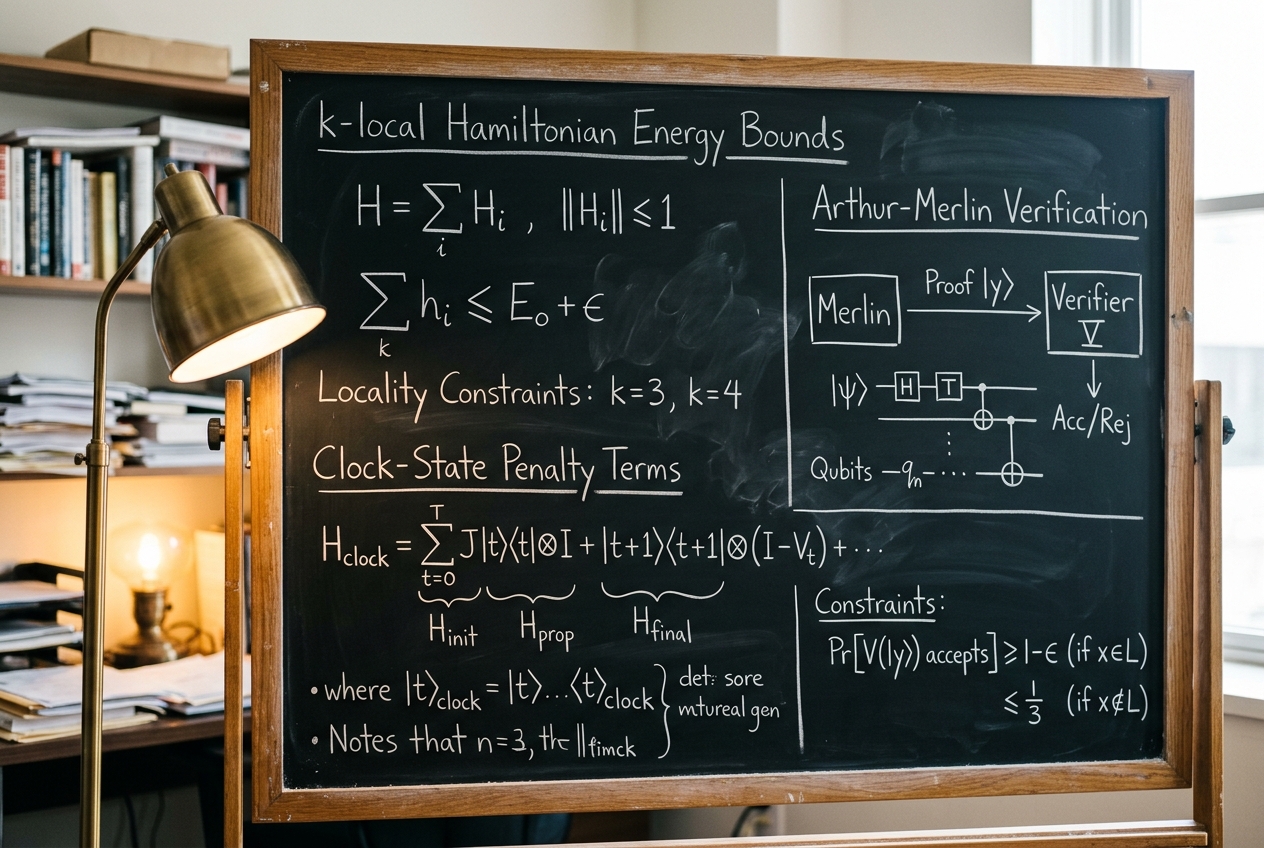
In 1999, physicist Alexei Kitaev formulated the Quantum Cook-Levin Theorem, establishing that the $k$-Local Hamiltonian Problem is QMA-complete (originally proved for $k=5$, and subsequently tightened to $k=2$ by Julia Kempe, Alexei Kitaev, and Oded Regev).
+-----------------------------------------------------------------------------------+
|                        THE k-LOCAL HAMILTONIAN PROBLEM                            |
|                                                                                   |
|  Given a system of n qubits and an energy operator H = ∑ H_j, where each term     |
|  H_j acts non-trivially on at most k qubits with ||H_j|| ≤ 1, and two energy     |
|  thresholds a and b such that b - a ≥ 1/poly(n):                                 |
|                                                                                   |
|  • YES Instance: The ground state energy E_0 = min_ψ ⟨ψ|H|ψ⟩ ≤ a.                 |
|  • NO Instance:  The ground state energy E_0 = min_ψ ⟨ψ|H|ψ⟩ ≥ b.                 |
+-----------------------------------------------------------------------------------+
Kitaev's genius was devising a method to encode the time-dependent execution of any quantum verification circuit into the static spatial ground state of a physical Hamiltonian.
To enforce this, Kitaev introduced a register called the quantum clock, which tracks the step-by-step progress of Arthur's verifier circuit from time $t = 0$ to $t = T$. The total Hamiltonian is engineered as a sum of four distinct penalty operators:
$$H = H_{\text{in}} + H_{\text{clock}} + H_{\text{prop}} + H_{\text{out}}$$
Let us deconstruct each of these local penalty terms to see how they govern the quantum circuit's history:
- Input Penalty ($H_{\text{in}}$): Enforces that Arthur's ancilla workspace is correctly initialized to the zero state $|0\rangle$ at the beginning of the computation ($t=0$). If an ancilla qubit is set to $|1\rangle$ at step zero, $H_{\text{in}}$ applies a severe energy penalty.
- Clock Validity Penalty ($H_{\text{clock}}$): Ensures the clock register transitions through legitimate, properly ordered temporal states (typically represented as a unary "domain wall" clock to ensure locality).
- Propagation Hamiltonian ($H_{\text{prop}}$): The dynamic core of the construction. It ensures that the state of the computation at time $t$ transitions faithfully to time $t+1$ under the specific unitary quantum gate $U_t$ dictated by Arthur's verification circuit. For each discrete time step $t$, the local propagation term is written as:
$$H_{\text{prop}}^{(t)} = \frac{1}{2} \left( I \otimes |t\rangle\langle t| + I \otimes |t-1\rangle\langle t-1| - U_t \otimes |t\rangle\langle t-1| - U_t^\dagger \otimes |t-1\rangle\langle t| \right)$$
This elegant operator acts as a discrete Laplacian across time. If the quantum state transitions precisely according to the gate $U_t$, the terms cancel, yielding an energy eigenvalue of exactly zero.
The unique quantum state that effortlessly rides through this temporal sequence with zero propagation energy is the History State $|\eta\rangle$:
$$|\eta\rangle = \frac{1}{\sqrt{T+1}} \sum_{t=0}^T \Big( U_t U_{t-1} \cdots U_1 |\psi_{\text{witness}}, 0^m\rangle \Big) \otimes |t\rangle$$
The history state is an equal superposition of all computational snapshots of Arthur's quantum computer from initialization to completion, entangled with the clock register.
- Output Penalty ($H_{\text{out}}$): Checks Arthur's designated output qubit at the final time step $t=T$. If Arthur's circuit reaches the end and rejects the witness by measuring $|0\rangle$ on the output qubit, $H_{\text{out}}$ injects an energy penalty.
                    KITAEV'S CIRCUIT-TO-HAMILTONIAN MAP

   Time t=0           Time t=1                   Time t=T
   +-----------+      +-----------+              +-----------+
   |  Witness  | ---> | Apply U_1 | ---> ... --->| Output    |
   |  |ψ, 0^m⟩ |      | Gate      |              | Check     |
   +-----------+      +-----------+              +-----------+
         |                  |                          |
   Energy Penalty     Energy Penalty             Energy Penalty
   H_in checks        H_prop checks              H_out checks
   ancilla = 0        unitary fidelity           acceptance = 1
If an instance is a YES instance, Merlin provides the authentic witness $|\psi\rangle$, Arthur's circuit accepts with high probability, and the history state $|\eta\rangle$ incurs almost zero energy across all four terms, keeping the ground-state energy below $a$.
If it is a NO instance, any state submitted to the Hamiltonian will inevitably violate either the input conditions, the unitary gate progression, or the final acceptance criteria, pushing the lowest possible energy eigenvalue above $b$.
Because finding the ground state of a $k$-local Hamiltonian can verify any QMA computation, the local Hamiltonian problem is QMA-complete.
4. Real-World Applications Today
The classification of the Local Hamiltonian problem as QMA-complete has profound real-world consequences for contemporary physics, quantum algorithm design, and computational chemistry. It proves that calculating the exact electronic structure of complex molecules is not merely difficult for classical computers—it belongs to a complexity tier that resists even universal quantum computers.
+-----------------------------------------------------------------------------------+
|                     THE COMPUTATIONAL BOUNDARIES OF NATURE                        |
|                                                                                   |
|   WHAT QUANTUM COMPUTERS DO BEST (BQP)                                            |
|   ✔ Simulating coherent real-time quantum dynamics (Schrödinger equation)        |
|   ✔ Factoring large integers via period finding (Shor's Algorithm)                |
|   ✔ Quantum phase estimation on states with large ground-state overlap             |
|                                                                                   |
|   WHAT REMAINS INTRINSICALLY HARD (QMA-Complete)                                  |
|   ✖ Finding exact ground-state energies of strongly correlated, frustrated matter |
|   ✖ Guaranteeing convergence for generic Variational Quantum Eigensolvers (VQE)   |
|   ✖ Resolving electronic configurations of frustrated multi-reference enzymes     |
+-----------------------------------------------------------------------------------+
Here is how this theoretical boundary guides practical research across leading institutions today:
1. Quantum Chemistry and Catalyst Discovery
- Institutions: Google Quantum AI, IBM Quantum, and Nature Physics Research Groups.
- The Objective: To compute the exact ground states of transition-metal catalysts, such as the nitrogenase enzyme's iron-molybdenum cofactor (FeMoco), which bacteria use to synthesize ammonia at room temperature.
- The Quantum Reality: Industrial chemical synthesis relies on the energy-intensive Haber-Bosch process, which consumes roughly 1–2% of global energy. Designing an artificial biomimetic catalyst requires resolving the ground-state electronic energy of FeMoco's entangled d-electron orbitals. Because the general ground-state problem is QMA-hard, algorithms like the Variational Quantum Eigensolver (VQE) cannot guarantee finding the ground state for arbitrary complex molecules without getting trapped in local minima (known as barren plateaus). Recognizing this boundary steers researchers away from blind heuristic searches and toward physics-informed state preparation and active-space reductions.
                     CATALYSIS MEETS COMPLEXITY

      FeMoco Cluster (Active Site)       Energy Optimization Landscape
             [Fe_7 Mo S_9 C]
                                           Energy
                 S --- Fe                    ^      Local Minima
                / \   / \                    |       (Traps VQE)
              Fe---S---Mo                    |   \     /\     /
                \ /   / \                    |    \___/  \___/
                 S --- Fe                    |             \_______ Ground State
                                             +------------------------> State Space
    Multi-reference correlation makes               QMA-Hardness forbids generic
    exact ground-state energy QMA-hard.             polynomial-time discovery!
2. Frustrated Magnetism and Novel Materials
- Institutions: Harvard University Department of Physics and the Max Planck Institute for Quantum Optics.
- The Objective: Mapping the phase diagrams of two-dimensional frustrated quantum spin systems, such as Kagome antiferromagnets and high-$T_c$ cuprate superconductor models.
- The Quantum Reality: When quantum spins are arranged on triangular or geometrically frustrated lattices, they cannot simultaneously minimize their mutual interaction energies. Kitaev's theorem with 2-local interactions proves that frustrated magnetic lattices harbor computational hardness directly within their physical bonds. Physicists use analog quantum simulators not to seek exact mathematical answers to the hardest worst-case instances, but to explore stable thermodynamic phases and collective quantum phenomena that survive computational intractability.
3. Verification of Quantum Hardware & Cryptographic Primitives
- Institutions: MIT Center for Theoretical Physics and the Quantum Information Processing Community.
- The Objective: Building unforgeable quantum money and developing protocols that allow a classical or weak quantum user to verify that a cloud-based quantum supercomputer is executing computations correctly.
- The Quantum Reality: QMA principles form the bedrock of Hamiltonian Cryptography. Because a quantum witness state $|\psi\rangle$ cannot be cloned, physical quantum states can serve as unforgeable credit tokens or digital banknotes. Merlin (the mint) creates a quantum state that satisfies a hidden local Hamiltonian; Arthur (a merchant) verifies the token's validity by measuring the energy of local terms without possessing the mathematical capacity to forge another copy of the state.
5. What This Means for You
It is easy to view complexity classes as distant mathematical abstractions with no bearing on everyday life. But QMA carries a profound philosophical and practical insight: nature is not an all-powerful supercomputer.
If computing the ground state of local Hamiltonians were easy, a physical quantum system placed in contact with a cold thermal reservoir would instantly compute the solution to every NP-complete problem simply by cooling down into its ground state. The universe would function as an omnipotent computing engine.
                               THE BIG PICTURE

     +---------------------------------------------------------------+
     | If ground states were easy to find efficiently (BQP = QMA):   |
     | Nature would solve every NP-complete and QMA-complete problem |
     | simply by cooling down into its lowest energy state.          |
     |                                                               |
     | The reality (QMA-Completeness):                               |
     | Physical systems get stuck in disordered, glassy states.     |
     | Nature faces the same computational bottlenecks we do!        |
     +---------------------------------------------------------------+
Because finding ground states is QMA-complete, physical systems themselves get stuck in disordered, metastable configurations—a phenomenon we observe daily in glassy materials, chemical reaction kinetics, and protein misfolding diseases like Alzheimer's. Intractability is woven into the fabric of the cosmos.
For technology leaders, investors, and engineers, understanding QMA provides a vital antidote to quantum hype. Quantum computers are not magic machines that will accelerate every problem exponentially. They are exquisite physical instruments designed to solve problems in BQP (Bounded-Error Quantum Polynomial-Time)—such as factoring large numbers, computing discrete logarithms, and simulating real-time quantum dynamics.
Recognizing that problems in QMA lie beyond BQP ensures that the world focuses quantum investments on challenges where quantum advantages are physically achievable, rather than chasing computational miracles that violate the laws of physics.
6. Today's Takeaway
+===================================================================================+
|                                 TODAY'S TAKEAWAY                                  |
|                                                                                   |
|   Quantum Merlin-Arthur (QMA) is the definitive quantum counterpart to NP,        |
|   capturing problems whose solutions can be verified using an uncloneable         |
|   quantum witness state. Through Kitaev's Quantum Cook-Levin Theorem, we know     |
|   that finding the lowest energy state of interacting quantum particles is        |
|   QMA-complete. This proves that even fault-tolerant quantum supercomputers       |
|   cannot magically solve every problem in physics and chemistry, fundamentally    |
|   defining the outer limits of quantum computation.                               |
+===================================================================================+
Authoritative References & Further Reading
- Quantum Merlin-Arthur Definition & Complexity Zoo — Comprehensive encyclopedia of quantum complexity classes and promise problems.
- Alexei Kitaev's Local Hamiltonian Problem Proof — Deep dive into the circuit-to-Hamiltonian clock construction.
- Nature Physics: Quantum Computational Complexity — Foundational perspectives on physical Hamiltonians and computational boundaries.
- IBM Qiskit: Fundamentals of Quantum Algorithms — Interactive tutorials on quantum circuits, unitary operators, and Hamiltonian simulation.
- MIT OpenCourseWare: Quantum Complexity Theory (Prof. Scott Aaronson) — Graduate lecture notes on Jordan's Lemma, Marriott-Watrous amplification, and the Cook-Levin quantum theorem.