Random Circuit Sampling: Demonstrating Quantum Computational Advantage Via Porter-Thomas Distributions and Cross-Entropy Benchmarking
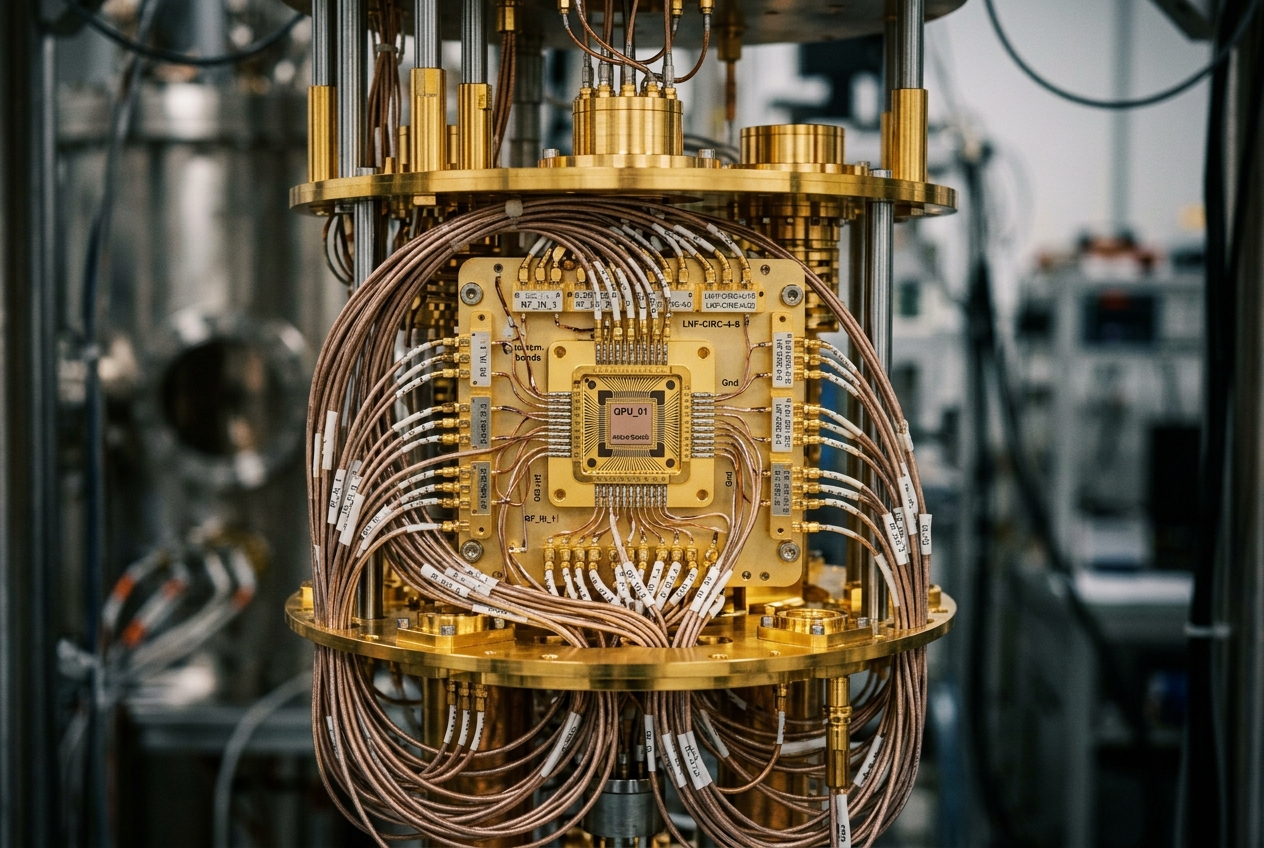
In the autumn of 2019, a room-sized cryogenic refrigerator in Santa Barbara, California, cooled a silicon chip named Sycamore to twenty millikelvins—a sliver of a degree above absolute zero. In just over three minutes, this microscopic lattice of superconducting circuits executed a calculation that, according to its designers, would have paralyzed the world’s most powerful classical supercomputer for millennia. The announcement sent shockwaves through computer science, igniting a fierce global debate over whether humanity had finally crossed the threshold into the era of quantum supremacy.
The task performed on that chip did not cure a disease, break an encryption cipher, or optimize a global logistics network. Instead, it was an esoteric mathematical exercise known as Random Circuit Sampling. To the uninitiated, running a "random" circuit might sound like throwing dice into an abyss of computational white noise. Yet, within the architecture of modern physics and complexity theory, random circuit sampling serves as the ultimate litmus test for the limits of the physical universe. It is the crucible in which our long-standing understanding of computation—the belief that any physical process can be efficiently simulated by a classical Turing machine—is put to a rigorous, existential trial.
Understanding how random circuits work is not merely an academic exercise for quantum physicists. The mathematical principles underpinning these chaotic quantum state evolutions govern the boundary between what is fundamentally computable and what is forever beyond the reach of classical silicon. The race to master this phenomenon directly dictates the future of verifiable cryptographic randomness, the simulation of exotic quantum materials, and our ability to prove whether a noisy, imperfect quantum processor is genuinely operating in a Hilbert space of unfathomable dimensions.
2. The Idea in Plain English
To understand random circuit sampling without drowning in abstract linear algebra, imagine shining a pure green laser pointer through a pane of heavily frosted bathroom glass onto a distant wall.
If light were composed of simple classical particles like tiny sand grains, you would expect to see a smooth, uniform smear of green illumination across the wall. But light consists of waves. As the coherent laser beam passes through the microscopic imperfections of the frosted glass, the light rays bend in millions of competing directions. In some places, the peaks of these waves collide with other peaks, amplifying the light into dazzling, intense bright spots. In other places, peaks collide with troughs, cancelling each other out completely to leave pitch-black voids. The resulting image on the wall is an intricate, granular constellation of bright and dark speckles, known in optics as a laser speckle pattern.
Now, replace the laser beam with a collection of quantum bits (qubits), and replace the frosted glass with a series of randomly chosen quantum logic gates.
A classical bit is like a light switch: it is either decisively OFF (0) or decisively ON (1). A qubit, by contrast, behaves like a coin spinning suspended in mid-air. It maintains a continuous range of possibilities—a combination of zero and one simultaneously—governed by mathematical weighting factors known as quantum amplitudes.
When a quantum computer links dozens of these spinning qubits together through a web of interacting gates, their quantum amplitudes begin to overlap and interfere across an astronomical landscape of possible combinations. If you have $n$ qubits, there are $2^n$ possible outcomes (sequences of zeros and ones, known as bitstrings). For a 60-qubit processor, $2^{60}$ is roughly one quintillion possibilities—a number vastly larger than the count of grains of sand on all the beaches on Earth.
Just as the frosted glass deflects laser waves into a granular speckle pattern of bright peaks and dark voids, a random quantum circuit scrambles the quantum amplitudes across this quintillion-dimensional space. Through constructive and destructive interference, the circuit ensures that a tiny fraction of the quintillion possible bitstrings have a relatively high probability of being observed (the "bright spots"), while the overwhelming majority have near-zero probability (the "dark voids").
When the quantum processor is measured at the end of the experiment, it spits out a single bitstring chosen from this hidden landscape. If you run the experiment thousands of times, the quantum chip naturally outputs the "bright" bitstrings far more often than the "dark" ones.
The profound computational challenge is this: for a classical supercomputer to predict which bitstrings are the bright ones, it must mathematically calculate how every single path through the quantum circuit interferes with every other path. It must track all quintillion numbers simultaneously. The quantum chip, on the other hand, simply lets nature take its course, using the laws of quantum mechanics to settle into its interference pattern in a fraction of a millisecond.
3. How It Actually Works — The Mechanics
To transform this intuitive wave interference into a mathematically rigorous proof of computational advantage, quantum engineers and complexity theorists construct 2D random quantum circuits using a precise clockwork architecture.
The Architecture of Chaos: 2D Lattice Circuits
Consider a two-dimensional grid of superconducting qubits arranged on a planar chip, as documented in seminal benchmarks published in Nature. The execution of a random quantum circuit proceeds in discrete cycles or "clock ticks":
- Single-Qubit Haar-Random Rotations: At each cycle, every qubit independently undergoes a continuous single-qubit rotation chosen randomly from the mathematical rotation group known as $\text{SU}(2)$. In technical terms, these rotations are sampled according to the uniform Haar measure, which ensures that the qubit's quantum state is aimed in an entirely unbiased direction on the geometric sphere of quantum states (the Bloch sphere).
- Two-Qubit Entangling Layers: Next, fixed two-qubit quantum gates—such as Controlled-Z ($\text{CZ}$) or square-root-of-iSWAP ($\sqrt{\text{iSWAP}}$)—are applied between neighboring qubits across the 2D grid according to a specific geometric tiling pattern (alternating between horizontal, vertical, and diagonal pairings). These gates entangle the qubits, creating deeply interconnected quantum states where the state of one qubit cannot be described independently of the others.
As these layers repeat across a circuit depth of $d$ cycles, entanglement spreads outward across the chip like an ink drop diffusing through water. Within a dozen cycles, the system reaches a condition called anti-concentration: the quantum information becomes completely non-local, distributed uniformly across the entire $2^n$-dimensional state space.
The Porter-Thomas Distribution: Signatures of Quantum Chaos
When an $n$-qubit circuit scrambles information completely, the resulting pure quantum state vector $|\psi\rangle$ resembles a truly random vector drawn from the massive $N = 2^n$ dimensional complex sphere. The probability of measuring any specific bitstring $x \in {0, 1}^n$ is given by $p(x) = |\langle x | \psi \rangle|^2$.
In a purely classical system choosing random numbers, every output would have an identical, flat probability of $1/N$. But in a chaotic quantum system governed by wave interference, the probabilities fluctuate wildly according to a universal statistical distribution known in nuclear physics as the Porter-Thomas distribution.
The probability density function $P(p)$ of finding a bitstring with probability $p$ is defined by:
$$P(p) = N e^{-N p}$$
In plain English, this formula tells us that the landscape of quantum probabilities is exponentially distributed. The average probability of a bitstring is $p_{\text{avg}} = 1/N$. However, the Porter-Thomas law dictates that there is a vast surplus of bitstrings whose probabilities are significantly higher than the average—the "heavy bitstrings"—and an even larger ocean of bitstrings whose probabilities are nearly zero.
Because of this exponential profile, measuring the circuit does not yield uniform noise. It preferentially samples these heavy bitstrings, leaving a mathematical fingerprint that is uniquely quantum.
Key Theoretical Milestones in Quantum Sampling Complexity
- Hilbert Space Dimension ($N = 2^n$): At $n = 60$ qubits, $N \approx 1.15 \times 10^{18}$ complex amplitudes must be tracked simultaneously by any brute-force classical state-vector simulator.
- Anti-Concentration Depth ($d = O(\sqrt{n})$): The circuit depth required on a 2D planar lattice to guarantee that the output distribution spreads across all $2^n$ states, precluding classical sparse approximations.
- Polynomial Hierarchy Collapse ($\text{PH} = \Sigma_3^P$): If classical computers could efficiently and approximately sample from random circuits within bounded total variation distance, the foundational tower of computational complexity would collapse.
Why Classical Computers Fail: The Complexity Foundations
Why is generating bitstrings from this Porter-Thomas distribution so ferociously difficult for classical machines?
To simulate this process classically, an engineer has two primary strategies: 1. Full State-Vector Evolution: The computer stores all $2^n$ complex numbers in memory and multiplies them by $2^n \times 2^n$ unitary matrices at each gate step. The memory requirement scales as $O(2^n)$, which instantly exceeds the RAM of every supercomputer on Earth once $n > 50$. 2. Tensor Network Contraction: The circuit is represented as an interconnected mathematical web of numbers called tensors. The classical supercomputer contracts this web by multiplying tensors together along the most efficient path. The computational cost scales exponentially with the geometric treewidth of the circuit graph. For a 2D lattice at depth $d \ge 20$, the treewidth grows so massive that exact contraction requires exaflops of computation running over weeks or months.
From a formal complexity-theoretic perspective, the classical hardness of Random Circuit Sampling rests on the bedrock of computational complexity theory, as explored in curricula at MIT OpenCourseWare.
In 2016, complexity theorists Scott Aaronson and Lijie Chen demonstrated that calculating the transition amplitude of a random circuit is #P-hard (pronounced "number-P hard")—a class of problems drastically harder than the NP-complete problems that govern commercial encryption.
Furthermore, by applying Stockmeyer’s theorem, theorists proved that if a classical computer could generate bitstrings from a random circuit within a small statistical error in polynomial time, the Polynomial Hierarchy—the overarching organizational structure of computational complexity—would collapse to its third level ($\text{PH} = \Sigma_3^P$). Computer scientists widely consider such a collapse as improbable as discovering that $P = NP$.
Verifying the Unverifiable: Linear Cross-Entropy Benchmarking (XEB)
This theoretical hardness presents a profound experimental paradox: if a classical computer cannot simulate the circuit, how can experimentalists verify that a physical, noisy quantum processor actually executed the intended unitary operation $U$ rather than producing meaningless hardware noise?
To solve this, researchers invented Linear Cross-Entropy Benchmarking (XEB).
When an experimental quantum processor runs a random circuit, it generates a list of $M$ measured bitstrings: $S = {x_1, x_2, \dots, x_M}$. Using a classical supercomputer, physicists calculate the exact theoretical probabilities $P(x_i)$ that an ideal, noise-free quantum computer should have assigned to those specific observed bitstrings.
The Linear XEB fidelity estimator, denoted as $F_{\text{XEB}}$, is calculated as:
$$F_{\text{XEB}} = 2^n \left( \frac{1}{M} \sum_{i=1}^{M} P(x_i) \right) - 1$$
In plain English, this formula measures how well the quantum processor's physical output correlates with the theoretical peaks of the Porter-Thomas speckle pattern: * If the quantum hardware is completely overtaken by decoherence and environmental noise, it outputs uniformly random bitstrings. In that case, the average calculated probability is simply $1/2^n$, and the formula yields $F_{\text{XEB}} = 0$ (zero fidelity / pure noise). * If the quantum processor behaves with absolute perfection, with zero error, the observed bitstrings land on the heavy peaks of the Porter-Thomas distribution. The average probability jumps to $2/2^n$, and the formula yields $F_{\text{XEB}} = 1$ (100% fidelity). * In real-world Noisy Intermediate-Scale Quantum (NISQ) devices, physical gate errors degrade the signal, producing fidelities typically ranging between $F_{\text{XEB}} \approx 0.001$ and $0.01$. While a fidelity of 0.2% might sound low, across millions of measured shots, an $F_{\text{XEB}} > 0$ with extreme statistical significance ($>5\sigma$) rigorously proves that the quantum processor is executing quantum state evolution across the full Hilbert space.
Classical Spoofing and the Supercomputing Counterattack
The declaration of quantum supremacy ignited an intense counter-offensive from classical supercomputing laboratories.
Classical researchers quickly realized that while exact classical simulation is impossible at large depths, a supercomputer does not need to simulate the circuit perfectly to match the low fidelity ($F \approx 0.002$) of a noisy NISQ processor. Using methods such as: * Matrix Product States (MPS) and Projected Entangled Pair States (PEPS) that truncate low-weight quantum entanglement, * Tensor Slicing and Graph Partitioning deployed across tens of thousands of GPUs on exascale systems like Frontier at Oak Ridge National Laboratory or Summit, * Classical "Spoofing" Algorithms that deliberately bias outputs toward heavy bitstrings without performing the full quantum evolution,
classical scientists managed to reduce the theoretical classical simulation times of early 53-qubit benchmarks from 10,000 years to mere hours.
This ongoing intellectual duel has established a dynamic computational frontier: to maintain verifiable quantum advantage, quantum hardware builders must continuously scale qubit counts (beyond 70–100+ qubits), increase circuit depths, and lower two-qubit error rates below the threshold where tensor-network approximations can squeeze through.
4. Real-World Applications Today
While random circuit sampling was initially conceived as a foundational test of complexity theory, its core principles, mathematical distributions, and benchmarking techniques are actively driving cutting-edge quantum applications across industry and academia.
1. Certified Cryptographic Randomness (Google Quantum AI)
- The Mission: Modern high-security cryptography, proof-of-stake blockchains, and zero-knowledge privacy protocols require sources of pure, unguessable entropy. Classical pseudorandom number generators can be secretly backdoored or mathematically predicted.
- The Quantum Advantage: By utilizing random circuit sampling protocols pioneered on their Sycamore and next-generation superconducting architectures, Google researchers can generate certified, unforgeable randomness. Because the output bitstrings pass rigorous cross-entropy tests that only a quantum Hilbert-space evolution could produce, a remote party can be mathematically guaranteed that the numbers were generated non-deterministically and could not have been pre-computed or spoofed by an adversary.
2. Full-Chip Error Characterization and Calibration (IBM Quantum)
- The Mission: Operating enterprise quantum systems on platforms like IBM Qiskit requires real-time diagnostic tools that evaluate how two-qubit gate crosstalk and decoherence compound across complex topological graphs like the "heavy-hex" lattice.
- The Quantum Advantage: IBM uses scaled-down variants of cross-entropy benchmarking (such as Cycle Benchmarking and Randomized Benchmarking) as the definitive operational metric for their Eagle (127-qubit) and Heron processors. Rather than testing gates in isolation, running randomized entangling circuits tests the entire machine under full operational stress, diagnosing subtle phase errors and environmental drift.
3. Simulating Quantum Chaos and Many-Body Thermalization (USTC / National Laboratory for Quantum Sciences)
- The Mission: Physicists at the University of Science and Technology of China (USTC), operating the Zuchongzhi superconducting processor and the Jiuzhang photonic system, utilize random quantum circuits to model the fundamental laws of statistical mechanics.
- The Quantum Advantage: In theoretical physics, the way information scrambles across an entangling quantum circuit is mathematically identical to how information thermalizes when falling past the event horizon of a black hole (the Hayden-Preskill thought experiment). USTC researchers use multi-qubit random circuits to experimentally observe the transition from localized quantum states to chaotic thermalized ensembles, probing questions in fundamental physics that are completely inaccessible to classical numerical solvers, as detailed across open-access research repositories on arXiv.
4. High-Fidelity Diagnostics for Neutral-Atom Arrays (QuEra Computing & Harvard University)
- The Mission: Neutral-atom quantum computing platforms, which manipulate individual rubidium or ytterbium atoms trapped in optical tweezer grids, are rapidly scaling into hundreds of physical qubits.
- The Quantum Advantage: Researchers at QuEra and Harvard use random circuit patterns to benchmark analog Rydberg entangling pulses. By measuring how output distributions conform to Porter-Thomas statistics during deep entangling sweeps, engineers can identify optical phase jitter and spatial laser aberrations, accelerating the transition toward fault-tolerant logical qubit processors.
5. Validating Logical Qubit Integrity (Quantinuum)
- The Mission: Quantinuum’s trapped-ion systems (such as the H1 and H2 series) feature all-to-all qubit connectivity and record-setting quantum volume.
- The Quantum Advantage: When compiling complex algorithms for quantum chemistry and molecular Hamiltonian simulations, Quantinuum uses randomized circuit compilation. Scrambling algorithmic circuits into randomized unitary sequences converts coherent, systematic hardware errors into harmless stochastic white noise, dramatically boosting calculation accuracy when simulating chemical catalyst reactions.
5. What This Means for You
It is easy to look at random circuit sampling and dismiss it as a self-contained scientific spectacle—a bespoke race between room-sized supercomputers and dilution refrigerators playing a mathematical game of no direct relevance to everyday life.
That impression is entirely mistaken.
First, random circuit sampling serves as our most reliable empirical verification that nature truly permits quantum parallel information processing at scale. If these experiments had failed—if physical noise had completely washed out the Porter-Thomas speckle pattern as soon as chips crossed 50 qubits—it would have indicated that quantum mechanics breaks down in complex systems. The success of RCS proves that the "computational superpower" promised by quantum theory is physically real and waiting to be harnessed.
Second, the technology forged to execute and benchmark random circuits is the exact foundation required to build quantum computers that will transform everyday life: * Unbreakable Cryptography: The certified randomness derived from quantum sampling protocols will soon secure the international financial messaging systems, government communications, and digital identity infrastructures of the twenty-first century against interception. * Material Science and Clean Energy: The precise gate controls and error mitigation techniques refined through Linear Cross-Entropy Benchmarking are currently being transferred to chemistry algorithms. These algorithms aim to simulate the nitrogenase enzyme (revolutionizing fertilizer production to consume a fraction of the world’s natural gas) and design solid-state electrolyte materials for next-generation electric vehicle batteries. * The Evolution of Classical Computing: The fierce competition ignited by quantum supremacy claims has forced classical supercomputing architects to invent vastly superior tensor algorithms. Classical computing is becoming faster and more efficient precisely because it is being chased by quantum mechanics.
The validation of random circuit sampling marks the definitive historical moment where classical silicon ceased to be the absolute master of computational mathematics. To read more about the broader historical context of this milestone, explore the comprehensive overview on Wikipedia's Quantum Supremacy archive.
6. Today's Takeaway
Random Circuit Sampling is the ultimate quantum stress test: by deliberately driving an array of qubits into complete mathematical chaos, it generates an intricate, wave-interfered speckle pattern whose peaks can only be produced by navigating the astronomical dimensions of Hilbert space. Verified by Linear Cross-Entropy Benchmarking, this process provides rock-solid proof that a physical quantum processor can perform computational feats impossible for any classical supercomputer—validating the foundational reality of quantum physics and laying the operational groundwork for the practical quantum revolution ahead.