
QUANTUM COMPUTING
Positive Operator-Valued Measure: Surpassing Projective Limits for Optimal Quantum State Discrimination
### QUANTUM INFORMATION / THE MEASUREMENT PROBLEM
⚡ 7,469 Tokens • $0.00 Cost
### QUANTUM INFORMATION / THE MEASUREMENT PROBLEM
# Beyond the Noise: How Quantum Metrology Is Rewriting the Ultimate Limits of Measurement
**QUANTUM COMPUTING | SPECIAL REPORT**

## Opening Hook — Why You Should Care

The encryption protecting global financial transactions, sovereign communications, and confidential medical registries relies on mathematical problems that would take classical supercomputers millennia to unravel. As quantum computing advances, the threat of rapid cryptanalysis has sparked an urgent race toward quantum-secure infrastructure. Yet beneath the headlines of quantum supremacy lies a fundamental, counterintuitive law of physics that dictates how much data the universe allows us to extract from physical matter: a single quantum bit, despite existing in an infinite continuum of simultaneous possibilities, can never deliver more than one single bit of readable classical information under standard transmission.

### By Antigravity Science & Technology Desk

**QUANTUM FOUNDATIONS | THE POWER OF GLOBAL PROPERTIES**

### THE QUANTUM HORIZON | A Long Read on the Physics of the Next Internet
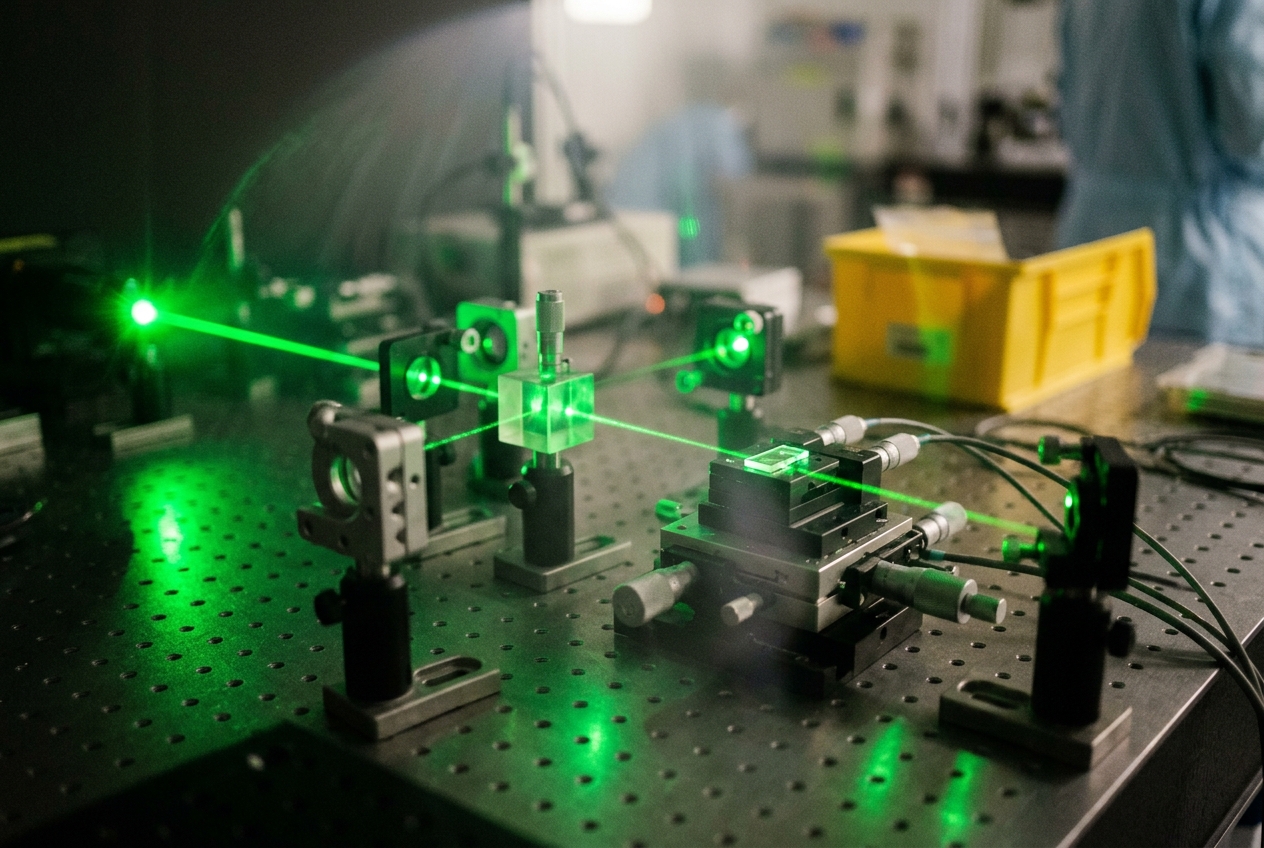
The world’s most formidable supercomputers—monolithic installations spanning thousands of square feet and consuming megawatts of electrical power—are quietly approaching a fundamental physical boundary. If tasked with simulating the precise trajectory of just one hundred indistinguishable particles of light dancing through a labyrinth of semi-transparent mirrors, the fastest classical supercomputer on Earth would require billions of years to complete the calculation. A shoebox-sized optical processor, operating at room temperature, can execute that exact physical process and output the resulting probability distribution in a fraction of a millisecond.
### QUANTUM FOUNDATIONS | A long-read inquiry into the theorem that proved the universe is not locally real, and how the collapse of Einstein’s intuition is securing the modern digital world.
Every evening at the close of trading on Wall Street and in the City of London, bank mainframes initiate one of the most computationally demanding routines in human history. To calculate their overnight risk exposure and ensure they remain solvent under regulatory stress tests, financial institutions simulate millions upon millions of possible market futures. They model fluctuating interest rates, sudden currency devaluations, sovereign debt defaults, and complex asset price trajectories using a centuries-old mathematical workhorse: the Monte Carlo method.

## ABSTRACT

`THE LONG READ | THEORETICAL AND CONDENSED MATTER PHYSICS`

---

# The Geometry of Quantum Survival: How 2D Surface Codes and Lattice Surgery Tame Physical Chaos into Fault-Tolerant Computation

*By Dr. Julian Vance*

*QUANTUM METROLOGY & STATE CHARACTERISATION*

### QUANTUM INFORMATION THEORY & COMPILER DESIGN

## Abstract For more than two decades following the inception of quantum information science, the landscape of quantum algorithmic design resembled an archipelago of ingenious yet mathematically disparate techniques. Seminal paradigms—such as amplitude amplification, quantum phase estimation, Trotterized Hamiltonian simulation, and quantum linear systems solvers—appeared to rely on distinct physical intuitions and operational mechanisms. In 2019, the introduction of Quantum Singular Value Transformation (QSVT) fundamentally unified these disparate protocols into a single, comprehensive linear-algebraic framework. By embedding non-unitary operators into orthogonal blocks of larger unitary operators (block encodings) and interweaving these with projector-controlled phase shifts, QSVT demonstrates that nearly all known quantum algorithms can be understood as the polynomial transformation of the singular values of an underlying matrix. This chapter provides a rigorous, pedagogical exposition of the QSVT framework. We delineate its foundations in single-qubit Quantum Signal Processing (QSP), formalize the algebraic structure of block encodings, prove the invariant subspace decomposition via Jordan’s Lemma, and demonstrate how canonical quantum algorithms emerge as specific polynomial instances with optimal asymptotic complexity.

---