Bell's Theorem: Refuting Local Hidden Variables and Quantifying Non-Locality Via the CHSH Inequality
1. Opening Hook — Why You Should Care
Every transaction securing global financial networks, every encrypted diplomatic cable, and every confidential record sitting in cloud servers rests on a silent, fragile assumption: that the mathematical locks guarding our data cannot be solved before the sun burns out. Yet that assumption is rapidly degrading. As advanced quantum processors edge closer toward fault tolerance, the mathematical puzzles underlying modern public-key cryptography—such as prime factorisation and discrete logarithms—face inevitable obsolescence.
To prevent systemic cryptographic collapse, computer scientists and physicists are not merely writing harder math problems. Instead, they are turning to a profound, unsettling discovery about the fundamental fabric of our physical reality: Bell’s theorem.
First formulated in 1964 by the Northern Irish physicist John Stewart Bell, this theorem proved that nature defies classical logic at its most elementary level. If you measure two entangled particles separated across galaxies, the outcome cannot be explained by any pre-existing local properties coded inside them, nor by any sub-light signal passing between them.
What began as an esoteric philosophical debate between Albert Einstein and Niels Bohr has evolved into the ultimate security architecture of the twenty-first century. Today, Bell’s theorem does not just settle arguments about the philosophy of physics; it provides the operational blueprint for "device-independent" cryptography—a paradigm where two computers can establish provably unbreakable encryption even if the hardware was manufactured by an adversary. To understand how we can build an unhackable future, we must first confront why our classical intuition about the physical universe is provably, mathematically wrong.
2. The Idea in Plain English
To appreciate the revolution brought about by Bell's theorem, we must first understand what Einstein believed physics ought to be: local and real.
In everyday human experience, the physical universe obeys two commonsense rules: 1. Realism (Counterfactual Definiteness): Objects possess definite, objective properties regardless of whether anyone observes them. A traffic light is green or red whether your eyes are open or shut. A tossed coin resting beneath a cup is already heads or tails before you lift the cup. 2. Locality: Physical influences cannot travel faster than the cosmic speed limit—the speed of light in a vacuum. What happens on Mars cannot instantly change what happens in London without a physical signal crossing the intermediate space.
Combined, these two principles form Local Realism. In 1935, Albert Einstein, Boris Podolsky, and Nathan Rosen published their celebrated EPR paradox paper, arguing that because quantum mechanics predicted instantaneous statistical correlations between distant entangled particles, the theory was fundamentally incomplete. Einstein famously rejected the idea that measuring one particle could instantaneously dictate the physical state of another across space, deriding it as spukhafte Fernwirkung—"spooky action at a distance." He concluded that entangled particles must be like a pair of matching shoes separated into two identical boxes. If you open Box A in London and find a left shoe, you know instantly that Box B in Tokyo contains the right shoe. There is no magic, no signal, and no telepathy: the identity of the shoe was fixed the moment it was placed in the box. Physicists called these hypothetical pre-existing instructions local hidden variables.
[ Classical Local Realism: The Hidden-Pair Model ]

       ( Source ) -----------------------------> Fixed at emission!
       /        \
      v          v
  [ Left Shoe ]  [ Right Shoe ]
  (London: Left) (Tokyo: Right)
  --> Measurement reveals a pre-existing state.
For nearly three decades, the physics community treated Einstein’s objection as an untestable philosophical dispute. Because both classical hidden-variable theories and standard quantum mechanics yielded identical predictions for simple measurements, there seemed to be no way to experimentally verify whether the shoes had colors before the boxes were opened.
In 1964, John Stewart Bell exposed a fatal flaw in Einstein's reasoning. Bell realised that if you do not measure the shoes along the same axis—if, for instance, you measure the orientation of shoe laces at randomly chosen angles—local realism and quantum mechanics yield fundamentally irreconcilable statistical predictions. Bell translated a metaphysical argument into an experimental formula. He showed that if local realism were true, the statistical correlations between independent measurements across two distant locations could never exceed a strict numerical threshold.
When modern laboratories run the experiment, nature repeatedly breaches this threshold. The particles do not behave like classical shoes carrying secret instructions. Instead, their physical properties remain genuinely indeterminate until measured, yet fundamentally unified across arbitrary distances.
3. How It Actually Works — The Mechanics
To comprehend the mathematical force of Bell's insight, we examine the modern, experimentally tractable formulation of his theorem devised by John Clauser, Michael Horne, Abner Shimony, and Richard Holt: the CHSH inequality.
             [ Entangled Source ]
                  /        \
                 /          \
                v            v
        Alice's Station    Bob's Station
        Settings: {a, a'}  Settings: {b, b'}
        Outcome: A = ±1    Outcome: B = ±1
The Setup of the CHSH Game
Imagine two experimenters, Alice and Bob, situated in laboratories separated by light-years. A central source emits pairs of entangled particles, sending one particle to Alice and the other to Bob.
Upon receiving her particle, Alice chooses one of two measurement detector settings, denoted by angles $a$ or $a'$. Her measurement apparatus always yields a binary outcome: $A \in {+1, -1}$. Simultaneously, Bob independently selects one of two measurement settings, $b$ or $b'$, obtaining a binary outcome: $B \in {+1, -1}$.
Crucially, the selections of $a, a'$ and $b, b'$ are made via independent, fast random number generators while the particles are in flight, ensuring that no sub-light or speed-of-light communication can pass between Alice and Bob before the measurements conclude.
The Classical Expectation: Deriving the CHSH Bound
Let us assume Einstein was correct: there exists some complete set of local hidden variables, represented collectively by the parameter $\lambda$, distributed according to a probability distribution $\rho(\lambda)$ satisfying $\int \rho(\lambda)\,d\lambda = 1$.
Under local realism: 1. Realism: Alice's outcome $A(a, \lambda) = \pm 1$ and Bob's outcome $B(b, \lambda) = \pm 1$ are deterministic functions of their local setting and the shared hidden state $\lambda$. 2. Locality: Alice's outcome $A$ does not depend on Bob's setting $b$ or Bob's outcome $B$, and Bob's outcome $B$ does not depend on Alice's setting $a$ or Alice's outcome $A$.
For any specific pair of particles governed by hidden variable $\lambda$, consider the following algebraic combination of outcomes across all four hypothetical measurement configurations:
$$\Gamma(\lambda) = A(a,\lambda) B(b,\lambda) + A(a,\lambda) B(b',\lambda) + A(a',\lambda) B(b,\lambda) - A(a',\lambda) B(b',\lambda)$$
Factoring this expression yields:
$$\Gamma(\lambda) = A(a,\lambda) \Big[ B(b,\lambda) + B(b',\lambda) \Big] + A(a',\lambda) \Big[ B(b,\lambda) - B(b',\lambda) \Big]$$
Because $B(b,\lambda)$ and $B(b',\lambda)$ can only take the discrete values $+1$ or $-1$, look at the two possible cases: - If $B(b,\lambda) = B(b',\lambda)$, then $[B(b,\lambda) + B(b',\lambda)] = \pm 2$, while $[B(b,\lambda) - B(b',\lambda)] = 0$. - If $B(b,\lambda) \neq B(b',\lambda)$, then $[B(b,\lambda) + B(b',\lambda)] = 0$, while $[B(b,\lambda) - B(b',\lambda)] = \pm 2$.
Since $A(a,\lambda) = \pm 1$ and $A(a',\lambda) = \pm 1$, one term in the sum is always $\pm 2$ while the other is strictly zero. Consequently, for any individual instance of $\lambda$:
$$\Gamma(\lambda) = \pm 2 \implies |\Gamma(\lambda)| \le 2$$
To obtain the statistical correlation parameter $S$ observable in an actual experiment, we compute the expectation value by integrating $\Gamma(\lambda)$ over the probability distribution $\rho(\lambda)$ of all hidden variables:
$$S \equiv E(a,b) + E(a,b') + E(a',b) - E(a',b')$$
where each correlation expectation value is defined as $E(x,y) = \int A(x,\lambda) B(y,\lambda) \rho(\lambda)\,d\lambda$. Taking the absolute value and applying the triangle inequality:
$$|S| \le \int |\Gamma(\lambda)| \rho(\lambda)\,d\lambda \le 2 \int \rho(\lambda)\,d\lambda = 2$$
This yields the monumental CHSH Inequality:
$$|S| \le 2$$
The Classical Ceiling: Any physical theory predicated on locality and pre-existing objective reality (local hidden variables) strictly mandates that the statistical correlation parameter $S$ cannot exceed $2$.
The Quantum Calculation: Violating Local Realism
Now, let us calculate what standard quantum mechanics predicts when Alice and Bob share a maximally entangled two-qubit Bell state—specifically the singlet state $|\psi^-\rangle$:
$$|\psi^-\rangle = \frac{1}{\sqrt{2}} \Big( |01\rangle - |10\rangle \Big)$$
According to the laws of quantum measurement detailed in standard university curricula like MIT OpenCourseWare's Quantum Physics Series, when Alice measures spin along unit vector $\vec{a}$ and Bob measures along unit vector $\vec{b}$, the quantum correlation expectation value is given by the inner product of the operator observables:
$$E(\vec{a}, \vec{b}) = \langle \psi^- | (\vec{\sigma} \cdot \vec{a}) \otimes (\vec{\sigma} \cdot \vec{b}) | \psi^- \rangle = -\vec{a} \cdot \vec{b} = -\cos(\theta_{ab})$$
where $\theta_{ab}$ is the relative angle between Alice's detector axis $\vec{a}$ and Bob's detector axis $\vec{b}$.
Let Alice and Bob orient their polarisers on a single two-dimensional plane with the following angular settings: - Alice's settings: $a = 0^\circ$, $a' = 90^\circ$ - Bob's settings: $b = 135^\circ$, $b' = 45^\circ$
Calculating the relative angular separations: - Angle between $a$ ($0^\circ$) and $b$ ($135^\circ$): $\theta_{ab} = 135^\circ \implies E(a,b) = -\cos(135^\circ) = +\frac{\sqrt{2}}{2}$ - Angle between $a$ ($0^\circ$) and $b'$ ($45^\circ$): $\theta_{ab'} = 45^\circ \implies E(a,b') = -\cos(45^\circ) = -\frac{\sqrt{2}}{2}$ - Angle between $a'$ ($90^\circ$) and $b$ ($135^\circ$): $\theta_{a'b} = 45^\circ \implies E(a',b) = -\cos(45^\circ) = -\frac{\sqrt{2}}{2}$ - Angle between $a'$ ($90^\circ$) and $b'$ ($45^\circ$): $\theta_{a'b'} = 45^\circ \implies E(a',b') = -\cos(45^\circ) = -\frac{\sqrt{2}}{2}$
Substituting these quantum expectation values into the CHSH correlation parameter:
$$S_{\text{quantum}} = E(a,b) - E(a,b') + E(a',b) + E(a',b')$$
$$S_{\text{quantum}} = \left(\frac{\sqrt{2}}{2}\right) - \left(-\frac{\sqrt{2}}{2}\right) + \left(\frac{\sqrt{2}}{2}\right) + \left(\frac{\sqrt{2}}{2}\right) = 4 \times \frac{\sqrt{2}}{2} = 2\sqrt{2} \approx 2.828$$
===================================================================
                   THE CHSH CORRELATION SPECTRUM
===================================================================
[ 0.0 ] ---------------- [ 2.0 ] ---------- [ 2.828 ] ---- [ 4.0 ]
  No           Classical Local Hidden       Quantum       Algebraic
Correlation       Variable Limit        Tsirelson Bound    Maximum
===================================================================
Because $2\sqrt{2} > 2$, quantum mechanics directly contradicts local realism. In 1980, the mathematician Boris Tsirelson proved that $2\sqrt{2}$ is the absolute physical maximum achievable by any quantum system obeying Hilbert space mechanics—a limit known as Tsirelson’s Bound.
Closing the Loopholes: The Experimental Verdict
Deriving a mathematical violation on paper is one thing; proving that physical nature violates the inequality is another. Skeptics originally argued that early experimental violations suffered from experimental imperfections known as "loopholes":
- The Locality Loophole: If the measurement settings were chosen too slowly, a signal traveling at the speed of light could secretly coordinate Alice's and Bob's detectors. Alain Aspect and his team in Orsay, France, took a major step toward closing this loophole in 1982 by using ultra-fast acoustic switches to change detector settings while the photons were actively in flight.
- The Detection Loophole: If detectors are inefficient, an adversary could argue that the detected subset of particles was biased, mimicking quantum correlations from an underlying classical ensemble.
- The Freedom-of-Choice Loophole: If the random number generators choosing detector settings were somehow correlated with the particle emission, the statistical independence assumption would break down.
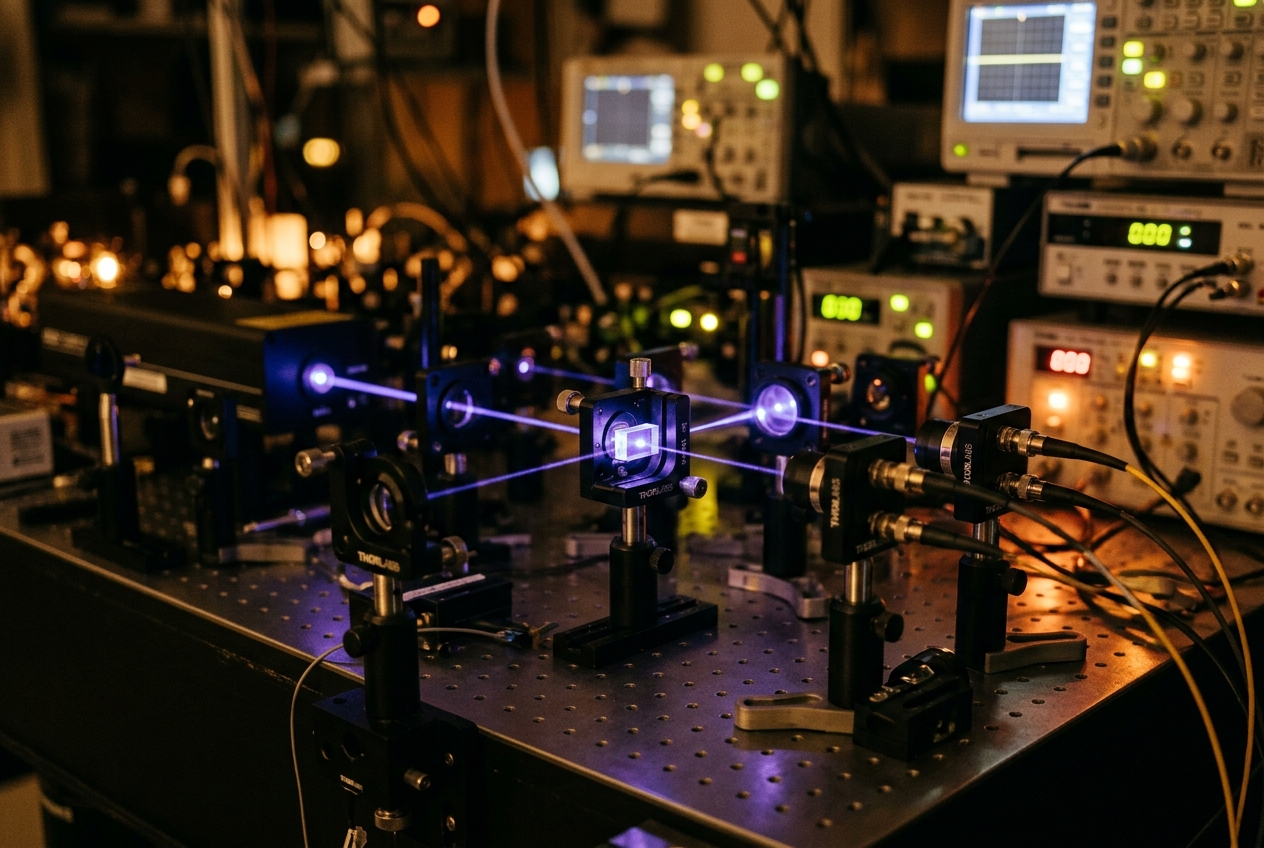
In a landmark 2015 study published in Nature, researchers at Delft University of Technology led by Ronald Hanson, alongside simultaneous experiments at NIST in Boulder and the University of Vienna, definitively performed the world's first loophole-free Bell tests. By trapping electron spins in diamond nitrogen-vacancy centres separated across 1.3 kilometres of the Delft campus, they recorded statistically decisive CHSH violations while closing the locality, detection, and setting-choice loopholes simultaneously.
The philosophical verdict is permanent: Nature is not locally real.
4. Real-World Applications Today
The violation of Bell’s inequality is far more than a triumph of quantum physics; it is an industrial asset. Over the past several years, engineers have transformed Bell test violations into practical tools for security, computing, and communications.
+-------------------------------------------------------------------------+
|                  APPLICATIONS OF BELL NON-LOCALITY                      |
+------------------------------------+------------------------------------+
| 1. Device-Independent QKD          | 2. Certified Quantum Randomness    |
| - Unhackable cryptographic keys    | - Intrinsically unpredictable bits |
| - Zero trust in hardware vendors   | - Audited by CHSH violation        |
+------------------------------------+------------------------------------+
| 3. Distributed Quantum Networks    | 4. Self-Testing Quantum Processors |
| - Entanglement-swapped mesh nets   | - Blind cryptographic computation  |
| - Space-to-ground quantum links    | - Verifiable quantum advantage     |
+------------------------------------+------------------------------------+
1. Device-Independent Quantum Key Distribution (DI-QKD)
- Pioneering Institutions: University of Oxford, Sorbonne Université, and quantum hardware firms like ID Quantique.
- The Goal: Traditional quantum cryptography (such as BB84) guarantees security based on the laws of physics, but in practice, real-world hardware suffers from side-channel vulnerabilities (e.g., optical blinding of detectors). DI-QKD eliminates the need to trust the physical hardware entirely.
- The Quantum Advantage: In a DI-QKD protocol, Alice and Bob constantly run a live CHSH Bell test on a shared stream of entangled photons. If an eavesdropper attempts to intercept, clone, or tamper with the particles, the shared correlation parameter $S$ instantly plummets toward the classical bound of $2$. As long as the measured correlation satisfies $|S| > 2$, mathematics guarantees that no third party holds any mutual information about the outcomes. Alice and Bob can generate encryption keys with mathematical certainty of privacy, even if their quantum devices were manufactured by a malicious adversary. Interactive implementations of these entanglement dynamics can be explored through the IBM Qiskit Quantum Framework.
2. Certified, Self-Auditing Quantum Random Number Generation (QRNG)
- Pioneering Institutions: National Institute of Standards and Technology (NIST), Quantinuum, and the Swiss firm ID Quantique.
- The Goal: High-assurance cryptographic systems, lottery systems, and massive Monte Carlo simulations require pure, mathematically certified randomness. Classical pseudo-random algorithms are deterministic, and standard physical thermal noise generators cannot prove that an adversary did not secretly manipulate or predict the seed.
- The Quantum Advantage: When a quantum system violates Bell's inequality, counterfactual definiteness is broken; the measured outcomes were physically non-existent prior to measurement. By monitoring the ongoing CHSH violation rate, NIST and commercial vendors extract "certified private randomness." The Bell test acts as a real-time cryptographic audit: the violation quantitatively bounds the maximum possible predictability of the generated numbers to zero.
3. Verification and Self-Testing in Distributed Quantum Networks
- Pioneering Institutions: QuTech (Delft), Quantum Internet Alliance (Europe), and AWS Quantum Networking.
- The Goal: As distributed quantum supercomputers are connected via optical fibre, network routers must establish entanglement between remote quantum processing units (QPUs) across continental scales via entanglement swapping.
- The Quantum Advantage: Network operators cannot inspect quantum states directly without destroying them. By performing periodic Bell tests across network nodes, operators can "self-test" the integrity of the network links. A sustained CHSH violation of $S \approx 2.82$ proves that a link is maintaining high-fidelity, maximally entangled states across optical repeaters without requiring invasive state tomography.
5. What This Means for You
It is easy to perceive quantum non-locality as an abstract concept confined to underground physics laboratories. But in an increasingly hyper-connected society, Bell’s theorem forms the bedrock of our digital privacy and data longevity.
Consider the "Harvest Now, Decrypt Later" threat. Hostile intelligence services and cyber-syndicates are currently intercepting and storing encrypted corporate, healthcare, and state communications. Even though modern AES and RSA protocols prevent them from reading that data today, they are preserving those data troves until large-scale quantum computers can crack their mathematical keys a decade from now.
Bell’s theorem points the way toward total cryptographic permanence. When global telecommunications transition to entanglement-based quantum key networks, security will no longer depend on whether a mathematical equation is difficult for a supercomputer to compute. Instead, your privacy will be protected by the very structure of the universe: to break your encryption, an adversary would have to force the universe to become classical, undoing quantum physics itself.
From the banking records safeguarding your life savings to the medical histories stored in hospital databases, Bell’s discovery ensures that when you send a message, its security can be guaranteed not by a programmer’s code, but by the physical laws of nature.
6. Today's Takeaway
Albert Einstein spent the latter half of his life trying to prove that the universe is reasonable, deterministic, and locally real. John Stewart Bell proved that it is not.
The particles that constitute our universe do not carry hidden scripts; they exist in an interconnected, non-local reality that defies classical intuition. What began as a philosophical dispute over whether a coin is heads or tails inside an unopened box has given humanity its ultimate technological shield: a way to verify absolute truth and impenetrable security, certified by the fundamental fabric of the cosmos.
Key Mathematical References and Further Study
- Bell, J. S. (1964). "On the Einstein Podolsky Rosen Paradox." Physics Physique Fizika, 1(3), 195–200.
- Clauser, J. F., Horne, M. A., Shimony, A., & Holt, R. A. (1969). "Proposed Experiment to Test Local Hidden-Variable Theories." Physical Review Letters, 23(15), 880–884.
- Hensen, B., et al. (2015). "Loophole-free Bell inequality violation using electron spins separated by 1.3 kilometres." Nature, 526, 682–686. Accessible via Nature Physics Publications.
- For complete lecture notes and problem sets on Bell states and entanglement mechanics, explore MIT OpenCourseWare Quantum Physics and the Stanford Encyclopedia of Philosophy's Treatise on Bell's Theorem.