Boson Sampling: Demonstrating Computational Advantage Through Linear Optical Networks and Matrix Permanents
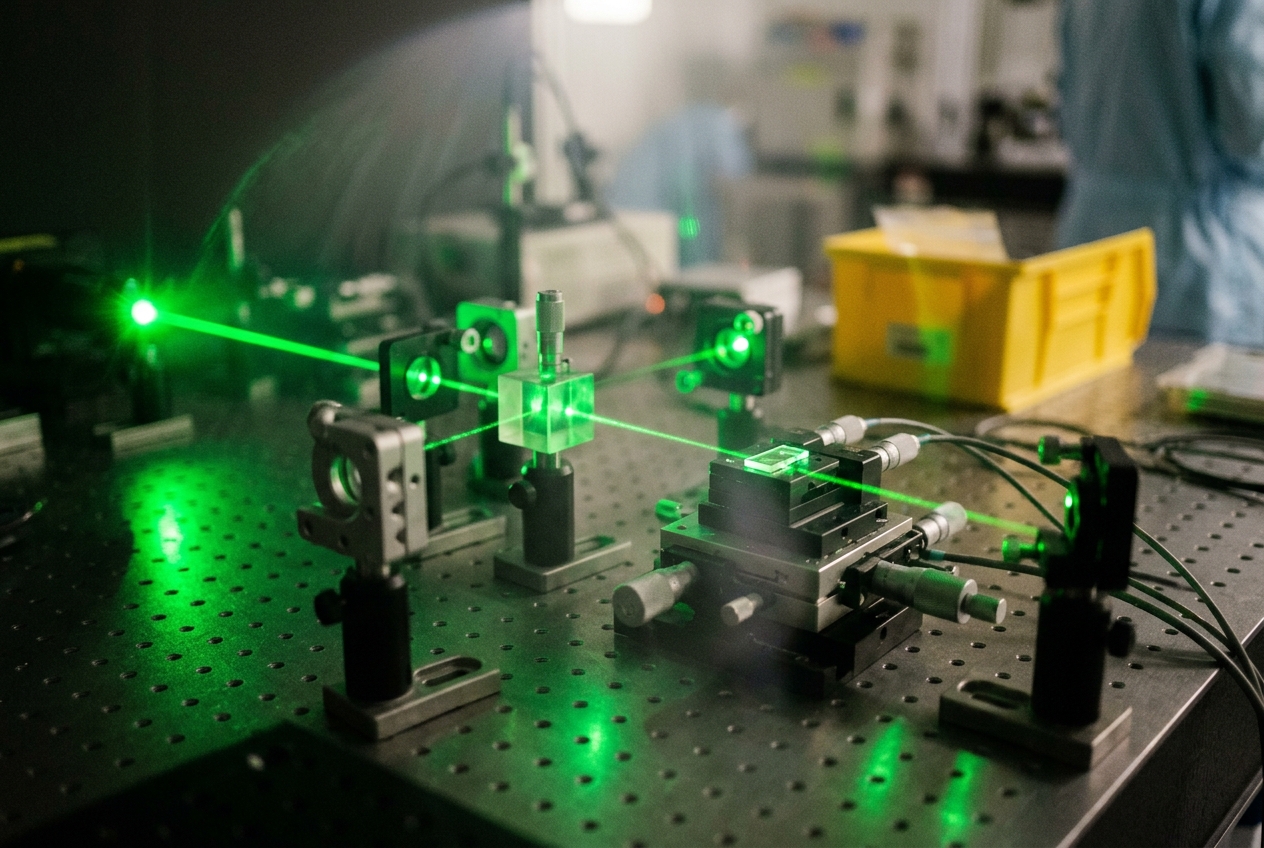
This dramatic computational disparity is not merely a triumph of engineering; it represents an epistemological earthquake in computational complexity theory. Known as Boson Sampling, this paradigm demonstrates that quantum mechanics possesses an innate computational capability that fundamentally transcends the Extended Church-Turing Thesis—the foundational bedrock of modern computing which asserts that any physical process can be efficiently simulated by a classical Turing machine. By turning the natural quantum interference of photons into an engine of mathematical calculation, boson sampling has provided the clearest, most mathematically unassailable proof of quantum computational advantage achieved to date.
1. The Idea in Plain English: From the Galton Board to Quantum Pinball
To grasp how a beam of light can outpace a supercomputer, consider a classic Victorian invention: Sir Francis Galton’s bean machine. In this vertical wooden board studded with pegs, hundreds of small steel ball bearings are dropped through a funnel at the top. As each ball cascades downward, it bounces left or right off each peg with a 50% probability before settling into a row of vertical slots at the base. Over thousands of drops, the balls naturally distribute themselves into the familiar, predictable bell curve of a normal Gaussian distribution.
A classical computer can simulate Galton’s machine effortlessly because every steel ball acts as an isolated, independent entity. Ball A does not care where Ball B lands; their trajectories do not interact or merge.
Now, replace the steel balls with single, completely indistinguishable photons—discrete packets of electromagnetic radiation—and replace the wooden pegs with optical beam splitters, which are essentially microscopic half-silvered mirrors. When a single photon encounters a beam splitter, it enters a quantum superposition of being both reflected and transmitted.
When two identical photons strike opposite sides of that same beam splitter simultaneously, something extraordinary occurs: they undergo Hong-Ou-Mandel interference. Because the photons are physically indistinguishable, their probability amplitudes for being both transmitted or both reflected cancel each other out completely. As a consequence, the photons are forced to "bunch" together, exiting the beam splitter through the same output port in unison.
When dozens of indistinguishable photons are injected simultaneously into an interconnected, multi-mode optical maze, their wavefunctions interfere across millions of crisscrossing paths simultaneously. The paths do not simply add up classically; their quantum amplitudes amplify some detection patterns to near-certainty while eradicating others entirely. Simulating where these photons will emerge requires tracking every conceivable path permutation—a combinatorial explosion that swiftly exhausts all the memory and silicon chips on Earth.
2. Foundational Complexity Theory: The Asymmetry of Bosons and Fermions
The mathematical foundations of this phenomenon were formalized in a watershed 2011 paper by theoretical computer scientists Scott Aaronson and Alex Arkhipov at MIT. Aaronson and Arkhipov posed a deceptively straightforward question: What is the computational complexity of sampling from the probability distribution of non-interacting, indistinguishable bosons traversing a linear optical network?
To appreciate their insight, one must first confront one of the most elegant dichotomies in quantum physics: the divide between fermions (matter particles, such as electrons, governed by the Pauli exclusion principle) and bosons (force-carrying particles, such as photons, governed by Bose-Einstein statistics).
When calculating the transition amplitude of non-interacting fermions hopping across an array of energy states, quantum mechanics dictates that the overall wavefunction must be completely anti-symmetric with respect to particle exchange. Mathematically, this transition probability is governed by the determinant of a matrix representing the network’s transmission coefficients.
Calculating the determinant of an $n \times n$ matrix is computationally straightforward; standard classical algorithms like Gaussian elimination can compute it in polynomial time, scaling gracefully as $O(n^3)$. Consequently, simulating complex non-interacting fermionic systems is classically tractable.
Bosons, conversely, possess wavefunctions that are entirely symmetric under particle exchange. When calculating the transition amplitude of non-interacting bosons through an identical optical matrix, the minus signs characteristic of the determinant vanish, yielding the matrix permanent.
For an $n \times n$ matrix $A$, the permanent is defined as:
$$\text{Perm}(A) = \sum_{\sigma \in S_n} \prod_{i=1}^n A_{i, \sigma(i)}$$
Where $S_n$ represents the symmetric group containing all $n!$ permutations of the sequence ${1, 2, \dots, n}$.
Although the permanent looks deceptively similar to the determinant, the absence of alternating signs prevents the use of row-reduction or Gaussian elimination. In 1979, computer scientist Leslie Valiant proved in a landmark theorem that calculating the permanent of even an arbitrary binary matrix is $#\text{P}$-hard (pronounced "number-P hard"). The complexity class $#\text{P}$ encompasses counting problems associated with decision problems in $\text{NP}$; calculating a permanent is significantly harder than solving an $\text{NP}$-complete problem like the Travelling Salesperson Problem.
Aaronson and Arkhipov proved that if a classical algorithm existed that could efficiently generate random samples from the exact output distribution of an ideal linear optical network, it would imply that:
$$\text{BPP}^{\text{NP}} = \text{BPP}^{#\text{P}}$$
Such an equality would trigger the collapse of the Polynomial Hierarchy—a foundational infinite tower of complexity classes studied in theoretical computer science and accessible through resources like MIT OpenCourseWare—down to its third level ($\text{PH} = \Sigma_3^P$). Because theoretical computer scientists consider a collapse of the Polynomial Hierarchy nearly as improbable as proving $\text{P} = \text{NP}$, boson sampling offers an ironclad complexity-theoretic guarantee: exact classical simulation of multi-photon linear interferometry is mathematically impossible in polynomial time.
3. Mathematical & Physical Mechanics of the Photonic Network
To formalize the experiment, imagine injecting $n$ identical single photons into an $m$-mode linear optical interferometer. Here, a "mode" refers to an isolated spatial pathway, such as an optical fiber or an integrated silicon-nitride waveguide etched onto a microchip.
The physical configuration must satisfy the condition $m \ge n^2$. This quadratic scaling of modes relative to the photon count ensures that the network operates well below the "birthday paradox" threshold, meaning the probability of two photons accidentally entering the exact same output mode (a phenomenon known as photon bunching or collision) remains negligibly low.
The entire passive optical network is described by an $m \times m$ unitary matrix $U$, drawn uniformly from the Haar measure (representing a completely unbiased, mathematically random transformation of optical modes). This unitary transformation is physically constructed on-chip using a dense lattice of elementary optical components: beam splitters (which mix two modes with a specific transmission amplitude) and phase shifters (which introduce a controllable optical delay $\theta$).
Let the input configuration of photons across the $m$ modes be represented by the state vector $|s\rangle = |s_1, s_2, \dots, s_m\rangle$, where $\sum s_i = n$, and let the detected output configuration across those same modes be $|t\rangle = |t_1, t_2, \dots, t_m\rangle$, with $\sum t_i = n$.
The quantum transition amplitude $\langle t | \hat{U} | s \rangle$ connecting the input state to the output state is derived by constructing a submatrix $U_{s,t}$ of size $n \times n$. This submatrix is formed by taking the original unitary matrix $U$ and extracting rows corresponding to the input modes containing photons and columns corresponding to the output modes where photons are detected.
The transition probability $P(s \to t)$ is precisely proportional to the absolute square of the permanent of this submatrix:
$$P(s \to t) = \frac{|\text{Perm}(U_{s,t})|^2}{s_1! s_2! \dots s_m! \cdot t_1! t_2! \dots t_m!}$$
When $n=1$, the permanent is simply the single matrix entry $U_{i,j}$, which describes classical ray optics. However, as $n$ climbs to 50, 70, or 100 photons, computing this single probability requires summing over up to $100! \approx 9.33 \times 10^{157}$ distinct terms—a quantity vastly exceeding the number of fundamental subatomic particles in the observable universe.
4. Classical Intractability & The Sampling Hardness Wall
Crucially, an actual boson sampling experiment does not explicitly calculate and write down the numerical value of $\text{Perm}(U_{s,t})$. Rather, the laws of quantum mechanics cause the optical hardware to sample directly from the output distribution, producing single-shot detection events at the speed of light.
To simulate this experiment on a classical computer, one must run algorithms that generate synthetic sample outputs that match the identical multivariate probability distribution. Classical algorithms for computing matrix permanents, such as Ryser’s algorithm and Glynn’s formula, scale deterministically as $O(n \cdot 2^n)$.
The fastest known classical exact sampling algorithm, developed by Peter Clifford and Raphaël Clifford, allows one to generate a single sample from an $n$-photon, $m$-mode distribution with an asymptotic time complexity scaling as:
$$T_{\text{classical}} \sim O(n \cdot 2^n + m \cdot n^2)$$
At $n = 20$ photons, a standard laptop can run Clifford’s algorithm and produce a valid output configuration in a few seconds. At $n = 50$ photons, calculating a single sample demands billions of floating-point operations, pushing supercomputing clusters to their limits. At $n = 100$ photons, the $2^{100} \approx 1.26 \times 10^{30}$ operations required per sample represent an impassable mathematical wall, requiring centuries of supercomputer run-time on top-ranked exascale systems for a handful of samples.
Furthermore, Aaronson and Arkhipov extended their proof to approximate sampling. Under two widely accepted conjectures in computational complexity—the Permanent Anti-Concentration Conjecture and the Permanent of Gaussians Conjecture—they demonstrated that even an approximate classical simulation operating within a small total variation distance $\epsilon$ remains classically intractable, cementing the impossibility of a classical shortcut.
5. Experimental Architectures: From Single Photons to Gaussian Boson Sampling
While theoretically watertight, building physical hardware to execute standard boson sampling presented staggering experimental hurdles. Early demonstrations in 2013 utilized Spontaneous Parametric Down-Conversion (SPDC) sources, where a high-energy laser pumps a non-linear crystal to spontaneously split single photons into entangled pairs.
However, SPDC is fundamentally probabilistic: the crystal produces a photon pair with only a small probability, meaning the likelihood of simultaneously firing $n$ independent single photons drops exponentially as $p^n$.
To break this bottleneck, experimentalists turned to two distinct technological avenues: 1. Deterministic Solid-State Emitters: Utilizing semiconductor quantum dots (such as Indium Arsenide dots embedded in micropillar optical cavities), researchers can generate high-purity, streamable single photons deterministically upon optical excitation. 2. Gaussian Boson Sampling (GBS): Pioneered theoretically by Christian Weedbrook, Nicolas Quesada, and colleagues, GBS eliminates single-photon sources altogether. Instead, it injects deterministic squeezed vacuum states—continuous-variable quantum states of light generated via non-linear optical parametric oscillators—into the interferometer.
In Gaussian Boson Sampling, the underlying mathematics shifts from the matrix permanent to the hafnian ($\text{Haf}$) and the Torontonian ($\text{Tor}$). The hafnian calculates the number of perfect matchings in an arbitrary graph. Like the permanent, computing the hafnian of a general non-negative matrix is $#\text{P}$-hard, preserving the theoretical hardness of the sampling task while yielding orders of magnitude higher photon throughput.
This architectural shift catalyzed two landmark quantum advantage milestones:
- Jiuzhang (USTC, China): In a milestone paper published in Science, a research team led by Jian-Wei Pan and Chao-Yang Lu demonstrated Gaussian Boson Sampling with up to 76 detected output photons across a 100-mode optical network, later upgraded in Jiuzhang 2.0 and 3.0 to detect over 250 photons across 144 modes. They sampled a state-space dimension exceeding $10^{43}$, accomplishing in minutes what was estimated to require billions of years on the Fugaku supercomputer.
- Borealis (Xanadu, Canada): In 2022, quantum computing firm Xanadu unveiled Borealis, a programmable photonic quantum processor described in Nature. Borealis utilized time-bin encoded squeezed light pulses routed through dynamic, loop-based fiber interferometers, providing dynamic programmability across 216 squeezed optical modes and full remote accessibility via cloud platforms.
Maintaining quantum advantage in the presence of noise remains an ongoing theoretical and experimental battle. As researchers refine classical tensor-network algorithms, the boundary for the number of required photons and acceptable optical loss continues to push the limits of modern physics.
6. Real-World Applications: From Abstract Complexity to Practical Quantum Advantage
While initially conceived as a specialized, non-universal computational task designed exclusively to refute the Extended Church-Turing Thesis, Gaussian Boson Sampling has rapidly emerged as a practical computational tool for discrete optimization, molecular modeling, and graph analytics.
1. Molecular Vibronic Spectra Calculation
When complex organic molecules absorb light, electrons transition between molecular orbitals while atomic nuclei simultaneously vibrate. Calculating the resulting vibronic spectra requires computing Franck-Condon factors—the quantum mechanical overlap integrals between vibrational wavefunctions of different electronic states.
For large, multi-ringed molecules (such as anthracenes, porphyrins, or pharmaceutical compounds), the number of vibrational modes creates a combinatorial catastrophe. Because the mathematical transformation of molecular vibrational modes exactly mirrors the unitary mixing of squeezed light in GBS, an optical processor can simulate molecular spectra natively. Research teams at Xanadu and academic partners have demonstrated that a GBS chip can calculate the vibronic transition profiles of complex molecules with minimal algorithmic overhead.
2. Dense Subgraph Finding & Combinatorial Optimization
In graph theory, identifying the densest cluster of connected nodes within a massive, sparse network is an $\text{NP}$-hard optimization challenge with critical applications in detecting financial fraud rings, optimizing telecommunication routing, and unearthing protein interaction clusters.
Because the hafnian calculated by a GBS setup corresponds to graph matchings, encoding the adjacency matrix of a real-world graph directly into the interferometer’s beam splitters programs the photons to naturally sample denser subgraphs with exponentially higher probability. Feeding these optical samples into classical local-search algorithms yields hybrid quantum-classical heuristics that find near-optimal graph clusters substantially faster than purely classical routines.
3. Graph Similarity Matching and Molecular Drug Discovery
Determining whether two complex molecules share functional bio-active properties requires evaluating the topological similarity of their molecular graphs. By mapping molecular graphs onto photonic circuits and generating characteristic GBS output probability distributions, researchers can construct unique "quantum graph kernels."
Pharmaceutical researchers utilize these quantum kernels in machine learning pipelines to dramatically accelerate high-throughput screening of drug candidates, evaluating molecular docking compatibility and predicting toxicological risks in early-stage discovery.
7. What This Means for You: The Near-Term Horizon of Quantum Technology
For the wider public, discussions of quantum technology are frequently framed around distant, all-or-nothing milestones: the hypothetical day when a fault-tolerant universal quantum computer running Shor's algorithm cracks the RSA cryptographic protocols protecting banking networks and personal communications, as explored across frameworks in IBM Quantum.
Boson sampling paints an entirely different, far more immediate portrait of quantum utility.
Building a universal, fault-tolerant quantum computer requires orchestrating millions of fragile, error-corrected physical qubits operating at millikelvin temperatures inside liquid-helium dilution refrigerators. Boson sampling demonstrates that we do not need to wait decades for full-scale error correction to harness the raw power of quantum mechanics.
By utilizing non-universal, specialized photonic networks that operate at ambient room temperatures with high stability, quantum advantage has already been extracted from the laboratory and etched into physical silicon chips. In the coming decade, photonic quantum co-processors will integrate directly into existing high-performance computing data centers as specialized hardware accelerators.
You may never hold a quantum chip in your smartphone, but the downstream impacts of boson sampling will tangibly touch daily life. The materials inside your next electric vehicle’s solid-state battery, the discovery pipeline of targeted oncology drugs, and the algorithmic routing keeping supply chains resilient during global shocks will increasingly rely on the silent, hyper-fast interference of photons coursing through microscopic optical tracks.
8. Today's Takeaway
Boson sampling transformed a subtle quantum anomaly—the collective, wave-like interference of identical particles of light—into an undeniable mathematical demonstration of quantum computational supremacy. By proving that calculating matrix permanents via photons transcends the limits of classical supercomputing, it bridged the chasm between theoretical computer science and laboratory physics, inaugurating the modern era of practical, near-term photonic quantum computation.