Quantum Channel Capacity: Establishing Transmission Limits Across Noisy Media Via the Lloyd-Shor-Devetak Theorem
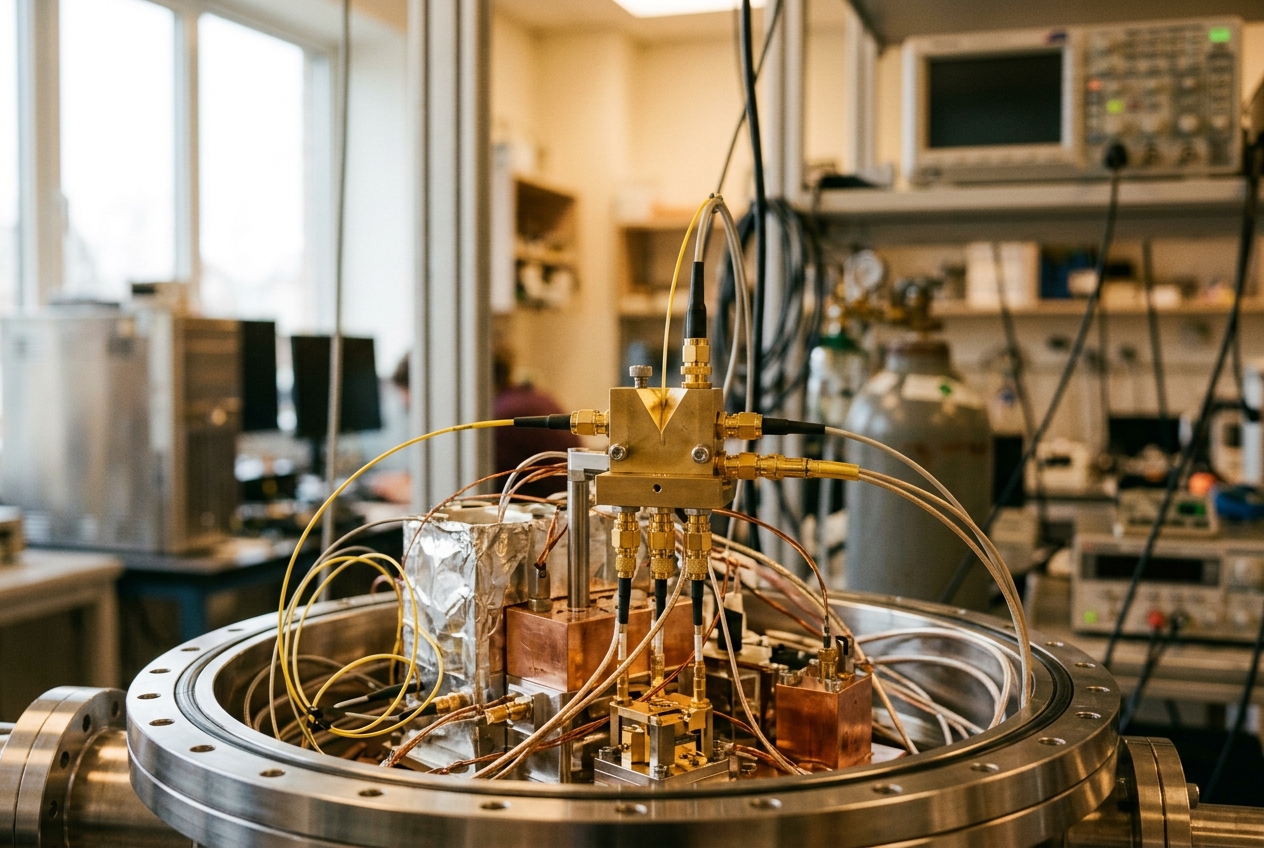
Every byte of data that powers modern civilization—from financial transactions to classified diplomatic cables—traverses thousands of miles of undersea fiber-optic glass as pulses of classical light. If those laser pulses dim or distort across the Atlantic Ocean, standard optical repeaters intercept them, measure their intensity, amplify the signal, and blast fresh, pristine copies downstream. This seamless regime of copy-and-amplify rests upon a foundational mathematical certainty discovered by Claude Shannon in 1948: the classical channel capacity, an exact ceiling on the rate at which bits can travel through noisy environments without error.
Yet, as physics edges into the quantum era, this classical blueprint disintegrates. Quantum communication does not transmit robust classical pulses; it transmits delicate quantum states—individual photons entangled across vast distances or fragile superpositions holding quantum information. If a quantum computer in Cambridge wishes to run a distributed computation with a processor in Zurich, it cannot simply beam light and rely on conventional amplifiers. The immutable laws of quantum mechanics forbid the exact copying of an unknown quantum state. Try to amplify a quantum signal with a conventional repeater, and the act of measurement instantly collapses the superposition, destroying the quantum entanglement forever.
How, then, do we transmit pristine quantum data across a noisy, imperfect planet? The answer lies in the subtle discipline of quantum channel capacity—a field governed not by Shannon’s classical formulas, but by the revolutionary Lloyd-Shor-Devetak (LSD) theorem. Navigating this theoretical frontier reveals that quantum information behaves in ways that defy classical intuition: noise can conspire with noise to unlock hidden capacity, entanglement can turn useless optical fibers into open conduits, and fundamental cosmic limits dictate precisely when quantum communication is possible—and when the universe strictly forbids it.
The Idea in Plain English: Sending Spinning Coins Through Turbulent Waters
To grasp quantum channel capacity, consider a physical analogy.
In classical communication, transmitting a message is like sending a row of coins resting flat on a conveyor belt—each clearly showing either heads (0) or tails (1). If the belt jostles and some coins flip over, Shannon’s classical information theory dictates how many redundant check-coins you must insert so the receiver can deduce the original sequence. Because anyone can look at a coin without changing its face, you can measure, duplicate, and clean up the message at every station along the path.
In quantum communication, transmitting a qubit is like launching a coin spinning in mid-air through a turbulent wind tunnel. The coin is not merely heads or tails; it exists in a delicate continuum of probabilities, spinning with a precise phase and orientation. The goal of the receiver is not just to see whether it lands heads or tails, but to catch the coin while it is still spinning, preserving its exact rotational angle, speed, and subtle quantum correlations with another coin kept at home.
       CLASSICAL CHANNEL                         QUANTUM CHANNEL
 [Coin: Heads] ---> [Belt Jostle] ---> [Inspect & Re-stamp: Heads] (Duplication Allowed)

[Spinning Coin] -> [Air Turbulence] -> [Catch Mid-Spin or Collapse] (No-Cloning Enforced)
The wind tunnel represents the quantum channel—the optical fiber, the atmosphere, or a cryogenic wire. The air turbulence is environmental noise: thermal vibrations, microscopic glass imperfections, or stray magnetic fields.
In the classical world, noise merely flips bits. In the quantum world, noise behaves as an invasive eavesdropper called the "environment." The instant a spinning coin brushes against an air molecule, the environment effectively steals a sliver of its quantum orientation.
This introduces our first critical dilemma: the No-Cloning Theorem. Because you cannot duplicate an unknown quantum state, you cannot build a simple amplifier. The transmission succeeds if and only if the receiver extracts more pure quantum orientation from the channel than the environment managed to steal. If the environment learns too much about the coin’s spin, the laws of physics dictate that the quantum information at the receiving end is irrevocably dead.
How It Actually Works: The Mechanics of Quantum Transmission
When quantum physicists formalize this physical intuition, they treat a communication channel not as a simple cable, but as an open quantum operation known mathematically as a Completely Positive Trace-Preserving (CPTP) map, denoted by $\mathcal{N}$.
In standard mechanics, an isolated quantum state is represented by a density matrix $\rho$—a mathematical ledger containing all statistical information about the system. When a qubit enters a noisy channel, it ceases to be isolated. It interacts unitarily with the external environment, and when the environment is discarded, the qubit emerges altered: $\rho \mapsto \mathcal{N}(\rho)$.
To quantify how much quantum information survives this physical transformation, physicists rely on von Neumann entropy, denoted $S(\rho)$, which measures the intrinsic uncertainty or quantum disorder within a state. When a state passes through a channel $\mathcal{N}$, two distinct entropies emerge: 1. $S(\mathcal{N}(\rho))$: The entropy of the quantum state received at the output. 2. $S_e(\rho, \mathcal{N})$: The entropy exchange, which measures how much entropy was injected into the system via its entanglement with the discarded environment.
1. Coherent Information: The Currency of Quantum Capacity
The true net rate of quantum information transmission for a single use of the channel is governed by the balance between what reaches the receiver and what leaks to the environment. This fundamental metric is known as coherent information, denoted $I_c(\rho, \mathcal{N})$.
$$\mathbf{Equation\ 1:}\quad I_c(\rho, \mathcal{N}) = S(\mathcal{N}(\rho)) - S_e(\rho, \mathcal{N})$$
In plain words: Coherent information calculates the quantum disorder arriving at the receiver minus the quantum disorder leaked to the outside environment. When this number is positive, the receiver holds more shared entanglement with the sender than the environment was able to siphon away, enabling perfect quantum error correction.
Unlike classical mutual information, which can never be negative, coherent information can drop below zero. When $I_c(\rho, \mathcal{N}) < 0$, the environment has intercepted the quantum correlations, rendering the single channel use completely incapable of transmitting quantum states faithfully.
2. The Lloyd-Shor-Devetak (LSD) Theorem and the Ghost of Superadditivity
In classical information theory, Claude Shannon showed that you only need to analyze a single use of a phone line to understand its ultimate capacity—a mathematical property known as additivity. If one second of line gives you 10 bits of data, two seconds give you exactly 20 bits.
For decades, physicists assumed quantum channels would behave with the same linear elegance. They were mistaken. In a landmark theoretical breakthrough established across a trio of monumental papers by Seth Lloyd, Peter Shor, and Igor Devetak—culminating in the Lloyd-Shor-Devetak (LSD) theorem—the quantum channel capacity $Q(\mathcal{N})$ was proven to require an infinite regularization limit.
$$\mathbf{Equation\ 2:}\quad Q(\mathcal{N}) = \lim_{n \to \infty} \frac{1}{n} \max_{\rho^{(n)}} I_c\left(\rho^{(n)}, \mathcal{N}^{\otimes n}\right)$$
In plain words: The true quantum capacity of a channel is the maximum coherent information achievable per channel use, but only when you calculate it across an arbitrarily large block of channels ($n \to \infty$) whose inputs are entangled together across time.
The physical reason for this infinite limit is one of the most astonishing discoveries in modern physics: the superadditivity of coherent information.
For certain noisy channels, sending separate, individual qubits yields zero coherent information ($I_c = 0$). By all classical logic, such a channel should be entirely dead. However, if you entangle a massive cluster of $n$ qubits across multiple channel uses simultaneously, the quantum correlations can suddenly punch through the noise, yielding a strictly positive capacity ($Q(\mathcal{N}) > 0$). In fact, as demonstrated in seminal studies documented by Nature, two channels with individual capacities of zero can be combined to produce a combined positive quantum capacity—a phenomenon known as superactivation.
  =============================================================
                    THE CAPACITY SPECTRUM
  =============================================================

  [ANTI-DEGRADABLE]               [GENERAL CPTP]             [DEGRADABLE]
  -----------------               --------------             ------------
  Environment wins.               Superadditive.             Additivity holds!
  Receiver gets less              Entangled inputs           Single-letter
  than environment.               unlock hidden rates.       formula works:
  Q(N) = 0 strictly.              Limit n -> ∞ needed.       Q(N) = max Ic(ρ, N).
  =============================================================
3. Degradable vs. Anti-Degradable Channels: The No-Cloning Firewall
When can we bypass the infinite limit of the LSD theorem and calculate capacity simply? The answer depends on the structural symmetry between what the receiver receives and what the environment steals:
- Degradable Channels: A channel is degradable if the receiver’s output is inherently cleaner than the environment's output—meaning an observer at the receiving end could, in principle, simulate the noise of the environment by applying a secondary physical map. For degradable channels, coherent information is strictly additive. The regularized limit collapses into a simple "single-letter" formula: $Q(\mathcal{N}) = \max_\rho I_c(\rho, \mathcal{N})$.
- Anti-Degradable Channels: A channel is anti-degradable if the environment receives a cleaner copy of the state than the intended receiver. Because the environment can simulate the receiver's state, if the receiver were able to reconstruct the original qubit, the environment could do so as well. By the No-Cloning Theorem, two parties cannot both hold identical, independent copies of an unknown quantum state. Therefore, the quantum capacity of any anti-degradable channel is strictly zero: $Q(\mathcal{N}) = 0$.
4. Concrete Physical Channels: Where Capacity Survives and Dies
In experimental laboratory settings, noise is categorized into specific mathematical models, each with distinct capacity thresholds:
- The Quantum Erasure Channel ($\mathcal{E}_p$): With probability $p$, a photon is lost entirely or tagged as erased; with probability $1-p$, it passes unharmed. Because an erasure channel with $p > 0.5$ delivers more photons to the environment than to the receiver, the channel becomes anti-degradable. Its exact quantum capacity is given by:
$$\mathbf{Equation\ 3:}\quad Q(\mathcal{E}_p) = \max(0,\, 1 - 2p)$$
In plain words: If fewer than 50% of the photons are lost ($p < 0.5$), quantum capacity decreases linearly. The instant photon loss hits exactly 50%, quantum capacity drops instantly to zero and remains zero for all higher loss rates.
- The Amplitude Damping Channel: This channel models the physical dissipation of energy—such as an excited atom decaying to its ground state by emitting a photon into the vacuum, or light being absorbed by fiber-optic glass. It is degradable when the damping parameter $\gamma \le 0.5$ and anti-degradable for $\gamma > 0.5$.
- The Depolarizing Channel: This represents isotropic noise, where a qubit is left untouched with probability $1-p$ and completely scrambled into random noise with probability $p$. Due to severe non-additivity, computing the exact quantum capacity of the depolarizing channel remains one of the premier unsolved problems in quantum information theory, though researchers use advanced bounds taught in MIT OpenCourseWare's Quantum Curriculum to delineate its operational limits.
KEY RESULT: The Quantum Transmission Criterion
A quantum communication channel can transmit pristine quantum states with vanishing error if and only if its Lloyd-Shor-Devetak quantum capacity is strictly positive ($Q(\mathcal{N}) > 0$). If environmental noise renders the channel anti-degradable, the No-Cloning Theorem imposes a strict physical firewall: capacity collapses to absolute zero, and no quantum error-correcting code in existence can restore the signal.
Real-World Applications Today: Engineering the Quantum Web
Understanding quantum capacity is not an abstract mathematical game. Between 2024 and 2026, leading industrial and academic consortia have transformed these capacity formulas into hardware blueprints to construct the first continental-scale quantum networks.
1. Quantum Key Distribution and Satellite Links (European Space Agency & Toshiba Europe)
- The Mission: Commercial entities like Toshiba Europe's Quantum Technology Division and the European Space Agency (via the EAGLE-1 satellite initiative) are constructing long-range Quantum Key Distribution (QKD) systems to distribute unhackable cryptographic keys.
- The Channel Challenge: Standard terrestrial telecom fibers absorb photons exponentially—after 100 kilometers of glass, 99% of photons are lost ($p = 0.99$), pushing the fiber far beyond the anti-degradable threshold where $Q(\mathcal{N}) = 0$.
- The Quantum Advantage: By beaming single photons vertically through just 10 to 20 kilometers of dense atmosphere into the vacuum of low-Earth orbit, satellites experience vastly lower attenuation, maintaining positive coherent information across thousands of kilometers.
2. Quantum Repeaters and Diamond Color Centers (AWS Center for Quantum Networking & Harvard University)
- The Mission: The AWS Center for Quantum Networking, in collaboration with the Harvard Quantum Initiative, is developing hardware-level quantum repeaters using silicon-vacancy (SiV) centers in synthetic diamond.
- The Channel Challenge: Because classical amplifiers cannot clone qubits, quantum repeaters must divide an optical link into short segments, generate local entanglement within each segment, and stitch the links together using entanglement swapping and purification.
- The Quantum Advantage: By utilizing the mathematical principles of the LSD theorem, engineers determine the minimum physical fidelity their diamond quantum memories must achieve before entanglement purification can successfully distill pure quantum states from lossy glass.
3. Distributed Quantum Supercomputing (IBM Quantum & PsiQuantum)
- The Mission: Modern quantum processing chips (QPUs) cannot scale indefinitely on a single silicon wafer due to thermal and spatial constraints within dilution refrigerators. Both IBM Quantum and PsiQuantum are pioneering modular quantum architectures that link separate QPUs together via quantum optical interconnects.
- The Channel Challenge: The inter-chip cryogenic links suffer from thermal crosstalk and dephasing noise.
- The Quantum Advantage: Quantum capacity formulas tell systems architects precisely how many physical interconnect lines must run in parallel, and what error-correction codes must be applied, to execute distributed quantum logic gates across separate quantum computing units without introducing logical faults.
4. Entanglement-Enhanced Sensor Arrays (US Department of Energy / Fermilab)
- The Mission: The US Department of Energy's National Quantum Information Science Research Centers, centered at Fermilab and Argonne National Laboratory, are building distributed quantum sensor networks spanning metropolitan fiber loops.
- The Channel Challenge: Phase noise in metropolitan fibers scrambles delicate multiphoton entangled states (such as GHZ states) used to detect dark matter signatures or subtle gravitational variations.
- The Quantum Advantage: By computing the coherent information of metropolitan fibers subjected to temperature fluctuations, researchers optimize dynamical decoupling pulses to keep channel capacity above zero, allowing distributed atomic clocks and sensors to operate at the Heisenberg precision limit.
What This Means for You: The Stakes of Quantum Communication
To a non-physicist, quantum capacity might seem like an esoteric debate over photon mathematics. In truth, it establishes the physical boundaries of human privacy and computational capability for the coming century.
Every banking transaction, medical record, and national power grid controller today relies on public-key infrastructure (such as RSA and Elliptic Curve Cryptography). These algorithms are mathematically vulnerable: the moment a fault-tolerant quantum computer comes online, it will crack those encryptions in minutes.
To build a truly invulnerable digital society, we cannot merely patch classical mathematics; we must build a physical Quantum Internet. Such a network transmits cryptographic security rooted directly in the laws of quantum physics: if an adversary attempts to tap an optical cable, their physical presence alters the channel's quantum capacity, and the transmission instantly breaks off before a single byte of privacy is compromised.
+---------------------------------------------------------------------------------------+
|                                    AT A GLANCE                                        |
|                                                                                       |
|  * The Classical Web:  Amplifies signals by reading and cloning bits.                 |
|  * The Quantum Web:    Transmits un-cloneable superpositions and entanglement.        |
|  * The Fundamental Bottleneck: If fiber noise siphons more than 50% of information    |
|    to the outside environment, the quantum channel capacity collapses to zero.        |
+---------------------------------------------------------------------------------------+
Understanding quantum channel capacity tells telecommunications engineers how close we are to making this infrastructure viable. It proves that the bottleneck is not merely manufacturing cleaner glass or faster lasers; it requires mastering the subtle mathematics of superadditivity and multi-qubit entanglement to bypass the relentless noise of our physical world.
Today's Takeaway
The classical internet conquered distance by turning light into a printing press, endlessly copying and amplifying bits across continents; the quantum internet cannot copy a single syllable, forcing us to play a far more demanding game against environmental entropy. The Lloyd-Shor-Devetak theorem reveals that transmitting a quantum state is a high-stakes balance: whenever environmental noise steals more quantum correlations than your receiver collects, the No-Cloning Theorem erects an absolute physical firewall, dropping channel capacity to zero. Yet, beneath this strict limit lies quantum mechanics’ most profound surprise: by intertwining fragile qubits across time with entanglement, quantum channels can spontaneously awaken from noise, transforming once-impassable physical barriers into clear conduits for the next digital revolution.
Further Reading & Authoritative References
- Explore foundational research on channel capacities via the Physical Review Letters Archive.
- Read the comprehensive academic overview at Wikipedia's Quantum Capacity Guide.
- Discover hands-on quantum error correction tutorials via the IBM Qiskit Documentation.
- Study advanced lecture series through MIT OpenCourseWare: Quantum Information Science.
- Review breakthrough experiments on superactivation and non-additivity in Nature.