Quantum Metrology: Surpassing the Standard Quantum Limit Through Entangled Probe States and Quantum Fisher Information
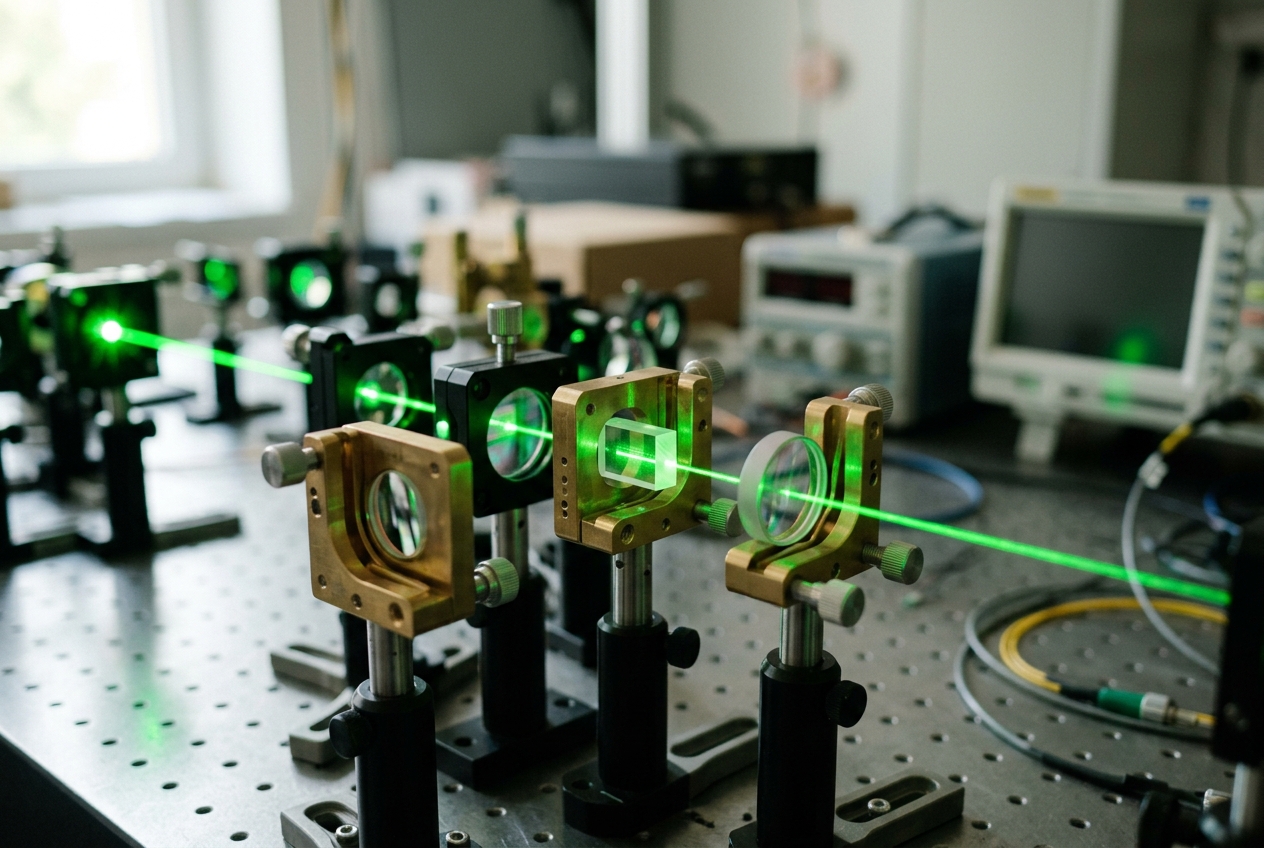
By harnessing the strange collective behavior of entangled photons and cold atoms, physicists are bypassing centuries-old statistical barriers to build sensors capable of tracking shifting tectonic plates, mapping single biological molecules, and peering into the collision of black holes.
1. Opening Hook — Why You Should Care
On 14 September 2015, two four-kilometre-long subterranean vacuum chambers in Washington State and Louisiana recorded a shudder that altered our understanding of the cosmos. The LIGO Scientific Collaboration had observed a gravitational wave: a ripple in spacetime generated by the violent collision of two black holes 1.3 billion light-years away. By the time this cosmic disturbance reached Earth, it displaced the observatory’s heavy fused-silica mirrors by less than one ten-thousandth the diameter of a single proton.
Measuring a distance change that infinitesimally small should, by all classical laws of physics, have been impossible. At that scale, the physical world is not a calm, predictable stage; it is a roiling storm of quantum fluctuations. The laser beams traversing the vacuum arms are not continuous ribbons of energy, but torrential streams of individual photons hitting detectors with random, jittery arrival times.
Yet scientists succeeded because they altered the quantum character of empty space itself.
Measurement is the silent architecture of modern human civilization. Every technology we rely upon—the satellite constellation that synchronizes financial transactions, the magnetic resonance scanners that detect early-stage tumours, the inertial navigation systems that guide aeroplanes through cloudbanks—depends entirely on the fidelity with which we can quantify physical parameters such as time, frequency, magnetic fields, and distance. For three centuries, experimental science operated under a seemingly unbreakable statistical law: to measure something ten times more precisely, you had to collect one hundred times more data or pump one hundred times more energy into your instrument.
Today, a discipline known as quantum metrology has dismantled that assumption. By replacing independent, uncoordinated particles with highly correlated, quantum-entangled states, researchers can surpass the historical noise ceilings of classical instrumentation. We are crossing the threshold from an era of passive observation into an age where sensors do not merely record nature, but actively orchestrate quantum states of matter and light to interrogate physical reality at the fundamental limits allowed by the laws of physics.
2. The Idea in Plain English: From Random Crowds to Choreographed Ensembles
To understand how quantum metrology fundamentally changes measurement, imagine attempting to gauge the exact tempo of an orchestra using the sound of the audience applauding.
In a classical audience of one thousand spectators, each person claps independently. Because their hand strikes occur at slightly different moments, the sound arrives as a diffuse, continuous roar. If you average the sound over time, the statistical noise—the random fluctuation in the arrival of claps—partially cancels out. According to the classical Central Limit Theorem, your estimation precision improves only in proportion to the square root of the number of clappers. If one thousand people are clapping, your measurement precision increases by roughly a factor of thirty-one ($\sqrt{1000} \approx 31.6$). If you want to double that precision, you cannot merely add another thousand people; you must quadruple the crowd to four thousand.
This statistical taxation is known in physics as the Shot-Noise Limit or the Standard Quantum Limit (SQL). Whenever an instrument uses independent particles—such as uncorrelated photons in a laser beam or isolated atoms in an atomic vapour cell—the measurement uncertainty scales as:
$$\Delta \theta_{\text{SQL}} \propto \frac{1}{\sqrt{N}}$$
where $N$ represents the total number of probe particles utilized in the experiment. For over a century, this square-root scaling was treated as an unyielding law of nature. If an industrial laser interferometer had reached the limit of its laser power, no further precision could be extracted without melting its optical mirrors under intensified thermal heat loads.
CLASSICAL (STANDARD QUANTUM LIMIT):
  Probe Particles:  (•)   (•)   (•)   (•)   (•)   (•)  [Uncorrelated]
  Noise Scaling:    Precision improves as 1 / √N

QUANTUM (HEISENBERG LIMIT):
  Probe Particles:  (• === • === • === • === • === •)  [Entangled Ensemble]
  Noise Scaling:    Precision improves as 1 / N
Now, replace that chaotic crowd with a troupe of one thousand synchronized dancers who have rehearsed a collective routine. Instead of clapping independently, every dancer strikes their hands at the exact same instant in absolute unison. The acoustic pulse is no longer a dull, rolling roar; it is a razor-sharp acoustic crack.
In the quantum realm, this collective choreography is achieved through quantum entanglement—the physical phenomenon wherein particles become so deeply interconnected that the state of any individual particle cannot be described independently of the others. When $N$ particles are bound in a correlated quantum state, they act not as $N$ separate sensors, but as a single composite super-particle whose sensitivity is amplified by the full ensemble.
In this collective regime, the measurement uncertainty scales inversely with the total number of particles:
$$\Delta \theta_{\text{HL}} \propto \frac{1}{N}$$
This ultimate physical boundary is known as the Heisenberg Limit. Moving from $1/\sqrt{N}$ to $1/N$ is not an incremental engineering improvement; it is a fundamental mathematical acceleration. In a system utilizing one million entangled photons ($N = 10^6$), the classical standard quantum limit yields a precision gain of $1,000$, whereas the Heisenberg limit yields an enhancement factor of $1,000,000$—a thousandfold leap in measurement resolution without increasing the probe energy by a single watt.
KEY RESULT: THE TWO REGIMES OF MEASUREMENT
- Standard Quantum Limit (Classical / Shot Noise): $\Delta \theta \ge \frac{1}{\sqrt{N}}$
Particles act independently. Precision scales with the square root of resources.- Heisenberg Limit (Ultimate Quantum Precision): $\Delta \theta \ge \frac{1}{N}$
Particles act in an entangled collective state. Precision scales linearly with resources.
3. How It Actually Works: The Mechanics of Quantum Estimation
To establish why the Heisenberg limit represents the absolute horizon of physical knowledge, mathematical physicists rely on the geometry of quantum states and information theory, accessible through foundational curricula such as MIT OpenCourseWare.
The Mathematical Framework: Classical and Quantum Fisher Information
In classical estimation theory, suppose an unknown parameter $\theta$ (such as an optical phase shift, a magnetic field strength, or an elapsed time interval) is encoded into an experimental probability distribution of measurement outcomes, $P(x|\theta)$. The amount of information that these measurement outcomes carry about the hidden parameter is quantified by the Classical Fisher Information, denoted as $I(\theta)$.
The classical Cramér-Rao inequality dictates that the variance $(\Delta \theta)^2$ of any unbiased estimator is bounded from below by the inverse of the Fisher information multiplied by the number of experimental trials, $M$:
$$(\Delta \theta)^2 \ge \frac{1}{M \, I(\theta)}$$
When we enter the quantum domain, a physical parameter $\theta$ is not directly imprinted onto classical probability tables; it is encoded onto a quantum state density operator, $\hat{\rho}(\theta)$, via a physical transformation generated by a Hamiltonian operator $\hat{H}$, such that $\hat{\rho}(\theta) = e^{-i\hat{H}\theta} \hat{\rho}_0 e^{i\hat{H}\theta}$.
Because quantum mechanics permits an infinite variety of measurement strategies (known formally as Positive Operator-Valued Measures, or POVMs), one must optimize over every mathematically possible measurement that could ever be performed on the quantum system.
This optimization yields the Quantum Fisher Information (QFI), denoted $\mathcal{F}Q[\hat{\rho}(\theta)]$. The QFI is defined via a special self-adjoint operator known as the Symmetric Logarithmic Derivative (SLD), $\hat{L}\theta$, which satisfies the operator equation:
$$\frac{\partial \hat{\rho}(\theta)}{\partial \theta} = \frac{1}{2} \left( \hat{\rho}(\theta) \hat{L}\theta + \hat{L}\theta \hat{\rho}(\theta) \right)$$
The Quantum Fisher Information is the expectation value of the squared SLD operator: $\mathcal{F}Q = \operatorname{Tr}[\hat{\rho}(\theta) \hat{L}\theta^2]$. This formulation culminates in the Quantum Cramér-Rao Bound (QCRB), which sets the ultimate lower bound on parameter variance for any physically realizable measurement scheme:
$$\Delta \theta \ge \frac{1}{\sqrt{M \, \mathcal{F}_Q[\hat{\rho}(\theta)]}}$$
When pure probe states $|\psi_0\rangle$ undergo unitary evolution generated by $\hat{H}$, the Quantum Fisher Information simplifies directly to four times the quantum variance of the generator: $\mathcal{F}_Q = 4 \, (\Delta \hat{H})^2$.
If an experiment deploys $N$ independent, unentangled particles, the variance of the collective generator scales additively as $(\Delta \hat{H})^2 = N (\Delta \hat{h}_1)^2$, immediately recovering the classical Standard Quantum Limit $\Delta \theta \ge 1/(\sqrt{N} \cdot 2\Delta \hat{h}_1)$.
However, if the probe state is prepared in an optimally entangled state across all $N$ constituents, the quantum fluctuations can scale quadratically: $(\Delta \hat{H})^2 = N^2 (\Delta \hat{h}_1)^2$. Substituting this into the Quantum Cramér-Rao Bound demonstrates mathematically how quantum mechanics permits parameter uncertainty to collapse to the ultimate Heisenberg scaling: $\Delta \theta \ge 1/N$.
Probe State Engineering: Squeezing and Multi-Particle Entanglement
To harness this mathematical advantage, quantum physicists engineer non-classical probe states possessing distinct noise profiles:
1. Squeezed Vacuum States
Heisenberg’s uncertainty principle dictates that for an electromagnetic wave, the uncertainty in its amplitude quadrature ($\Delta X_1$) and its phase quadrature ($\Delta X_2$) must obey the inequality $\Delta X_1 \Delta X_2 \ge 1/4$. In a standard laser beam or classical vacuum, these uncertainties are distributed symmetrically in a circular error disc.
Through nonlinear optical processes—such as optical parametric down-conversion inside a nonlinear crystal—physicists can "squeeze" this error circle into an ellipse. By dramatically compressing the uncertainty in the phase quadrature at the expense of inflating the amplitude uncertainty, one produces squeezed light. When injected into the unused optical port of an interferometer, squeezed light suppresses the phase jitter of interfering photons below the standard vacuum fluctuation level without requiring destructive laser intensities.
2. NOON States
In optical interferometry, a NOON state is a macroscopic photonic superposition state expressed mathematically as:
$$|\psi_{\text{NOON}}\rangle = \frac{1}{\sqrt{2}} \left( |N\rangle_A |0\rangle_B + |0\rangle_A |N\rangle_B \right)$$
This equation describes an entangled state where $N$ photons travel entirely along arm $A$ while zero travel along arm $B$, simultaneously entangled in superposition with the reverse configuration. As these $N$ photons pass through a phase delay $\theta$, the entire quantum state acquires an accumulated phase of $e^{i N \theta}$.
When the two paths recombine on a beam splitter, the resulting interference pattern oscillates $N$ times faster than that of a classical light beam, effectively shortening the de Broglie wavelength of the light to $\lambda_{\text{eff}} = \lambda / N$ and achieving the pristine Heisenberg Limit $\Delta \theta = 1/N$.
3. GHZ States
In matter-wave systems, such as ions or neutral atoms, the equivalent state is the Greenberger-Horne-Zeilinger (GHZ) state:
$$|\psi_{\text{GHZ}}\rangle = \frac{1}{\sqrt{2}} \left( |00\dots 0\rangle + |11\dots 1\rangle \right)$$
Here, all $N$ atomic spins are held in an entangled superposition of pointing entirely "down" ($|0\rangle$) and entirely "up" ($|1\rangle$). When exposed to an external field, the relative phase between these two macroscopic branches precesses at $N$ times the single-atom Larmor frequency.
The Reality of Decoherence and Error Mitigation
Why, then, is every sensor in the world not already operating at the Heisenberg limit? The central vulnerability of maximally entangled states (such as NOON and GHZ states) is their fragile susceptibility to environmental decoherence.
If a NOON state containing one hundred photons loses just a single photon to environmental scattering or absorption, the delicate quantum superposition collapses instantly into a classical statistical mixture. In mathematical terms, single-photon loss acts as an unmonitored trace operation over the photon environment. Under even modest transmission losses $(1 - \eta)$, where $\eta$ represents optical efficiency, the Quantum Fisher Information collapses precipitously:
$$\mathcal{F}_Q \le \frac{\eta}{1 - \eta} N$$
This means that for any non-zero loss rate, the asymptotic scaling of precision for arbitrarily large $N$ is forced to revert from the Heisenberg Limit ($1/N$) back to the classical Standard Quantum Limit ($1/\sqrt{\eta N}$), albeit with a slightly improved constant prefactor.
To overcome this fundamental vulnerability, contemporary research in quantum metrology has moved away from fragile, maximally entangled states toward continuous-variable quantum error correction and bosonic codes, such as GKP (Gottesman-Kitaev-Preskill) states and cat states, documented in research published across Nature Physics. These advanced states embed discrete quantum information into harmonic oscillator phase spaces, enabling active detection and correction of single-photon loss events without destroying the underlying phase sensitivity of the probe.
4. Real-World Applications Today
Far from remaining a blackboard curiosity, quantum-enhanced metrology has graduated into operational infrastructure and experimental platforms across the globe:
1. Gravitational Wave Observatories (LIGO, Virgo, KAGRA)
The LIGO Laboratory in the United States and the Virgo observatory in Italy represent the largest and most successful implementations of quantum metrology in human history. In their modern operational runs, both observatories inject frequency-dependent squeezed vacuum states directly into the dark output ports of their primary four-kilometre beam splitters.
At high frequencies (above 100 Hz), phase-squeezed light suppresses photon shot noise; at low frequencies (below 100 Hz), a dedicated filter cavity rotates the squeezing angle to suppress amplitude fluctuations, mitigating the radiation pressure noise that physically pushes the heavy mirrors. This quantum-enhancement protocol increases the volume of space LIGO can monitor by over 60%, allowing astronomers to detect compact binary black hole and neutron star mergers almost every few days.
2. Optical Lattice Atomic Clocks (NIST, JILA, and RIKEN)
At the joint institute JILA (operated by NIST and the University of Colorado Boulder) and at RIKEN in Japan, physicists construct atomic clocks that do not tick using macroscopic pendulums or quartz crystals, but rather by probing the optical transitions of thousands of neutral strontium or ytterbium atoms trapped in a web of intersecting laser beams called an optical lattice.
By preparing these atomic ensembles in spin-squeezed states, researchers can push clock uncertainties down to the regime of $10^{-19}$. A clock of this precision will not gain or lose a single second over the entire 13.8-billion-year age of the universe. This allows researchers to perform relativistic geodesy: because Einstein’s General Theory of Relativity dictates that time passes slower closer to a massive gravitational body, these quantum clocks can detect changes in Earth's elevation of less than a single millimetre simply by measuring the shift in the ticking rate of time.
3. Nanoscale Biomagnetic Imaging via NV Diamond Centers
At Harvard University and the Max Planck Institute for Solid State Research, along with commercial quantum sensor firms like Qnami, researchers employ Nitrogen-Vacancy (NV) centers in synthetic diamond. An NV center is an atomic defect in a diamond crystal lattice where a nitrogen atom sits adjacent to an empty lattice site, creating an isolated electron spin that behaves as an individual quantum sensor at room temperature.
By driving these defect spins with microwave pulses and preparing them in entangled quantum probe configurations, physicists can place an NV center within nanometres of a living biological cell or a complex protein. The sensor measures the minute magnetic fields generated by the nuclear spins of individual atoms, enabling non-destructive, three-dimensional magnetic resonance imaging (MRI) of single biomolecules without requiring crystallization.
4. Quantum Inertial Navigation (Infleqtion and AOSense)
Organizations like the quantum hardware firm Infleqtion and the UK National Quantum Technologies Programme are pioneering cold-atom interferometry for satellite-free navigation. By cooling rubidium or cesium atoms to fractions of a microkelvin above absolute zero and launching them along split trajectories using laser pulses, these devices create matter-wave interferometers.
Because matter waves have mass, they interact strongly with gravity and acceleration. Quantum-enhanced atom interferometers can measure local gravitational gradients and rotational rates with drift-free stability, enabling aircraft, submarines, and autonomous underground vehicles to navigate across the globe with high precision without ever connecting to a GPS satellite network.
5. What This Means for You: The Personal Stake
It is tempting to view quantum metrology as an abstract branch of experimental physics, sequestered in underground cryogenic chambers and multimillion-dollar optical laboratories. Yet the societal consequences of hyper-precise measurement will reshape everyday life across the coming decades:
- Early Natural Disaster Warning Systems: Quantum gravimeters installed on fault lines and volcanic flanks can detect the subterranean redistribution of magma and underground aquifers days before an eruption or earthquake occurs, measuring tiny shifts in subterranean mass density long before classical seismometers register physical shaking.
- Revolutionizing Drug Discovery: Single-molecule quantum diamond magnetometers will allow structural biologists to observe the dynamic conformational folding of pathogenic proteins in real time at physiological temperatures. This promises to compress the timeline for designing targeted drug therapies for neurodegenerative diseases and viral pathogens from years down to weeks.
- Unhackable, Drift-Free Navigation: Modern civil aviation, telecommunications, and automated shipping rely on satellite GPS signals that are vulnerable to jamming, spoofing, and orbital solar storms. Quantum inertial navigation systems will provide vehicles with self-contained, unjammable positioning systems capable of navigating subterranean tunnels, dense urban centers, and deep-sea trenches.
- Decarbonization and Resource Mapping: Ultra-sensitive airborne quantum gravity gradiometers allow geoscientists to map underground deposits of critical minerals (such as lithium and rare-earth elements) and locate leaking subterranean carbon-sequestration reservoirs without invasive excavation or seismic detonation.