Positive Operator-Valued Measure: Surpassing Projective Limits for Optimal Quantum State Discrimination
1. Opening Hook — Why You Should Care
Every single second, trillions of dollars race across undersea fiber-optic cables, insulated only by mathematical problems that modern supercomputers cannot solve within the lifespan of the universe. Yet this cryptographic armor is wearing thin. The advent of quantum computing promises to render standard public-key infrastructure obsolete almost overnight. In response, global telecommunications consortia, intelligence agencies, and financial institutions are deploying quantum key distribution networks—systems where security is guaranteed not by mathematical complexity, but by the fundamental laws of quantum mechanics.
In these cutting-edge networks, information is transmitted using the fragile quantum states of individual light particles. If an eavesdropper attempts to intercept and read this photonic traffic, the act of measurement itself irrevocably alters the signal, instantly alerting the communicating parties. But this introduces an excruciating technical dilemma: how can the legitimate recipient read an incoming quantum message with absolute certainty when the transmitted signals are deliberately designed to look almost identical?
Standard physics textbooks teach that measuring a quantum system is an all-or-nothing affair—a violent, destructive collision that collapses a particle into a single, arbitrary reality. If this traditional view were the whole story, our most advanced quantum cryptographic protocols would grind to a halt, crippled by unavoidable decoding errors. To overcome this barrier, quantum engineers and mathematical physicists have embraced a profound generalization of physical observation known as Positive Operator-Valued Measures, or POVMs. By dismantling the century-old dogma of textbook quantum collapse, POVMs unlock a world of unsharp, highly tailored measurements, enabling optical receivers to extract maximum information, identify eavesdroppers with mathematical perfection, and transform our ability to probe the microscopic universe.
2. The Idea in Plain English
To understand why traditional quantum measurements fall short, consider how physical reality is presented in introductory physics. We are usually told that measuring a quantum particle is like flipping a spinning coin onto a hard wooden table. While airborne, the coin is in a fluid mixture of possibilities; once it strikes the surface, it is forced to land definitively flat—either heads or tails. In formal terminology, this is an orthogonal projective measurement, commonly called a von Neumann measurement.
Projective measurements act like rigid sorting sieves. If you have a two-dimensional quantum system—such as the polarization state of a photon, which can point horizontally, vertically, or anywhere in between—a standard von Neumann measurement forces you to choose exactly two perpendicular directions to test. If a photon arrives pointing diagonally at a forty-five-degree angle, a horizontal-vertical detector will violently snap that photon into either purely horizontal or purely vertical polarization. The original diagonal orientation is obliterated, leaving you with an ambiguous clue about what was originally sent.
Now imagine a far more subtle scenario. Suppose a sender transmits one of two non-perpendicular signals: State A or State B. Because these two states overlap, a standard two-way sieve cannot separate them cleanly; whenever the detector clicks, there is a lingering chance that the particle was actually the other state in disguise. You are perpetually trapped between making mistakes and losing data.
This is where Positive Operator-Valued Measures come in. Rather than restricting an observer to a rigid, two-way perpendicular choice, a POVM functions like an exquisitely engineered optical prism that can route a particle into three, four, or dozens of distinct detection channels. Crucially, one of these channels can be explicitly reserved for an "inconclusive" outcome.
Instead of forcing a reckless guess between State A and State B, a POVM detector performs what physicists call unambiguous state discrimination. When the State A detector clicks, you are guaranteed with one hundred percent certainty that the incoming particle was indeed State A. When the State B detector clicks, you know with absolute certainty it was State B. And when the third detector clicks, the apparatus simply reports that the measurement was inconclusive, preserving the integrity of your knowledge without ever asserting a falsehood. A POVM trades mechanical rigidity for infallible precision.
3. How It Actually Works — The Mechanics
To appreciate the theoretical architecture of POVMs, one must examine how quantum mechanics defines physical states and observable quantities. In the orthodox formulation codified by John von Neumann in 1932, every physical property corresponds to a self-adjoint operator acting on a complex mathematical arena known as a Hilbert space. In this framework, a standard measurement consists of a set of projection operators that are mutually orthogonal and sum to the identity operator. Because these operators must be strictly orthogonal to one another, a physical system of dimension $d$ can yield at most $d$ distinct measurement outcomes.
The Generalized Formalism: Positive Semi-Definite Operators
Positive Operator-Valued Measures liberate quantum theory from this dimensional straitjacket. Instead of requiring measurement operators to be rigid orthogonal projections, the POVM framework defines a measurement as any set of positive semi-definite operators acting on the system's state space, subject to a single foundational rule: their sum must equal the identity operator.
$$\sum_{m=1}^{M} E_m = \mathbb{I}$$
In this formulation, each operator $E_m$ in the set represents a specific, observable outcome of the experiment. When a quantum system described by a density operator $\rho$ enters the apparatus, the probability of obtaining the $m$-th outcome is calculated via the trace rule:
$$P(m) = \operatorname{Tr}(\rho E_m)$$
Because the operators are positive semi-definite, every calculated probability is guaranteed to be non-negative. Because their sum resolves the identity operator $\mathbb{I}$, the sum of all probabilities over all possible outcomes is guaranteed to equal exactly one.
The profound departure from standard textbook physics lies in the quantity $M$: the number of distinct measurement outcomes. While a von Neumann measurement requires $M$ to equal the dimension of the system $d$, a POVM allows $M$ to be strictly greater than $d$. In a two-level qubit system—such as a single photon's polarization—an experimentalist is no longer confined to two outcomes. One can construct a measurement with three, six, or an infinite continuum of distinct detector outcomes, creating "unsharp" or generalized observations tailored to specific information-processing tasks.
[!NOTE]
PROJECTION VERSUS POVM AT A GLANCE
- von Neumann Measurement: Restricted to $M = d$ mutually orthogonal projections ($P_j P_k = \delta_{jk} P_j$). Destructive, rigid, and unable to extract multi-outcome statistics without severe disturbance.
- POVM (Generalized Measurement): Permits $M > d$ positive semi-definite operators ($\langle\psi|E_m|\psi\rangle \ge 0$) satisfying completeness ($\sum E_m = \mathbb{I}$). Flexible, minimally disturbing, and optimal for discriminating non-orthogonal states.
Neumark's Dilation Theorem: The Magic of the Hidden Ancilla
A natural question arises: if fundamental quantum interactions are governed by unitary transformations and standard projections, how can a laboratory apparatus physically implement an operator that is not a projection?
The answer is provided by one of the most elegant mathematical results in quantum theory: Neumark's Dilation Theorem (frequently transliterated as Naimark's Theorem). The theorem proves that any generalized measurement acting on a physical system can be perfectly realized as a standard, textbook von Neumann projection acting on a larger, combined universe.
To execute a three-outcome POVM on a single two-level qubit, the experimentalist introduces an auxiliary quantum particle—an "ancilla"—prepared in a known reference state. The primary qubit and the ancilla are brought together and allowed to interact through a joint reversible transformation known as a unitary operation. This interaction entangles the primary system with the ancilla, effectively dilating the two-dimensional state space into a four-dimensional space.
Once this higher-dimensional space is established, the experimentalist performs a conventional, orthogonal projective measurement across the combined system. When the auxiliary system is discarded, the resulting statistical impact on the primary qubit reproduces the exact mathematical action of the multi-element POVM. In essence, a POVM is nothing more than a standard measurement operating in a spacious, higher-dimensional room to which we have temporarily coupled our system.
Optimal State Discrimination: Helstrom Bound vs. Unambiguous Discrimination
The supreme utility of POVMs shines brightest in the challenge of quantum state discrimination. Suppose an emitter prepares a photon in one of two non-orthogonal pure states, $|\psi_0\rangle$ and $|\psi_1\rangle$, with equal prior probability. Because the states are not orthogonal, their inner product (overlap) is non-zero: $\langle\psi_0|\psi_1\rangle \neq 0$.
If an observer is forced to make a definitive guess on every trial using a standard projective measurement, they are constrained by the celebrated Helstrom Bound, derived by Carl Helstrom in 1969. The Helstrom bound defines the absolute minimum error probability achievable by any physical measurement:
$$P_{\text{error}}^{\text{Helstrom}} = \frac{1}{2}\left(1 - \sqrt{1 - |\langle\psi_0|\psi_1\rangle|^2}\right)$$
While the Helstrom strategy minimizes the average number of incorrect guesses, every single decision carries an unavoidable risk of error.
For applications like secure cryptographic key exchange, however, even a small error rate can compromise a network or disguise the presence of an eavesdropper. To eliminate errors entirely, physicists utilize Unambiguous State Discrimination (USD), a strategy discovered by Ivanovic, Dieks, and Asher Peres. USD requires a three-element POVM composed of two identification operators and one failure operator:
- An operator $E_0$ constructed to be strictly orthogonal to $|\psi_1\rangle$. If $E_0$ triggers, the state could not have been $|\psi_1\rangle$; it must be $|\psi_0\rangle$.
- An operator $E_1$ constructed to be strictly orthogonal to $|\psi_0\rangle$. If $E_1$ triggers, the state must be $|\psi_1\rangle$.
- An inconclusive operator $E_? = \mathbb{I} - E_0 - E_1$, which absorbs all the geometric overlap where the two states cannot be distinguished without error.
Under this optimal POVM construction, the probability of obtaining an inconclusive result is mathematically fixed by the magnitude of the states' overlap:
$$P_{\text{fail}}^{\text{USD}} = |\langle\psi_0|\psi_1\rangle|$$
Whenever the measurement succeeds and reports State A or State B, the error rate is strictly zero. By deploying a POVM, the observer converts quantum ambiguity into an occasional, harmless request to resend the signal, establishing an infallible channel of communication.
Physical Implementation: Optics and Spatial Sorters
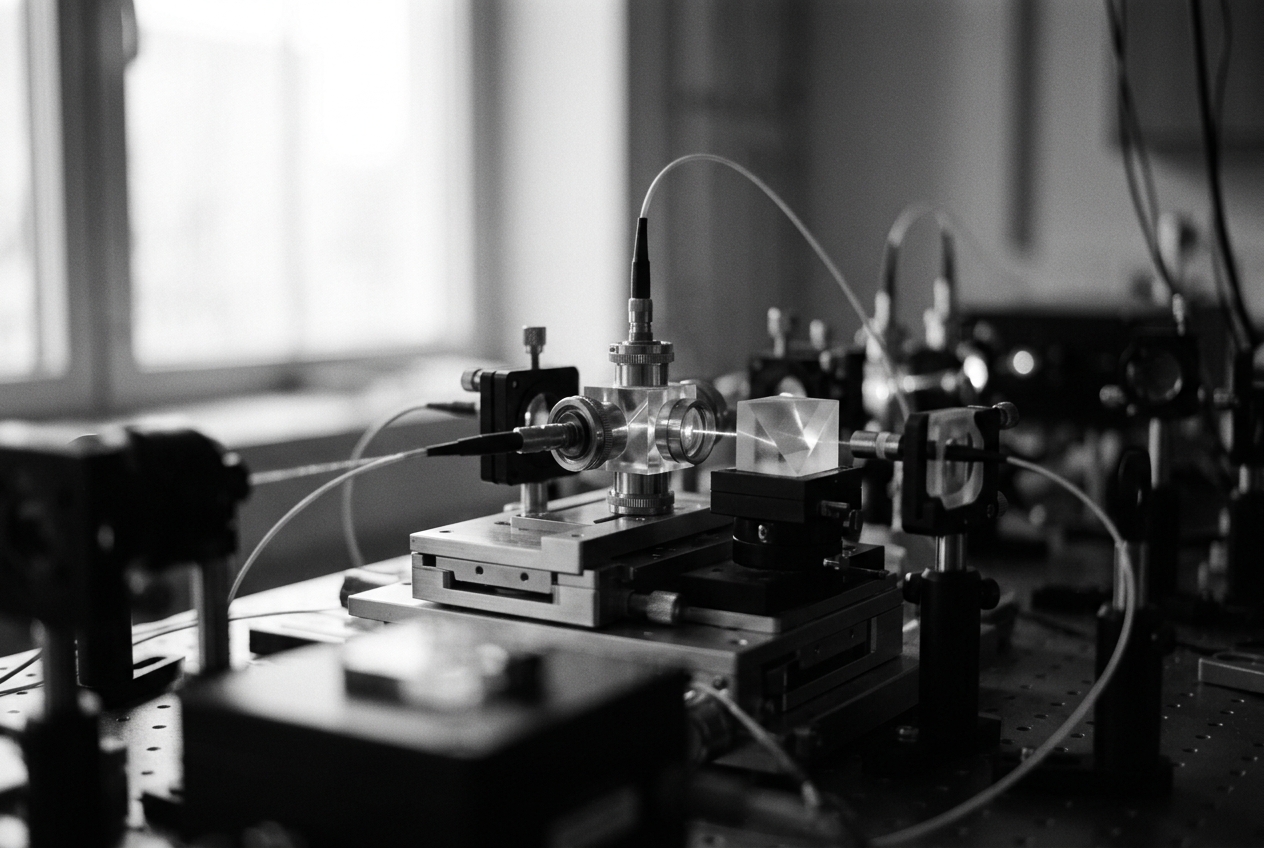
In modern optical laboratories, POVMs are not abstract mathematical matrices; they are physical networks of glass, crystals, and mirrors. Single photons are manipulated using polarization beam splitters, half-wave plates, and spatial light modulators.
When a photon enters a multi-port interferometer, its spatial path acts as the ancillary dimension required by Neumark's theorem. A beam splitter divides the photon's path into multiple distinct trajectories. Wave plates rotate the polarization along each path independently, and secondary splitters direct the light toward an array of single-photon avalanche photodiodes. Each individual detector corresponds precisely to one element $E_m$ of the POVM. Through the interference of light waves across multiple spatial ports, laboratory physicists routinely execute complex generalized measurements that textbook quantum theory once deemed impossible.
4. Real-World Applications Today
The transition of POVMs from theoretical curiosities to operational engineering tools is fueling breakthroughs across multiple high-technology sectors between 2024 and 2026.
1. Ultra-Secure Quantum Key Distribution (QKD)
Commercial quantum cryptography companies such as ID Quantique and Toshiba Quantum rely heavily on non-orthogonal quantum states to safeguard metropolitan fiber networks. In protocols like B92, the entire security proof rests on the receiver's ability to discriminate non-orthogonal states unambiguously.
By integrating multi-port POVM receivers into terminal nodes, these systems achieve optimal detection rates while maintaining mathematical immunity against intercept-and-resend attacks. If an adversary attempts to tap the fiber, their intrusive measurements inevitably distort the non-orthogonal geometry, creating detectable statistical anomalies at the receiver's POVM output ports.
2. Quantum State Tomography and Quantum Computing Calibration
As quantum computing companies like IBM Quantum and national measurement bodies like NIST scale processors to hundreds of physical qubits, diagnosing quantum errors becomes an immense challenge. Reconstructing the exact quantum state of a multi-qubit processor—a process known as quantum state tomography—traditionally requires measuring thousands of different combinations of standard observables.
Researchers now use a specialized class of measurements known as Symmetric Informationally Complete POVMs (SIC-POVMs). A SIC-POVM uses $d^2$ distinct operators that symmetrically span the entire state space of a $d$-dimensional quantum system. By performing a single SIC-POVM instead of dozens of separate projective sweeps, quantum engineers can reconstruct the complete density matrix of their processor with the absolute minimum number of experimental runs, vastly accelerating the calibration of fault-tolerant quantum processors.
3. Deep-Space Laser Communication
Interplanetary laser communication systems developed by NASA Jet Propulsion Laboratory and MIT Lincoln Laboratory face an extreme physical constraint: deep-space optical signals arrive at Earth as faint trickles of light, often averaging less than a single photon per bit of data.
To decode these heavily attenuated coherent laser pulses, standard photon-counting detectors are fundamentally limited by the classical shot-noise limit. By implementing adaptive optical POVM receivers—often referred to as Dolinar receivers—ground stations can dynamically adjust their optical measurements in real time as each photon arrives. This generalized measurement approach breaks through the standard quantum noise floor, allowing NASA to stream high-definition video across hundreds of millions of kilometers of interplanetary space.
4. Continuous-Variable Photonic Quantum Computing
Pioneering photonic quantum computing enterprises such as PsiQuantum and Xanadu are constructing computers that encode quantum information into continuous optical fields and squeezed light states.
In these architectures, fault-tolerant quantum error correction requires continuous tracking of subtle phase shifts and photon-number fluctuations. Standard homodyne detectors can only measure a single field quadrature at a time (analogous to measuring position but completely ignoring momentum). By employing eight-port optical POVMs, these photonic processors simultaneously measure both conjugate quadratures with minimal added quantum noise, enabling rapid extraction of error syndromes essential for fault-tolerant computation.
5. What This Means for You
For the non-physicist, the shift from rigid textbook measurements to Positive Operator-Valued Measures might initially sound like an esoteric mathematical nuance. In reality, it represents a foundational shift in how human technology interacts with the physical world, carrying direct consequences for personal privacy, medicine, and data infrastructure.
Consider the immediate issue of personal privacy and financial cybersecurity. As post-quantum cryptography standards are finalized, the underlying infrastructure of the internet is transitioning toward hybrid quantum-secure networks. The algorithms protecting your online banking, personal medical records, and municipal power grids will soon rely on quantum key distribution lines monitored by POVM receivers. Because these generalized measurements can detect the faintest unauthorized observation without false alarms, they guarantee that eavesdropping on critical data transit is physically impossible without immediate detection.
Beyond digital security, the principles governing POVMs are transforming medical imaging and sensor technologies. Conventional diagnostic techniques, from magnetic resonance imaging (MRI) to optical microscopy, are strictly limited by how much electromagnetic energy living tissue can absorb before suffering biological damage.
By designing sensors that utilize generalized, unsharp quantum measurements, biomedical engineers can extract maximum structural information from delicate biological molecules using minuscule, non-destructive doses of light. The same mathematical principles that allow an optical receiver to identify overlapping quantum states without error are enabling biologists to image fragile proteins and cellular machinery at single-photon sensitivity, opening new frontiers in early disease detection and targeted pharmacology.
6. Today's Takeaway
For nearly a century, popular science has portrayed quantum observation as a blunt instrument: an unavoidable collapse that forces nature to abandon its possibilities and choose a single reality. Positive Operator-Valued Measures dismantle this simplistic view, demonstrating that observation is a flexible, highly tunable craft.
By permitting our measurement devices to access higher-dimensional auxiliary spaces through Neumark's dilation, POVMs allow experimentalists to extract nuanced physical data, discriminate overlapping quantum signals with absolute zero error, and beat the theoretical limits of classical sensing. As quantum technologies migrate from academic physics departments into our global communications infrastructure, the gentle, generalized touch of the POVM is proving to be the ultimate key to unlocking the power of the quantum age.
Further Reading & Academic References
- MIT OpenCourseWare: Quantum Physics and Measurement Theory
- IBM Quantum Learning: Generalized Measurements and Density Matrices
- Nature Physics: State Discrimination and Quantum Information
- Wikipedia: Positive Operator-Valued Measure (POVM)
- Wikipedia: Quantum State Discrimination & The Helstrom Bound
- arXiv Quantum Physics Archive: Foundations and Applications of POVMs